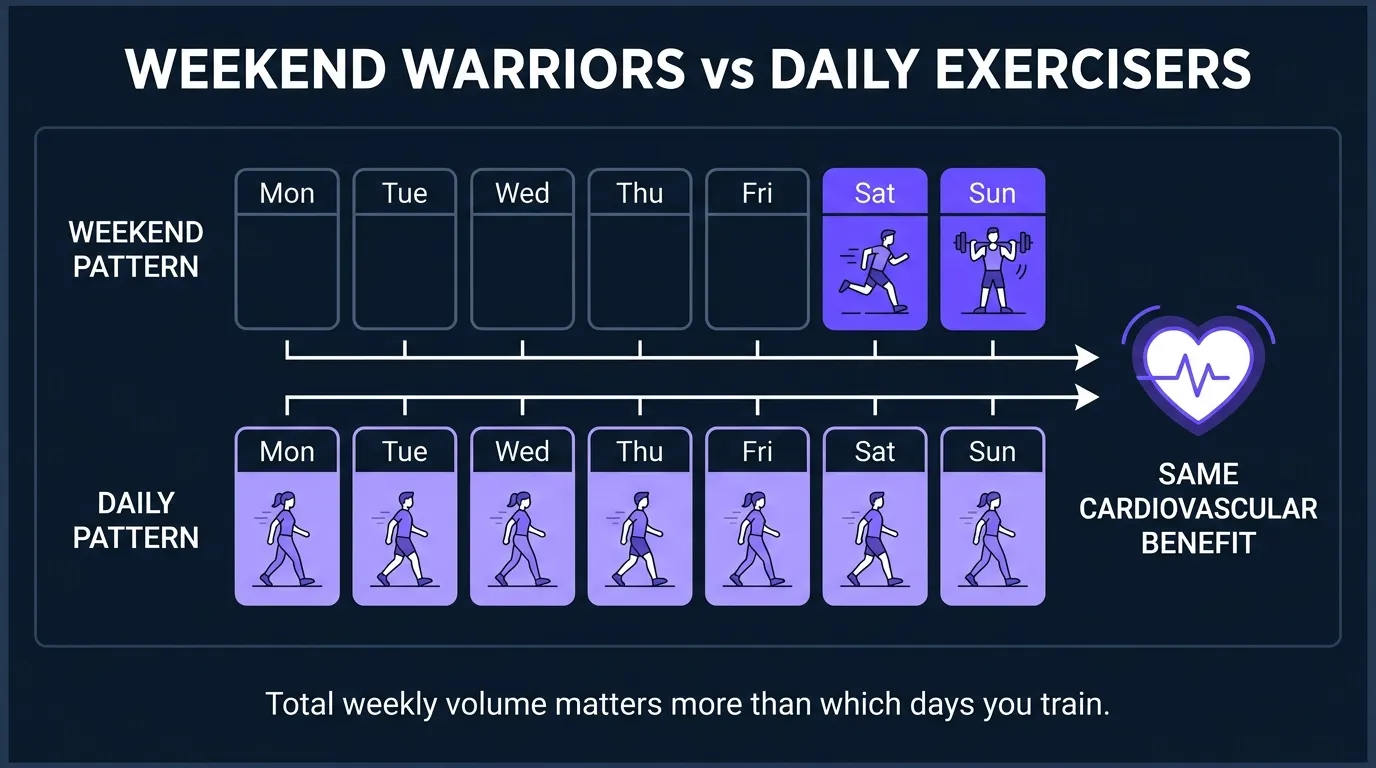
You've heard it before. "You can't out-exercise a sedentary week." "Five short workouts beat one long one." "Doing it all on Saturday is a recipe for injury." Every one of these statements gets repeated like settled science. None of them are.
The actual research on weekend warriors, people who concentrate their weekly exercise into one or two longer sessions, has been quietly piling up since 2017. And the conclusion is not what gym culture suggests. When weekly volume is held constant, the health outcomes look nearly identical to a daily routine. That's a big deal for the millions of adults whose schedules genuinely don't allow daily training.
This article walks through three landmark studies (O'Donovan 2017, dos Santos 2022, Khurshid 2023), the 2025 meta-analysis that pooled the field, where the pattern still falls short, and what it means for people who can only train on weekends.
The Research: What the Studies Actually Found
Khurshid et al. (2023): The Accelerometer Study
This is the most rigorous weekend warrior study to date, and the one most worth understanding.
Shaan Khurshid and colleagues at Massachusetts General Hospital analyzed 89,573 UK Biobank participants (mean age 62, 56% women) who wore wrist accelerometers for a full week between 2013 and 2015. Wrist accelerometers solve the biggest weakness in earlier exercise research: self-report bias. People wildly overstate how much they move. Accelerometers don't lie.
Participants were sorted into three groups based on a 150-minute moderate-to-vigorous physical activity (MVPA) threshold:
- Active weekend warrior: 150+ min/week with ≥50% of total MVPA in 1-2 days (42.2% of the cohort)
- Active regular: 150+ min/week spread more evenly (24.0%)
- Inactive: less than 150 min/week (33.7%)
Then the team followed cardiovascular incidence over a median of 6.3 years. Here's what they found compared to the inactive reference group:
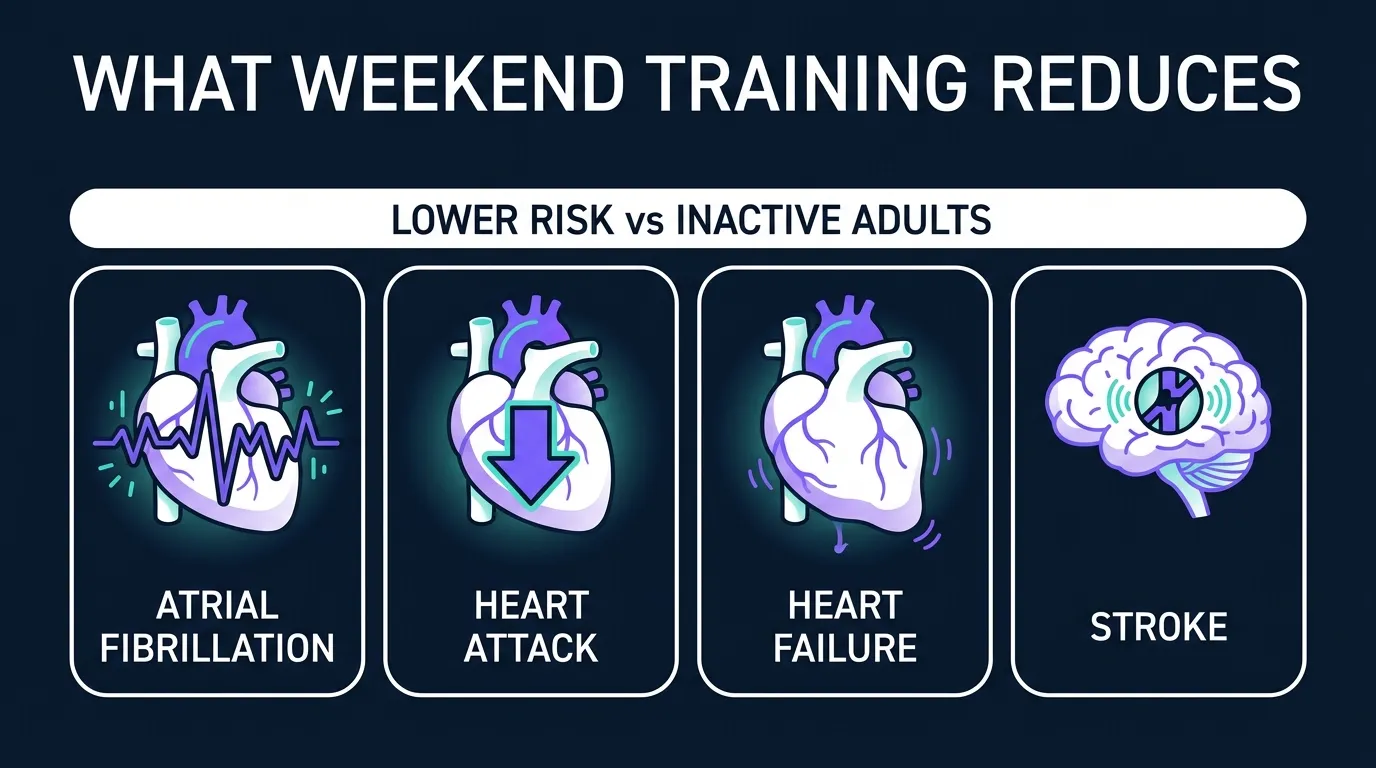
- Atrial fibrillation: weekend warrior HR 0.78, active regular HR 0.81
- Myocardial infarction: weekend warrior HR 0.73, active regular HR 0.65
- Heart failure: weekend warrior HR 0.62, active regular HR 0.64
- Stroke: weekend warrior HR 0.79, active regular HR 0.83
Translation: weekend warriors had a 22% lower a-fib risk, 27% lower heart attack risk, 38% lower heart failure risk, and 21% lower stroke risk versus inactive adults. The 95% confidence intervals for weekend warriors and active regulars overlapped substantially. Across all four cardiovascular endpoints, the pattern of activity didn't materially change the benefit. Total weekly volume did.
O'Donovan et al. (2017): The Mortality Signal
Before the accelerometer era, Gary O'Donovan and colleagues pooled data from 63,591 English and Scottish Health Survey respondents over 561,159 person-years of follow-up. They defined weekend warriors as adults reporting 150+ min/week of moderate or 75+ min/week of vigorous activity in 1-2 sessions.
Compared to inactive adults, weekend warriors had:
- All-cause mortality: HR 0.70 (30% reduction)
- Cardiovascular mortality: HR 0.60 (40% reduction)
- Cancer mortality: HR 0.82 (18% reduction, not quite statistically significant)
This was the paper that put "weekend warrior" on the map as a legitimate scientific category, not a punchline. The mortality reduction was nearly identical to the regularly active group's HR of 0.65, well within the overlap zone.
dos Santos et al. (2022): The Larger Cohort
A 2022 JAMA Internal Medicine study by Mauricio dos Santos and colleagues ran a similar analysis on a much larger US sample: 350,978 adults from the National Health Interview Survey, followed for a median of 10.4 years. Total deaths logged: 21,898 (4,130 cardiovascular, 6,034 cancer).
The headline finding: when total activity volume was held constant, weekend warriors and regularly active adults had statistically identical mortality outcomes. The hazard ratio comparing the two patterns was 1.08 (95% CI 0.97-1.20), meaning no meaningful difference.
The takeaway is consistent across cohort, sample size, and country: your weekly volume is what matters. How you slice it across the week is mostly a logistics question, not a physiology question.
The 2025 Meta-Analysis: Pooling the Field
A 2025 BMC Public Health systematic review and meta-analysis pooled 21 studies (14 cohort, 7 cross-sectional) covering sample sizes from 351 to 350,978. The pooled hazard ratio for all-cause mortality among weekend warriors versus inactive adults was 0.77 (95% CI 0.68-0.87, p<0.0001), with CVD mortality at HR 0.80 and cancer mortality at HR 0.85.
The most interesting finding wasn't the mortality numbers. It was the brain. The pooled hazard ratio for "brain diseases" (a composite including dementia, stroke incidence, and neurodegenerative outcomes) was 0.71 among weekend warriors. The review authors noted weekend warriors actually showed "slightly greater risk reduction" than regularly active adults in this category. That contradicts the assumption that frequency must matter for neuroplasticity. Brain-volume research suggests aerobic exercise drives hippocampal growth via BDNF; the meta-analysis hints that the total volume signal may dominate over the frequency signal here too.
One caveat from the review: metabolic biomarker improvements (insulin sensitivity, fasting glucose, lipid panels) were inconsistent between weekend warriors and regularly active adults. Disease endpoints converged; some intermediate metabolic markers didn't. That's a research gap worth knowing about, not a deal-breaker.
What "Weekend Warrior" Actually Means
The term gets used loosely. The studies are precise. To qualify in the literature, you need to hit two criteria:
- Weekly volume threshold: at least 150 minutes of moderate activity, OR 75 minutes of vigorous activity, OR an equivalent combination. This matches the WHO 2020 physical activity guidelines.
- Concentration: at least 50% of that weekly volume happens in 1-2 sessions, typically Saturday and Sunday.
So a 90-minute Saturday hike alone doesn't make you a weekend warrior in the research sense. It makes you someone who took a 90-minute hike. To qualify for the benefit signal, you'd need that hike plus, say, an hour-long Sunday strength session, or a similar second bout.
This matters because the "150 minutes" threshold is doing most of the work in these studies. The reason the pattern produces comparable benefits to daily training isn't magic. It's that the dose is the same. The body responds to total stimulus over the week.
Enjoying the article?
Start a new fitness routine today, written by me and coached by the AI I designed.
Take the Free Assessment Free • 2 minutes • No credit cardCommon Misconceptions
Misconception 1: "Weekend-only workouts are dangerous"
The injury concern is the most cited objection. It deserves a careful answer. The studies above measured population-level outcomes, mostly cardiovascular events and mortality, not week-one orthopedic injury rates. So the data don't directly settle the injury question.
What they do show: across millions of person-years, weekend warriors didn't accumulate excess all-cause mortality. If concentrated activity caused catastrophic injury rates, you'd expect to see it in the death data. You don't. The bigger injury risk pattern in the literature is sedentary adults jumping into vigorous activity with no on-ramp. That's true whether the activity is daily or weekly. Build a base first. The frequency you choose afterward is a scheduling decision.
Misconception 2: "You need consistency for adaptations"
This one mixes up two things. Performance adaptations (getting faster, stronger, building muscle) do respond to frequency. A skilled lifter training once a week will plateau a powerlifter training four. But the studies above weren't measuring performance. They measured disease and mortality. Health-defining exercise effects emerge from total volume, not session frequency.
If your goal is building muscle or hitting a strength PR, daily exercise has a real edge. If your goal is "live longer, lower my heart attack risk, protect my brain," the weekly volume is what's moving the needle.
Misconception 3: "Weekend exercise can't replace daily movement"
Daily light movement and weekend training aren't actually competing. The dos Santos and Khurshid studies measured moderate-to-vigorous activity specifically. Walking around your apartment, doing chores, taking the stairs, those are non-exercise activity, and they have their own independent health value. The weekend warrior data is about workouts, not about whether you sit on a couch the other five days. The healthiest pattern is probably moderate background activity all week plus your training bouts whenever they fit, weekday or weekend.
How This Fits Real Schedules
Here's the practical version. If you're a parent, a shift worker, a long-commuting professional, or anyone whose Tuesday at 6 PM is genuinely impossible for exercise, the research is on your side. Your training week doesn't have to look like a magazine plan.
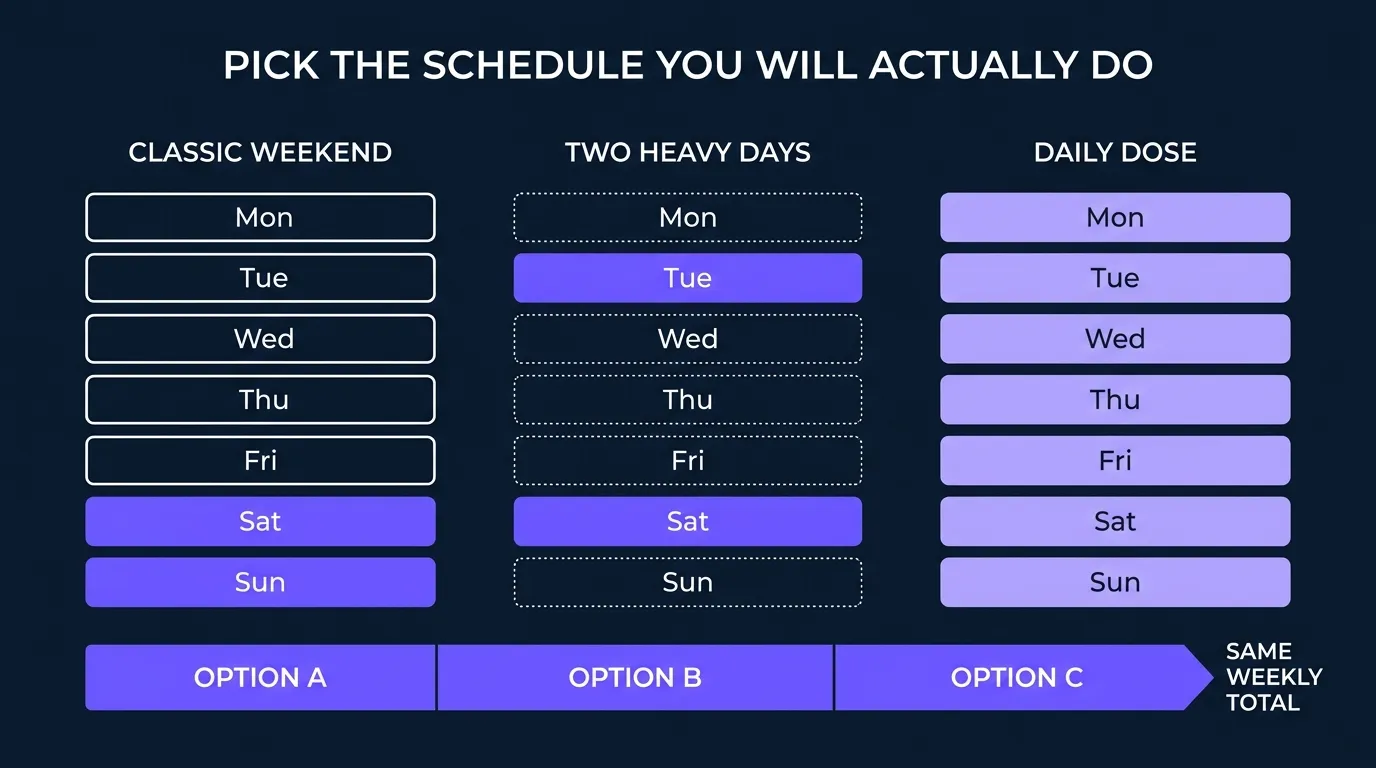
What it does need: total weekly volume that hits the WHO threshold. Some workable patterns:
- The classic weekend warrior: 90-minute Saturday session (mix of strength and conditioning), 75-minute Sunday session (longer aerobic, hike, or active recovery)
- Two heavy days, lighter in-between: 60 min Tuesday strength, 60 min Saturday cardio, brief 15-min walks the other days for non-exercise activity
- Saturday-only with a make-up day: one 2.5-hour session if your schedule genuinely allows nothing else. The data suggest this still works at the population level, though it's the most demanding format.
The bigger pitfall is shame-driven inactivity. People who can't commit to daily training often quit entirely because "twice a week isn't enough." The research says it is enough, if you hit the volume. Choose the schedule you'll actually do. That's the variable that ends up mattering, more than which day of the week the workout lands on.
What the Research Still Can't Tell Us
A few honest limitations are worth flagging before you take this too far.
Most evidence is observational
These are cohort studies, not randomized controlled trials. You can't randomly assign people to "weekend warrior" for a decade. So the evidence shows a strong, replicated association between weekly volume and mortality, with little dependence on how that volume is sliced. Causation is highly plausible (the biology is well-established), but the strict experimental proof isn't there.
Population effects, not personalized predictions
The hazard ratios describe what happens across tens of thousands of people. They don't tell your specific cardiologist what your individual cardiovascular event risk is next year. If you have a chronic condition, work with your clinician on the right activity prescription for you.
Performance goals are different
The literature is mortality-and-disease focused. If you're trying to build measurable strength after 60, run a sub-4-hour marathon, or seriously hypertrophy, frequency starts to matter again. Programming for adaptation isn't the same as programming for health.
Injury rates under-studied
The injury data on weekend warriors specifically is thin. The mortality data is reassuring at the population level, but a sedentary 55-year-old jumping straight into a Saturday CrossFit class should ease in, not test the limits.
References
- Khurshid S, Al-Alusi MA, Churchill TW, Guseh JS, Ellinor PT. "Accelerometer-Derived Weekend Warrior Physical Activity and Incident Cardiovascular Disease." JAMA 330.3 (2023): 247-252. doi:10.1001/jama.2023.10875
- O'Donovan G, Lee I-M, Hamer M, Stamatakis E. "Association of 'Weekend Warrior' and Other Leisure Time Physical Activity Patterns With Risks for All-Cause, Cardiovascular Disease, and Cancer Mortality." JAMA Internal Medicine 177.3 (2017): 335-342. doi:10.1001/jamainternmed.2016.8014
- dos Santos M, Ferrari G, Lee DH, et al. "Association of the 'Weekend Warrior' and Other Leisure-time Physical Activity Patterns With All-Cause and Cause-Specific Mortality: A Nationwide Cohort Study." JAMA Internal Medicine 182.8 (2022): 840-848. doi:10.1001/jamainternmed.2022.2488
- Bull FC, Al-Ansari SS, Biddle S, et al. "World Health Organization 2020 guidelines on physical activity and sedentary behaviour." British Journal of Sports Medicine 54.24 (2020): 1451-1462. doi:10.1136/bjsports-2020-102955
- Lee I-M, Shiroma EJ, Lobelo F, et al. "Effect of physical inactivity on major non-communicable diseases worldwide: an analysis of burden of disease and life expectancy." The Lancet 380.9838 (2012): 219-229. doi:10.1016/S0140-6736(12)61031-9
- The weekend warrior phenomenon: comparable mortality reduction to regular exercise with enhanced neuroprotective effects, a systematic review and meta-analysis. BMC Public Health (2025). PMC12604259
Frequently Asked Questions
Are weekend-only workouts as good as daily exercise?
Research shows the cardiovascular benefit is comparable when total weekly volume is equal. The Khurshid et al. (2023) JAMA study of 89,573 UK Biobank participants found weekend warriors (people who packed 150+ minutes of moderate-to-vigorous activity into 1-2 days) had a 27% lower heart attack risk and 38% lower heart failure risk versus inactive adults, statistically similar to people who spread the same volume across the week.
How much exercise does a weekend warrior need to do?
The threshold used in the major studies is 150 minutes per week of moderate-to-vigorous activity, with at least 50% of that volume completed in 1-2 sessions. This matches the WHO 2020 physical activity guideline. The pattern only delivers comparable benefit when you hit that total weekly volume. Doing 60 minutes once a week and calling it a workout doesn't reach the dose where the research applies.
Does weekend exercise reduce mortality risk?
Yes. O'Donovan et al. (2017) analyzed 63,591 adults across 561,159 person-years and found weekend warriors had a 30% lower all-cause mortality risk and 40% lower cardiovascular mortality risk compared to inactive adults. A 2025 BMC Public Health systematic review of 21 studies pooled the data and confirmed a hazard ratio of 0.77 for all-cause mortality, comparable to regularly active patterns.
Is weekend-only exercise risky for unfit beginners?
Concentrated activity raises the per-session injury risk somewhat, especially for sedentary adults jumping straight into vigorous weekend efforts. The studies showing equivalent benefit measured population-level outcomes over years, not week-one injury rates. A reasonable on-ramp is 4-6 weeks of shorter, lower-intensity sessions before stacking your volume into 1-2 longer days. Always consult a qualified healthcare provider before starting any new exercise program, especially if you have cardiovascular disease, hypertension, or have been sedentary for an extended period.
Does FitCraft work for people who can only train on weekends?
Yes. FitCraft's free assessment builds a plan around your real schedule, whether that's two days a week or seven. The AI trainer Ty programs sessions that fit the time you actually have. Take the free FitCraft assessment to get started.