
Grapes get mixed reviews. One person calls them nature's candy, the next says the skin protects your heart, and a third tells you to skip them because of the sugar. When every snack comes with an argument, trying to eat better starts to feel like a test you can fail.
Small habits you can repeat do more for your health than a perfect food list, and a bowl of fruit in the fridge is one of the easiest to keep.
Below are the USDA numbers per cup, what the human trials found, and how grapes compare with raisins and juice.
Grape Nutrition Facts per Cup
A cup of whole grapes weighs 151 grams in USDA FoodData Central, which works out to about 30 grapes. These numbers come from USDA's entry for red or green European-type grapes, such as Thompson seedless. The percentages are shares of the FDA's adult Daily Values.
| Per cup (151 g) | Amount | Daily Value |
|---|---|---|
| Calories | 104 | 5% of 2,000 |
| Carbohydrate | 27.3 g | 10% |
| Sugars | 23.4 g | none set |
| Fiber | 1.4 g | 5% |
| Protein | 1.1 g | 2% |
| Sodium | 3 mg | under 1% |
| Potassium | 288 mg | 6% |
| Copper | 0.19 mg | 21% |
| Vitamin K | 22 mcg | 18% |
| Vitamin C | 4.8 mg | 5% |
| Iron | 0.5 mg | 3% |
USDA FoodData Central SR Legacy entry 174683, scaled to 151 grams and rounded.
Copper and vitamin K are the two real contributions here, at about a fifth of the Daily Value each. No other vitamin or mineral reaches 10 percent, and vitamin C is low for a fruit, at 5 percent. Grapes are about 81 percent water with almost no fat, so most of what you're eating is water and sugar.
Do Grapes Have a Lot of Sugar?
Yes, for a fruit. Grapes have about 15.5 grams of sugar per 100 grams, more than the other common fruits below, and a cup gives you about 23 grams. Nearly all of it is a close split of fructose and glucose, about 12 and 11 grams per cup.
| Fruit | Sugar per 100 g | Typical portion | Calories | Sugar | Fiber |
|---|---|---|---|---|---|
| Grapes | 15.5 g | 1 cup, 151 g | 104 | 23.4 g | 1.4 g |
| Banana | 12.2 g | 1 medium, 118 g | 105 | 14.4 g | 3.1 g |
| Apple, with skin | 10.4 g | 1 medium, 182 g | 95 | 18.9 g | 4.4 g |
| Blueberries | 10.0 g | 1 cup, 148 g | 84 | 14.7 g | 3.6 g |
| Strawberries | 4.9 g | 1 cup halves, 152 g | 49 | 7.4 g | 3.0 g |
USDA FoodData Central SR Legacy entries 174683, 173944, 171688, 171711 and 167762, rounded.
Grapes have the most sugar and the least fiber in this group. They're also easy to keep eating, with no peel or core to slow you down, so a bowl on the couch can turn into three cups before you notice.
Do grapes spike blood sugar?
Less than their sugar suggests. In a controlled test by Chen and colleagues (2011), grapes with 25 grams of carbohydrate scored a glycemic index of 49 in 20 healthy adults and 49 in 17 adults with type 2 diabetes. The international GI tables class 55 or below as low.
GI describes the type of carbohydrate, so the portion still counts. A cup of grapes carries about 26 grams of digestible carbohydrate, which gives a glycemic load of about 13. Half a cup brings that down to about 6. If you have diabetes, count grapes as carbohydrate like any other fruit, and ask your doctor or dietitian how much fits your plan.
The long-term data are reassuring. Muraki and colleagues (2013) followed three US cohorts of health professionals. Every three weekly servings of grapes and raisins went with a 12 percent lower risk of type 2 diabetes (hazard ratio 0.88), and the same amount of fruit juice with an 8 percent higher risk (1.08). These are associations, but they give no sign that the sugar in whole grapes harms healthy people.
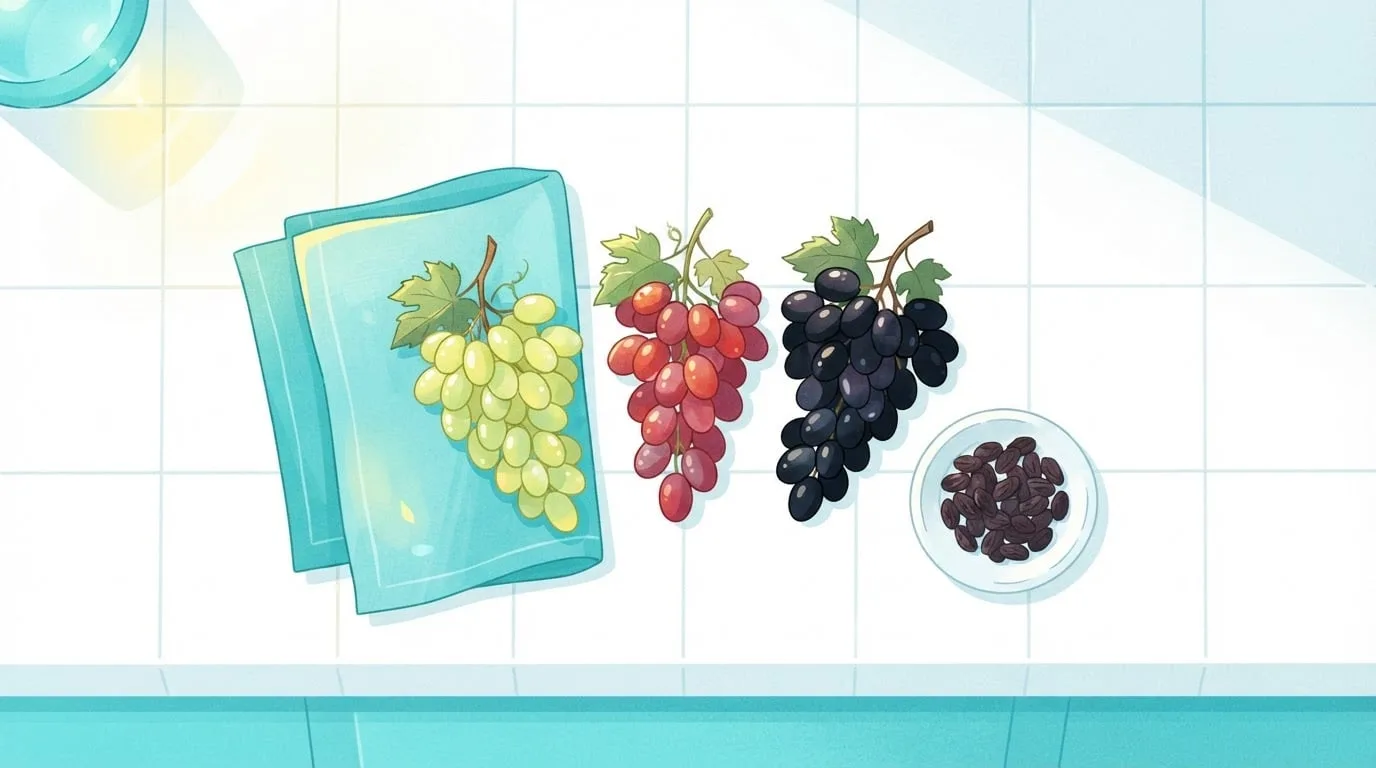
Black Grapes vs Red Grapes vs Green Grapes
For calories and sugar, color barely matters. USDA's standard reference data combine "red or green" European-type grapes in one entry and have none for black table grapes, so there's no official number for calories in black grapes. Most black seedless grapes are the same European species, so expect about the same 69 calories per 100 grams.
USDA's other entry covers American slip-skin grapes such as Concord. At 67 calories and 16.3 grams of sugar per 100 grams, it's nearly the same fruit on paper. The biggest difference is manganese, at 0.72 milligrams against 0.07.
The skin is where the colors differ. Red and black grapes get their color from anthocyanins, the same family of pigments found in blueberries. In a survey of US fruits, Wu and Prior (2005) identified 31 different anthocyanins in Concord grapes, the most of any fruit they tested. The darker the skin, the more of these pigments it tends to hold, and green grapes have little.
Are black grapes good for you?
Yes, and so are the others. Black grapes give you the same basic nutrition as red or green ones, plus more skin pigment. We didn't find a human trial that compares the colors head to head for any health outcome, so the benefits of black grapes over red ones are unproven. Choose the grapes you enjoy.
What the Human Trials on Grape Polyphenols Found
Polyphenols are the plant compounds in grape skins and seeds, and they're the reason grapes have a health reputation. Most trials don't use fresh grapes. They use freeze-dried grape powder, seed extract or juice, because those can be dosed and matched against a placebo.
- Blood pressure. In a crossover trial by Barona and colleagues (2012), 24 men with metabolic syndrome took a freeze-dried grape powder for 30 days and a placebo for 30 days, and systolic pressure was lower on the powder. A wider meta-analysis by Li and colleagues (2015) of 10 trials found a drop of only 1.48 mm Hg and no change in diastolic pressure. The authors called that modest compared with blood pressure drugs.
- Cholesterol. Lupoli and colleagues (2020) pooled 24 papers with 618 people on grape products and 587 on placebo for 2 to 24 weeks. LDL cholesterol fell 6.3 mg/dL on average, and whole-grape powder and pomace drove that result. Seed extract (4.3 mg/dL lower) and juice (0.2 mg/dL higher) didn't reach significance. The trials varied widely and none measured heart attacks or strokes.
- Memory. Krikorian and colleagues (2010) gave Concord grape juice or a placebo to 12 older adults with memory decline for 12 weeks. Verbal learning improved, and the authors called their results preliminary.
Put together, concentrated grape products produced small changes in short trials, mostly in people who already had risk factors. None of this shows that a daily bowl of fresh grapes prevents heart disease.
Knowing what to do is the easy part.
FitCraft, our mobile fitness app, pairs you with an AI coach who builds you a personalized plan around your goals, schedule, and fitness level. Every FitCraft program is designed by Domenic Angelino, MPH (Brown University) and NSCA-CSCS, with research published in the Journal of Strength and Conditioning Research and Medicine & Science in Sports & Exercise.
Take the Free Assessment Free • 2 minutes • No credit cardHow Much Resveratrol Is in Grapes?
Very little. Resveratrol is the grape compound behind most of the headlines. A review by Weiskirchen and Weiskirchen (2016) lists 92 to 1,604 micrograms per kilogram of fresh red grapes and 59 to 1,759 in white grapes, so color doesn't reliably predict it. For a cup of red grapes, that's roughly 14 to 240 micrograms, or about a quarter of a milligram at the very most.
Many of the human trials in that review used 500 milligrams to 5 grams a day. Even at the top of the grape range, 500 milligrams would take about 2,000 cups. A 5-ounce glass of red wine, at an average of 1.9 milligrams per liter, holds about 0.3 milligrams. The authors concluded that you can't reach 1 gram a day from ordinary food.
Higher exposure from normal eating hasn't shown a benefit either. Semba and colleagues (2014) measured resveratrol by-products in the urine of 783 older adults in Italy's Chianti region and followed them for nine years. Death rates didn't differ between the highest and lowest levels, and neither did heart disease or cancer.
High-dose pills may even get in the way of training. In a study by Gliemann and colleagues (2013), 27 inactive men around age 65 did eight weeks of high-intensity training with either 250 milligrams of resveratrol a day or a placebo, and the resveratrol blunted several training gains, including those in blood pressure and maximal oxygen uptake. That dose equals at least 1,000 cups of grapes, so the result says nothing against the fruit.
Grapes vs Raisins
A raisin is a grape with most of the water gone, so everything else concentrates. Per 100 grams, raisins have 299 calories against 69 for grapes, 65 grams of sugar against 15.5, and 4.5 grams of fiber against 0.9. Measured by the portions people really eat, the two come out almost even:
| Per portion | 1 cup grapes (151 g) | 1/4 cup raisins (36 g) |
|---|---|---|
| Calories | 104 | 108 |
| Sugars | 23.4 g | 23.5 g |
| Fiber | 1.4 g | 1.6 g |
| Potassium | 288 mg | 268 mg |
| Water | 122 g | 6 g |
USDA FoodData Central SR Legacy entries 174683 and 168165 (dark seedless raisins, from USDA's 145-gram cup), rounded.
So a quarter cup of raisins is about a cup of grapes with the water taken out. That makes grapes the more filling choice per calorie, and raisins the easier one to carry. It also makes raisins easy to overdo: a full cup has about 434 calories and 95 grams of sugar. Published glycemic index values for raisins run from 49 to 69, according to a 2019 review.
Raisins also work as training fuel. In a crossover study by Too and colleagues (2012), 11 male runners ran for 80 minutes and then raced 5 kilometers. They finished in 20.6 minutes on raisins, 20.7 on commercial sports chews and 21.6 on water alone. A 30-minute dumbbell session doesn't call for any of this, so save it for long efforts.
Whole Grapes vs Grape Juice
Whole grapes are the better everyday choice. Juice keeps the sugar and loses most of the fiber and all of the chewing. The research lines up with that: juice was linked to higher diabetes risk in the Muraki cohorts, and it did nothing for LDL cholesterol in Lupoli's pooled trials.
Black grape juice benefits come mostly from small Concord juice studies. In a 12-week trial of 76 overweight adults by Hollis and colleagues (2009), those assigned 480 milliliters of Concord juice a day didn't gain significant weight, but their glucose and insulin responses rose slightly and their antioxidant status didn't improve. A small glass is fine if you like it. Our list of foods that seem healthy but aren't explains why "no added sugar" doesn't make juice equal to fruit.
Are Grapes Good for Weight Loss?
They can fit, though they aren't the most filling fruit. At 69 calories and 0.9 grams of fiber per 100 grams, grapes give you less bulk for your calories than apples or berries. Even so, raisins and grapes were among the fruits linked to less weight gain in a 24-year analysis of US adults by Bertoia and colleagues (2015). Portion out a cup instead of eating from the bag, and see our guide to the best fruits for weight loss for the most filling options.
Do Grapes Help With Digestion?
A little. A cup adds 1.4 grams of fiber and about 122 grams of water, but that fiber is only 5 percent of the Daily Value. A medium apple has about three times as much.
Do grapes affect bowel movement?
Yes, in large portions. A cup holds about 12 grams of fructose, and three cups hold about 37. When Rao and colleagues (2007) gave 20 healthy adults fructose drinks, nobody malabsorbed 15 grams, 2 malabsorbed 25 grams and 16 malabsorbed 50 grams. That test used fructose alone, so it's only a guide, but if a big bowl leaves you gassy or running to the bathroom, try a smaller portion.
How Many Grapes Should You Eat a Day?
No official limit exists for grapes. The Dietary Guidelines for Americans, 2025-2030 call for 2 servings of fruit a day, and a cup of grapes is a sensible portion. USDA weighs 10 grapes at 49 grams, so a cup is about 30 grapes.
Is it okay to eat 20 grapes a day?
Yes. Twenty grapes weigh about 98 grams and give you about 68 calories, 15 grams of sugar and just under a gram of fiber. That's a reasonable daily snack for most people. Rotate in other fruit too, since berries bring more fiber for less sugar. Our page on how many blueberries to eat per day covers one good option.
Who Should Be Careful With Grapes?
Most people can eat grapes freely. A few groups need care:
- Babies and toddlers. The CDC lists uncut grapes among the foods that can cause choking. Cut them into small pieces.
- People taking warfarin. A cup has about 22 micrograms of vitamin K. MedlinePlus advises eating consistent amounts of vitamin K foods from week to week, so talk to your doctor before making big changes.
- People on a potassium limit. A cup has 288 milligrams. If you have kidney disease, ask your dietitian how much fits.
What This Means for You
Grapes earn their place as an easy, sweet fruit. A cup gives you copper, vitamin K and water for about 100 calories, and the color you pick matters far less than the labels suggest. Keep them whole and keep the portion near a cup.
Picking a snack is the easy decision. The harder one is keeping your training going once the first burst of motivation fades. Sarah put it this way: "First app that made exercise feel like something I chose, not forced." If consistency is your sticking point, a workout app that keeps you motivated can carry part of the load. In FitCraft, 3D AI coaches demonstrate each bodyweight and dumbbell exercise and call you by name, and streaks, leaderboards and a new seasonal quest each month give you a reason to come back.

Frequently Asked Questions
What is a grape?
A grape is a small, juicy berry that grows in clusters on woody vines of the genus Vitis. Most table grapes are the European type, Vitis vinifera, and Concord-style grapes belong to the American slip-skin group.
Which is healthier, grapes or apples?
Apples have the edge for fullness, and grapes bring more copper, potassium and vitamin K. Per 100 grams, apples have 52 calories and 2.4 grams of fiber, against 69 calories and 0.9 grams for grapes. Both were linked to lower type 2 diabetes risk in three large US cohorts.
Are green grapes good for you?
Yes. Green grapes have the same calories, sugar, copper and vitamin K as red grapes in USDA's reference data, which list them as one food. Their skins carry less pigment than red or black grapes, but we found no human trial showing that this changes a health outcome.
Do grapes have iron?
Only a little. A cup of grapes has about 0.5 milligrams of iron, or 3 percent of the Daily Value. A quarter cup of raisins gives only about 0.6 milligrams.
Are grapes good for your skin?
Grapes might help some people a little, but the evidence is thin. In a 2022 study by Pezzuto and colleagues, 29 adults took freeze-dried grape powder equal to about three servings of fresh grapes a day for two weeks, and 9 of them became harder to sunburn. There was no placebo group, so it's no reason to skip sunscreen.
Are grapes good for dogs?
No. Grapes and raisins can cause kidney failure in dogs, and the Merck Veterinary Manual doesn't identify a safe amount. Call a veterinarian right away if your dog eats any, even before symptoms appear.