Somewhere around midlife, a quiet assumption takes hold. The muscle you had is the muscle you get to keep, and from here it is all managed decline. It feels intuitive. It is also wrong, and the research proving it wrong has been sitting in the literature for three decades.
Muscle is not a fixed asset that only depreciates. It is living tissue that responds to demand, and that responsiveness does not switch off at 55, or 65, or even 95. What changes is the dose you need and the speed of the response, not whether the response happens at all. That distinction is the whole ballgame.
This piece walks through the evidence on rebuilding muscle after 55: the landmark trial that started it, the meta-analyses that quantified it, the honest caveat about what "rebuild" actually means at this age, and the practical program that produces results. If you want the deeper clinical picture on age-related muscle loss, our sarcopenia and resistance training research page covers the diagnostic side in full.
The Assumption That Needs to Die
The belief that muscle building is a young person's game comes from a real observation. Muscle mass does decline with age. After about 50, most people lose 1 to 2 percent of muscle mass per year if they do nothing, and strength declines even faster. That part is true. That default decline is also what makes dieting risky at this age, which is why our guide on how to lose weight after 50 puts protein and resistance training ahead of the size of the deficit.
The error is treating that decline as fixed. The "if you do nothing" clause is doing enormous work in that sentence. The decline describes what happens by default, in the absence of a training stimulus. It is not a law of biology that overrides training. When you add progressive resistance training, the trajectory changes, and it changes at any age you introduce it.
Why the Myth Persists
Part of it is that older adults who never lift keep declining, and that is visible everywhere. Part of it is that the mass gains after 55 are genuinely smaller than at 25, so the change is less dramatic on a mirror or a scan. And part of it is that "it's too late" is a comfortable story. It removes the obligation to start. The research does not support the comfort.
The Landmark Study: Lifting in the 90s Works
If one study broke the myth, it was Fiatarone et al. (1994) in the New England Journal of Medicine. The researchers took 100 frail nursing-home residents, mean age 87, some as old as 98, and randomized them to high-intensity progressive resistance training, a nutritional supplement, both, or neither. The training ran three times a week for 10 weeks, starting at 50 percent of one-rep max and progressing to 80 percent.
The results were hard to believe. Muscle strength increased 113 percent in the exercise groups versus 3 percent in the non-exercisers. Gait speed improved almost 12 percent. Cross-sectional thigh muscle area, measured by CT, increased 2.7 percent. The nutritional supplement alone did essentially nothing without the training. People who had been too weak to reliably stand from a chair could do it independently by the end.
The point is not that everyone should train at 80 percent of max in a nursing home. The point is the ceiling. If a frail 90-year-old can double leg strength in 10 weeks, the idea that a 55-year-old has missed the window is not defensible. Muscle plasticity survives into extreme old age.
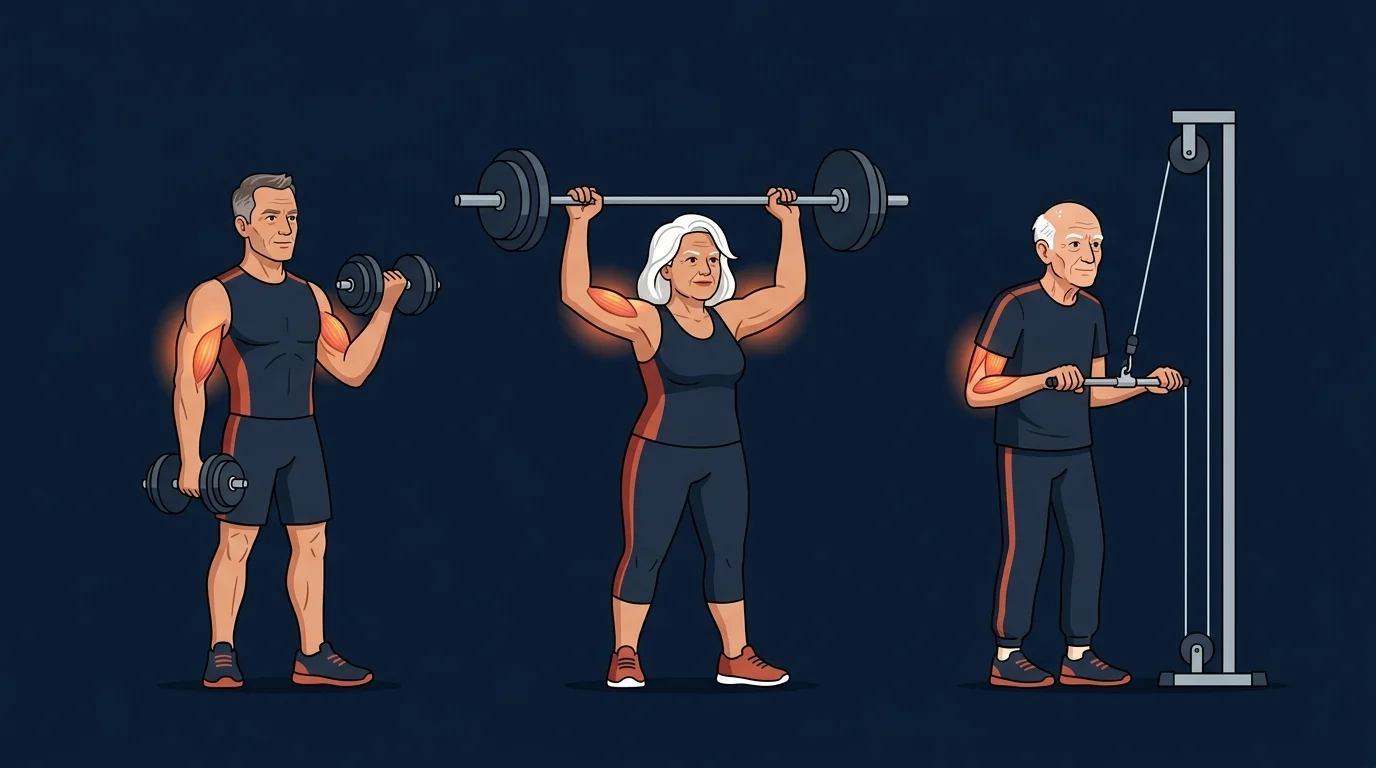
What the Meta-Analyses Say
One dramatic trial is a headline. What makes the case airtight is that the pooled evidence agrees.
Peterson et al. (2010): The Dose-Response Numbers
Peterson, Rhea, Sen, and Gordon (2010) in Ageing Research Reviews pooled 47 studies of progressive resistance training in older adults and reported the average strength gains: about 29 percent on leg press, 33 percent on knee extension, 24 percent on chest press, and 25 percent on lat pulldown. They also found that for every increment in training intensity, participants gained about 5.3 percent more relative strength. Higher relative intensity worked better. Load, applied progressively, is the lever.
Chen et al. (2021): Restricted to People Who Already Lost Muscle
The toughest test is people who are already diagnosed with sarcopenia. Chen et al. (2021) in the European Review of Aging and Physical Activity pooled 14 randomized trials of resistance training in sarcopenic older adults. They found large effects on handgrip strength (SMD 0.81), knee extension strength (SMD 1.26), and gait speed (SMD 1.28), plus a large improvement in the timed up-and-go mobility test.
Here is the honest caveat, and it matters. In that same analysis, the gain in skeletal muscle mass (SMD 0.27) was not statistically significant. So in people who have already lost significant muscle, training reliably makes them stronger and more mobile, but the scan does not always show a dramatically bigger muscle. That reframes what "rebuild" means, and we come back to it below.
Radaelli et al. (2025): The Biggest Modern Synthesis
The most current large synthesis is Radaelli et al. (2025) in Sports Medicine, a network meta-analysis of 151 randomized trials with 6,306 adults over 60. It confirmed resistance training reliably improves lean body mass, muscle size, strength, and walking speed. Encouragingly, even lower-volume programs were enough to drive lean mass and hypertrophy gains, while higher volumes maximized strength and walking speed. In other words, you do not need to train like a bodybuilder to rebuild meaningful muscle after 60.
Liu and Latham (2009): The Sheer Weight of Evidence
And the base of the pyramid is the Liu and Latham (2009) Cochrane review, which pooled 121 progressive resistance training trials with 6,700 participants aged 60 and up. The direction of effect was uniformly positive for strength and physical function, and adverse events were rare and minor. When 121 trials and 6,700 people all point the same way, that is about as settled as exercise science gets.
Knowing what to do is the easy part.
FitCraft, our mobile fitness app, pairs you with an AI coach who builds you a personalized plan around your goals, schedule, and fitness level. Every FitCraft program is designed by Domenic Angelino, MPH (Brown University) and NSCA-CSCS, with research published in the Journal of Strength and Conditioning Research and Medicine & Science in Sports & Exercise.
Take the Free Assessment Free • 2 minutes • No credit cardWhat "Rebuild" Actually Means After 55
This is where honesty matters more than hype. When people ask "can I rebuild muscle after 55," they usually picture a scan showing visibly bigger muscles. The research says the more reliable, more important win is different.
What you rebuild most reliably after 55 is strength and function. The neural side of strength (your nervous system recruiting muscle more efficiently) comes back fast and large. The mass side (more actual muscle tissue) comes back too, but slower and smaller than it would have at 25, especially if you have already lost a lot. That is why Chen's meta-analysis showed big strength effects and a non-significant mass effect.
And functionally, strength is what you actually care about. The ability to stand from a low chair, carry groceries up stairs, catch yourself when you stumble, get off the floor. Those are strength-limited tasks, not muscle-size-limited tasks. Rebuilding the strength rebuilds the life, even when the muscle photo is subtle. There is also a genuine head start hiding in older muscle: the muscle memory research shows that if you trained earlier in life, retained myonuclei make retraining faster than starting from scratch.
How to Actually Do It: The Practical Dose
The trials converge on a program that is refreshingly simple. You do not need to copy Fiatarone's supervised machine protocol. The pooled evidence supports a much wider, more doable range.
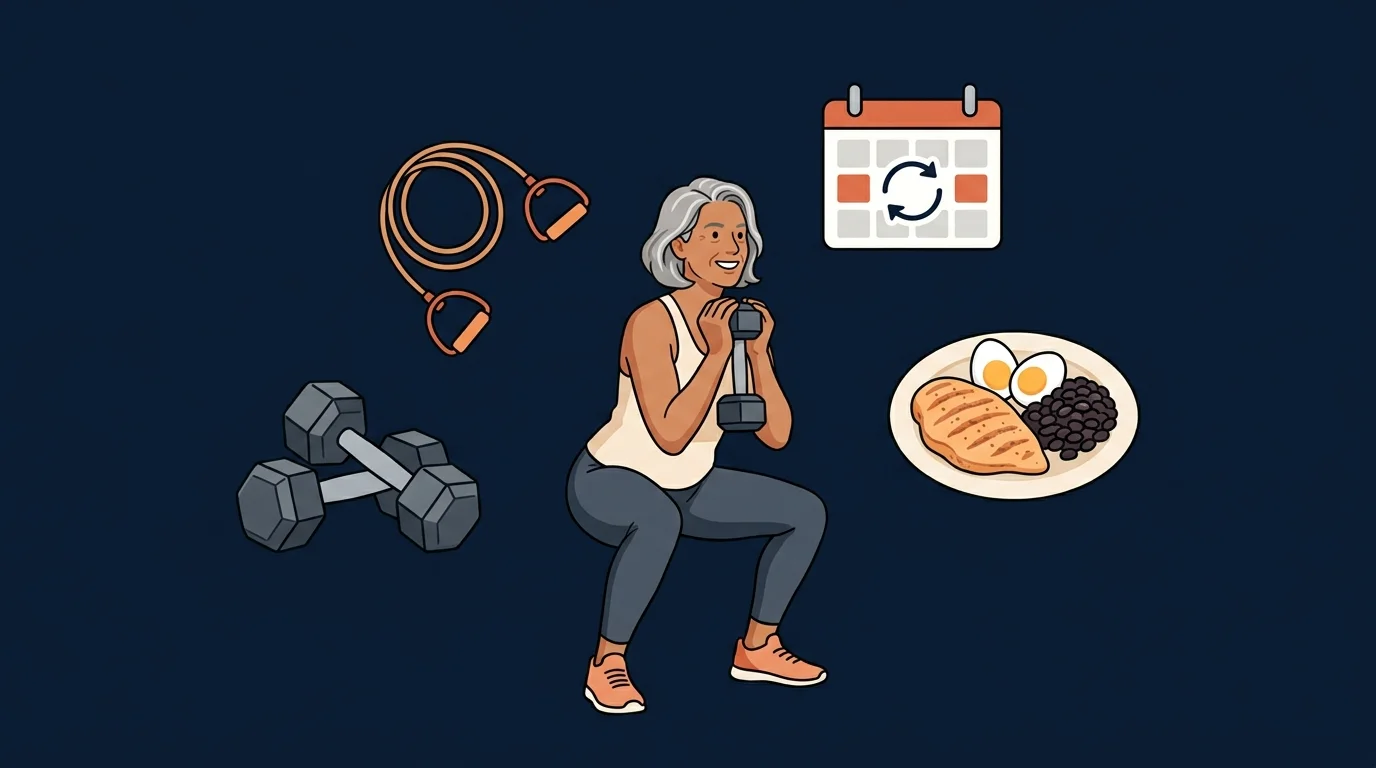
- Frequency: 2 sessions per week, full-body. Add a third if you recover well. More than 3 adds little.
- Movements: cover the major patterns. Sit-to-stands, step-ups, hip hinges, presses, and rows. Start with bodyweight and bands, move to dumbbells.
- Sets and reps: 2 to 3 sets of 8 to 12 reps, with the last couple of reps genuinely hard.
- Progression: when the top of the rep range gets easy, add load. This is the part people skip, and it is the part that matters most. The progressive overload is the whole mechanism.
Two adjustments make this age-appropriate. First, progress a little more gradually than a 25-year-old would, and prioritize good form over rushing to heavier weights. Second, respect recovery. Older muscle recovers a bit slower, so those non-consecutive training days are not optional. For a full walk-through of getting started later in life, our fitness over 60 guide covers the ramp and the common concerns.
The Protein Half of the Equation
Training is the stimulus, but after 55 the nutrition side pulls more weight than it used to. Anabolic resistance means older muscle needs more protein per meal to trigger the same building response. The practical target from the research is 1.2 to 1.6 grams of protein per kilogram of body weight per day, spread across meals, aiming for roughly 30 to 40 grams per meal. The distribution matters as much as the total, which we cover in the protein distribution research piece. Skimping on protein is the most common reason a good training program under-delivers after 55.
What This Means for You
If you are over 55 and reading this, the takeaway is not "you might be able to hold on to what you have." It is stronger than that. You can add strength, add function, and add real muscle, starting from wherever you are right now. The 87-year-olds in Fiatarone's trial started weaker than you almost certainly are, and they doubled their leg strength in 10 weeks.
The window did not close. It never closes. What the research asks of you is specific and doable: lift progressively twice a week, eat enough protein, and keep going long enough for the adaptations to stack. Do that for a few months and the payoff shows up where it counts, in stairs that feel easier and a body that trusts itself again. For women navigating this alongside the hormonal changes of menopause, our strength training after menopause plan lays out a conservative starting routine. And if you want guided structure rather than programming it yourself, we compared the best fitness apps for over-50s.
Frequently Asked Questions
Can you rebuild muscle after 55?
Yes. The neuromuscular system responds to progressive resistance training at every age tested, including frail adults in their late 80s and 90s. The landmark 1994 Fiatarone trial saw a 113 percent increase in leg strength in nursing-home residents with a mean age of 87 after just 10 weeks of lifting. After 55 you can absolutely rebuild strength and function. The response is somewhat slower than at 30, but it is real and reliable.
How long does it take to build muscle after 55?
Strength improves within the first 2 to 4 weeks, mostly from your nervous system learning to recruit muscle more effectively. Measurable increases in muscle size typically take 8 to 12 weeks of consistent progressive training, and meaningful function gains build over 3 to 6 months. Most older-adult trials that showed clear results ran 8 to 20 weeks. Consistency over months is what produces the durable change.
Is it harder to build muscle after 55?
Somewhat. Older muscle shows anabolic resistance, meaning it needs a stronger stimulus (adequate training intensity and more protein per meal) to trigger the same building response as younger muscle. But harder does not mean impossible. Meta-analyses of resistance training in adults over 60 consistently show significant strength, muscle, and walking-speed gains. The adjustments are progressive loading and higher protein, not giving up.
How much protein do you need to build muscle after 55?
Because of anabolic resistance, older adults benefit from more protein than the standard adult recommendation. Most research points toward 1.2 to 1.6 grams per kilogram of body weight per day, spread across meals, with roughly 30 to 40 grams per meal to reliably trigger muscle protein synthesis. Protein supports the training, but it does not replace the mechanical stimulus of lifting.
Do you need a gym to rebuild muscle after 55?
No. While the most intense bone and strength trials used gym equipment, meta-analyses show meaningful gains from a wide range of methods including bodyweight, resistance bands, and dumbbells. What matters is that the load is challenging relative to your capacity and that it progresses over time. A consistent home program with progressive overload rebuilds muscle effectively after 55.