
You started creatine because everyone at the gym swears by it, and now you're trying to lose weight and wondering if it's working for you or against you. The scale went up two pounds in the first week. Your friend says that's water. A supplement shop says creatine "supports fat loss." A forum thread says it makes you puffy. You just want to know whether to keep the tub or drop it.
The confusion comes from treating weight and fat as the same thing. Creatine moves them in different directions. It tends to push the scale up a little, through water at first and lean tissue later, while doing nothing measurable to fat on its own. Put it next to strength training and a calorie deficit, though, and the picture changes: you hold on to muscle that a diet usually takes, and your body-fat percentage falls faster than your weight does.
This article goes through what the body-fat meta-analyses found, whether creatine burns fat in any direct way, why the scale goes up first, what happens when you take creatine in a calorie deficit or on a GLP-1 medication, the belly-fat question, and how to use it if fat loss is your goal.
What the Body-Fat Trials Show
Three meta-analyses have looked directly at what creatine does to body fat when it's added to resistance training. They agree with each other, and the agreement is more useful than any single headline number.
Adults under 50: a small drop in body-fat percentage
Candow, Prokopidis, Forbes, Rusterholz, Campbell and Ostojic (2023) in Nutrients pooled 12 randomized trials and 266 people under 50 who did resistance training with either creatine or a placebo. Body-fat percentage came out 1.19 points lower in the creatine groups. Fat mass in kilograms didn't differ: the gap was 0.18 kg and nowhere near significant. The authors called it "a very small, yet significant reduction in body fat percentage" and stated plainly that creatine combined with resistance exercise does not increase fat mass.
Adults over 50: the same pattern
Four years earlier, Forbes, Candow, Krentz, Roberts and Young (2019) ran the same analysis in older adults: 19 studies and 609 people with a mean age of 50 or more, training 2 to 3 times a week for 7 to 52 weeks. Body-fat percentage was 0.55 points lower with creatine. Fat mass was about 0.5 kg lower, but that difference wasn't statistically significant.
143 studies: the scale goes up, body fat goes down
The broadest pooling is the 2024 GRADE-assessed meta-analysis by Pashayee-Khamene and colleagues in the Journal of the International Society of Sports Nutrition, covering 143 studies. Creatine raised body mass by 0.86 kg and fat-free mass by 0.82 kg, and lowered body-fat percentage by 0.28 points. The effects were stronger in studies that included a maintenance dose and resistance training.
Why the percentage moves when the fat doesn't
This is the part that trips people up, so it helps to run the numbers. Say you weigh 80 kg with 20 kg of fat, which is 25 percent body fat. Add 1.2 kg of lean tissue and change nothing else. You now weigh 81.2 kg, and 20 kg of fat is 24.6 percent. Your body-fat percentage fell 0.4 points and you didn't lose a gram of fat. That's roughly what the meta-analyses describe: creatine improves body composition by building the lean side of the ratio, not by shrinking the fat side.
Does Creatine Burn Fat?
There's a real biological reason people hoped it might. In 2015, Kazak and colleagues reported in Cell that beige fat in mice runs a creatine-driven cycle that burns energy as heat. When the researchers lowered creatine levels in the mice, whole-body energy expenditure after a fat-burning drug fell, and so did the metabolic rate of their fat tissue. If the same cycle could be switched up in people, creatine might raise calorie burn directly.
The human test didn't find it. Connell and colleagues (2021) in Nature Metabolism gave 14 young vegetarian adults 20 grams of creatine a day or placebo in a crossover design, then measured brown fat activity after cold exposure with PET-MRI scans. Brown fat volume and activity were similar on creatine and on placebo. The volunteers were vegetarians, a group whose low starting creatine stores leave the most room for an effect.
That leaves the indirect route through muscle, and it's smaller than supplement marketing suggests. Wang and colleagues (2010) estimated that resting skeletal muscle burns about 13 calories per kilogram per day. The extra 1 to 1.5 kg of lean tissue creatine adds over a training block works out to around 15 to 20 calories a day, which is roughly the energy in a teaspoon of sugar. Muscle is worth having for many reasons, and our article on whether muscle burns fat explains where its real value for fat loss lies. A faster metabolism from creatine isn't one of them.
Why the Scale Can Go Up First
If you weigh yourself daily, expect the number to rise when you start. The 2021 misconceptions review by Antonio and colleagues puts the typical gain during a loading week at 1 to 3 kg, almost all of it water drawn into muscle cells, and the trials it reviewed don't show creatine adding fat. Without loading, the same water arrives more slowly over three or four weeks and then levels off. Our research review on whether creatine makes you gain weight covers where that water sits, how long it lasts and what happens when you stop. For fat loss, the practical point is simple: judge creatine by your waist and your strength over a month, not by the scale in week one.
Creatine in a Calorie Deficit
This is where creatine earns its place in a weight-loss plan. When you eat less than you burn, your body takes energy from fat and from lean tissue, and losing muscle while dieting makes the weight harder to keep off and leaves you weaker. Two trials have tested creatine during an actual calorie deficit.
Rockwell 2001: four days of hard dieting
Rockwell, Rankin and Toderico (2001) in Medicine & Science in Sports & Exercise put male resistance trainers on a formula diet of 18 calories per kilogram a day for four days, with 20 grams of creatine or placebo. Both groups lost the same weight and the same body fat. Fat-free mass fell 1.4 percent on creatine and 2.4 percent on placebo, and sprint work tended to hold up better on creatine. But nitrogen losses in urine, a marker of protein breakdown, were the same in both groups. The authors concluded creatine didn't change fat or protein loss, so the smaller drop in fat-free mass was probably water the creatine kept in muscle.
Chun 2026: twelve weeks of exercise and a moderate deficit
The stronger evidence is recent. Chun and colleagues (2026), a Texas A&M team led by Richard Kreider, followed 64 sedentary adults aged 45 to 65 (40 women and 24 men) for 12 weeks. People chose whether to join an exercise program, then were randomized to 10 grams of creatine a day or placebo. The exercise groups did resistance and aerobic training three times a week, aimed for 10,000 steps on other days, and ate to a deficit of about 300 to 500 calories a day.
- Body fat: exercise plus creatine cut body-fat percentage by 3.24 points, against 1.87 for exercise plus placebo.
- Lean tissue: exercise plus creatine gained 1.27 kg of lean tissue while dieting. Exercise plus placebo gained 0.14 kg, which is essentially no change.
- Fat mass: both exercise groups lost fat. The extra drop in body-fat percentage came mostly from the lean tissue gain.
- Strength: one-rep max gains on the leg press and bench press were significantly larger with creatine.
- Creatine alone: the group that took creatine without the exercise program also gained about 1.1 kg of lean tissue, but its body-fat percentage barely moved.
Two caveats keep this honest. People weren't randomized to exercise, only to creatine, and DXA scans count water held in muscle as lean tissue, so part of that 1.27 kg is likely water. Protein intake was also low, at about 0.94 grams per kilogram a day, which the authors flagged as a target for future work. Even so, it's the clearest sign yet that creatine can turn a diet that usually costs muscle into one that holds or adds it. Our guide to losing fat without losing muscle covers the bigger levers: the size of the deficit, protein and training volume.
Knowing what to do is the easy part.
FitCraft, our mobile fitness app, pairs you with an AI coach who builds you a personalized plan around your goals, schedule, and fitness level. Every FitCraft program is designed by Domenic Angelino, MPH (Brown University) and NSCA-CSCS, with research published in the Journal of Strength and Conditioning Research and Medicine & Science in Sports & Exercise.
Take the Free Assessment Free • 2 minutes • No credit cardCreatine on GLP-1 Medications
GLP-1 medications such as semaglutide and tirzepatide produce large weight losses, and part of that loss is lean tissue. A 2025 network meta-analysis in Metabolism by Karakasis and colleagues pooled 22 randomized trials and 2,258 people and found lean mass made up about 25 percent of the weight lost, with semaglutide and tirzepatide among the least protective of lean mass. That's why creatine keeps coming up in GLP-1 conversations.
As of this writing we could find no published trial of creatine taken alongside a GLP-1 medication. The first registered one is under way: a University of Saskatchewan pilot led by Phil Chilibeck (NCT07625202) plans to randomize 40 people on GLP-1 therapy to 10 grams of creatine a day or placebo during 12 weeks of resistance training. Its main outcome is a sit-to-stand test, with lean and fat mass among the secondary measures. Results aren't expected before 2027.
Until then, the evidence-based order is clear. Resistance training and enough protein come first, because they're what the GLP-1 body-composition research actually supports. Creatine is a reasonable add-on for someone already lifting, and it's worth clearing with whoever prescribes your medication, since GLP-1 users often eat and drink less, and creatine can raise the creatinine number on kidney blood tests. Our review of GLP-1 muscle loss research covers the training and protein side in detail.
Does Creatine Help You Lose Belly Fat?
No. No supplement takes fat off one part of your body, and none of the creatine meta-analyses reports a belly-specific effect. The Chun trial did measure visceral fat, the deep abdominal fat linked to metabolic risk, and it fell significantly in both exercise groups, creatine and placebo alike. The training and the deficit did that work. Belly fat comes off the same way the rest does, and keeping muscle while it happens is the part creatine can help with.
Does Creatine Help Women Lose Weight?
The fat-loss evidence doesn't show a different answer for women. In the Candow meta-analysis, the female-only trials showed no difference in fat mass from placebo, the same null result seen in men, and the authors found no significant difference between the sexes. The Forbes analysis in adults over 50 re-ran its numbers on male-only and female-only studies and got the same result. The Chun trial, where 40 of the 64 completers were women, is the best evidence that creatine helps protect lean tissue during a diet. For dosing and the questions specific to women's health, see our guide to creatine for women.
How to Use Creatine if Fat Loss Is the Goal
If you decide creatine fits, the setup is simple. The dose doesn't change for weight loss, and our research review on how much creatine to take a day covers dosing by body weight, sex and age. The rest of the plan matters more than the scoop:
- Skip the loading week. A steady daily dose avoids the quick water jump that makes people panic and quit in week one.
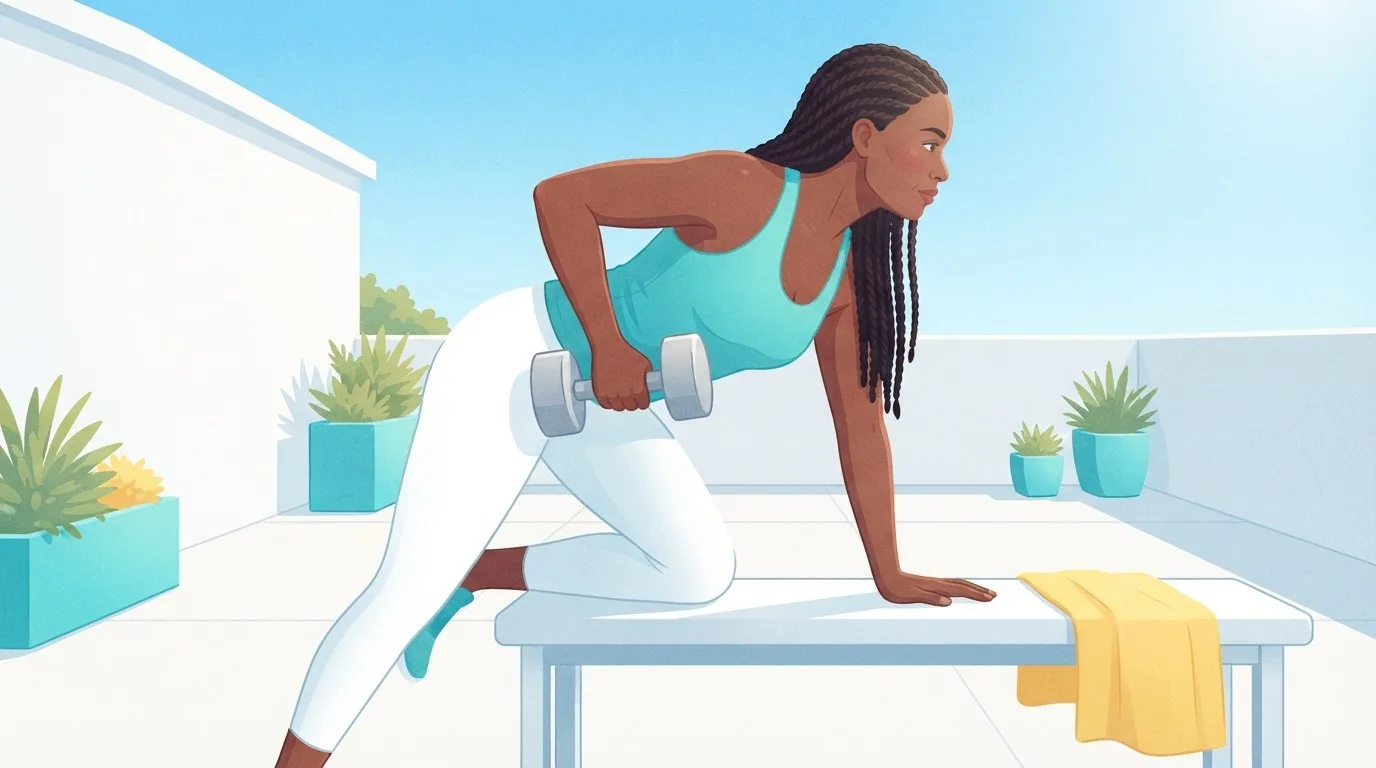
- Lift two or three times a week. Every trial that showed an extra drop in body-fat percentage paired creatine with resistance training. Dumbbells and bodyweight are enough: squats, lunges, rows, presses and push-ups, taken close to fatigue.
- Keep the deficit moderate. The Chun trial used 300 to 500 calories a day. Bigger deficits tend to cost more muscle.
- Eat enough protein. Protein matters more than creatine for keeping muscle, and the Chun participants ate less than most guidelines suggest for people who train.
- Measure more than weight. A weekly average weight, your waist and the weights you lift tell you what's happening. The daily scale only tells you about water.
The hardest part of that list isn't the creatine. It's the strength sessions you have to keep showing up for while you're eating less and feeling flat. If you'd like help with the training side, our roundup of the best workout apps for weight loss compares the apps built to keep people consistent.
What This Means for You
If you take creatine expecting it to melt fat, you'll be disappointed, and the scale will probably make it worse in the first week. If you take it as a muscle-keeper while you diet and lift, the research is on your side. Your weight may come down a bit slower than you'd like on paper, but more of what leaves will be fat, and you'll keep the strength that makes the next workout possible.
That's the real win for most people trying to lose weight. It isn't a faster drop. It's ending the diet stronger than you started instead of smaller and weaker. Stacy, 41, who lost 22 lb in four months, put the need simply: "After my second kid, I needed something stupidly simple." A simple plan you can repeat for 12 weeks beats a perfect one you abandon in three.
Frequently Asked Questions
Does creatine help you lose weight?
Not on its own. Creatine doesn't burn fat or cut appetite, and in the first weeks it usually adds 1 to 3 kg of water to the scale. What it does, alongside strength training, is help you keep or add muscle, so more of the weight you lose comes from fat. In a 2026 trial by Chun and colleagues, adults on creatine during exercise and a 300 to 500 calorie daily deficit lost 3.24 points of body fat against 1.87 on placebo.
Should I take creatine while trying to lose weight?
If you're also lifting, it's a reasonable choice. A calorie deficit tends to strip some muscle along with fat, and creatine plus resistance training is one of the better-studied ways to hold onto it. Skip it if a rising scale would make you quit, or if you have kidney disease or take a medication your doctor hasn't cleared creatine alongside. Training and protein do more for muscle retention than creatine does.
Why did I gain 10 pounds after taking creatine?
Creatine itself usually accounts for 1 to 3 kg, about 2 to 7 pounds, of water held inside muscle, mostly in the first week if you loaded. A 10-pound jump is more than the trials typically show, so the rest is likely normal day-to-day swings in food, salt and glycogen, or a calorie surplus. Track a weekly average and your waist for a month before you judge it.
Does creatine help to lose belly fat?
No supplement removes fat from one area. Belly fat comes off with overall fat loss from a calorie deficit and regular exercise. In the 2026 Chun trial, visceral fat fell in both exercise groups whether they took creatine or placebo, so the drop came from the training and diet rather than the creatine.
Does creatine make you look leaner?
Over a few months of training it can, because body-fat percentage drops a little when lean mass rises. The trial averages are small: 0.3 to 1.2 percentage points lower body fat than training alone. In the first couple of weeks the extra water sits inside the muscle, so muscles can look slightly fuller rather than softer.
Does creatine give you a puffy look?
Not usually. The water creatine draws in is held inside muscle cells rather than under the skin, which is what a puffy face or soft midsection reflects. If you feel puffy after starting creatine, a large loading dose taken in one go, salty meals, alcohol or poor sleep are more likely causes. Our review of creatine and weight gain covers the water evidence in full.
Is 1 week off creatine bad?
No. Muscle creatine drains slowly, taking roughly a month to return to baseline after you stop, so a week off costs very little. You might see the scale dip by a small amount of water. Pick your daily dose back up when you return and the store refills within days to weeks.
Why am I losing weight on creatine?
Because something else changed, usually your calorie balance. Creatine on average adds a little weight rather than removing it: a 2024 meta-analysis of 143 studies found body mass rose 0.86 kg with creatine. If the scale is falling, your eating, activity or training changed, and the creatine is most likely helping you keep muscle while it happens.