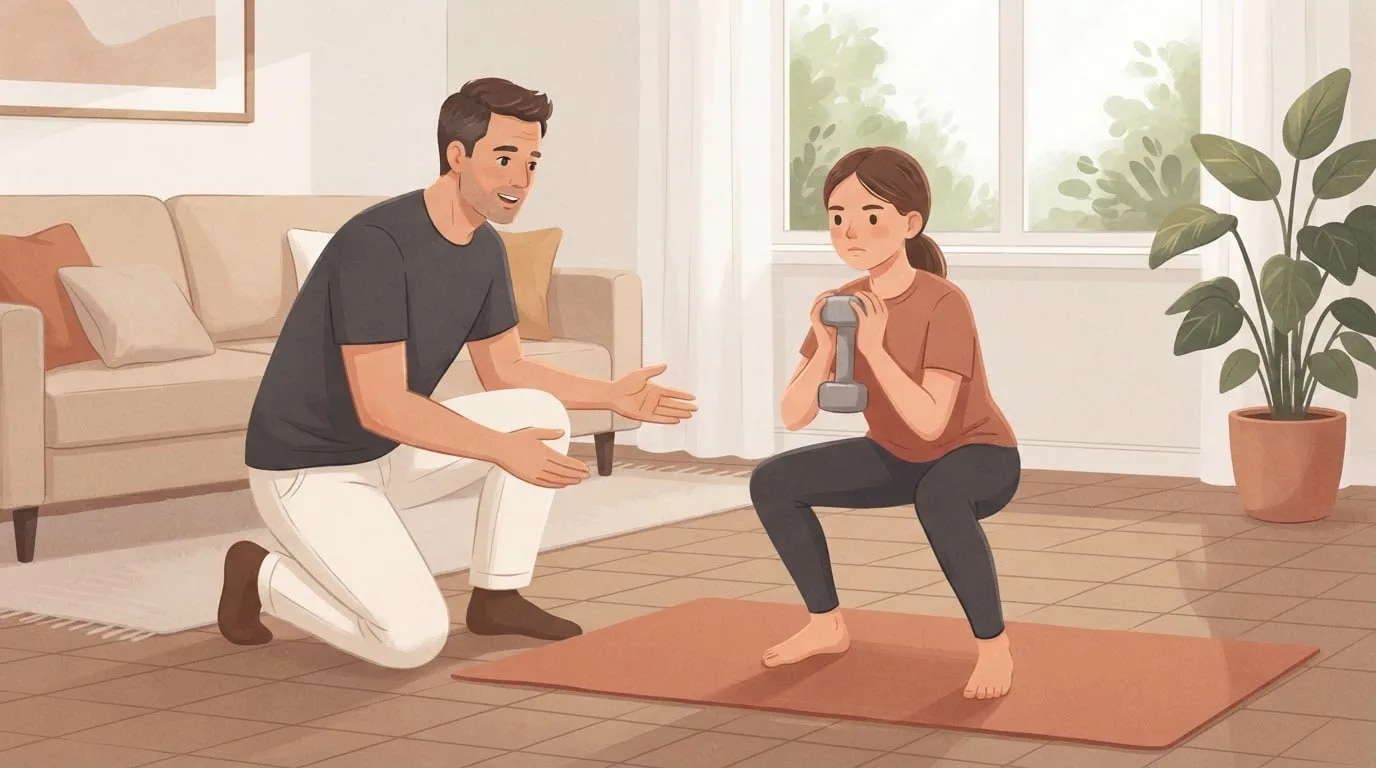
You just bought your first pair of dumbbells, or your kid did, and someone said it right away: careful, lifting weights will stunt your growth. Maybe it was a coach. Maybe it was a grandparent who heard it decades ago. So you searched for the answer. Can weights stunt your growth? Does weight lifting stunt your growth, or is that an old gym myth?
It's a fair thing to worry about. Wanting to protect a growing body is a good instinct. The research just points that instinct at a different target. Supervised strength training doesn't shorten anyone, but dropped weights, sloppy technique and trying to lift the heaviest weight possible can cause injuries.
Below you'll find what growth plates are and when they close, where the myth came from, what the major youth resistance-training position statements say, the injury numbers, and a simple bodyweight and dumbbell progression for kids and teens.
Does Lifting Weight Affect Height Growth?
No. When training is supervised and sensible, lifting weight doesn't affect height growth. Malina (2006) reviewed 22 experimental resistance training programs in pre- and early-pubertal children. Most used free weights and machines 2 or 3 days a week for 8 to 12 weeks. The children got significantly stronger. The programs didn't influence their growth in height or weight.
A wider review of youth resistance training by Faigenbaum and Myer (2010) reached the same conclusion. No prospective youth resistance training study with professional guidance and instruction had reported an injury to the growth cartilage. And the authors found no evidence that resistance training harms growth in height during childhood or adolescence.
The American Academy of Pediatrics (AAP) now lists "stunts growth or harms growth plates" as a myth on its resistance training myth-versus-fact page. It says well-designed programs haven't been shown to have any negative effects on growth, and that they can help build stronger bones.
What growth plates are and when they close
Growth plates, also called physes, are discs of cartilage near the ends of long bones like the thigh, shin and forearm. New bone forms there through childhood and the growth spurt of puberty. Late in puberty, estrogen and its receptors shut the plates down, and they fuse into solid bone (Shim, 2015). Boys make estrogen from testosterone, so this applies to them too.
A rare case shows how strongly hormones control that timing. Smith and colleagues (1994) described a 28-year-old man whose estrogen receptors didn't work. His growth plates had never fully closed, and he had kept growing into adulthood, reaching 204 cm (6 ft 8 in). Load on the skeleton doesn't flip that switch. Hormones do.
Plates close at different times in different bones and different people. In X-rays of 570 children and young adults, the growth plates at the ankle end of the shin had fully fused in every girl by 16 and every boy by 19. Some girls had finished by 12 and some boys by 14 (Crowder and Austin, 2005).
Why the worry made sense on paper
Until they fuse, growth plates are a weak spot. Faigenbaum and Myer note that the plate can be three to five times weaker than the connective tissue around it, and less able to resist shearing and twisting forces. A bad injury there can disturb growth. That's a real reason for care with technique and load.
It isn't a reason to avoid strength training. Everyday play already loads growth plates hard: jumping and landing in sport can create ground forces of 5 to 7 times body mass, far more than a goblet squat with a light dumbbell. And bone answers load by getting denser. In a study of 25 elite junior weightlifters around 17 years old, spine and hip bone density was higher than in age-matched non-lifters and even higher than in adult men aged 20 to 39 (Conroy and colleagues, 1993).
Where the Idea That Lifting Stunts Growth Came From
The fear traces back to a small set of case reports from the 1970s and 1980s. Ryan and Salciccioli (1976) described fractures of the growth plate at the wrist end of the forearm in adolescent weight lifters aged 14 to 17. Similar reports followed.
Look at what those teenagers were doing. In the case reports Faigenbaum and Myer collected, most injuries came from pressing barbells overhead with loads of 30 to 81 kg, plus bench presses and deadlifts of up to 160 kg in one 16-year-old. One 13-year-old boy broke the growth plates in both wrists when he lost control of a 30 kg barbell he was pressing overhead, alone, in a makeshift home gym. The reviewers concluded that most of these injuries came from improper technique, poorly chosen loads or a lack of qualified adult supervision.
Those injuries were real, and they're worth learning from. They came from heavy, near-maximal barbell lifts with no adult watching, which is a long way from a supervised set of dumbbell rows. The lesson is about how kids lift, not whether they lift.
Does gymnastics stunt your growth?
Gymnastics added to the confusion. Elite gymnasts tend to be short, so it looked as if hard training from a young age kept them small. The International Gymnastics Federation asked a committee of growth researchers to settle it. Their review (Malina and colleagues, 2013) concluded that intensive gymnastics training doesn't compromise adult height. It also found no slowing of leg or trunk growth and no change to the timing of the growth spurt. The sport selects children who are naturally small and mature later. It doesn't make them that way.
What the Youth Resistance-Training Position Statements Say
Every major organization that has reviewed the evidence has landed in the same place: supervised, age-appropriate strength training is safe and useful for kids and teens.
- National Strength and Conditioning Association (NSCA). Its 2009 position statement (Faigenbaum and colleagues) says many of the benefits of adult strength training are attainable by children and adolescents who follow age-specific guidelines, and it was written by a panel of exercise scientists, physicians and physical education teachers.
- American Academy of Pediatrics. Its 2020 clinical report (Stricker and colleagues) revises the AAP's 2008 policy statement and reviews the benefits and risks of strength training for children and adolescents, athletes and non-athletes alike.
- The 2014 International Consensus. Adapted from the UK Strength and Conditioning Association's statement, this position statement (Lloyd and colleagues) was written by 20 experts in pediatric exercise science, pediatric medicine, physical education and sports medicine, then reviewed and endorsed by leading professional organizations in those fields.
The practical rules are consistent across these groups. The AAP's parent guide to strength training sums them up:
- Start when a child has the balance and body control to follow instructions, which for most is around 7 or 8.
- Train 2 to 3 times a week for 20 to 30 minutes.
- Do 2 to 3 sets of 8 to 15 repetitions.
- Add weight gradually, by no more than 10% a week.
- Skip one-rep maximums, maximum weights and ballistic moves until skeletal maturity.
- Train with an adult supervising and spotting. A good program has no more than 10 kids per qualified coach.
How Safe Is Lifting Weights for Kids and Teens?
Supervised strength training is one of the safer things a young person can do. In Malina's review, only 10 of the 22 studies tracked injuries, and they recorded three in total. None were serious. That works out to 0.053 to 0.176 injuries per 100 hours of training.
Faigenbaum and Myer also collected the larger surveys. In one retrospective study of teenagers, the injury rate per 100 participation hours was 0.8 for rugby, 0.0035 for resistance training and 0.0017 for competitive weightlifting. In another study, 70 competitive weightlifters aged 7 to 16 were followed for a year, and none had an injury that cost them training time.
The real risk is a dropped weight, not a growth plate
Emergency room data show what actually goes wrong. Myer and colleagues (2009) analyzed 4,111 weightlifting injuries treated in US emergency rooms from 2002 to 2005 in people aged 8 to 30. Accidental injuries, from dropped weights or misused equipment, were most common in the 8 to 13 group and fell with each older group. Two thirds of the injuries in that youngest group were to the hands and feet, mostly from dropping and pinching. Adults had more sprains and strains than children did. The authors concluded that most youth injuries could be prevented with better supervision and stricter safety rules.
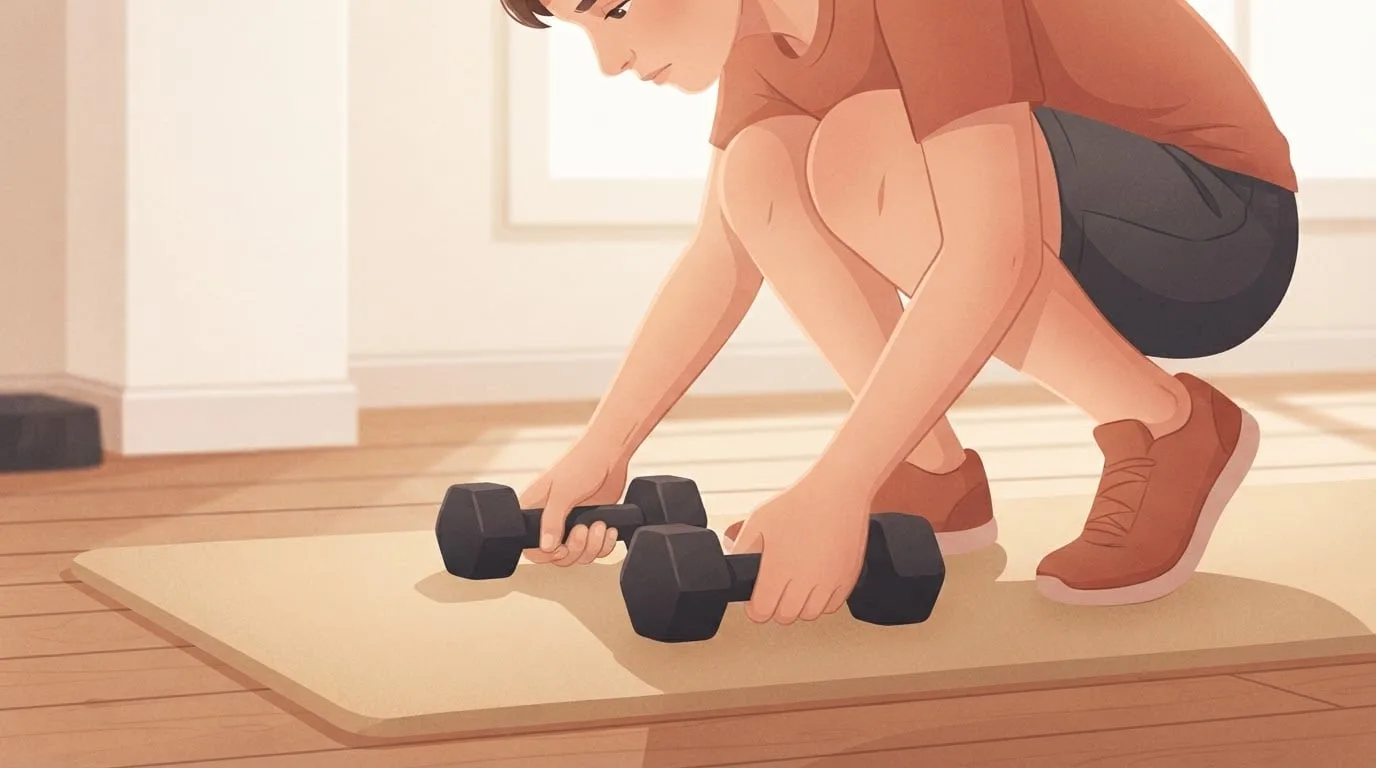
Strength training also protects young athletes in their sports. Faigenbaum and Myer found that regular strength work with coaching on how to move may reduce sports injuries. Our review of strength training and injury prevention covers the trials behind that in adults and athletes.
Knowing what to do is the easy part.
FitCraft, our mobile fitness app, pairs you with an AI coach who builds you a personalized plan around your goals, schedule, and fitness level. Every FitCraft program is designed by Domenic Angelino, MPH (Brown University) and NSCA-CSCS, with research published in the Journal of Strength and Conditioning Research and Medicine & Science in Sports & Exercise.
Take the Free Assessment Free • 2 minutes • No credit cardDoes Lifting Weights at a Young Age Stunt Your Growth?
No. Age changes how a child should train, not whether training is safe. The NSCA defines children as boys and girls who haven't yet developed secondary sex characteristics, roughly up to age 11 in girls and 13 in boys. Adolescence runs from about 12 to 18 in girls and 14 to 18 in boys.
Younger children still get stronger. The AAP notes that before puberty, strength gains don't come mainly from bigger muscles. Most of the early progress is the nervous system learning to use the muscle a child already has. A meta-analysis of youth strength training by Behringer and colleagues (2010) found a large overall effect on strength (effect size 1.12). The gains grew with age and maturity, with no sudden boost at puberty. Longer programs and more sets produced bigger gains.
Does weight lifting stunt growth at 12, 13, 14 or 15?
No. Those are the years of the growth spurt for most kids, when growth plates are at their busiest. The rules don't change, though. Learn technique first, keep an adult watching, raise the load slowly and save maximal lifts for after the plates close. A 13-year-old doing goblet squats and dumbbell rows twice a week is doing exactly what the position statements describe.
What about 16 to 18?
By the late teens many growth plates have fused or are close to it, and the training can look more like an adult beginner's. Older teens with solid technique can handle heavier dumbbells and lower rep ranges. The AAP's advice to avoid one-rep maxes holds until skeletal maturity, and a doctor can tell from an X-ray whether that has happened.
A Supervised Dumbbell and Bodyweight Progression for Kids and Teens
This is a home-friendly plan built on the AAP numbers above. Every stage uses bodyweight or dumbbells, 2 to 3 nonconsecutive days a week, with a 5 to 10 minute warm-up of easy movement first. An adult watches every set until the young lifter has the technique down.
Stage 1: Bodyweight basics (any age, first 4 to 8 weeks)
- Squat to a chair: sit back until you lightly touch the seat, then stand.
- Glute bridge: lie on your back, feet flat, and lift your hips.
- Incline push-up: hands on a kitchen counter or a sturdy table.
- Reverse lunge: hold a counter for balance at first.
- Bird dog and front plank: for trunk control.
Do 1 to 2 sets of 10 to 15 reps (planks for 15 to 30 seconds). Move on when every rep looks the same as the first for two sessions in a row.
Stage 2: Light dumbbells (once bodyweight form is solid)
- Goblet squat: one dumbbell held upright at the chest.
- Dumbbell Romanian deadlift: hinge at the hips with a flat back.
- One-arm dumbbell row: one hand braced on a bench or chair.
- Dumbbell floor press: the floor limits the range, which makes it safer to learn than a bench press.
- Split squat and farmer carry: holding a dumbbell in each hand.
Do 2 to 3 sets of 8 to 15 reps. Add weight only when the lifter finishes all 15 reps with clean form, and keep increases to about 10% a week or less. Teach the set-down from day one: weights go to the floor with control, never dropped.
Stage 3: Heavier dumbbells for older teens
Teens with six months or more of clean technique can work in the 6 to 12 rep range with step-ups, single-leg Romanian deadlifts, harder push-up variations and heavier rows. Leave a rep or two in reserve on every set, and still skip one-rep max testing until skeletal maturity.
If you want more moves to rotate in, our list of the best dumbbell exercises for beginners explains how to do each one. For adults training at home, a dumbbell workout app like FitCraft shows each exercise as an interactive 3D demo you can pinch and zoom for a closer look. A young lifter still needs an adult watching every set.
What Happens If I Lift Weights Every Day?
Muscles, tendons and bones adapt in the recovery time between sessions, so lifting hard every day mostly adds fatigue. For kids and teens, the AAP guidance is 2 to 3 sessions a week. Repetitive overload is also the growth plate risk that does show up in youth sport. A review by Caine and colleagues (2006) flagged a growing number of stress-related growth plate injuries in organized sports, including in the legs. Most healed with treatment and rest, but some led to growth disturbance.
So spread the work out. Lift on two or three days, play and move on the others, and treat pain near a joint that lingers or gets worse as a reason to stop and see a doctor.
What Actually Stunts Your Growth?
Height comes mostly from your genes, and the rest depends on how well your body is supplied while the plates are open. Growth through puberty depends on nutrition and on hormones, including growth hormone and estrogen (Shim, 2015). The things that can hold it back are:
- Not eating enough. Long-term undernutrition, including a young athlete eating too little for the training they do.
- Long-term illness or hormone problems. A pediatrician tracks these on a growth chart.
- Anabolic steroids. The AAP's subject review on adolescents and anabolic steroids warns that they can close growth plates early, which lowers adult height.
- Too little sleep. Growth hormone is released mostly during deep sleep (Van Cauter and colleagues, 2004).
Strength training isn't on the list. No exercise makes bones longer either, and our look at whether stretching makes you taller explains what posture and a rested spine can and can't add.
Protein powder isn't on the list either. If supplements are the next question, our look at whether creatine is safe for teens goes through the youth studies.
What This Means for You
If you're a parent, put your worry where the evidence puts it: on supervision, technique and sensible loads, not on height. A child who learns to squat, hinge, push and pull with good form at 10 has a head start on strong bones, fewer sports injuries and a habit that can last a lifetime.
If you're a teenager, you won't end up shorter. You'll end up stronger. The hard part is the same one adults face, which is showing up week after week. As one FitCraft user, Mike, put it: "The streak system got me hooked. I didn't want to break my chain."
Frequently Asked Questions
Does lifting weights make you shorter?
Only for a few hours, and only by millimeters. Everyone is shorter in the evening because the discs between the vertebrae lose fluid under the day's load: one study measured an average daily swing of 19.3 mm, about 1.1% of height, and about 70% of it came back in the first half of the night (Tyrrell and colleagues, 1985). A circuit of weight training shrank the spine by about 5.4 mm, not much more than a 6 km run (Leatt and colleagues, 1986), and sleep restores it. Your bones and adult height don't change.
Does squatting stunt growth?
No. Squats are one of the basic movements in youth strength programs, and the supervised training studies in children found no effect on growth in height. A bodyweight or goblet squat loads the legs far less than the landings in jumping sports, which can reach 5 to 7 times body mass. Learn the movement with bodyweight first, then add a light dumbbell.
At what age can a child start lifting weights?
Most children are ready for supervised strength training at about 7 or 8 years old, when they have the balance and body control to follow instructions, according to the American Academy of Pediatrics' parent guidance. Start with bodyweight exercises, then light dumbbells, 2 to 3 times a week, with an adult watching technique.
Can lifting weights make you taller?
No. Your height is set by your genes, your nutrition, your sleep and your general health while your growth plates are still open. Lifting won't add length to your bones, but it builds stronger bones and muscles and can help you stand up straighter, so you carry the height you have.
Is it bad to lift heavy weights as a teenager?
Not when it's done with good technique and supervision. The American Academy of Pediatrics' parent guidance advises against one-rep maximums and maximum weights before skeletal maturity. A teenager with good technique can use challenging dumbbells for sets of 6 to 12 reps under supervision, and add weight gradually, no more than about 10% a week.
Does working out stunt your growth?
No. Regular exercise, strength training included, supports healthy bone and muscle development. What can hold growth back is not eating enough for the amount of training, long-term illness, hormone problems or anabolic steroids. A young athlete who is losing weight, missing periods or always exhausted should see a doctor.