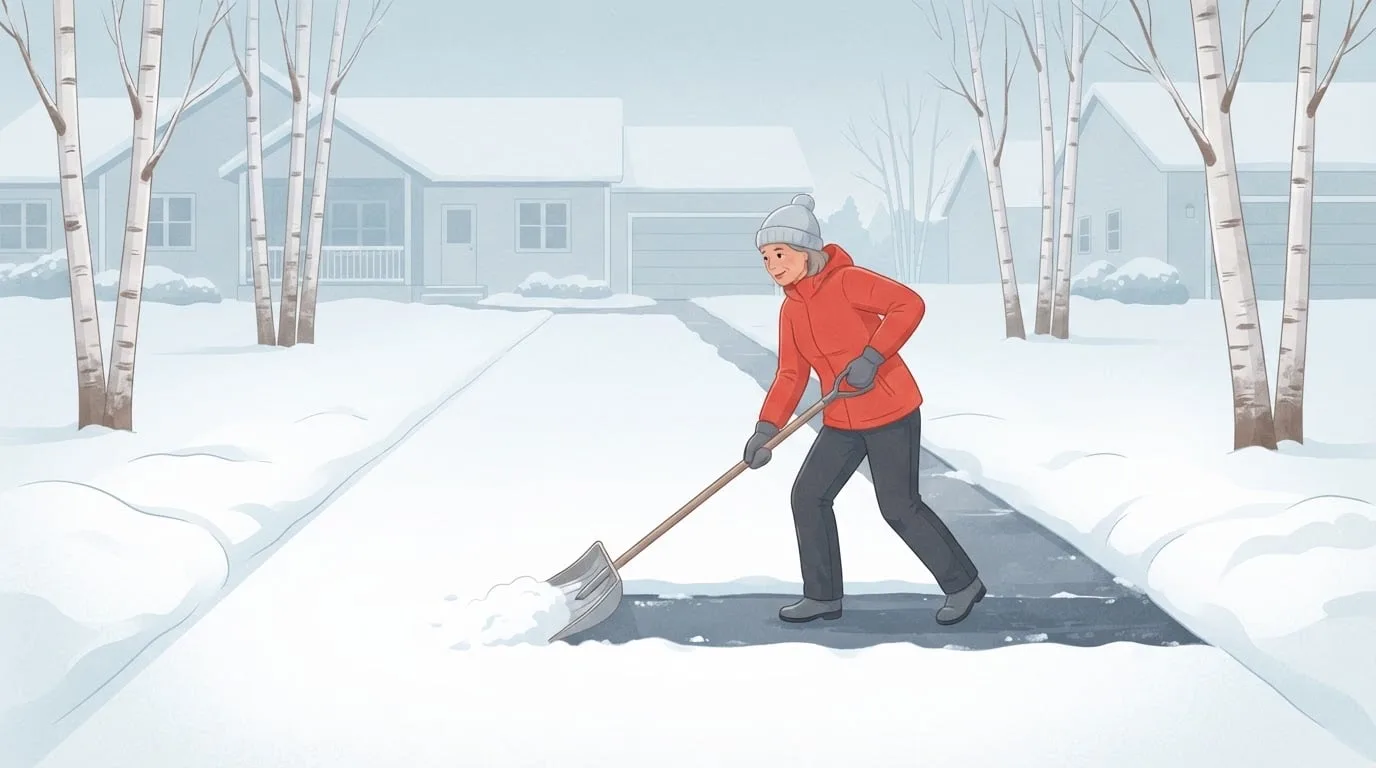
The storm stops, the driveway is buried and your car is somewhere under all of it. An hour later your shoulders ache, your shirt is damp under your coat and your watch says you burned 700 calories. So does shoveling snow count as a workout, and is that number anywhere close?
It does count, and the real number is usually a little lower than the watch's. Shoveling snow is also one of the few household chores that cardiologists study as a heart attack trigger. Most winters the job falls on people who haven't done anything that strenuous since the last storm, in cold air, with a deadline to get the car out. If you've ever felt your heart pounding halfway down the driveway, that's why this page spends as much time on safety as on calories.
Below you'll find the calories for every snow job in the 2024 Compendium, tables for your body weight, what lab studies measured, how a snow blower compares, who should hand the shovel to someone else, the warning signs to stop, and the technique that spares your lower back.
Calories Burned Shoveling Snow by Effort
The 2024 Adult Compendium of Physical Activities by Herrmann and colleagues is the standard reference for the energy cost of everyday activities, and it lists six jobs that involve snow. Each one gets a MET value, a multiple of the energy you use sitting still:
| Snow job (2024 Compendium wording) | Code | METs |
|---|---|---|
| Shoveling snow, by hand, vigorous effort | 08202 | 7.5 |
| Shoveling snow, by hand | 08200 | 6.0 |
| Shoveling snow, by hand, moderate effort | 08195 | 5.3 |
| Raking roof with snow rake | 08170 | 4.0 |
| Riding snow blower | 08180 | 3.0 |
| Operating snow blower, walking | 08130 | 2.5 |
The Compendium doesn't define moderate and vigorous for snow. In practice, a moderate effort looks like a few inches of light snow at a pace you could keep up while talking. A vigorous one means deep or wet snow, full scoops and few pauses. The CDC's guide to activity intensity classes 3 to 5.9 METs as moderate and 6.0 or more as vigorous, and it names heavy yard work such as digging or shoveling as a vigorous example. So most snow shoveling is vigorous exercise, while walking behind a snow blower is light activity.
Turning METs into calories takes one multiplication: METs times your weight in kilograms times the hours you spend. One MET is roughly one calorie per kilogram per hour, so an hour of general shoveling at 180 lb (82 kg) comes to about 6.0 times 82, or 490 calories. It's the same arithmetic behind our ranking of what exercise burns the most calories, which explains where MET values come from and how far a real person can stray from them. The figures on this page are gross calories, so they include the roughly 80 calories an hour you'd burn at 180 lb sitting on the couch. Calculators that convert METs through oxygen use, at about 5 calories per liter, come out about 5 percent higher.
How Many Calories Does Shoveling Snow Burn Per Hour?
Calories burned shoveling snow rise almost in step with body weight, because every scoop also moves you. Here's an hour of each snow job by weight, using the 2024 Compendium values, rounded to the nearest 5:
| Snow job | METs | 120 lb | 150 lb | 180 lb | 210 lb | 240 lb |
|---|---|---|---|---|---|---|
| Shoveling, vigorous effort | 7.5 | 410 | 510 | 610 | 715 | 815 |
| Shoveling, general | 6.0 | 325 | 410 | 490 | 570 | 655 |
| Shoveling, moderate effort | 5.3 | 290 | 360 | 435 | 505 | 575 |
| Raking a roof with a snow rake | 4.0 | 220 | 270 | 325 | 380 | 435 |
| Riding a snow blower | 3.0 | 165 | 205 | 245 | 285 | 325 |
| Walking behind a snow blower | 2.5 | 135 | 170 | 205 | 240 | 270 |
Gross calories for 60 minutes of steady work. If you stop often to rest or catch your breath, count only the minutes you spend moving snow.
Calories burned shoveling snow in 30 minutes
For a half-hour session, here's what each shoveling effort burns:
| Body weight | Moderate (5.3 METs) | General (6.0 METs) | Vigorous (7.5 METs) |
|---|---|---|---|
| 120 lb (54 kg) | 145 | 165 | 205 |
| 150 lb (68 kg) | 180 | 205 | 255 |
| 180 lb (82 kg) | 215 | 245 | 305 |
| 210 lb (95 kg) | 250 | 285 | 355 |
| 240 lb (109 kg) | 290 | 325 | 410 |
Vigorous shoveling at 7.5 METs matches the Compendium's rating for vigorous calisthenics such as burpees and jumping jacks, and general shoveling at 6.0 sits well above brisk walking at 4.8. In the pool, general shoveling is level with leisure swimming, and our page on how many calories swimming burns puts every stroke on the same scale. Even power yoga, at 4.0 METs, burns less than the gentlest shoveling entry, as our page on how many calories yoga burns shows.
Does the cold make shoveling burn more?
Only a little. Your working muscles make enough heat that you rarely get cold enough to shiver, and shivering is where the real calorie cost of cold begins, as our page on whether being cold burns calories explains with lab numbers. The weight of the snow matters far more than the temperature.
What Lab Measurements Show About Shoveling Calories
The Compendium's numbers hold up when people shovel real snow wearing a breathing mask. Sheldahl and colleagues (1992) had 12 younger healthy men, 13 older healthy men and 16 fairly fit men with symptom-free coronary artery disease shovel at their own pace. Their oxygen use averaged 25.6, 22.2 and 18.5 ml per kilogram per minute, about 7.3, 6.3 and 5.3 METs. That's within about 0.3 MET of the Compendium's vigorous, general and moderate ratings.
The study's main finding explains why your number may not match your neighbor's. Every group paced itself at 60 to 68 percent of its peak treadmill oxygen uptake, so the men burned calories in proportion to their fitness. A fitter shoveler moves more snow per minute and burns more. A less fit one works just as hard relative to their limit and burns less. Your VO2 max sets the pace your body chooses.
In Finland, Smolander and colleagues (1995) measured nine men clearing 40 to 60 cm of snow for 15 minutes with a shovel and with a snow pusher. The shovel took 2.1 liters of oxygen a minute, 63 percent of their VO2 max, or roughly 10 calories a minute by our arithmetic. The pusher took 2.6 liters, about 13 calories a minute, at the same heart rate of about 141 beats a minute.
The best-known study of snow and the heart found a lower rate. In Franklin and colleagues (1995), ten untrained men clearing heavy, wet snow averaged 5.7 METs, about 455 calories an hour at 80 kg (176 lb). Their heart readings, covered under the risks below, were far higher than that number suggests.
How much does a driveway of snow weigh?
The weight of the snow is why the effort range is so wide. NOAA's National Severe Storms Laboratory says 13 inches of snow holds as much water as 1 inch of rain on average across the US, with the ratio running from nearly 50 to 1 for very dry powder down to 2 to 1 for sleet. An inch of water over a square foot weighs 5.2 pounds, so 6 inches on a 10 by 50 foot driveway can weigh very different amounts:
| 6 inches of snow on 500 square feet | Snow to water ratio | Approximate weight |
|---|---|---|
| Very dry powder | About 50 to 1 | About 300 lb |
| Average US snowfall | 13 to 1 | About 1,200 lb |
| Sleet | 2 to 1 | About 7,800 lb |
Our arithmetic from NOAA's snow to water ratios and the weight of water. Heavy, wet snow falls between the average and sleet rows.
Heavier snow raises the cost of every scoop, so the vigorous rating fits a wet storm and the moderate one fits powder. It's also why clearing a long storm in stages helps: two passes through 3 inches move the same snow as one pass through 6, with lighter scoops.
Is Shoveling Snow a Good Workout?
Yes, for a healthy adult who's already active, shoveling snow is a good workout. It reaches vigorous intensity, works your legs, back, shoulders and arms at once, and counts toward the 75 to 150 vigorous minutes a week that US guidelines recommend, as summarized by Piercy and colleagues (2018). A vigorous minute counts like two moderate ones, so 30 minutes of hard shoveling equals an hour of brisk walking. Sheldahl's team called the self-chosen pace hard work within the range recommended for aerobic training, and Smolander's team said snow clearing could serve as training for healthy adults.
As a training plan, though, it has three weak spots. It only happens when it snows, the weather sets the load instead of you, and the stop-start mix of lifting and throwing loads your heart far more than the calorie count suggests. Treat it as a hard session the weather hands you, best done by someone who trains the rest of the year.
What muscles does shoveling work?
Shoveling works most of your body, and your lower back does the hardest job. Each scoop is a loaded hip hinge and partial squat, so your glutes, hamstrings and quadriceps drive the lift. The muscles along your spine hold your trunk steady while the load sits out in front, and the further you lean, the more they hold: in a lab study by Lewinson and colleagues (2014), peak load at the base of the spine rose with trunk lean, with a correlation of 0.70. Your shoulders, upper back, arms and grip lift the shovel, and your obliques and deep core muscles control the turn when you toss the snow aside.
Knowing what to do is the easy part.
FitCraft, our mobile fitness app, pairs you with an AI coach who builds you a personalized plan around your goals, schedule, and fitness level. Every FitCraft program is designed by Domenic Angelino, MPH (Brown University) and NSCA-CSCS, with research published in the Journal of Strength and Conditioning Research and Medicine & Science in Sports & Exercise.
Take the Free Assessment Free • 2 minutes • No credit cardSnow Blower vs Shovel: Calories, Heart Strain and Injuries
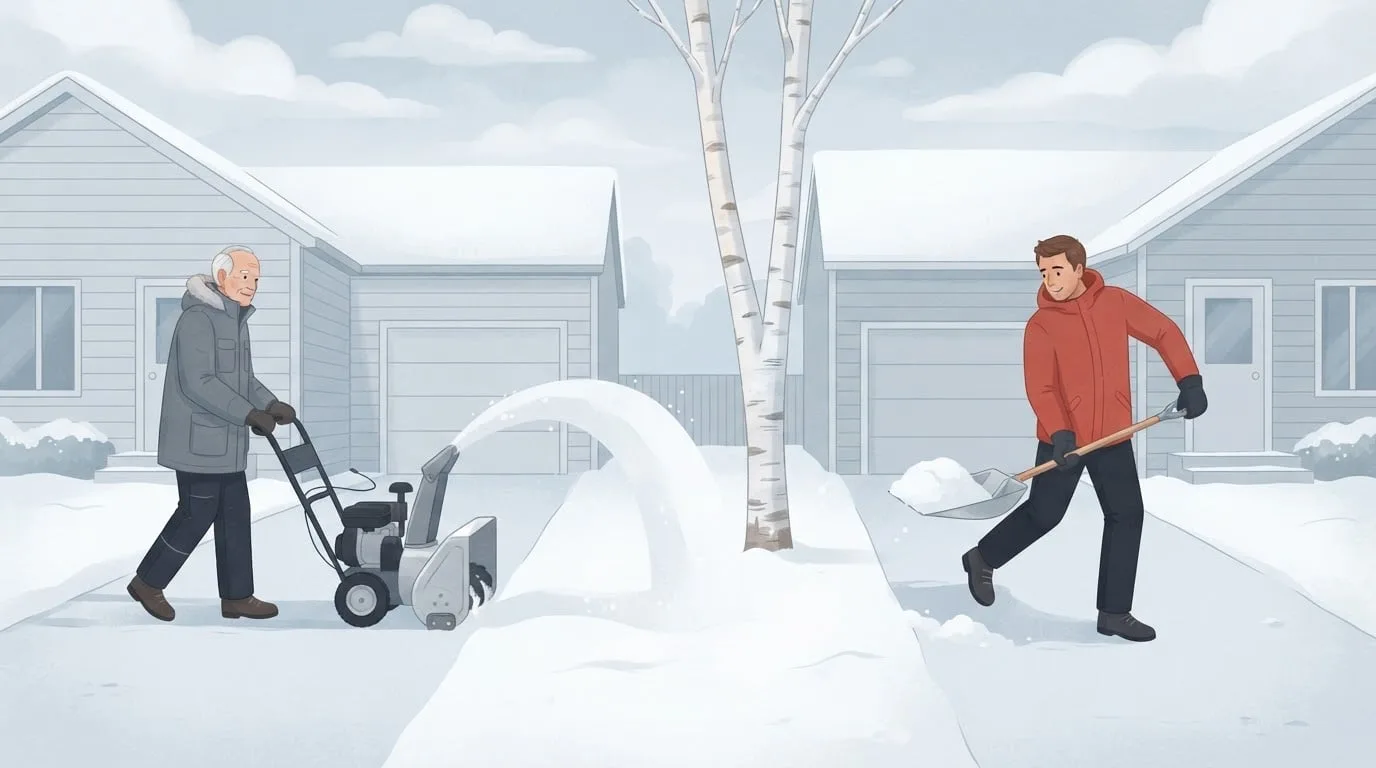
A snow blower cuts the calories by more than half. Walking behind one rates 2.5 METs and riding one 3.0, against 5.3 to 7.5 for shoveling. At 180 lb, an hour behind a blower burns about 205 calories, while an hour of shoveling burns about 435 to 610.
It also takes much of the strain off your heart. In Franklin's study, the same men cleared a second strip of snow with an electric snow thrower. Their heart rate, breathing and sense of effort were all lower than with the shovel, and their systolic blood pressure was significantly lower than the 198 mm Hg they reached while shoveling.
Pushing snow isn't the easy option it looks like. In Smolander's study, the snow pusher cost about a quarter more oxygen than the shovel in deep snow, at the same heart rate. Pushing spares your back from lifting, which matters, but it asks at least as much of your heart and lungs.
A blower brings its own risks. Loder and Solanki (2020) estimated 91,451 US emergency visits linked to snow blowers from 2003 to 2018, with an average age of 51 and 91 percent men. Reaching into the chute caused 44.5 percent of them, and almost every amputation involved fingers. Of 648 deaths, 647 were cardiac. Turn the engine off and clear a clog with a stick or a clean-out tool, never your hand.
What Are the Risks of Shoveling Snow?
The risks of shoveling snow fall into three groups: strained muscles and backs, falls, and heart attacks. Watson and colleagues (2011) estimated 195,100 emergency visits for snow shovel injuries and medical emergencies in the US from 1990 to 2006, about 11,500 a year. More than half came from acute strain on muscles and joints, 20 percent from slips and falls, and 15 percent from being hit by a shovel. Lower back injuries made up 34 percent of all cases. Heart problems were only 6.7 percent of the visits, yet they accounted for every one of the 1,647 deaths.
Why shoveling is so hard on your heart
Franklin's study shows how a moderate calorie burn can still push a heart to its limit. Within 2 minutes of shoveling heavy, wet snow, the ten untrained men averaged 154 beats a minute, 86 percent of their maximum. By 10 minutes they reached 173, or 97 percent of their maximum heart rate. Their systolic blood pressure averaged 198 mm Hg, higher than at the peak of their all-out treadmill test, where it averaged 181. Yet their oxygen use was only 5.7 METs, against 9.3 on the treadmill. The less fit the man, the closer to maximum his heart rate climbed.
Three features of shoveling explain that gap. It leans heavily on your arms, and arm exercise raises heart rate and blood pressure more than leg exercise at the same oxygen cost. Lifting a heavy scoop invites you to hold your breath and brace, which briefly spikes blood pressure with every throw. And it often starts cold, with no warm-up and a job that isn't finished until the driveway is clear.
Heart attacks after snowstorms
Population data show the same pattern outside the lab. Auger and colleagues (2017) matched 128,073 heart attack admissions and 68,155 heart attack deaths in Quebec from 1981 to 2014 against the weather. Compared with no snow, a 20 cm (8 inch) snowfall raised men's odds of a heart attack admission the next day by 16 percent and of a heart attack death by 34 percent. Women's odds didn't change, and the study couldn't record who did the shoveling.
In three Detroit-area counties, Chowdhury and colleagues (2003) reviewed medical examiner records around two heavy snowfalls: 36 of 271 sudden cardiac deaths happened during snow removal, and 33 of those 36 were men.
Who Should Not Shovel Snow?
The people most at risk are those who rarely exert themselves hard. In a study of 1,228 heart attack patients, Mittleman and colleagues (1993) defined heavy exertion as 6 METs or more, which covers general and vigorous shoveling. The risk of a heart attack in the hour after heavy exertion was 5.9 times the usual risk overall, and how often people exercised changed it enormously:
- Heavy exertion less than once a week: 107 times the usual risk.
- One or two times a week: 19.4 times.
- Three or four times a week: 8.6 times.
- Five or more times a week: 2.4 times.
The starting risk in any one hour is small, so most shovelers never have a problem. But the list shows why storms hit sedentary people hardest: for them, shoveling may be the most strenuous hour of the year.
Family history and sex matter too. Among 500 patients with acute coronary syndromes over two winters, Nichols and colleagues (2012) found that 35, or 7 percent, had been shoveling snow. Those patients were 3.6 times more likely to have a family history of early heart disease and 4.8 times more likely to be men, while age, diabetes, high blood pressure and known heart disease didn't differ.
Ask your doctor before you pick up a shovel, and consider a blower or help, if any of these apply to you:
- You've had a heart attack, a stent, bypass surgery or heart failure.
- You get chest discomfort or unusual breathlessness when you exert yourself.
- You rarely do anything strenuous, less than once a week.
- A parent or sibling developed heart disease at a young age.
- You have high blood pressure, diabetes or high cholesterol, or you smoke.
- You're older and haven't been active in a while.
Heart disease isn't always a firm no. In Sheldahl's lab, men with stable, symptom-free coronary disease and good fitness paced themselves at the same relative effort as healthy men, and their heart rhythm and pumping during shoveling looked like those on a treadmill test. That decision belongs to your cardiologist, ideally with a recent exercise test in hand.
At what age should you stop shoveling?
No study has found an age at which everyone should stop shoveling snow. In Nichols' data, age didn't separate shoveling-related heart events from other ones, and in Mittleman's, how often people exercised changed the risk enormously. Older adults do carry more of the injury burden: people 55 and over made up 21.8 percent of the emergency visits in Watson's study. Base the decision on your fitness and your heart history rather than your birthday.
Should a 70 year old be shoveling snow?
A fit, regularly active 70-year-old with a doctor's approval can shovel light snow in short bouts. For an average 70-year-old, though, vigorous shoveling is close to an all-out effort. The Older Adult Compendium by Willis and colleagues (2024) rates activities for adults 60 and over against a lower resting baseline of 2.7 ml of oxygen per kilogram per minute, and it puts vigorous snow shoveling at 8.0 METs for this age group. That's about 21.6 ml per kilogram per minute, or about 6.2 METs on the standard scale.
Now compare it with fitness norms. In the FRIEND registry's treadmill tests, the median VO2 max for adults in their 70s was 24.4 ml per kilogram per minute for men and 18.3 for women, according to Kaminsky, Arena and Myers (2015). So vigorous shoveling would take a typical man in his 70s to about 90 percent of his maximum, and it's beyond what a typical woman in her 70s can sustain. Older shovelers burn fewer calories, about 465 an hour at 165 lb by our arithmetic, because the pace they can hold is slower, yet they work much closer to their ceiling. For most people over 70, a snow blower or a neighbor's help is the better choice.
Warning Signs: When to Stop Shoveling and Call 9-1-1
Stop shoveling, go inside and get help if you notice any of the heart attack warning signs listed by the National Heart, Lung, and Blood Institute:
- Pain, pressure, heaviness or discomfort in the center or left side of your chest.
- Discomfort in one or both arms, your back, shoulders, neck, jaw or upper belly.
- Shortness of breath at rest or with light effort.
- Heavy sweating with no clear reason.
- Nausea or vomiting.
- Light-headedness or sudden dizziness.
- A fast or irregular heartbeat.
Symptoms can be mild, and they can come and go. Call 9-1-1 even if you aren't sure. Don't drive yourself to the hospital or wait to see whether it passes, because the NHLBI notes that acting fast limits damage to the heart. For your back, stop if pain shoots down a leg or comes with numbness or tingling.
How to Shovel Snow Without Hurting Your Back
Most shoveling injuries are strains, and a third involve the lower back, so technique matters as much as fitness. Two lab studies tested the most common equipment advice. In Lewinson's study, a bent-shaft shovel cut the cumulative load at the base of the spine by 16.5 percent, the peak load by 11.8 percent and peak trunk lean by 13 percent compared with a straight shaft. In ten men shoveling snow on asphalt, McGorry and colleagues (2003) measured trunk lean of 41 degrees with a bent shaft and 49 with a straight one. They advised against shoveling while walking backward, which the men handled poorly.
Put together with the injury data, these steps cover most of the risk:
- Warm up for 5 to 10 minutes. March in place, do a few squats and hip hinges, and circle your arms, so your heart doesn't go from rest to near-maximum at once.
- Clear early and often. In a long storm, two shallow passes mean lighter scoops than one deep one.
- Push when you can, lift when you must. Pushing spares your back, but in deep snow it took more oxygen than shoveling in Smolander's study, so pace it.
- Take small scoops. A half-full blade of wet snow is plenty.
- Hinge and bend your knees. Keep your back long, push your hips back and lift with your legs, as you would with a heavy box.
- Keep the load close. Slide your lower hand down the shaft toward the blade, because a scoop held far out makes your lower back work harder.
- Turn your feet, not your spine. Step toward where the snow is going, and never throw it over your shoulder.
- Work in short bouts. Franklin's men hit 97 percent of maximum heart rate within 10 minutes, so rest for a few minutes every 10 to 15 minutes.
- Watch your footing. Slips caused a fifth of the injuries in Watson's data, so wear boots with grip and sand or salt icy patches first.
If your back is already sore, our guide to the best exercises for lower back pain has a four-week routine, and its hip hinge is the same movement that makes shoveling safer.
What This Means for You
At 150 to 180 lb, shoveling snow burns about 360 to 610 calories an hour, and more if you're heavier or the snow is wet. That's a real workout. The number that matters more is how hard your heart works to get there, and that depends on how fit you are when the storm arrives.
That part you can change, and you don't need snow to do it. In Mittleman's data, people who exerted themselves hard five or more times a week had a relative risk of 2.4 in the hour after heavy effort, against 107 for those who did it less than once a week. Short bodyweight and dumbbell sessions through the fall build the legs, back and grip that shoveling uses, so each scoop takes a smaller share of your maximum. Stacy, 41, said it plainly: "After my second kid, I needed something stupidly simple."
If keeping those sessions going is the hard part, a home workout app that needs no equipment can carry the plan for you. FitCraft's 3D AI coaches demonstrate every bodyweight and dumbbell exercise, your coach calls you by name during the workout, and streaks keep you coming back on cold mornings while the workouts adjust as you progress. On days without snow, dancing in your living room is another way to collect vigorous minutes, and our page on how many calories dancing burns covers each style.
Frequently Asked Questions
How many calories does shoveling snow burn in 30 minutes?
Shoveling snow for 30 minutes burns about 180 to 255 calories at 150 lb and about 215 to 305 at 180 lb, depending on whether you work at a moderate or a vigorous effort. Those figures use the 2024 Compendium's 5.3 to 7.5 METs and rise with body weight, so a 240 lb shoveler burns about 290 to 410.
Does shoveling snow count as exercise?
Yes. Shoveling snow by hand rates 6.0 METs in general and 7.5 at a vigorous effort, and the CDC counts anything at 6 METs or more as vigorous activity. US guidelines treat each vigorous minute like two moderate ones, so 30 minutes of hard shoveling counts the same as an hour of brisk walking toward your weekly total.
Does shoveling snow build muscle?
Not much. Shoveling works your legs, back, shoulders and grip, but storms come irregularly and the snow sets the load, so it can't give your muscles the steady, rising challenge that builds them. Two strength sessions a week with dumbbells or your body weight will do more, and they make the next storm easier.
Is shoveling dirt good exercise?
Yes. The 2024 Compendium rates shoveling dirt or mud at 5.5 METs, about 375 calories an hour at 150 lb, and vigorous garden digging at 7.3 METs. Dirt is heavier than most snow, so the same rules apply: small scoops, bent knees, short bouts and regular rests.
How many calories do 10,000 steps a day burn?
Walking 10,000 steps burns about 380 to 420 calories at 150 lb at an ordinary 3 mph pace, over roughly an hour and a half. At the same body weight, 45 minutes of vigorous snow shoveling burns about the same, around 385 calories. Our page on how many calories 10,000 steps burn breaks it down by weight and pace.
Why does shoveling snow cause heart attacks?
Shoveling combines arm work, heavy lifting, breath-holding and cold air, and together they push heart rate and blood pressure up fast. In a 1995 study, heavy wet snow took untrained men to 97 percent of their maximum heart rate within 10 minutes, with systolic blood pressure above their treadmill peak. The risk falls hardest on people who rarely exercise hard.