
Few foods split opinion like bacon. One camp treats it as the reward at the end of a long week, or as proof that a low-carb diet can still be fun. The other has read the headlines that put processed meat in the same cancer category as tobacco and wonders whether every slice is a small act of self-harm.
Both reactions miss the numbers. Is bacon healthy? Not really. Is bacon bad for you in the way those headlines implied? Also no. This page walks through what bacon actually contains, what the World Health Organization's cancer agency did and didn't say, what the cohort studies show in absolute risk, how much sodium and nitrite you're getting, whether turkey or nitrate-free bacon helps, and how long bacon keeps in the fridge.
What Is Bacon, and What's in It?
In US labeling rules, bacon is the cured belly of a hog. The USDA's Food Safety and Inspection Service describes the process: the belly is cured with salt and sodium nitrite, heated, often smoked, then chilled and sliced. Bacon made from turkey or beef has to say so on the label, and Canadian bacon comes from the much leaner loin.
Here's what three medium slices of each type carry once cooked, from USDA FoodData Central:
| 3 slices, cooked | Pork bacon (24 g) | Reduced-sodium pork bacon (24 g) | Turkey bacon (33 g) | Canadian bacon (41 g) |
|---|---|---|---|---|
| Calories | 112 | 130 | 121 | 60 |
| Protein | 8.1 g | 8.9 g | 9.7 g | 11.7 g |
| Fat | 8.4 g | 10.0 g | 8.5 g | 1.1 g |
| Saturated fat | 2.9 g | 3.3 g | 2.3 g | 0.4 g |
| Sodium | 404 mg | 247 mg | 667 mg | 411 mg |
USDA entries 2705889, 2705891, 2706135 and 2705884, scaled to three medium slices: 8 grams each for pork bacon, 11 grams for turkey bacon and 13.8 grams for Canadian bacon.
A few things stand out. Bacon's protein is real but modest, about 2.7 grams a slice. The fat in pork bacon is about a third saturated, while the largest share, about 44 percent, is monounsaturated, the same kind that dominates olive oil. Three slices use roughly 15 percent of the 20-gram daily value for saturated fat, which is less than many people assume. Sodium is the bigger number: 404 milligrams is nearly a fifth of the 2,300-milligram daily value, before the eggs, toast or cheese that usually come with it.
Why Bacon Counts as Processed Meat
In 2015, 22 scientists from 10 countries met at the International Agency for Research on Cancer (IARC), part of the World Health Organization, and reviewed more than 800 studies on meat and cancer. Their summary in the Lancet Oncology (Bouvard and colleagues, 2015) put processed meat in Group 1, carcinogenic to humans, based on sufficient evidence that it causes colorectal cancer. Unprocessed red meat went into Group 2A, probably carcinogenic.
IARC defines processed meat as meat transformed by salting, curing, fermentation, smoking or other processes that improve flavor or preservation. Bacon is cured with salt and nitrite and usually smoked, so it fits squarely. So do ham, hot dogs, sausages, salami and deli meats, including turkey and chicken versions.
What Group 1 does and doesn't mean
This is the part the headlines got wrong. IARC's own Q&A on the evaluation says the groups describe how strong the evidence is that something causes cancer, not how dangerous it is. Processed meat sits in the same group as tobacco smoking, but IARC states plainly that this doesn't make them equally dangerous. Citing Global Burden of Disease estimates, the same Q&A puts the toll at about 34,000 cancer deaths a year worldwide from diets high in processed meat, against about 1 million from smoking.
IARC also couldn't say exactly how processed meat raises the risk, only that it does. The leading suspects are compounds that form during curing and cooking, especially N-nitroso compounds and polycyclic aromatic hydrocarbons, plus the heme iron in red meat. If you want the broader comparison of fresh red meat, processed meat and chicken, our guide to chicken vs beef protein covers it. The rest of this page sticks to bacon.
Bacon and Cancer Risk in Absolute Numbers
The 18 percent figure comes from a meta-analysis of prospective cohort studies. Chan and colleagues (2011) pooled the studies that tracked people's diets and then their cancer diagnoses for years. They found colorectal cancer risk rose by about 18 percent for every 50 grams of processed meat eaten daily. By the USDA's slice weights, 50 grams is about six medium or four thick slices of cooked bacon, or about two slices weighed raw, because bacon loses well over half its weight in the pan.
A relative increase only means something next to a starting risk. The National Cancer Institute's SEER program puts the lifetime risk of colorectal cancer at about 3.9 percent for US adults. Here's a rough illustration of what that 18 percent means at a few bacon habits, assuming the risk scales evenly with the amount:
| Bacon habit | Processed meat per day | Illustrative lifetime risk | Per 1,000 people |
|---|---|---|---|
| None | 0 g | about 3.9% | about 39 |
| 3 medium slices once a week | about 3 g | about 3.9% | about 39 |
| 2 medium slices every day | 16 g | about 4.1% | about 41 |
| 6 medium slices every day | about 50 g | about 4.6% | about 46 |
Our calculation from the SEER lifetime risk and the 18 percent per 50 grams estimate, using cooked weights. Treat it as a sense of scale, not a personal prediction: the 3.9 percent baseline already includes people who eat processed meat, and family history, age, body weight, alcohol, smoking and fiber all move your own risk.
Two things are true about that table. The risk is real and it climbs with the amount, which is why a daily bacon habit is worth rethinking. And the extra cases at a weekend-breakfast level are tiny. IARC itself says the data couldn't establish whether any amount is completely safe.
How certain is this evidence?
Not everyone reads it the same way. In 2019, the NutriRECS group rated the same body of evidence as low certainty. Han and colleagues (2019) pooled cohorts with more than 6 million people and concluded that cutting processed meat by three servings a week was linked to only very small reductions in cancer, with low to very low certainty because diet studies can't fully separate meat from everything else people do. The NutriRECS panel (Johnston and colleagues, 2019) then issued a weak recommendation that adults continue their current processed meat intake.
Read together, the two camps mostly agree on the numbers and disagree about how much to worry. The World Cancer Research Fund's 2018 colorectal cancer report still judges the evidence that processed meat causes colorectal cancer as convincing, and its recommendation is to eat very little, if any. That's the sensible default for a food you can enjoy without needing it.
Bacon, Heart Disease and Diabetes
Cancer gets the headlines, but the heart and metabolic data are worth knowing too. In a meta-analysis of 20 studies with more than 1.2 million people, Micha and colleagues (2010) found each 50 grams of processed meat a day was linked to a 42 percent higher risk of coronary heart disease and a 19 percent higher risk of type 2 diabetes. Unprocessed red meat showed no link with heart disease in the same analysis. That gap suggests something added in processing, such as salt or preservatives, matters more than the meat itself, though these studies can't prove which.
A newer US analysis gives absolute numbers directly. Zhong and colleagues (2020) followed 29,682 adults from six cohorts for a median of 19 years. Eating two servings of processed meat a week, compared with none, was linked to a 7 percent higher risk of cardiovascular disease, an absolute difference of 1.74 percentage points over 30 years. Each extra two servings a week was linked to a 3 percent higher risk of death, or 0.90 percentage points over 30 years. Those are observational links, and small ones, but they point the same direction as the cancer data.
How Much Sodium Is in Bacon?
Sodium is the most immediate issue with bacon, because it adds up fast. Three medium slices of pork bacon carry about 404 milligrams, three slices of turkey bacon about 667 and three slices of Canadian bacon about 411, per USDA data. Most of the salt in American diets comes from processed and restaurant foods, and bacon is a dense example.
Why it matters: salt raises blood pressure in many people, and blood pressure drives heart disease and stroke. In a Cochrane meta-analysis of 34 trials, He and colleagues (2013) found that cutting salt by about 4.4 grams a day for at least four weeks lowered systolic blood pressure by about 4.2 mm Hg on average, by 5.4 mm Hg in people with high blood pressure and by 2.4 mm Hg in people without it. Three slices of bacon hold about 1 gram of salt, so bacon alone won't make or break your blood pressure. A bacon, egg and cheese sandwich on a salty roll can, if it's daily.
Reduced-sodium bacon helps here. USDA lists it at about 1,030 milligrams of sodium per 100 grams, against about 1,680 for regular pork bacon, which is about 40 percent less.
Knowing what to do is the easy part.
FitCraft, our mobile fitness app, pairs you with an AI coach who builds you a personalized plan around your goals, schedule, and fitness level. Every FitCraft program is designed by Domenic Angelino, MPH (Brown University) and NSCA-CSCS, with research published in the Journal of Strength and Conditioning Research and Medicine & Science in Sports & Exercise.
Take the Free Assessment Free • 2 minutes • No credit cardNitrites, Nitrosamines and Nitrate-Free Bacon
Sodium nitrite is what keeps bacon pink, gives it the cured flavor and, most importantly, helps block the bacteria that cause botulism. The concern is that nitrite can react with amines from protein to form nitrosamines, many of which cause cancer in animals. IARC classifies ingested nitrite as probably carcinogenic to humans when it's eaten under conditions that lead to nitrosamine formation in the body (Grosse and colleagues, 2006).
US rules already limit nitrosamines
Bacon is regulated more tightly than most cured meats. Per the FSIS, nitrate is no longer allowed in any bacon, added nitrite is capped at 120 parts per million in pumped bacon, and pumped bacon must also contain 550 parts per million of sodium ascorbate or erythorbate, forms of vitamin C that sharply cut nitrosamine formation. When USDA researchers tested 48 cooked bacon samples, Lehotay and colleagues (2015) found every one below 15 nanograms per gram of nitrosamines, most below 1, and microwaved bacon slightly lower than pan-fried.
Heat is the variable you control
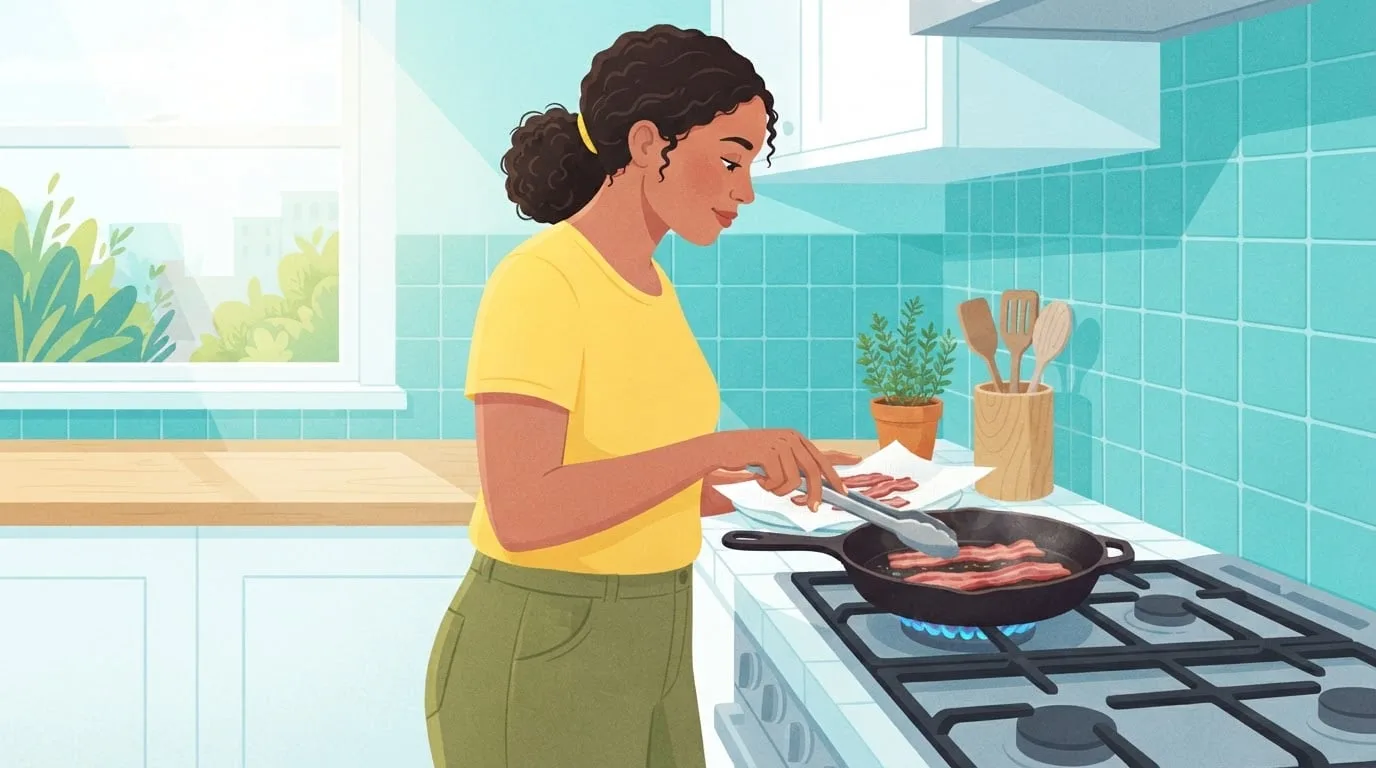
Cooking temperature matters most. In a USDA study, Pensabene and colleagues (1974) found no nitrosamines in bacon fried at 210 or 275 degrees F, including 275 degrees for a full 30 minutes, but did find them at 350 and 400 degrees F. The FSIS concludes that well-done or burned bacon is potentially more hazardous. The practical version: cook bacon on medium heat, in the oven or in the microwave, and pull it when it's crisp rather than black.
Is nitrate-free bacon healthier?
Bacon sold as "uncured" or "no nitrates or nitrites added" is usually cured with celery powder or another vegetable source rich in nitrate, which bacteria convert to nitrite. FSIS requires those labels to add "except for those naturally occurring" in ingredients such as celery powder. In a survey of 470 cured meat products from five US cities, Nuñez de González and colleagues (2012) found generally no difference in residual nitrite between conventional products and organic, natural or uncured ones. Nitrate-free bacon is still cured, salted, processed meat. Buy it for flavor if you like it, not as a health upgrade.
Is Turkey Bacon Bad for You?
Turkey bacon is the swap people make to feel better about breakfast, and it carries the same kind of halo as the items on our list of foods that seem healthy but aren't. By USDA numbers, a medium slice of cooked turkey bacon has about 0.8 grams of saturated fat against 1.0 gram for pork, a modest win. It also has 222 milligrams of sodium against 135, and per 100 grams it's saltier than pork bacon. Turkey bacon is cured and processed, so IARC's definition covers it.
If you want a leaner cured meat, Canadian bacon is the bigger change: about 4 grams of protein per slice for roughly 20 calories and almost no fat, with about the same sodium as pork bacon. It's still processed meat, though. The real swap for the cancer question is a fresh protein, such as eggs, fresh chicken or turkey, fish, tofu or beans.
How to Eat Bacon if You Love It
- Make it a side, not the base. Two slices next to eggs and vegetables is a different meal from half a pound in a sandwich. Crumbled over a salad or soup, a single slice does a lot of flavor work.
- Make it a weekend food. The illustrative risk at a few slices a week is close to zero. The daily habit is the one the data flag.
- Cook it crisp, not burned. Medium heat, the oven or the microwave, and drain it on a paper towel.
- Choose reduced-sodium bacon if you eat it often or watch your blood pressure.
- Watch the rest of the plate. Whole grains and foods with fiber are what the WCRF judges as probably protective against colorectal cancer, and vegetables help balance out a salty breakfast. For ideas that hit the protein without the cured meat, see our high-protein breakfast ideas.
Bacon Food Safety: How Long It Lasts and When to Toss It
Most people searching about bacon want to know whether the pack in their fridge is still good. Here's what the FSIS bacon guidance says:
| Bacon | Refrigerator (40°F or below) | Note |
|---|---|---|
| Raw bacon | 7 days | Use or freeze within 7 days of purchase, or by the use-by date |
| Raw bacon thawed in the fridge | 7 days | Can be refrozen uncooked during that time |
| Bacon you cooked at home | 4 to 5 days | Freeze within that time for about 1 month of best quality |
| Precooked bacon, refrigerated | Package use-by date | Safe to eat without reheating |
| Precooked bacon, shelf-stable | 5 to 14 days after opening | Store unopened at 85°F or below |
Freezing keeps bacon safe indefinitely at 0°F; the FSIS storage times for frozen bacon are about quality, which fades after a few months.
Can you eat raw bacon?
No. Plain pork bacon is sold raw and must be cooked before eating, even though it's cured and often smoked. Like other raw pork, it can carry Salmonella, Staphylococcus aureus, Toxoplasma, Listeria and other germs, all of which cooking destroys. Cured bacon can stay a little pink after it's fully cooked, so judge by crispness, not color. Don't partly cook bacon to finish later, because the half-cooked stage lets bacteria survive. Bacon sold as precooked or fully cooked is safe straight from the package.
How to tell if bacon is bad
Go by the date first. If raw bacon has been in the fridge longer than 7 days or is past its use-by date, throw it out even if it looks fine, because the germs that make people sick don't always change how food looks or smells. Before that, the signs of spoilage are a sour or rotten smell, a slimy or sticky surface, and color turning grey, green or brown. Fresh bacon's pink comes from the nitrite cure, and it can fade toward grey with air and light, so a grey pack that's within its date and smells normal isn't automatically spoiled. When you're not sure, don't eat it.
How to defrost bacon fast
The FSIS lists three safe ways to thaw bacon: in the refrigerator, in cold water and in the microwave. For speed, seal the package in a leak-proof bag and submerge it in cold tap water, changing the water every 30 minutes; a one-pound package can thaw in an hour or less. Cook it right away after cold-water or microwave thawing. You can also cook bacon straight from frozen. Never thaw it on the counter.
What This Means for You
Bacon isn't a health food, and you don't have to treat it like a hazard either. The evidence says processed meat raises colorectal cancer risk in a dose-dependent way, that the extra risk from small amounts is small, and that the salt adds up faster than the cancer risk does. So enjoy it the way you'd enjoy dessert: on purpose, in a modest portion, a few times a week or less, cooked crisp, next to vegetables and whole grains.
One more thing on the same WCRF list is worth your attention. The panel that judged processed meat a convincing cause of colorectal cancer also judged physical activity as convincingly protective against colon cancer. That's a habit worth building no matter what's on your plate. If getting started is the hard part, our roundup of the best fitness apps for beginners compares apps that make the first weeks easier. In FitCraft, a 3D AI coach demonstrates each exercise and says your name while you train, and streaks and leaderboards keep you coming back. As Katie put it: "I've tried everything. This is the first time I've stuck with something past two weeks."

Frequently Asked Questions
Is bacon healthy?
Not really, though it isn't poison either. Bacon brings protein and flavor, but it's a processed meat classified as a cause of colorectal cancer, and three medium slices carry about 400 mg of sodium. As a small side a few times a week or less, the added risk is small.
How long does bacon last in the fridge?
USDA's Food Safety and Inspection Service says to refrigerate raw bacon at 40 degrees F or below and use it within 7 days of purchase or by the package's use-by date, or freeze it. Bacon thawed in the fridge also keeps about 7 days before cooking.
How long is cooked bacon good for in the fridge?
Bacon you cooked at home keeps 4 to 5 days in the refrigerator, according to the USDA's storage chart. Store-bought precooked bacon follows the package date; shelf-stable precooked bacon should be refrigerated once opened and used within 5 to 14 days.
Can you eat raw bacon?
No. Regular pork bacon is sold raw and must be cooked, even though it's cured and smoked. Raw pork can carry Salmonella, Toxoplasma, Listeria and other germs that cooking destroys. Bacon labeled precooked or fully cooked is safe to eat straight from the package.
How can you tell if bacon is bad?
Throw raw bacon out if it smells sour or rotten, feels slimy or sticky, or has turned grey, green or brown. Go by the date first, though: if raw bacon has been in the fridge more than 7 days or is past its use-by date, discard it even if it looks fine, because the germs that cause illness don't always change smell or color.
Is turkey bacon better for you than regular bacon?
Slightly, on saturated fat, but not on salt or processing. Per USDA data, a medium slice of cooked turkey bacon has about 0.8 grams of saturated fat and 222 mg of sodium, against 1.0 gram and 135 mg in a medium slice of pork bacon. Turkey bacon is still cured, so it counts as processed meat.
Is nitrate-free bacon healthier?
Probably not by much. Bacon labeled uncured or no nitrates added is usually cured with celery powder, a natural source of nitrite. A survey of 470 US cured meats found no general difference in nitrite levels between conventional and uncured products, and both are still processed meat.
Is bacon still good after 2 years in the freezer?
It's safe if it stayed frozen at 0 degrees F the whole time, because freezing keeps food safe indefinitely. The quality won't be good, though. USDA storage times for frozen bacon run a few months, and long-frozen bacon tends to taste rancid and dry out.
How do you defrost bacon fast?
Seal the package in a leak-proof bag and submerge it in cold tap water, changing the water every 30 minutes. A one-pound package can thaw in about an hour, and it should be cooked right away. You can also thaw it in the microwave and cook it immediately, or cook bacon straight from frozen.