
Chicken is the default healthy protein, right up until a headline says it isn't. In 2025, news stories warned that eating it a few times a week could shorten your life. If you've built your meals around chicken breast, that's unsettling, and it's one more reason healthy eating can feel like a moving target.
Most of the argument comes down to what happened to the chicken before it reached your plate. Below are USDA protein numbers, what the long-term studies found, the study behind those headlines, and how cooking changes the picture.
Is Chicken a Good Source of Protein? Protein and Calories by Cut
Yes. Three ounces of roasted skinless breast gives about 26 grams, more than half the FDA's 50-gram Daily Value. How much fat and sodium comes with it depends on the cut and the cooking, as these USDA FoodData Central entries show:
| Per 3 oz (85 g) | Calories | Protein | Fat | Saturated fat | Sodium |
|---|---|---|---|---|---|
| Breast, roasted, no skin | 140 | 26.4 g | 3.0 g | 0.9 g | 63 mg |
| Breast, braised, no skin | 133 | 27.3 g | 2.8 g | 0.9 g | 40 mg |
| Whole chicken, meat and skin, roasted | 203 | 23.2 g | 11.6 g | 3.2 g | 70 mg |
| Drumstick with skin, fried in batter | 228 | 18.7 g | 13.4 g | 3.5 g | 229 mg |
USDA FoodData Central SR Legacy entries 171477, 171140, 171450 and 172374, scaled to 85 grams and rounded.
Protein per calorie tells the story. Roasted breast gives about 19 grams of protein per 100 calories, whole roasted chicken with skin about 11, and the battered drumstick about 8. Thighs and other dark cuts carry less protein and more fat than breast, and our chicken vs beef protein guide has the full cut-by-cut table.
Benefits of chicken beyond protein
The main health benefits of chicken are its protein and its B vitamins. Three ounces of roasted breast gives about 73 percent of the Daily Value for niacin, 43 percent for selenium, 30 percent for vitamin B6 and 16 percent for phosphorus.
Is Chicken Bad for You? What the Long-Term Studies Found
Plain chicken looks neutral to mildly helpful. These are the studies that matter most:
- Europe. Rohrmann and colleagues (2013) followed 448,568 adults for a median of 12.7 years. Poultry wasn't related to death from any cause, even at 80 grams a day or more (hazard ratio 1.05, 95% CI 0.94 to 1.18). Processed meat was: 160 grams a day or more carried a 44 percent higher risk.
- United States. Zhong and colleagues (2020) pooled six cohorts with 29,682 adults. Two more servings of poultry a week went with a 4 percent higher risk of cardiovascular disease, about 1 percentage point over 30 years, and no change in death from any cause. The authors said the link may reflect fried chicken, which the cohorts couldn't separate out.
- Pooled cohorts. Lupoli and colleagues (2021) combined 22 cohort studies with 3.1 million people. The biggest white meat eaters had a 6 percent lower risk of death from any cause than the smallest, and no difference in heart disease outcomes. The Barilla Center for Food and Nutrition Foundation funded the work and had no role in the analysis.
- Swapping for red meat. Pan and colleagues (2012) followed 37,698 men and 83,644 women for up to 28 years. Replacing one daily serving of red meat with poultry went with a 14 percent lower risk of death.
These are observational studies, so people who eat more chicken may differ in other ways. Direct trials are also scarcer than you'd expect. A 2022 scoping review by Connolly and colleagues, funded by the National Chicken Council, found 525 papers on poultry and health, only 64 of them randomized trials. Just 4 of the 366 observational studies looked at processed poultry, and 52 reported the cooking method. The authors themselves wrote that "a paucity of research exists to support poultry as health-promoting foods." So chicken looks good mostly in comparison with what it replaces.
Is chicken healthy for your heart?
Skinless chicken fits a heart-healthy diet, especially when it replaces processed meat or fatty red meat. Three ounces of roasted breast has 0.9 grams of saturated fat, against 3.2 grams for roasted chicken with skin. It isn't automatically better for LDL cholesterol than red meat, though. The section "Is Chicken Better for You Than Red Meat?" in our chicken vs beef guide covers the feeding trial that tested this.
Knowing what to do is the easy part.
FitCraft, our mobile fitness app, pairs you with an AI coach who builds you a personalized plan around your goals, schedule, and fitness level. Every FitCraft program is designed by Domenic Angelino, MPH (Brown University) and NSCA-CSCS, with research published in the Journal of Strength and Conditioning Research and Medicine & Science in Sports & Exercise.
Take the Free Assessment Free • 2 minutes • No credit cardThe 2025 Study Behind the "Chicken and Mortality" Headlines
The headlines came from Bonfiglio and colleagues (2025), who followed 4,869 adults in southern Italy for a median of about 19 years. People eating more than 300 grams of poultry a week, about three and a half 3-ounce servings, had a 27 percent higher risk of death from any cause than people eating under 100 grams (hazard ratio 1.27, 95% CI 1.00 to 1.61). Their risk of dying from gastrointestinal cancer was more than double (2.27, 95% CI 1.23 to 4.17). By age 83, about 6 percent of the top group had died of these cancers, against about 3 percent of the lowest group.
Those numbers come with real limits:
- Small counts. Only 488 people were in the top group, and the whole study had 108 gastrointestinal cancer deaths. The all-cause result sits right at the edge of significance.
- A rough measure of diet. Intake came from a food questionnaire with a general question on poultry.
- No detail on the chicken. It didn't capture processed poultry such as cold cuts or fast food, and it didn't test cooking methods. Those are the factors most likely to matter.
- Missing factors. Physical activity wasn't measured.
- Uneven results. The cancer link was significant in men (2.61) but not in women (1.49, 95% CI 0.35 to 5.26), and red meat showed no such link in this cohort.
The authors themselves call the analysis preliminary in the title. It's a good reason to study cooking and processing more closely. It isn't a reason to drop plain chicken, since EPIC found no rise in deaths from any cause among more than 90 times as many people.
Fried, Grilled, Baked or Boiled: How Cooking Changes Chicken
Is fried chicken bad for you?
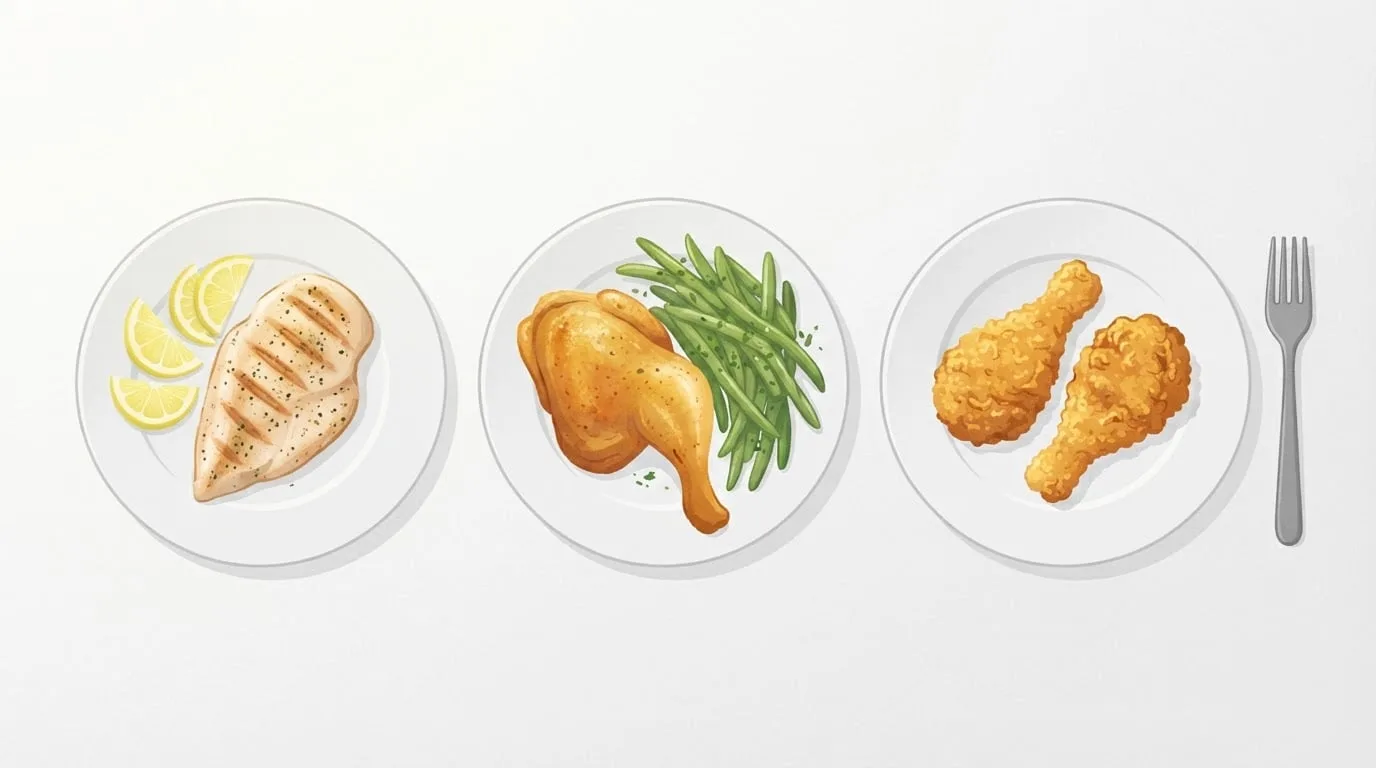
It's the version with the clearest warning. Sun and colleagues (2019) followed 106,966 postmenopausal US women. Those who ate fried chicken at least once a week had a 13 percent higher risk of death from any cause and a 12 percent higher risk of cardiovascular death than those who ate none. That's an association, but the USDA table points the same way: the battered drumstick has less than half the protein per calorie of roasted breast and more than three times the sodium.
Is grilled chicken good for you?
Yes, if you keep it from charring. High heat forms heterocyclic amines, which cause tumors in rodents at very high doses. Sinha and colleagues (1995) measured one of them, PhIP, at 12 to 480 nanograms per gram in chicken breast that was pan-fried, oven-broiled or grilled, with more at longer cooking times and heavier browning. The National Cancer Institute says human studies haven't established a definite link, and no federal guideline sets a limit.
Two simple habits cut your exposure anyway. Marinate first: in a test by Salmon and colleagues (1997), marinating lowered total amines from 330 to 44 nanograms per gram after 40 minutes on the grill, though one amine rose and sugar was involved, so go easy on sweet marinades. And turn the meat often, keep it away from direct flame and trim anything charred, as the NCI advises.
Is baked chicken healthy?
Yes. In Sinha's study, whole roasted chicken didn't show the high PhIP levels of the pan-fried and grilled breasts, and USDA's roasted breast is the lean benchmark in the table above. Roasted chicken is good for you for the same reasons. Just watch the skin and any salty rub.
Is boiled chicken good for you?
Yes. Stewed chicken also avoided the high PhIP levels in Sinha's study. USDA's braised breast, the closest entry to simmered chicken, has 133 calories, 27 grams of protein and the lowest sodium in the table. It's plain, which makes it a good base for soups and salads.
Is chicken fat good for you?
It's mostly unsaturated, but it still adds calories. In USDA's roasted meat-and-skin entry, 100 grams has 13.6 grams of fat: 3.8 grams saturated, 5.3 grams monounsaturated and 3.0 grams polyunsaturated. A piece of skin now and then is no crisis. If you eat chicken most days, taking it off is the easiest way to save calories.
Deli Chicken, Canned Chicken and Sodium
Processing can change chicken more than cooking does. The World Health Organization describes processed meat as meat altered by salting, curing, fermentation, smoking or other processes that add flavor or extend shelf life. That description fits most deli slices, nuggets and chicken sausages, so they don't get a pass for starting out as poultry. Our page on whether bacon is bad for you puts processed meat risk in absolute numbers.
Sodium is the easy part to check. USDA's plain roasted breast has just 63 milligrams per 3 ounces, so most of the salt in packaged chicken was added. In a CDC analysis by Quader and colleagues (2017), cold cuts and cured meats supplied 5.4 percent of the sodium Americans eat, and chicken pieces supplied 3.7 percent. So read the label. The FDA treats 5 percent of the Daily Value per serving as low and 20 percent as high. Check raw chicken too, since some packs contain an added salt solution.
If you're pregnant, 65 or older, or have a weakened immune system, the CDC says to avoid unheated deli meats and to reheat them to 165°F or until steaming hot.
Is Chicken Healthy for Weight Loss?
Yes, and the skin seems to matter. Smith and colleagues (2015) tracked diet and weight in 120,784 US adults for 16 to 24 years. Each extra daily serving of skinless chicken went with 0.48 kilograms (about 1 pound) less weight over four years, and each extra serving of chicken with skin went with 0.48 kilograms more. Studies like this can't prove cause, but the protein-per-calorie numbers above explain why lean chicken makes a calorie budget easier to hold.
Is It Healthy to Eat Chicken Every Day?
For most adults, yes. We found no guideline that sets a limit for plain poultry, and the top group in EPIC ate about 3 ounces a day or more with no rise in deaths. The Dietary Guidelines for Americans, 2025-2030 set a protein target of 1.2 to 1.6 grams per kilogram of body weight a day, and our guide on how much protein per day shows how to split that across meals.
Eating chicken daily is no reason to skip other proteins. Fish wasn't linked to heart disease or earlier death in Zhong's cohorts, and beans bring the fiber chicken lacks. Rotating them through your week covers more nutrients.
When Should We Not Eat Chicken?
Don't eat chicken that's undercooked or has sat out. The CDC estimates that about 1 million Americans get sick from contaminated poultry each year, and about 1 in 25 packages of chicken at the store carries Salmonella. Its advice is simple:
- Cook chicken to 165°F and check with a food thermometer.
- Don't wash raw chicken, because the splashes spread germs.
- Refrigerate leftovers within 2 hours, or within 1 hour if the food has been above 90°F.
Skip chicken if you have a poultry allergy. If you have kidney disease, ask your doctor or dietitian how much protein suits you.
What This Means for You
Chicken earns its healthy reputation when you keep it simple: skinless, baked, grilled or simmered, with the salt under your control. The 2025 headlines aren't a reason to change that. Fried chicken once in a while is fine too. It just shouldn't be your weekly default.
Protein only does its job if you give your muscles a reason to use it, and that means training regularly. Mike put it this way: "The streak system got me hooked. I didn't want to break my chain." If you'd like a simple routine at home, a dumbbell workout app can take the planning off your plate. In FitCraft, 3D AI coaches demonstrate each dumbbell and bodyweight exercise and call you by name, your workouts adjust as you progress, and streaks and leaderboards give you a reason to come back.

Frequently Asked Questions
Is chicken healthy or unhealthy?
Chicken is healthy when it's unprocessed and not deep fried. Plain skinless chicken is high in protein, niacin and selenium and low in saturated fat. The unhealthy versions get that way from batter, frying oil and salt, so fried chicken and salty processed chicken are the ones to limit.
Is chicken breast healthy?
Yes. A 3-ounce roasted skinless chicken breast has about 140 calories, 26 grams of protein and 3 grams of fat. Thighs and drumsticks are healthy too, with somewhat more fat and less protein.
Is chicken in a can good for you?
Yes, canned chicken is a convenient source of cooked protein, but it can carry a lot of added salt. Compare labels and choose a lower-sodium can. The FDA treats 20 percent of the Daily Value per serving as high.
What are the top 3 healthiest meats?
There's no official ranking, but fish, skinless poultry and lean unprocessed red meat are the usual picks. They bring protein with less saturated fat than fatty or processed meats. Fish has the strongest case, since it wasn't linked to heart disease or earlier death in six pooled US cohorts.
Can I eat chicken when I have a cough?
Yes. Nothing links chicken to a worse cough, and warm chicken soup is an easy way to get fluids when you're sick. In a lab study by Rennard and colleagues (2000), chicken soup slowed the movement of certain white blood cells in a dish, but that hasn't been shown to treat a cough in people.
Does chicken have added hormones?
No. The FDA says no steroid hormone implants are approved for growth in poultry, so a no-hormones label doesn't set one chicken apart from another.