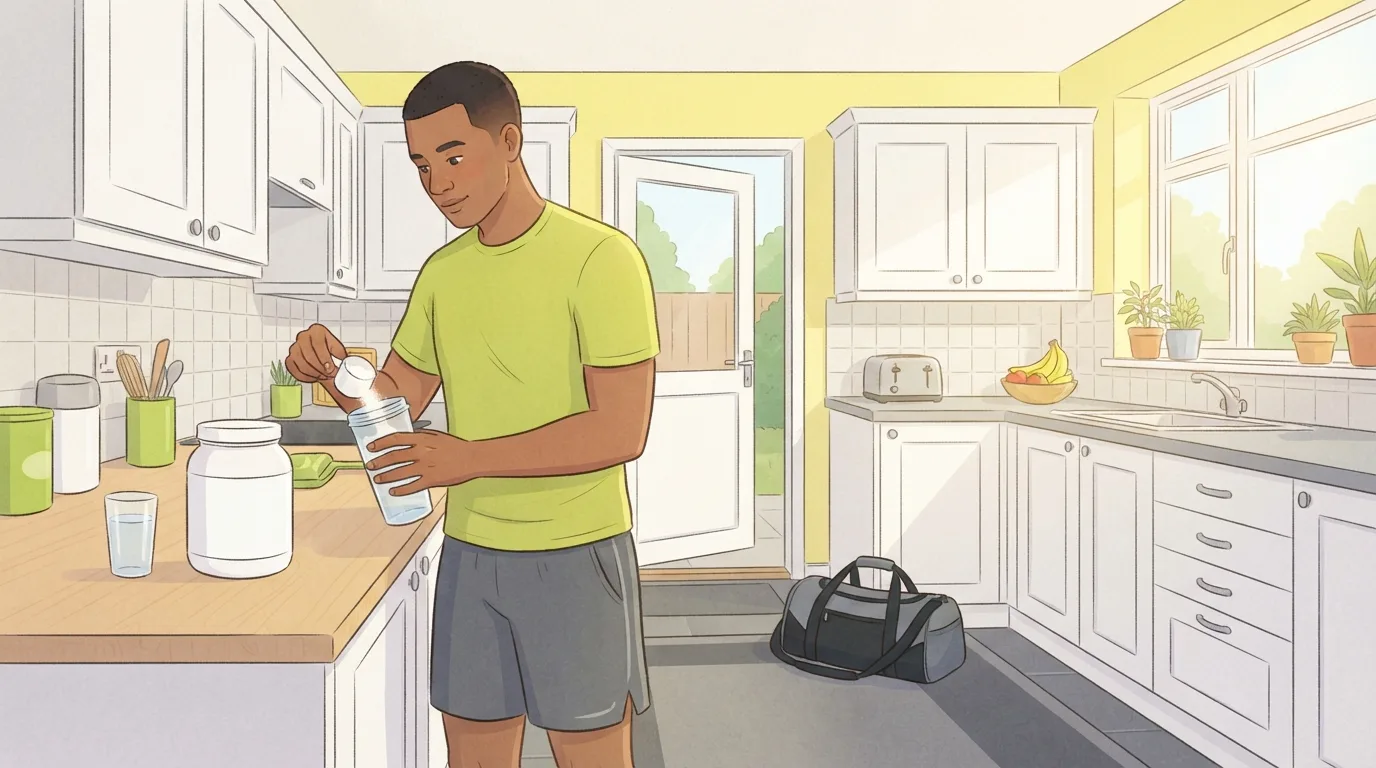
You mix a scoop, and twenty minutes later your face tingles, your heart is thumping and the warm-up feels easy. Then you're awake at midnight wondering whether pre workout is bad for you. It's a fair question. Pre-workout is one of the few supplements people take for a feeling, and that feeling comes mostly from a stimulant dose that few labels make easy to judge.
The answer isn't the energy-drink horror story, and it isn't "totally harmless" either. Three things decide it: how much caffeine is really in the scoop, what else is in it, and who's drinking it. Pre workout side effects are mostly short-lived and dose-dependent, which means most of them are in your control.
This page starts with the caffeine in pre workout, since it drives most of the effects. Then it covers the other common ingredients, your heart, blood pressure and sleep, what labels leave out, daily and long-term use, who should skip it, and the safest way to take it if you do.
How Much Caffeine Is in Pre Workout?
The average pre-workout serving has about 254 mg of caffeine. That figure comes from Jagim and colleagues, who went through the supplement facts panels of the 100 best-selling multi-ingredient pre-workout products. Caffeine appeared in 86 of them. One average scoop is nearly two-thirds of the 400 mg a day the FDA describes as an amount not generally associated with negative effects in healthy adults.
The label isn't always right, either. Desbrow and colleagues (2019) tested 15 popular pre-workouts sold in Australia and measured 91 to 387 mg of caffeine per serve. Only 6 of the 15 labels stated a caffeine amount, and the measured caffeine ranged from 59 to 176 percent of what packages claimed. All but one product varied by 40 mg or more between servings and batches.
Two safety lines help you judge a scoop. The European Food Safety Authority's 2015 opinion on caffeine concluded that single doses up to 200 mg, about 3 mg per kilogram for a 70 kg adult, and up to 400 mg a day don't raise safety concerns for healthy adults other than pregnant women. The FDA adds that rapid intake of around 1,200 mg can cause seizures, which is less than half a teaspoon of pure caffeine powder. So the average scoop already sits above EFSA's single-dose line, and two scoops (about 508 mg) pass the daily limit before you count your coffee.
Body weight changes what a scoop means. Here's how the average 254 mg serving compares with a 3 mg per kilogram dose:
| Body weight | 3 mg/kg dose | Average 254 mg scoop, per kg | Half scoop (127 mg), per kg |
|---|---|---|---|
| 120 lb (54 kg) | about 160 mg | 4.7 mg/kg | 2.3 mg/kg |
| 150 lb (68 kg) | about 205 mg | 3.7 mg/kg | 1.9 mg/kg |
| 180 lb (82 kg) | about 245 mg | 3.1 mg/kg | 1.6 mg/kg |
| 220 lb (100 kg) | about 300 mg | 2.5 mg/kg | 1.3 mg/kg |
Figures rounded. The per-kilogram columns use the label's caffeine, and lab tests show real products can run well above or below it.
You don't need the top of the range for a performance boost. The International Society of Sports Nutrition's position stand on caffeine (Guest and colleagues, 2021) found consistent benefits at 3 to 6 mg per kilogram, possibly from as little as 2 mg per kilogram, and linked very high doses around 9 mg per kilogram to frequent side effects with no extra gain. Our review of caffeine and exercise performance covers the performance side and timing in detail.
Pre Workout Side Effects, Ingredient by Ingredient
The same handful of ingredients shows up in most tubs. In the Jagim label analysis, the most common were beta-alanine (87 of 100 products), caffeine (86), citrulline (71), tyrosine, taurine, creatine and niacin. Each one has its own side-effect profile.
Caffeine
Caffeine causes most of what people feel and most of what they complain about. The FDA lists a racing heart, palpitations, raised blood pressure, trouble sleeping, nervousness, shakiness, an upset stomach, nausea and headaches as signs of too much. These effects grow with the dose, so the same product that feels great at half a scoop can feel awful at two.
Beta-alanine
Beta-alanine is the ingredient behind the pins-and-needles tingle on your face, neck and hands. It's called paresthesia, and it's harmless. The ISSN's beta-alanine position stand (Trexler and colleagues, 2015) names it as the only reported side effect and notes that smaller divided doses of about 1.6 g, or a sustained-release form, reduce it. A risk assessment by Dolan and colleagues (2019) pooled 101 human studies and confirmed it: tingling was about nine times more likely than on placebo, dropout rates were the same, and a small rise in one liver enzyme stayed well inside normal ranges.
The tingle isn't a sign the product is working. Beta-alanine helps only after 2 to 4 weeks of 4 to 6 g a day, and in the Jagim analysis the average serving held 2.0 g. Just one product reached 4 g. Our beta-alanine research review explains what that daily loading does.
Citrulline
Citrulline is the nitric oxide ingredient sold for "the pump." It's well tolerated, and its benefit is real but small. In a meta-analysis by Vårvik and colleagues (2021), 6 to 8 g of citrulline malate taken 40 to 60 minutes before lifting added about 3 repetitions, roughly 6 percent, over several sets. Most products don't reach that dose: the average serving in the Jagim analysis held 4.0 g, and only 18 of the products that listed an amount reached 6 g.
Niacin, creatine and the rest
Niacin, found in about half the products, can cause a warm, red, itchy skin flush that fades on its own. Creatine shows up in about half the tubs too, usually at about 2 g, which is below the 3 g daily dose it needs, and it works from daily use, not from timing. Tyrosine and taurine rarely cause problems at label doses.
Proprietary blends
A proprietary blend lists ingredients without their amounts. In the Jagim analysis, 58 of the 100 products had at least one, and 44 percent of all ingredients sat inside a blend. You can't tell from a blend whether you're getting an effective dose of anything, or how much of a stimulant you're taking.
Is Pre Workout Bad for Your Heart?
For a healthy heart, caffeine at ordinary doses doesn't appear to trigger dangerous rhythms, but it does change your heartbeat in ways you can measure. In the randomized CRAVE trial, Marcus and colleagues (2023) fitted 100 adults with heart monitors for 14 days and told them by text each day whether to drink caffeinated coffee or avoid caffeine. Coffee days didn't bring significantly more extra beats from the upper chambers (58 against 53 a day). They did bring about 51 percent more extra beats from the lower chambers, 154 against 102 a day, plus 36 minutes less sleep and about 1,000 more steps.
Those extra beats are the "skipped" or thumping beat many people notice after a strong scoop. The trial used coffee, not a 250 mg powder, so a bigger dose is unlikely to do less.
The other stimulants in a product may matter too. In a crossover trial by Fletcher and colleagues (2017), 18 healthy young adults drank 32 ounces of either an energy drink or a control drink with the same 320 mg of caffeine. The energy drink lengthened the QTc interval, a heart rhythm measure, more than caffeine alone at two hours, and left systolic blood pressure higher at six hours (about 4.7 against 0.8 mmHg above baseline).
The worst outcomes have involved stimulants that shouldn't be in supplements at all. Eliason and colleagues (2012) described two soldiers who collapsed from cardiac arrest during exertion and died after taking multi-ingredient supplements containing DMAA, a stimulant the FDA later removed from the market. Nationally, Geller and colleagues (2015) estimated about 23,000 emergency visits a year for supplement side effects in the US. Weight-loss and energy products caused about 72 percent of the visits involving palpitations, chest pain or a racing heart, and most of those patients were 20 to 34.

Can Pre Workout Raise Blood Pressure?
Yes, for a few hours. In a meta-analysis of people with hypertension, Mesas and colleagues (2011) found that 200 to 300 mg of caffeine raised systolic pressure by about 8 mmHg and diastolic pressure by about 6 mmHg. The rise started within the first hour and lasted at least three hours. Two weeks of regular coffee didn't raise blood pressure compared with a caffeine-free diet, and long-term coffee drinking wasn't linked to more heart disease.
In healthy, trained adults the bump is often small. Curtis and colleagues (2022) gave 14 trained men and women a pre-workout with 300 mg of caffeine or a placebo. Forty-five minutes later, heart rate (80 against 79 beats a minute) and systolic pressure (138 against 136 mmHg) were nearly identical, while reaction time and vigor improved. A 2018 review by Harty and colleagues found that no study of several weeks of pre-workout use had shown a different effect on resting blood pressure or heart rate than placebo, though some single-dose studies saw systolic pressure rise for 30 to 120 minutes.
Exercise raises blood pressure on its own, so a stimulant stacks on top of it. If your blood pressure already runs high, that combination is the reason to talk to your doctor before you use a stimulant pre-workout.
Knowing what to do is the easy part.
FitCraft, our mobile fitness app, pairs you with an AI coach who builds you a personalized plan around your goals, schedule, and fitness level. Every FitCraft program is designed by Domenic Angelino, MPH (Brown University) and NSCA-CSCS, with research published in the Journal of Strength and Conditioning Research and Medicine & Science in Sports & Exercise.
Take the Free Assessment Free • 2 minutes • No credit cardPre Workout and Sleep
Sleep is where most regular users pay. Gardiner and colleagues (2023) pooled 24 studies and found caffeine cut total sleep by about 45 minutes, lowered sleep efficiency by 7 percent and trimmed about 11 minutes of deep sleep. To avoid losing sleep time, they calculated that a standard pre-workout serving of about 218 mg should be taken at least 13.2 hours before bed, against 8.8 hours for a cup of coffee. For a 10:30 pm bedtime, that means before about 9:15 in the morning.
You may not notice the damage. In a study by Drake and colleagues (2013), 400 mg of caffeine taken six hours before bed cut sleep by more than an hour on a sleep monitor, while participants' own sleep diaries showed a smaller loss that didn't reach statistical significance. If you train after work, a late scoop can make tonight's session better and tomorrow's worse.
What Pre Workout Labels Don't Tell You
A supplement label is a promise from the seller, not a government check. The FDA states that it doesn't have the authority to approve dietary supplements before they're sold, and the company is responsible for safety and accurate labels.
That gap has let banned stimulants reach mainstream shelves. Cohen and colleagues (2014) found a methamphetamine analog that had never been studied in humans in a best-selling workout supplement, at 21 to 35 mg per recommended serving. A 2018 follow-up by Cohen and colleagues bought 12 sports and weight-loss supplements years after FDA warnings, and 9 of them still contained at least one of the four stimulants the agency had targeted. Half held two or more.
Hidden steroids are the concern for anyone who gets drug tested. In an international study by Geyer and colleagues (2004), 94 of 634 supplements that weren't sold as hormones, about 15 percent, contained anabolic steroids that weren't on the label. Those samples are two decades old, and testing programs have grown since, which is exactly why a third-party seal is worth looking for.
Is It Bad to Take Pre Workout Every Day?
Daily use isn't automatically harmful if your total caffeine from every source stays under 400 mg. Coffee, tea, soda and energy drinks all count. The problems with a daily scoop are subtler: the felt kick fades, people drift toward a scoop and a half, and the body gets used to it.
That last part shows up when you stop. A review of caffeine withdrawal by Juliano and Griffiths (2004) found headaches in about half of people in experimental studies. Symptoms usually started 12 to 24 hours after the last dose, peaked at 20 to 51 hours and lasted 2 to 9 days. Even habits as small as 100 mg a day produced withdrawal. If you skip your scoop on a rest day and feel foggy with a headache, that's why.
A better pattern is to save pre-workout for harder sessions and leave easy days and rest days caffeine-light. You'll keep more of the effect and protect your sleep.
Long-Term Side Effects of Pre Workout
Nobody has studied years of pre-workout use. The Harty review noted that most safety trials lasted under eight weeks. Within that window, studies that measured blood lipids, liver enzymes and kidney markers found largely benign effects on blood chemistry.
Caffeine itself has a long record, and it's reassuring. In the Mesas meta-analysis, seven cohort studies found no link between habitual coffee drinking and heart disease, even in people with hypertension. The real long-term unknowns are the newer stimulants and blends that change from one product to the next, and the sleep debt that builds from years of late-day doses.
For kidneys and liver, the clearest danger is adulteration. Tucker and colleagues (2018) reviewed FDA warnings from 2007 to 2016 and found 92 muscle-building supplements with unapproved drug ingredients, 82 of them containing synthetic steroids or steroid-like compounds. Those carry hormonal and liver risks no honest pre-workout label would list.
Who Should Avoid Pre Workout?
Stimulant pre-workouts are a poor fit for some people, whatever the dose:
- Anyone under 18. The American Academy of Pediatrics concluded in 2011 that caffeine and other stimulants have no place in the diets of children and adolescents. EFSA's level of no concern for young people is about 3 mg per kilogram a day, and one average scoop gives a 120 lb teenager about 4.7.
- People who are pregnant or breastfeeding. EFSA puts the safe habitual limit at 200 mg a day, and one average scoop is over it. The FDA advises talking with your provider about caffeine.
- People with high blood pressure, heart disease or a heart rhythm problem, or anyone who has had chest pain, fainting or palpitations during exercise.
- People with anxiety, panic attacks or insomnia, since caffeine makes all three worse.
- Anyone taking prescription medication, especially stimulant medication. The FDA notes that some medications make people more sensitive to caffeine, so check with your pharmacist.
- Athletes who get drug tested, unless the product carries a third-party banned-substance certification.
What Is the Safest Pre Workout Option?
The safest pre-workout is one where you know the dose of every active ingredient. In practice, that means:
- Start with single-ingredient caffeine. A cup of coffee or a caffeine tablet gives you a known dose. Around 100 to 200 mg keeps you at or under EFSA's single-dose line and still falls in the range the ISSN found can help.
- If you buy a powder, read the panel. Pick a product that lists every amount with no proprietary blend, and look for a third-party banned-substance seal such as NSF Certified for Sport or Informed Sport. Those programs test for banned substances; they don't prove a product works.
- Start with half a scoop. See how your heart rate, stomach and sleep respond before you take a full serving.
- Count all your caffeine. A morning coffee plus a full scoop can pass 400 mg before lunch.
- Mind the clock. Morning and midday training suits a stimulant. For evening sessions, use a lower dose or none.
- Never use pure caffeine powder. The FDA warns that these products have caused deaths, because a toxic amount is hard to measure by eye.
Food does a lot of what people buy pre-workout for. A carb-based snack an hour or two before training gives you fuel without a stimulant, and our guide to what to eat before a workout has the timing and the menu.
What This Means for You
If you're a healthy adult and you like how a pre-workout feels, you don't need to fear it. Take half a scoop or a known caffeine dose, keep your daily total under 400 mg, take it early in the day, and buy products that show every amount and carry a banned-substance seal. If you have a heart or blood pressure condition, are pregnant, or are under 18, skip the stimulant version.
It's also worth asking why you reach for it. For most people a pre-workout is about getting started on a day when motivation is low. That's a design problem, not a character flaw, and a scoop of stimulant is a costly fix for it. What gets you moving on a flat day is a plan you don't have to think about: a set time, a session short enough to survive a bad day, and a streak you don't want to break.
That's the part FitCraft is built for. Your 3D AI coach demonstrates every exercise, says your name as you train, and your streak shows the days you've stacked up. If motivation is what you're buying in powder form, see how a workout app that keeps you motivated handles the days you don't feel like it. As Matt put it: "The real win is I actually want to work out now. That's never happened before."
Frequently Asked Questions
Is pre-workout bad for our health?
For most healthy adults, an occasional pre-workout at a sensible caffeine dose isn't bad for your health. The average product carries about 254 mg of caffeine per scoop, which is above the 200 mg single dose EFSA rates as safe, so half a scoop is a better start. The real risks are hidden blends, contaminated products, late-day use and existing heart or blood pressure problems.
What is the recommended age to start taking pre-workout supplements?
No agency sets a starting age, but 18 is the sensible floor for stimulant pre-workouts. The American Academy of Pediatrics says caffeine and other stimulants have no place in the diets of children and adolescents. EFSA's level of no concern for young people is about 3 mg per kilogram a day, and one average scoop already exceeds that for a 120 lb teenager.
Does pre-workout cause high cholesterol?
There's no good evidence that it does. Short trials of multi-ingredient pre-workouts that tracked blood lipids, reviewed by Harty and colleagues in 2018, found largely benign effects on blood chemistry. Most of those trials lasted under eight weeks, so years of use haven't been studied.
Can pre-workout products affect high blood pressure?
Yes. In people with hypertension, 200 to 300 mg of caffeine raised systolic pressure by about 8 mmHg and diastolic pressure by about 6 mmHg for at least three hours, according to a 2011 meta-analysis. If you have high blood pressure, talk to your doctor before using a stimulant pre-workout.
Is it bad to drink pre-workout every day?
Not necessarily, as long as your total caffeine from every source stays under 400 mg a day. Daily use builds tolerance and dependence, and skipping a day can bring a withdrawal headache 12 to 24 hours later. Saving pre-workout for harder sessions keeps the effect and protects your sleep.
What is the safest pre-workout option?
The safest option is a single ingredient at a known dose, such as a cup of coffee or a 100 to 200 mg caffeine tablet, taken early in the day. If you prefer a powder, choose one with no proprietary blend and a third-party banned-substance certification, and start with half a scoop.
Is pre workout or energy drinks worse for you?
Neither is clearly worse, because the dose and the other ingredients decide it. An average pre-workout scoop has about 254 mg of caffeine. In a 2017 trial, a 32-ounce energy drink changed a heart rhythm measure and raised blood pressure more than the same 320 mg of caffeine alone, which suggests the extra stimulants in either product matter.
Is pre workout bad for your kidneys or liver?
Short trials of pre-workout products found kidney and liver markers within normal ranges in healthy adults. The bigger risk is an adulterated product: in FDA warnings from 2007 to 2016, 89 percent of tainted muscle-building supplements contained hidden steroids or steroid-like ingredients. Anyone with kidney or liver disease should ask a doctor first.