Your watch says your VO2 max is 34, and you want to know if that's good. The answer depends on your age and your sex, and the number on your wrist shows neither. A 34 puts a woman in her 40s in the top fifth of US women her age. The same 34 puts a man in his 20s in the bottom fifth.
So there's no single cutoff for a good VO2 max. Labs and watches rank you against people of your age and sex, and each one uses its own reference chart.
This page uses the newest US chart, the 2022 update of the FRIEND registry. It then covers what each range means for your health, why your watch may disagree and how a beginner in their 30s or 40s can raise the number.
What Does VO2 Max Mean?
VO2 max is the highest rate at which your body can take in and use oxygen during all-out exercise. It's measured in milliliters of oxygen per kilogram of body weight per minute (mL/kg/min), so people of different sizes can be compared. Some studies use METs instead, and 1 MET equals 3.5 mL/kg/min.
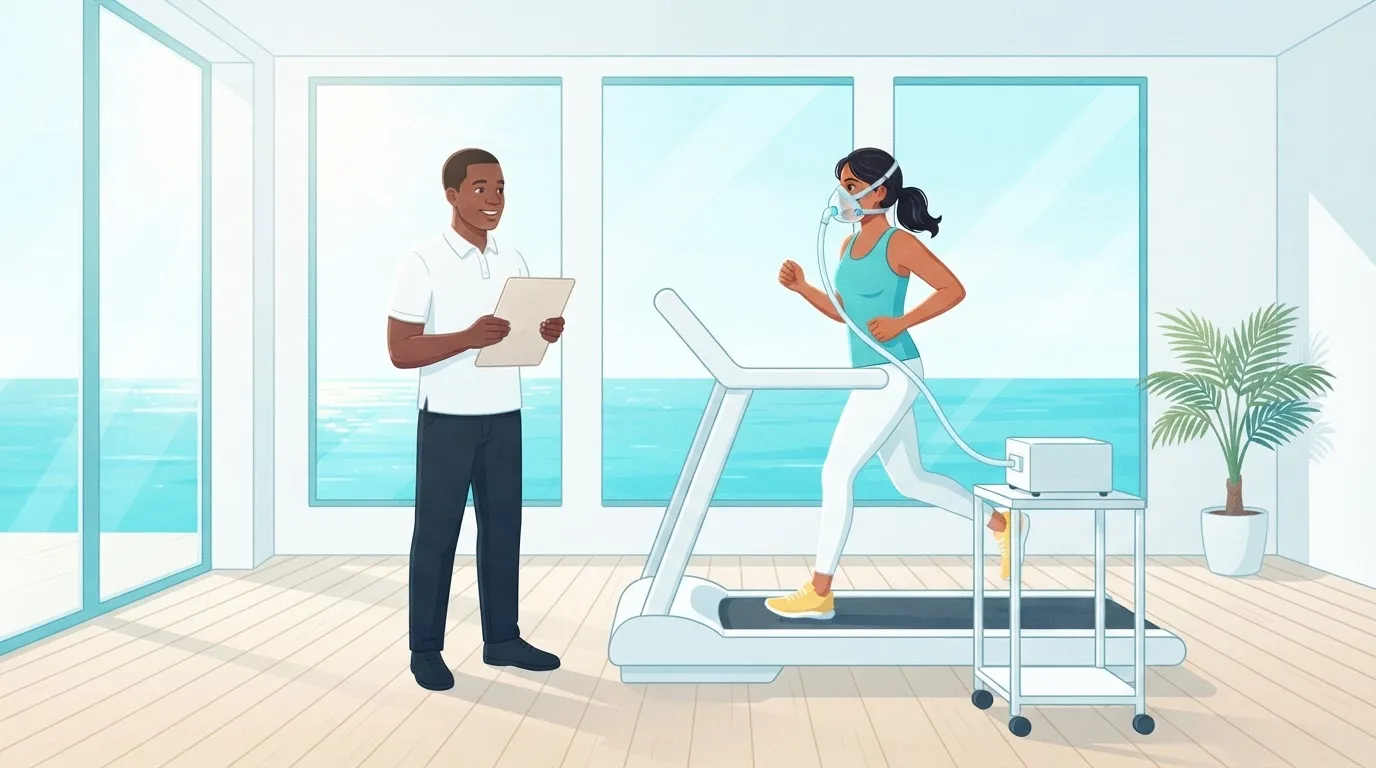
A lab measures it directly, with a mask that collects your breath while a treadmill or bike gets harder every minute or two until you can't continue. Every other number, from a 12-minute run to the reading on your wrist, is an estimate built from heart rate, pace or both.
What Is a Good VO2 Max for My Age?
A good VO2 max for your age is any score above the 50th percentile for your sex and decade, which means you're fitter than at least half the people like you who were tested. The most current US reference is the 2022 update of the Fitness Registry and the Importance of Exercise National Database (FRIEND). Kaminsky and colleagues (2022) pooled 16,278 treadmill tests with measured oxygen uptake from 34 US labs. The tests ran between 1968 and 2021 on adults aged 20 to 89 with no known heart disease or COPD.
Read the charts below like this. A score under the 20th percentile is low. The 50th percentile is the median, the middle score. Anything above the median is good, the 80th percentile and up is excellent, and the 90th puts you in the top 10 percent. All values are in mL/kg/min from treadmill tests.
VO2 max chart for men
| Age | Low (under 20th) | Median (50th) | Excellent (80th) | Top 10% (90th) |
|---|---|---|---|---|
| 20 to 29 | under 35.2 | 46.5 | 54.5 | 58.6 |
| 30 to 39 | under 29.8 | 39.7 | 50.0 | 55.5 |
| 40 to 49 | under 26.7 | 35.3 | 45.2 | 50.8 |
| 50 to 59 | under 22.2 | 29.2 | 38.3 | 43.4 |
| 60 to 69 | under 18.5 | 24.6 | 32.0 | 37.1 |
| 70 to 79 | under 15.9 | 20.6 | 25.9 | 29.4 |
| 80 to 89 | under 14.8 | 17.6 | 21.4 | 22.8 |
For a man in his 30s, a good VO2 max is anything above 39.7, and 50.0 is excellent. In his 40s, good starts above 35.3 and excellent starts at 45.2.
VO2 max chart for women
| Age | Low (under 20th) | Median (50th) | Excellent (80th) | Top 10% (90th) |
|---|---|---|---|---|
| 20 to 29 | under 27.2 | 36.6 | 44.8 | 49.0 |
| 30 to 39 | under 21.9 | 28.3 | 37.0 | 42.1 |
| 40 to 49 | under 19.7 | 25.7 | 33.0 | 37.8 |
| 50 to 59 | under 18.5 | 22.9 | 28.4 | 32.4 |
| 60 to 69 | under 15.4 | 19.6 | 24.3 | 27.3 |
| 70 to 79 | under 14.0 | 17.2 | 20.8 | 22.8 |
| 80 to 89 | under 12.6 | 15.4 | 18.4 | 20.8 |
For a woman in her 30s, a good VO2 max is anything above 28.3, and 37.0 is excellent. In her 40s, good starts above 25.7 and excellent starts at 33.0. Across all ages, the men in FRIEND scored 6.6 points (26 percent) higher than the women on the treadmill, so always read the chart for your own sex.
Don't know your number yet? Our VO2 max calculator estimates it from your resting pulse, a fast 1-mile walk or a timed run. It rates you against the smaller 2015 FRIEND table. The 2022 medians run 1.5 to 3.8 points lower for men and 0.4 to 1.9 points lower for women, so a result just under a cutoff there may clear it here.
What Is the Average VO2 Max?
The average VO2 max in FRIEND 2022 was 40.0 mL/kg/min for men in their 30s and 35.8 in their 40s, and 29.5 and 26.6 for women, close to the medians in the charts. Average doesn't mean fit, though. The registry left out known heart disease and COPD, but some of the adults tested had diabetes, obesity, back pain or arthritis. The average man and woman in their 30s and 40s had a body mass index between 26 and 28, in the overweight range.
How Much Does VO2 Max Drop in Your 30s and 40s?
VO2 max drops slowly in your 30s and 40s and faster after that. The FRIEND medians fall by an average of 4.0 mL/kg/min, or 13.5 percent, per decade, but those charts compare different people at each age. When the Baltimore Longitudinal Study of Aging retested 810 healthy adults over a median of 7.9 years, peak VO2 fell 3 to 6 percent per decade in their 20s and 30s and more than 20 percent per decade in their 70s and beyond (Fleg and colleagues, 2005). From the 40s on, men lost it faster than women, and the faster decline held at every level of leisure-time activity.
That makes your 30s and 40s a good time to build a reserve. In a study of independently living adults aged 55 to 86, the lowest VO2 max compatible with an independent life at 85 was about 18 mL/kg/min for men and 15 for women (Paterson and colleagues, 1999). In FRIEND 2022, the median man in his 80s tested at 17.6 and the median woman at 15.4, right at those lines.
Why Do VO2 Max Charts Disagree?
VO2 max charts disagree because they test different people in different ways. Three differences explain most of the gaps between the charts above, your watch and tables online.
- Who was tested. Garmin's VO2 max ratings carry the line "Data reprinted with permission from The Cooper Institute." On that Garmin table, "good" for a woman in her 40s starts at 36.3, between the 80th and 90th percentiles in FRIEND 2022. So a woman in her 40s who scores 34 would be rated fair by her watch while sitting above the 80th percentile of US women her age. For men in their 40s the gap is smaller, since Garmin's "good" starts at 42.4, between FRIEND's 70th and 80th percentiles.
- Treadmill or bike. In FRIEND, treadmill results averaged 22 percent (4.5 points) higher than bike results, so a bike test needs a bike chart. The 2022 cycle medians are 30.2 for men and 21.6 for women in their 30s, and 27.4 and 18.8 in their 40s.
- Measured or estimated. Many studies estimate fitness from how long you lasted on a treadmill instead of measuring your breath. The Cleveland Clinic study in the next section did that, and its cutoff for "low" in men in their 40s was 9.8 METs, about 34 mL/kg/min, just under the measured FRIEND 2022 median of 35.3. When researchers checked 15 prediction equations against measured VO2 max in 4,871 tests, the ones based on maximal exercise tests put people in the right third for fitness only 59 percent of the time (Peterman and colleagues, 2021).
So pick one chart and one test, then compare your number with your own past numbers.
What Does Your VO2 Max Mean for Your Health?
A higher VO2 max goes with a lower risk of dying early, and the biggest gap is between the least fit people and everyone else. Mandsager and colleagues (2018) followed 122,007 Cleveland Clinic patients for a median of 8.4 years after a treadmill test. In that time, 23.7 percent of the low fitness group died, against 10.6 percent below average, 7.3 percent above average, 4.7 percent high and 2.6 percent elite. Those raw numbers aren't adjusted for age or illness, and the low group had far more diabetes (21.9 against 2.4 percent). After adjustment, low fitness still carried about 5 times the risk of elite fitness.
A larger study agreed. Kokkinos and colleagues (2022) followed 750,302 US veterans aged 30 to 95 for a median of 10.2 years. Risk fell step by step as fitness rose, in men and women, in every racial group studied and in people in their 70s and 80s. The least fit fifth had 4.09 times the risk of the fittest group, and the lowest risk came at about 14 METs, or 49 mL/kg/min, with no rise in risk at the very top.
Both studies show an association, and neither proves that raising your number will add a set number of years. Our review of VO2 max and longevity covers the meta-analyses behind these findings and their limits.
For your health, the first target is to get out of the bottom fifth for your age and sex. Apple uses the same line. Its low cardio fitness alert for ages 20 to 59 fires when your estimate stays in the lowest fifth of the 2015 FRIEND data for your sex and decade, and from age 60 it uses floors of 18 for men and 15 for women (Apple, 2021). The low column in the charts above shows where that line falls in FRIEND 2022.
Knowing what to do is the easy part.
FitCraft, our mobile fitness app, pairs you with an AI coach who builds you a personalized plan around your goals, schedule, and fitness level. Every FitCraft program is designed by Domenic Angelino, MPH (Brown University) and NSCA-CSCS, with research published in the Journal of Strength and Conditioning Research and Medicine & Science in Sports & Exercise.
Take the Free Assessment Free • 2 minutes • No credit cardHow Do Watches Estimate VO2 Max?
Watches estimate VO2 max from how hard your heart works at a known pace. Apple Watch uses Outdoor Walk, Outdoor Run and Hiking workouts, and indoor workouts don't count (Apple Support). Apple's white paper adds that the ground has to be fairly flat and your heart rate has to climb about 30 percent of the way from resting to max.
The watch then projects that moderate effort up to a predicted maximum heart rate, using your age, sex, weight, height and any heart-rate-limiting medicine you've listed, within a range of 14 to 65 mL/kg/min. If you take a beta blocker and don't enter it, the white paper says the estimate will come out too high.
Garmin watches, the devices tested most often, run an algorithm from Firstbeat Technologies on heart rate from moderate outdoor runs. In a 2025 review, 7 of 13 validation studies found these estimates valid or acceptable (Železnik Mežan, 2025).
Watches that use exercise data beat those that use resting data. In a 2022 meta-analysis of 14 validation studies, resting-based devices ran 2.17 points high on average, and 95 percent of their readings fell between 13 points too low and 17 too high. Exercise-based devices had almost no average bias, and 95 percent of their readings fell within about 10 points of the lab value.

How Accurate Is Apple Watch VO2 Max?
Apple Watch VO2 max is close enough to track your trend, but one reading can miss your lab value by several points. Apple's own validation in 221 people found an average error of 1.4 mL/kg/min, give or take 4.7. Its lab reference was itself projected from moderate effort, though, the same kind of estimate the watch makes.
Independent studies that tested people to exhaustion found bigger misses. In 30 adults who wore the watch for 5 to 10 days before a treadmill test, Apple's estimates averaged about 6 points below the measured values, and the typical miss was 13 percent (Lambe and colleagues, 2025). In 19 adults tested on a bike, the watch averaged 41.4 against a measured 45.9. It read too high for people with poor fitness and too low for very fit people (Caserman and colleagues, 2024).
What about Garmin?
Garmin did a little better in small studies. A fēnix 6 came within about 7 percent of lab values on average in 19 adults (Carrier and colleagues, 2025). A Forerunner 265 read about 3 points high in 20 runners training for a half marathon, though its average miss stayed under 10 percent (Howard and colleagues, 2026).
Whatever you wear, treat one reading as a rough estimate, since independent tests missed by about 3 to 7 points on average. Follow the trend over 4 to 8 weeks of the same kind of workouts. If you're just starting out and your number looks generous, that fits the pattern above, where watches read high for less fit people.
How Can I Increase My VO2 Max?
You can increase your VO2 max with regular cardio that gets you breathing hard, then by making some of it harder as you get fitter. For a beginner in their 30s or 40s, that means walking first, adding harder minutes once walking feels easy and then adding short intervals at home.
Start with brisk walking
Brisk walking counts as cardio, and it raises VO2 max. Across 32 randomized trials in inactive adults, walking programs raised aerobic capacity by 3.04 mL/kg/min more than no exercise (Murtagh and colleagues, 2015). For a woman in her 40s at the FRIEND median of 25.7, a gain that size would carry her past the 60th percentile.
The CDC's adult guidelines ask for 150 minutes a week of moderate activity such as brisk walking, which could be 30 minutes a day, 5 days a week. Walk at a pace where you can talk in full sentences but wouldn't want to sing, the easy, steady effort many coaches call zone 2.
Add harder minutes once walking feels easy
In a 24-week trial, 121 sedentary, middle-aged adults with abdominal obesity exercised 5 days a week (Ross and colleagues, 2015). With a small amount of low-intensity exercise, 38.5 percent didn't improve their fitness. Doubling the amount cut that to 17.6 percent, and when the larger amount was done at 75 percent of their capacity, everyone improved. So once a 30-minute walk feels easy, turn two weekly walks into hill walks or walk-jog intervals, such as 1 minute of jogging after every 2 or 3 minutes of walking.
Try short bodyweight intervals at home
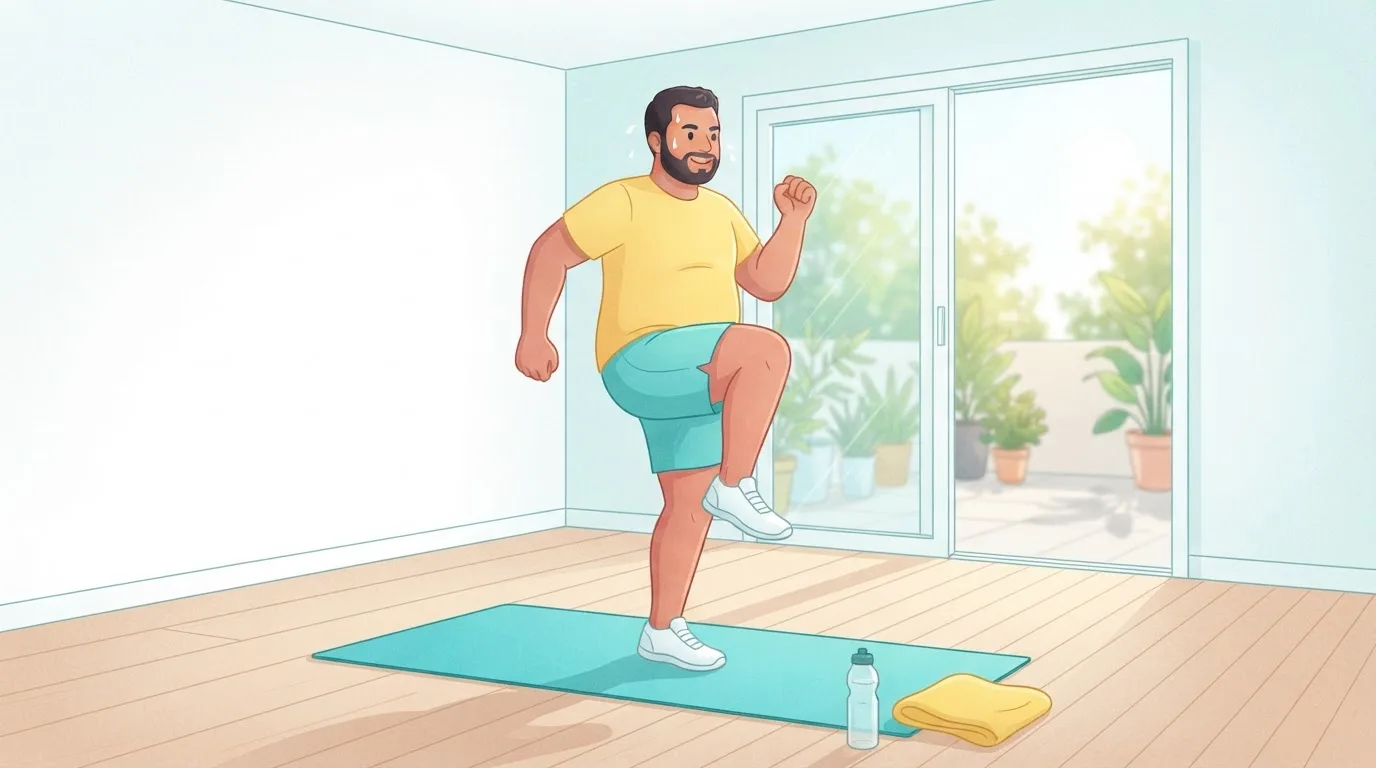
Short home sessions work too. In a 6-week trial, inactive young adults did an 11-minute routine of five 60-second moves 3 times a week, walking between them. The moves were burpees, high knees, split squat jumps, high knees again and squat jumps. They finished with a VO2 peak of 34.2 mL/kg/min against 30.3 in a control group (Archila and colleagues, 2021). In another study, eight 20-second bursts of one move, such as burpees or jumping jacks, with 10 seconds of rest between them, took 4 minutes. Done 4 days a week for 4 weeks, that raised VO2 peak about 8 percent, close to the 7 percent from 30 minutes of treadmill training (McRae and colleagues, 2012). Bursts like these are a form of HIIT.
Both studies tested people about 20 years old, so they show short home sessions can work but can't predict your own gains. If jumping bothers your knees or back, use fast marching or step-ups at the same effort. For a full 8-week home plan, see VO2 max at home, and for the trials that compare intervals with steady cardio, see our review of how to increase VO2 max.
A 12-week starter plan
Here's one way to combine those steps. It's a template built from the studies above, not a tested program.
| Weeks | Sessions each week | Effort |
|---|---|---|
| 1 to 4 | 3 to 5 brisk walks of 20 to 30 minutes | You can talk in full sentences |
| 5 to 8 | 3 brisk walks, 2 of them with hill or walk-jog intervals | Breathing hard during the faster minutes |
| 9 to 12 | 2 or 3 walks plus 2 short interval sessions at home, with a rest day between hard days | About 7 out of 10 during each burst |
Test yourself in week 1 and week 12 with the same method, such as the same walk test in the calculator or the same watch on the same route.
What This Means for You
Find your row in the chart, and you'll know where you stand. If you're under the 20th percentile, getting out of that group is where the health research shows the biggest payoff. If you're above the median, your job is to stay there as the decades pass, because the decline speeds up later.
Most people already know that walking and intervals work. Where they get stuck is week five, when three walks turn into one and the interval days slide off the calendar.
If you want help with the showing-up part, our roundup of the best AI fitness coach apps compares the options. In FitCraft, a 3D AI coach demonstrates each exercise, says your name during the workout and adjusts your workouts as you progress. Its cardio workouts include Zone 2 sessions, and streaks, XP and leaderboards give you a reason to come back the next day. As one FitCraft user, Stacy, 41, put it: "After my second kid, I needed something stupidly simple."
Frequently Asked Questions
Is a VO2 max of 40 good?
A VO2 max of 40 is good for any adult over 30. In the 2022 FRIEND data it sits just above the median for men in their 30s, between the 60th and 70th percentiles for men in their 40s, above the 80th percentile for women in their 30s and above the 90th for women in their 40s. For a man in his 20s, 40 is only the 30th percentile.
Does a 30 minute walk count as cardio?
Yes, a brisk 30-minute walk counts as moderate-intensity cardio. The CDC lists brisk walking as moderate activity, and 30 minutes a day, 5 days a week, meets its 150-minute weekly target. Across 32 trials in inactive adults, walking programs raised VO2 max by about 3 mL/kg/min.
What is the formula for calculating VO2 max?
In a lab, VO2 max is the most oxygen you use per minute at peak effort, divided by your body weight in kilograms. Physiologists describe it with the Fick equation, which multiplies cardiac output by the difference in oxygen content between arterial and venous blood. Outside a lab, field formulas estimate it from your pulse or a timed walk or run, and the FitCraft VO2 max calculator runs four of them.
What is a cardio fitness score?
A cardio fitness score is a wearable's estimate of your VO2 max in mL/kg/min. Apple Watch calls it cardio fitness, compares it with people of your age and sex, and can send you a notification when it stays low. Brands use different reference tables, so the same score can earn a different label on another device.
What was Lance Armstrong's VO2 max?
Lance Armstrong's VO2 max was about 6 liters of oxygen a minute in the trained state, according to a 2005 case study that followed him from age 21 to 28. That's about 1.7 times the 3.61 liters a minute averaged by US men in their 20s on the 2022 FRIEND bike tests.