
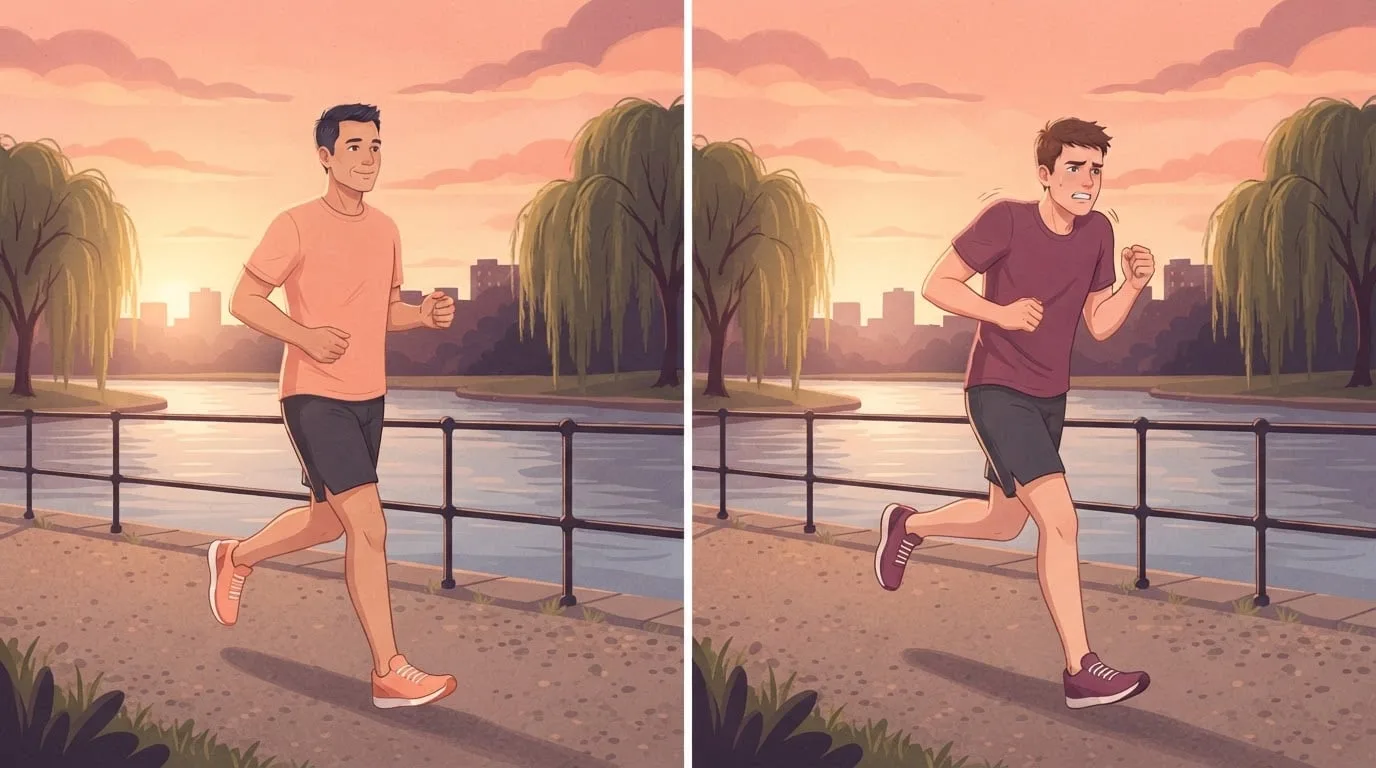
A friend tells you that a few miles in, the effort melted away and they felt they could run forever. You try it and get a stitch, tight calves and a strong wish to be back on the couch. If that's been your experience, you aren't doing anything wrong, and you're in good company. When researchers asked 19 trained runners about a marathon they'd run, only 3 said they'd had a runner's high.
So what is a runner's high, exactly? It's a temporary state of euphoria, calm and lower pain during or after sustained running. The question matters for a practical reason: if you expect that feeling on every run, ordinary runs can start to feel like failure, and that's a poor way to build a habit.
This page covers what it feels like, whether it's real, what the brain scans and blockade trials found, how long and how hard you have to run, why many runners never feel it and how to get a runner's high.
What Does a Runner's High Feel Like?
A runner's high feels like a lift in mood that comes with less effort and less pain. Runners usually describe euphoria, a quiet mind, easy movement and aches that fade into the background. People use the term for something stronger than the ordinary good mood after a workout.
There's no medical test for it, so researchers have to ask, and people rate their euphoria and anxiety on simple scales. That makes the definition fuzzy. Of the 19 marathon runners above, 3 said yes, 8 said no and 8 weren't sure, according to Siebers and colleagues (2026) in BMC Medicine.
Is Runner's High Real?
Yes, a runner's high is real, and it has been measured in controlled trials. In a double-blind trial of 63 adults, 45 minutes of moderate running raised euphoria and lowered anxiety compared with walking. In the 2026 field study, 19 trained runners completed a marathon and, on another day, a walk of the same length of time. Their euphoria ratings were higher for the marathon.
Its reputation is the part that doesn't hold up. In the second half of that study, 36 ultramarathon runners took on races of 100, 160 or 230 km. Twelve said they'd had a runner's high during the race, and 19 said they hadn't. After finishing, their anxiety was lower and their pain was higher, while their euphoria hadn't changed significantly. A runner's high is a possible result of a long run, and most long runs don't produce one.
What Causes a Runner's High? Endorphins vs Endocannabinoids
What causes a runner's high isn't settled. The best current evidence points to endocannabinoids, the body's own cannabis-like molecules, more than to endorphins, the body's own opioids. Neither has been proven in humans. These are the studies that shaped the debate.
| Study | Who | The exercise | What it found |
|---|---|---|---|
| Boecker 2008 | 10 athletes, PET scans | About 2 hours of running | Euphoria rose, and more euphoria went with less opioid receptor binding in prefrontal and limbic areas |
| Raichlen 2012 | 10 fit adults | 30 minutes of running or walking | Anandamide rose after running and not after walking |
| Saanijoki 2018 | 22 men, PET scans | 60 minutes of moderate exercise, or high-intensity intervals | Intervals lowered opioid receptor binding, along with more negative feelings |
| Siebers 2021 | 63 adults, double-blind | 45 minutes of running or walking, with naltrexone or placebo | Blocking opioid receptors didn't stop the euphoria, the lower anxiety or the rise in endocannabinoids |
| Siebers 2026 | 19 trained runners, 36 ultramarathon runners | A marathon and a matched walk; races of 100 to 230 km | Anandamide climbed through the marathon and stayed up 45 minutes later; a minority reported a high |
The endorphin theory and the PET scans
Endorphins were the obvious suspect because they act on the same receptors as morphine. The strongest evidence came from Boecker and colleagues (2008), who scanned 10 athletes at rest and after about 2 hours of running, 21.5 km on average. They used a tracer that binds to opioid receptors. After the run, less tracer bound in prefrontal and limbic areas that handle emotion, which the team read as the runners' own opioids occupying those receptors. The higher a runner rated their euphoria, the lower the binding. It's a strong result, but it's a correlation in 10 people.
A second PET study complicated the picture. Saanijoki and colleagues (2018) scanned 22 recreationally active men. An hour of moderate exercise didn't change opioid receptor binding overall, although more euphoria still went with lower binding. High-intensity intervals did lower binding, and the more it fell, the worse people felt. Brain opioids respond to exercise, but here the strongest signal came with negative feelings rather than euphoria.
Why blood endorphin tests can't settle it
For years, researchers measured endorphins in blood, and the results were inconsistent. Endorphins are large, water-soluble molecules, and the 2026 BMC Medicine authors write that there's no convincing evidence they cross the blood-brain barrier to a relevant extent. A rise in your bloodstream tells you little about your brain, although the brain can release its own opioids, which is what the PET scans looked for.
The blockade trials
If opioids cause the high, blocking their receptors should stop it. Fuss and colleagues (2015) tested that idea in mice. Running left the mice calmer and less sensitive to pain, and those effects depended on cannabinoid receptors rather than opioid receptors. Mice can't report euphoria, so the test had to move to people.
Siebers and colleagues (2021) ran it in 63 adults. In a randomized, double-blind trial, people took naltrexone, a drug that blocks opioid receptors, or a placebo, then ran or walked on a treadmill for 45 minutes. Running raised euphoria, lowered anxiety and raised blood levels of the endocannabinoids anandamide and 2-AG. Naltrexone prevented none of it, and about the same share of people reported a runner's high with the drug as with the placebo. That's the main reason endorphins lost their place as the default explanation.
The case for endocannabinoids
Endocannabinoids are fat-soluble, and unlike endorphins they can cross the blood-brain barrier. Raichlen and colleagues (2012) measured them before and after 30 minutes on a treadmill in 10 humans, 8 dogs and 8 ferrets. Anandamide rose after running in humans and dogs, both natural distance runners, and it didn't change in ferrets. In the humans, a bigger rise in anandamide went with a bigger rise in positive mood. Across the wider research, a 2022 meta-analysis by Desai and colleagues found that 74.4 percent of samples measuring anandamide showed a significant increase after a single bout of exercise.
What's still unknown
Anandamide can't be the whole story. In the 2026 marathon study it climbed on average in a group where only 3 of 19 runners reported a high, which suggests a rise in blood levels doesn't guarantee the feeling. The authors call the link between endocannabinoids and mood not linear and strongly influenced by context and duration. A 2023 systematic review from the same group counted 14 of 17 studies showing higher endocannabinoids after a single bout of exercise, and still concluded that reliable proof of their role in the runner's high hasn't been achieved in humans. Other brain chemicals respond to exercise too, and our review of dopamine and exercise explains why that reward builds slowly.
Knowing what to do is the easy part.
FitCraft, our mobile fitness app, pairs you with an AI coach who builds you a personalized plan around your goals, schedule, and fitness level. Every FitCraft program is designed by Domenic Angelino, MPH (Brown University) and NSCA-CSCS, with research published in the Journal of Strength and Conditioning Research and Medicine & Science in Sports & Exercise.
Take the Free Assessment Free • 2 minutes • No credit cardHow Long and How Hard Do You Have to Run?
Most studies that found a response used 30 to 60 minutes of steady running at a moderate effort. Gentle walking and very hard efforts both did less, and nobody has found a fixed minute when the feeling starts.
How hard to run
In Raichlen's 2012 study, running at 72.5 percent of maximum heart rate raised anandamide, while walking at 44.6 percent didn't. In a follow-up, Raichlen and colleagues (2013) tested recreational runners at four treadmill intensities and found significant changes at moderate intensities only. In everyday terms, moderate means you're breathing harder but can still speak in sentences.
| Effort | What it looks like | What the studies found |
|---|---|---|
| Easy walk | About 45 percent of maximum heart rate | No rise in anandamide after 30 minutes. A long walk matched to a marathon caused only modest changes |
| Steady run | About 72 percent of maximum heart rate, talking in sentences | Anandamide rose after 30 minutes. Euphoria rose and anxiety fell after 45 minutes |
| Very hard running or intervals | Too hard to talk | No significant change in endocannabinoids at very high intensity. Intervals released brain opioids, with more negative feelings |
When does runner's high kick in?
The trials give a rough floor rather than a schedule. Raichlen used 30 minutes, Siebers used 45, and a 2024 study by Weiermair and colleagues found higher mood and endocannabinoids in 16 adults after a 60-minute outdoor run. Long efforts seem to build slowly. The marathon runners held an unhurried 7 minutes per kilometer (about 11 minutes per mile), anandamide rose steadily, and at 28 km their euphoria hadn't yet pulled ahead of walking. The differences grew in the later stages.
How long does a runner's high last?
The feeling itself hasn't been timed well. The best marker comes from the marathon study: anandamide was still raised 45 minutes after the finish, which was the last sample taken. The ordinary lift in mood after exercise is a separate effect, and our article on exercise and mental health covers how long it takes to show up.
Why Many Runners Never Feel It
Most runners who miss it aren't doing anything wrong. A runner's high is uncommon even in trained people, and a few things make it less likely still.
- It's rare to begin with. Even runners who've covered huge distances can go without it, as the 2026 numbers show.
- The chemistry may not be enough. Average anandamide rose in both groups while most runners reported no clear high.
- Your pace is too hard for your fitness. Ekkekakis and colleagues (2011) reviewed how people feel at different intensities. Exercise below the lactate threshold feels pleasant for most people, and exercise above it feels bad for nearly everyone. For a new runner, a jog can already sit near that line.
- Your runs are short. A 20-minute run may be a great start, but it's shorter than the sessions in these studies.
- You're new to it. In Weiermair's study, regular runners reported stronger mood gains than occasional runners, though only 4 people were in the occasional group, so treat that as a hint.
How to Get a Runner's High
No routine guarantees a runner's high, but you can match the conditions in the studies. Here's how to get a runner's high, or at least give yourself the best chance:
- Run slowly enough to talk. Aim for full sentences. If you can only get out a word or two, slow down or take a walking break.
- Stay out for at least 30 minutes. That's the shortest session in the studies above. Work up to 45 to 60 minutes as your fitness allows.
- Keep the effort steady. Save intervals for another day, since steady sessions are the ones linked to euphoria.
- Build your base first. The easier a 30-minute run feels, the more likely it is to stay pleasant. If you can't run for 30 minutes yet, our guide on how to start running gets you there with an 8-week run-walk plan.
- Run with someone. Cohen and colleagues (2010) found that rowers' pain thresholds rose more after rowing together than alone at similar power. It's a small study, but a partner also keeps you at a talking pace.
- Stop waiting for it. Judge a run by whether you went and how you feel an hour later. A high is a bonus on top of that.
Can You Get a Runner's High Without Running?
You can get a similar lift in mood without running, though the chemistry differs by activity. The Desai meta-analysis found that endocannabinoids rose across types of exercise, and two smaller studies show the mood effect doesn't always follow them.
- Singing and dancing. In nine women aged 55 to 67, Stone and colleagues (2018) found that singing raised anandamide by 42 percent and improved mood. Dancing left endocannabinoids unchanged and still lowered negative mood.
- Strength training. In 32 adults, Sirotiak and colleagues (2023) found that a single resistance session improved mood even though anandamide fell. A lifting session can lift your spirits by a different route.
What This Means for You
A runner's high is a real but unreliable bonus, which makes it a poor reason to start running and a worse reason to quit. If you've never felt one, nothing has gone wrong. Most of the trained runners in the best recent study didn't report one either, and they still finished a marathon.
The rewards you can count on are quieter, and they build with repetition. Our review of exercise and depression research shows what regular training does for mood over weeks and months. That depends on showing up, and it's where most people struggle: you run well for two weeks, miss a few days, and the gap keeps growing.
Picture yourself a few months from now. A 30-minute run has stopped being an event, you know the pace you can hold, and some mornings the whole thing just feels good. If staying consistent is the hard part, a workout app that keeps you motivated can carry you through the ordinary days. In FitCraft, a 3D AI coach leads your workouts, including cardio sessions, says your name as you train and adapts your workouts as you progress, while streaks, leaderboards and a new quest every month give you a reason to come back when no high shows up. As one FitCraft user, Matt, put it: "The real win is I actually want to work out now. That's never happened before."
Frequently Asked Questions
Can you get a runner's high from walking?
An ordinary walk is unlikely to do it. Anandamide didn't rise after 30 minutes of walking at about 45 percent of maximum heart rate, and a long walk matched to marathon duration caused only modest changes. Whether a brisk uphill walk gets closer hasn't been well tested.
Is a runner's high bad for you?
A runner's high isn't harmful in itself, and it passes on its own. The practical risk is that a good mood and dulled discomfort can tempt you to keep going on a real injury. If a pain changes how you run, stop and rest, however good you feel.
What are the signs of high endorphin levels?
There's no reliable outward sign of high endorphin levels. People usually mean a lifted mood, calm and less pain, but those feelings don't prove endorphins are responsible: in a 2021 trial, euphoria and lower anxiety still appeared after running with opioid receptors blocked. Blood tests say little either, because endorphins cross poorly into the brain.
Why do people like running?
People like running because it can lift their mood, ease anxiety and give them a clear sense of progress. One theory says the reward is built in: Raichlen and colleagues suggest endocannabinoid signaling may encourage endurance exercise, because it rose after running in humans and dogs but not in ferrets. That's a hypothesis drawn from small studies.
Are humans good at running?
Yes, especially over long distances. Bramble and Lieberman (2004) argued that humans are unexpectedly good at sustained running, with features that leave traces in the skeleton, and that endurance running arose in the genus Homo about 2 million years ago.