
You laced up, headed out the door and lasted about four minutes before your lungs burned and your shins started to ache. Maybe you tried again the next day, and it felt worse.
That's usually where the story turns into "I'm just not a runner." It's a quiet, discouraging conclusion, and it's almost always wrong.
Getting into running fails for predictable reasons: going too fast, adding too much too soon, and stopping after the first sore week or injury. In a Dutch study of 774 people who signed up for a six-week beginner program, Fokkema and colleagues (2019) found that 29.5% had stopped running within six months, and the most common reason was a running-related injury. That's a problem with how most people start, and it has a fix. This guide shows you how to begin running in a way that lasts.
How Should a Beginner Start Running?
Start by running less, more slowly and more often than feels natural. Here are the six steps, in order:
- Check whether you need a doctor's OK first. Most healthy adults don't, but some people do, and the next section explains who.
- Get shoes that feel comfortable when you jog in them. That's the only gear you have to buy.
- Run three times a week, with walk breaks, on non-consecutive days. The rest day between runs is when your legs adapt.
- Keep every run easy enough to talk in full sentences. If you can't, slow down to a shuffle or walk.
- Lengthen the running pieces slowly. Never let one run jump far past your longest run of the past month.
- Add two short strength sessions a week. Twenty minutes with bodyweight and dumbbells is enough.
If a 20-minute walk feels hard today, start one step earlier. Our guide on how to start running when you're out of shape covers the walking base and the first runs for people starting from very low fitness.
When to See a Doctor Before You Start Running
Most people can start without a check-up. The American College of Sports Medicine rewrote its screening advice in 2015 because the old version sent too many healthy people to the doctor and could put them off exercising. Riebe and colleagues (2015) set out the new model, which rests on three questions: how active you are now, whether you have symptoms or known heart, metabolic or kidney disease, and how hard you plan to exercise. Age alone isn't one of them.
- Get medical clearance first if you have known heart disease, diabetes or kidney disease, or symptoms such as chest pain or pressure with effort, unusual breathlessness, dizziness or fainting, a racing or irregular heartbeat, or swollen ankles.
- Check in with your doctor or a physical therapist if you're pregnant, recovering from surgery, or have a joint or bone problem that hurts when you walk.
- Start without clearance if you're healthy and have none of those symptoms. The model says inactive, healthy adults can begin at a light to moderate effort and build up gradually, which is exactly what the plan below does.
Whatever your starting point, stop running and get checked if you feel chest pain, faintness or a heartbeat that feels wrong during a run. The screening authors noted that exercise-related heart events are often preceded by warning signs, which is why symptoms matter more than birthdays.
What You Need to Start Running
You need comfortable shoes, clothes you can move in and a way to time your intervals. That's the whole list.
Running shoes: pick for comfort
The old advice was to have your gait analyzed and buy a "stability" shoe if your feet roll inward. The evidence doesn't back it. Nielsen and colleagues (2014) followed 927 novice runners for a year, all running in the same neutral shoe. Runners with pronated feet didn't get hurt more often than runners with neutral feet. If anything, they had slightly fewer injuries per 1,000 km.
A review by Nigg and colleagues (2015) in the British Journal of Sports Medicine proposed a simpler rule, the "comfort filter": runners tend to choose the shoe that suits how they already move by picking the one that feels comfortable. In practice:
- Try on three or four pairs late in the day, when your feet are slightly bigger, with the socks you'll run in.
- Jog a few steps in each pair. Choose the one you barely notice.
- Leave about a thumb's width between your longest toe and the end of the shoe, and make sure your heel doesn't slip.
- Ignore the color, the price tag and the technology claims. Comfort is the test.
Everything else
- Clothes: anything that doesn't rub. Synthetic or wool socks blister less than cotton, and a supportive sports bra matters more than any other garment if you need one.
- A timer: any phone stopwatch or simple watch works for the run-walk intervals.
- A route: a flat loop of a mile or so near home, ideally with soft ground and a few places to stop. A treadmill works too, and you follow the same minutes on it.
Your First 8 Weeks of Running, Week by Week
Every session starts and ends with 5 minutes of brisk walking. In between, you alternate easy running with walking. The session length stays between about 34 and 42 minutes the whole way through. What changes from week to week is how much of that time you spend running.
| Week | Runs per week | Between the warm-up and cool-down walks | Minutes of running per session | Session length |
|---|---|---|---|---|
| 1 | 3 | Run 1 minute, walk 2 minutes. Repeat 8 times. | 8 | 34 min |
| 2 | 3 | Run 90 seconds, walk 2 minutes. Repeat 8 times. | 12 | 38 min |
| 3 | 3 | Run 2 minutes, walk 2 minutes. Repeat 7 times. | 14 | 38 min |
| 4 | 3 | Run 3 minutes, walk 2 minutes. Repeat 6 times. | 18 | 40 min |
| 5 | 3 | Run 4 minutes, walk 90 seconds. Repeat 5 times. | 20 | about 38 min |
| 6 | 3, or 4 if you feel fresh | Run 6 minutes, walk 90 seconds. Repeat 4 times. | 24 | 40 min |
| 7 | 3, or 4 if you feel fresh | Run 9 minutes, walk 90 seconds. Repeat 3 times. | 27 | about 42 min |
| 8 | 3, or 4 if you feel fresh | Runs 1 and 2: run 14 minutes, walk 1 minute, twice. Run 3: 25 to 30 minutes without stopping. | 28 to 30 | about 40 min |
Three rules make the table work:
- Move up a week only when the current one felt manageable. That means you finished every running piece at a talking pace and your legs felt close to normal the next morning. If not, repeat the week. Most people repeat at least one.
- Make an optional fourth run the shortest of the week. In weeks 6 to 8, a fourth day is half a normal session at your easiest pace. Skip it if anything aches.
- After a missed week, go back one week. After a missed fortnight, go back two.
The walk breaks aren't a crutch, and you can keep using them long after week 8. Our look at taking walk breaks while running covers the research and the physiology behind them.
How Slow Should a Beginner Run?
Slower than you think, often barely faster than a brisk walk. Use the talk test: during the running pieces you should be able to say a full sentence out loud, but not sing. Foster and colleagues (2008) ran four sets of experiments and found that the point where comfortable talking stops tracks the ventilatory threshold closely enough to use for setting exercise intensity. For a beginner, easy running sits below that point, at roughly a 3 or 4 on a 10-point effort scale.
If you can't keep talking, slow down until you can. If you can't slow down any more, walk until your breathing settles and start the next piece. Your heart and lungs adapt within weeks, while tendons and bones take longer, so a slow pace protects the parts that adapt last.
Later on, many coaches use the 80/20 rule: about 80% of your running easy and about 20% harder. Muñoz and colleagues (2014) randomized 30 recreational runners for 10 weeks. The group that kept about 77% of its training at a low intensity improved its 10K time by 5.0%, against 3.6% for a group that did more moderate running, although that gap wasn't statistically significant. For your first eight weeks, the answer is simpler. Keep all of it easy.
If your breathing is what makes you stop, our guide on how to breathe while running covers breathing rhythm, nose versus mouth breathing and side stitches.
Find out what's really holding you back
FitCraft, our mobile fitness app, pairs you with an AI coach who builds you a personalized plan around your goals, schedule, and fitness level. Every FitCraft program is designed by Domenic Angelino, MPH (Brown University) and NSCA-CSCS, with research published in the Journal of Strength and Conditioning Research and Medicine & Science in Sports & Exercise.
Take the Free Assessment Free • 2 minutes • No credit cardHow Fast to Add More: What the Evidence Says About the 10% Rule
The 10% rule says you should never raise your weekly running distance by more than 10% from one week to the next. It's simple and popular. The research behind it is weaker than its reputation.
The trial that tested it
Buist and colleagues (2008) randomized 532 novice runners preparing for a 4-mile (6.7 km) race. One group followed a standard 8-week program. The other followed a slower 13-week program built on the 10% rule. Injuries were almost identical: 20.8% in the 10% group and 20.3% in the standard group.
The watch studies
Nielsen and colleagues (2014) gave GPS watches to 874 novice runners and tracked them for a year. Overall injury rates didn't differ between runners who added less than 10%, 10 to 30% or more than 30% a week. The authors did find a signal for one group of injuries, including runner's knee, shin splints and iliotibial band pain: runners who added more than 30% over two weeks had a 59% higher rate of them. The confidence interval ran from 0.96 to 2.66, so the result was borderline, and the authors called the study exploratory.
The strongest data so far point at single runs rather than weekly totals. Frandsen and colleagues (2025) followed 5,205 adult runners through their Garmin watches for 18 months, covering 588,071 runs. When one run went more than 10% past the longest run of the previous 30 days, the overuse injury rate rose. It was 64% higher for spikes of 10 to 30%, 52% higher for spikes of 30 to 100%, and 2.28 times higher when a run more than doubled the recent longest. Week-to-week changes in total distance showed no clear link. These were mostly experienced runners, with a median of 9.5 years of running, and the injuries were self-reported, so treat it as strong evidence rather than proof.
How to use this as a beginner
- During run-walk weeks, judge by the session, not the percentage. Going from 8 to 12 minutes of running looks like a 50% jump, but the session barely gets longer and you were already on your feet for the walking parts.
- Once you run continuously, watch your longest run. Keep any single run within about 10% of the longest one you've done in the past month.
- Grow one run at a time. Add about 5 minutes to one run, keep it for a week, then add to another.
- Pain decides, not the calendar. If something hurts, repeat or drop back a week whatever the numbers say.
Strength Training for New Runners
Strength work is the cheapest insurance a new runner can buy, though the evidence is clearer for sport in general than for running in particular.
- Across sports: Lauersen and colleagues (2014) pooled 25 randomized trials with 26,610 participants. Strength training programs cut the risk of sports injury to about a third (risk ratio 0.315). Stretching made no difference (risk ratio 0.963).
- In runners: the picture is mixed. Toresdahl and colleagues (2020) gave 720 first-time New York City Marathon runners either a 10-minute strength routine three times a week or nothing. Injuries that stopped people finishing were 7.1% against 7.3%, no real difference. Ten minutes may simply be too little.
- For performance: a review by Blagrove and colleagues (2018) found that strength training generally improved running economy by 2 to 8% in distance runners, which means running at the same pace costs less effort.
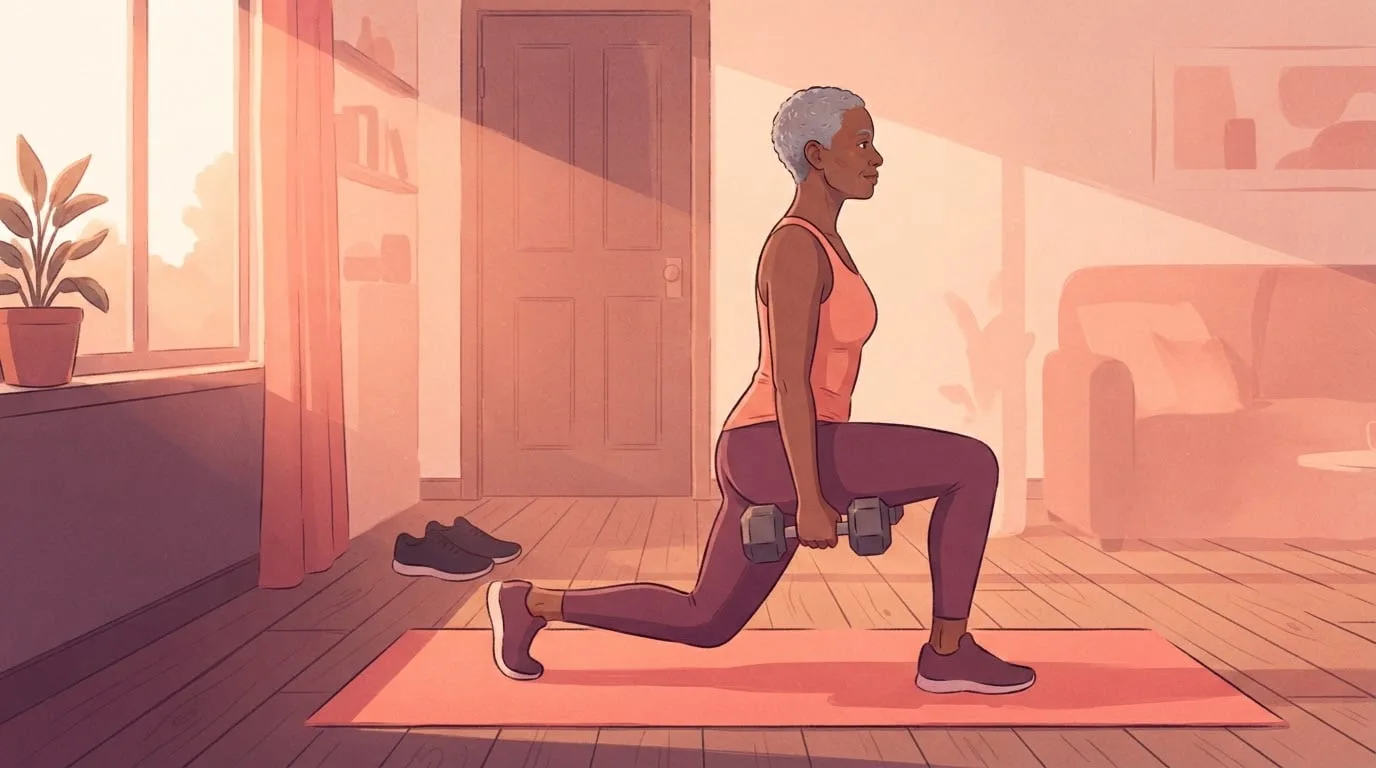
So do enough of it to matter: two sessions of about 20 minutes a week, on non-running days or after an easy run. This routine needs a mat and a pair of dumbbells.
- Split squat: 3 sets of 8 to 12 per leg, holding dumbbells at your sides once bodyweight feels easy.
- Dumbbell Romanian deadlift: 3 sets of 10. Move to the single-leg version when you can keep your hips level.
- Glute bridge: 3 sets of 12 to 15, with a dumbbell across your hips when it gets easy.
- Calf raise: 3 sets of 15 with straight knees and 3 sets of 15 with bent knees, which shifts the work to the deeper calf muscle that does much of the work in running.
- Side plank: 2 to 3 holds of 20 to 40 seconds per side.
If you'd rather have those sessions planned for you, FitCraft's strength workouts use bodyweight and dumbbells, an AI coach demonstrates each exercise on an interactive 3D model, and the workouts adjust as you progress. Streaks reward showing up on the days between runs. If you're new to working out as well as to running, our page on the best workout app for beginners shows how the free assessment builds your first session.
Five Mistakes That Make New Runners Quit
- Running every run too fast. This is the most common one. If the running pieces leave you gasping, the problem is pace, not fitness. Slow down until you pass the talk test.
- Doing too much in the first good week. You'll feel better around week 3 and want to add days or minutes. Your lungs are ready before your shins are. Stick to the table.
- Running through pain. A mild ache that fades as you warm up and is gone the next day is normal. Pain that makes you limp, gets worse as you run, or is sore when you press on a bone in your shin or foot means stop and rest. If it lasts more than a week, see a doctor or physical therapist. In the Fokkema study, injury explained 48% of the people who quit.
- Skipping rest days and strength work. Back-to-back running days give your legs no time to adapt. Rest or strength-train between runs.
- Treating a bad week as the end. Missed runs and heavy-legged weeks are part of every plan. Repeat the week and carry on. Nobody checks how many weeks your 8-week plan took.
Running form isn't on that list, because most beginners don't need to change much. The one change with decent evidence behind it is to stop overstriding. Our guide on how to improve running form ranks the fixes by the strength of their evidence.
What to Expect in Your First Two Months
- Weeks 1 and 2: the running pieces feel hard, and your calves and thighs may be sore for a day or two after each session. That's normal.
- Weeks 3 to 5: the same pace starts to feel easier, and your breathing settles sooner after each piece.
- Weeks 6 to 8: the walk breaks shrink and you run for 25 to 30 minutes without stopping. Most people hit one flat week somewhere in here.
Injury risk falls as you become a runner. A meta-analysis by Videbaek and colleagues (2015) put the injury rate at 17.8 per 1,000 hours of running in novices against 7.7 in recreational runners. The first months are the riskiest, which is why the plan is patient. For more on the first weeks, including why early runs feel so hard and how long it takes to get used to running, read our first-time running tips.
After Week 8: What Comes Next
Keep three easy 30-minute runs a week for at least a month before adding anything. That alone covers the 75 minutes of vigorous activity a week that US guidelines ask for. Then pick a direction.
- A first race: 30 minutes of easy running covers 2 to 3 miles for most new runners, so a 5K is close. Our 5K training plan for beginners takes you to race day.
- A longer goal: our couch to 10K plan builds the long run over 14 weeks without large single-run jumps.
- Running for health: keep the three runs, keep them easy, and keep the two strength sessions. That's a routine you can hold for years.
The Bottom Line
How to start running comes down to a few habits: run three times a week with walk breaks, keep every run easy enough to talk, and lengthen the running pieces over about eight weeks. Watch your longest run more closely than your weekly total, treat pain as a signal and add two short strength sessions.
You don't need to be built like a runner to become one. You need a pace that lets you come back, and a plan that expects you to repeat a week now and then.
Frequently Asked Questions
How do I get into running if I've never run before?
Start with run-walk sessions three times a week on non-consecutive days. Walk briskly for 5 minutes, then alternate 1 minute of very easy running with 2 minutes of walking eight times, and walk 5 minutes to finish. Lengthen the running parts a little each week, and expect to run 30 minutes without stopping after about eight weeks.
What is the 3-3-3 rule for running?
The 3-3-3 rule usually means running 3 miles, 3 times a week, for 3 months. It's a social media guideline, not a research standard, and 3 miles is too far for a first run for most people. It works better as the goal after an 8-week run-walk plan than as the starting point.
What is the 80% rule in running?
The 80% rule, often called 80/20 running, means doing about 80% of your running at an easy, conversational effort and about 20% harder. In a 10-week trial of 30 recreational runners, the group that kept about 77% of its training easy improved its 10K time by 5.0% against 3.6% for a group that ran more at moderate effort. In your first 8 weeks, keep all of it easy.
Can you lose belly fat from running?
Running can reduce belly fat, including the visceral fat around your organs, but you can't choose where your body loses fat first. A 2013 meta-analysis of 15 studies and 852 overweight adults found aerobic exercise reduced visceral fat even without a diet, with moderate or high-intensity aerobic training working best. Pairing running with a modest change in eating speeds it up.
Is a 40 minute 5K bad?
No. A 40-minute 5K works out to just under 13 minutes per mile, or 8 minutes per kilometer, which is a normal pace for a new runner or anyone using walk breaks. Finishing the distance comfortably matters far more than the time, and most people get faster in their first year simply by running consistently.
At what age is it hard to run?
There's no age at which you can't start running. The American College of Sports Medicine's screening model looks at your current activity, symptoms and known heart, metabolic or kidney disease rather than your age. Older beginners usually need more time: repeat weeks of the plan more often, keep every run easy and do the two strength sessions.