You have 15 minutes before the house wakes up, or between your last meeting and dinner, and a pair of dumbbells in the corner. What you don't have is time to decide what to do with them. So the 15 minutes goes to scrolling for a workout instead of doing one.
That decision is what makes short sessions so easy to skip. Skip a few and the dumbbells turn into furniture, and the voice that says you never stick with anything gets a little louder.
This page makes the decisions for you. Each workout below is timed to the second, warm-up included, and tells you the exercises, the work and rest intervals and the weight to use. Start a timer and follow the table.
How Each 15 Minute Workout With Weights Is Timed
All three workouts run on the same clock, so you only have to learn it once.
| Clock | What you do |
|---|---|
| 0:00-2:00 | Warm-up: four easy movements, 30 seconds each |
| 2:00-6:00 | Block A: two exercises, alternating, 45 sec on and 15 sec off, twice each |
| 6:00-10:00 | Block B: the same pattern with two new exercises |
| 10:00-14:00 | Block C: the same pattern with two more exercises |
| 14:00-15:00 | Finisher: one minute of a carry or a light exercise |
Inside a block, do the first exercise for 45 seconds and rest for 15, then do the second exercise for 45 seconds and rest for 15. Repeat both once more and the block is done. The 15 seconds is for putting one set of dumbbells down and picking up the next.
Pairing is what makes 15 minutes enough. In the full-body and upper plans, each exercise's muscles get about 75 seconds between their own sets, because the other exercise in the pair works a different area. The lower plan pairs leg exercises with each other, so expect it to feel harder by the second round. Every exercise gets two hard sets and 90 seconds of work in total. Set any interval timer to repeat 45 seconds on and 15 seconds off, and it will carry you through all three blocks.
The 15 Minute Full Body Dumbbell Workout
This is the one to start with. It works your legs, hips, back, chest, shoulders and grip, and it needs one pair of dumbbells and a mat.
| Clock | Exercise | Work and rest |
|---|---|---|
| 0:00-2:00 | Marching in place, bodyweight squats, hip hinges, arm circles | 30 sec each, no rest |
| 2:00-6:00 | A1 Goblet squat, A2 Dumbbell floor press | 45 sec on, 15 sec off, 2 rounds |
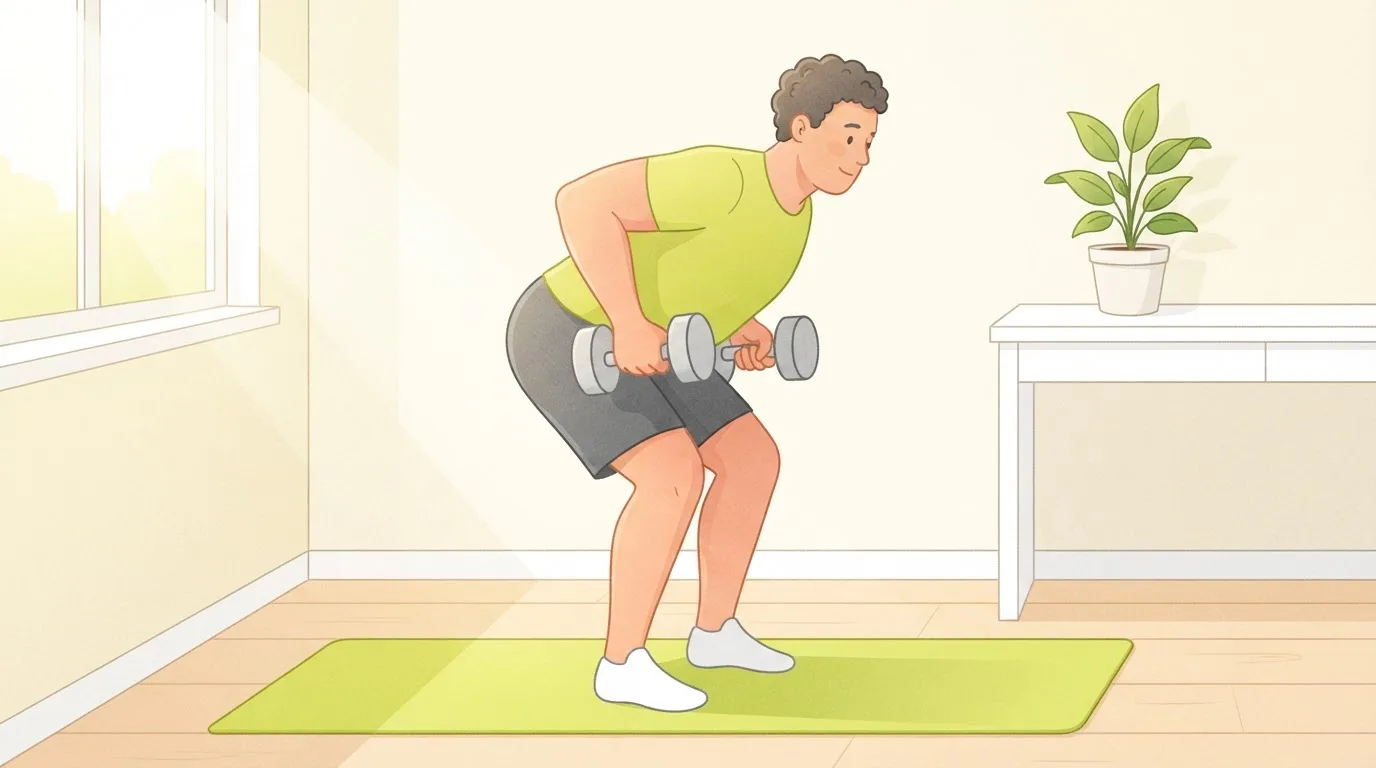
| 6:00-10:00 | B1 Dumbbell Romanian deadlift, B2 Bent-over row with two dumbbells | 45 sec on, 15 sec off, 2 rounds |
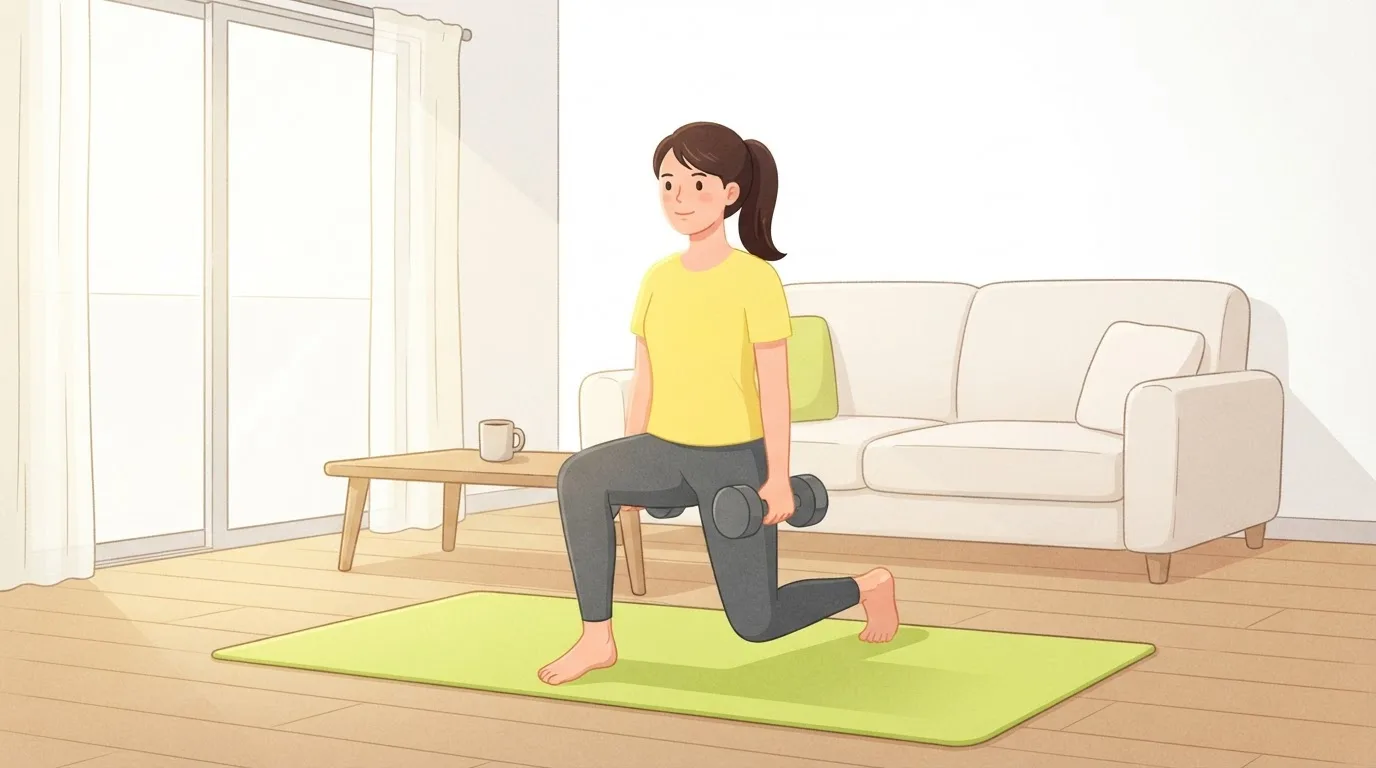
| 10:00-14:00 | C1 Alternating reverse lunge, C2 Standing overhead press | 45 sec on, 15 sec off, 2 rounds |
| 14:00-15:00 | Suitcase carry or march with one dumbbell | 30 sec per side |
Our full body dumbbell workout guide walks through the form for each of these exercises step by step. At this pace, one cue per exercise matters most:
- Goblet squat: hold one dumbbell upright at your chest, sit down between your heels and stand up smoothly without pausing at the top.
- Floor press: let your upper arms rest on the floor for a moment on every rep, which keeps the press honest when you're tired.
- Romanian deadlift: push your hips back until the backs of your thighs stretch, then stand by squeezing your glutes.
- Bent-over row: hold a flat back at about a 45-degree lean and pull both dumbbells toward your lower ribs.
- Reverse lunge: switch legs on every rep, so the 45 seconds covers both sides evenly.
- Overhead press: squeeze your glutes and keep your ribs down so you press straight up instead of leaning back.
- Suitcase carry: hold one dumbbell at your side and walk, or march in place, standing tall without tipping toward it.
15 Minute Upper Body Dumbbell Workout
This option trains your chest, back, shoulders and arms. Use your heavier dumbbells for the press and the row, and lighter ones for the reverse fly, the curls and the lateral raises.
| Clock | Exercise | Work and rest |
|---|---|---|
| 0:00-2:00 | Arm circles, wall push-ups, light rows, light presses | 30 sec each, no rest |
| 2:00-6:00 | A1 Dumbbell floor press, A2 Bent-over row with two dumbbells | 45 sec on, 15 sec off, 2 rounds |
| 6:00-10:00 | B1 Standing overhead press, B2 Bent-over reverse fly | 45 sec on, 15 sec off, 2 rounds |
| 10:00-14:00 | C1 Biceps curl, C2 Overhead triceps extension with one dumbbell | 45 sec on, 15 sec off, 2 rounds |
| 14:00-15:00 | Lateral raise | 30 sec on, 10 sec off, 20 sec on |
If your dumbbells feel too light for the floor press, swap it for push-ups and keep the timing the same. For the reverse fly, hinge forward like the row, let the dumbbells hang under your shoulders, and raise them out to the sides with a slight bend in your elbows. For the triceps extension, hold one dumbbell by its end in both hands behind your head and straighten your arms toward the ceiling.
15 Minute Lower Body Dumbbell Workout
This option works your thighs, glutes, hamstrings and calves. It suits a day after the upper workout, or any day your arms need a rest.
| Clock | Exercise | Work and rest |
|---|---|---|
| 0:00-2:00 | Marching in place, bodyweight squats, glute bridges, leg swings | 30 sec each, no rest |
| 2:00-6:00 | A1 Goblet squat, A2 Glute bridge with a dumbbell on your hips | 45 sec on, 15 sec off, 2 rounds |
| 6:00-10:00 | B1 Dumbbell Romanian deadlift, B2 Alternating reverse lunge | 45 sec on, 15 sec off, 2 rounds |
| 10:00-14:00 | C1 Split squat, left foot forward, C2 Split squat, right foot forward | 45 sec on, 15 sec off, 2 rounds |
| 14:00-15:00 | Standing calf raise holding both dumbbells | 45 sec on, 15 sec off |
Block C works a little differently. Your left leg rests while your right leg works, so the 15 seconds is only for switching your feet. Hold the dumbbells at your sides for the split squats, or hold one at your chest if your grip tires before your legs do. For the glute bridge, rest a dumbbell across your hip bones, hold it with both hands, and pause for a second at the top of every rep.
Find out what's really holding you back
FitCraft, our mobile fitness app, pairs you with an AI coach who builds you a personalized plan around your goals, schedule, and fitness level. Every FitCraft program is designed by Domenic Angelino, MPH (Brown University) and NSCA-CSCS, with research published in the Journal of Strength and Conditioning Research and Medicine & Science in Sports & Exercise.
Take the Free Assessment Free • 2 minutes • No credit cardHow Heavy Should Your Dumbbells Be for 45-Second Sets?
Pick a weight you could lift about 15 to 20 times when you're fresh. At a steady pace of about three seconds a rep, 45 seconds comes to 12 to 15 reps. So the first round ends with a few reps to spare, and the second round ends close to your limit.
Check it with reps in reserve: how many more good reps you could have done when the 45 seconds ran out. On the scale that Zourdos and colleagues (2016) tested with lifters, a 10 means no reps left, a 9 means one left and an 8 means two left. Aim to finish round one at about a 7 and round two at an 8 or 9.
| What happened | What it means | What to change |
|---|---|---|
| You had to stop before 45 seconds in round one | Too heavy | Drop a size, or keep the weight and slow down |
| Round one ended with 2 to 4 reps left and round two with 1 or 2 | About right | Keep it until round two feels easier |
| You could have done 5 or more reps at the end of round two | Too light | Go up a size, or take three seconds to lower each rep |
Is using 15-pound dumbbells good?
Yes, 15-pound dumbbells, about 7 kg, are a good middle weight for most beginners. They suit presses, rows and curls for many people. They often feel light for goblet squats and Romanian deadlifts after a few weeks, because your legs and hips are far stronger than your arms. When that happens, hold both dumbbells at your shoulders for the squats, slow the lowering, or switch to a single-leg version before you buy heavier ones.
If you only own one pair
Choose the pair for your weakest lift, which for most people is the overhead press. Then make the leg exercises harder without more weight: lower for three seconds, pause at the bottom, or raise your back foot on a step for the split squats.
Is a 15 Minute Dumbbell Workout Enough?
Yes, for strength and for health, if the sets are hard and you repeat the workout two to four times a week. The most direct evidence comes from Schoenfeld and colleagues (2019). They split 34 men with lifting experience into groups doing one, three or five sets of each exercise, three times a week for 8 weeks. The one-set group trained for about 13 minutes a session and gained as much strength and muscular endurance as the five-set group. The higher-volume groups did build more muscle size.
Fyfe, Hamilton and Daly (2022) reviewed this minimal-dose approach and concluded that low-volume strength training can improve strength and physical function in both younger and older adults, including lighter loads done often with little or no equipment. They named lack of time, how hard lifting looks and access to equipment as likely reasons so few people strength train. A 15-minute dumbbell session at home answers all three.
Health is the other half. Shailendra and colleagues (2022) pooled 10 studies and found that any resistance training was linked to a 15 percent lower risk of early death, with the largest drop, 27 percent, at about 60 minutes a week. Four 15-minute workouts add up to that hour. These studies observed people rather than assigning them to lift, so they can't prove the lifting caused the difference. For the wider evidence on short daily activity, see our review of the minimum effective exercise dose.
The limit is aerobic fitness. In a meta-analysis of circuit-style resistance training, Muñoz-Martínez and colleagues (2017) found these circuits raised both VO2max and bench press strength, but the larger aerobic gains came with sessions of at least 20 to 30 minutes. If heart and lung fitness is a main goal, add brisk walks or a longer cardio session on other days. And on days when even 15 minutes won't fit, our 10 minute workout guide has six shorter routines.
How to Fit a 15 Minute Dumbbell Workout Into Your Week
| Days a week | Workouts | Weekly time |
|---|---|---|
| 2 | Full body, full body (for example Tuesday and Friday) | 30 min |
| 3 | Full body, upper, lower (for example Monday, Wednesday and Friday) | 45 min |
| 4 | Upper, lower, upper, lower (for example Monday, Tuesday, Thursday and Friday) | 60 min |
Leave a day between full-body workouts. Upper and lower workouts can run on back-to-back days, because they train different muscles. Tie the workout to something you already do every day, like the first coffee or the end of the workday, and keep the dumbbells where you'll see them.
How to Progress a 15 Minute Dumbbell Workout
The clock stays at 15 minutes, so progress comes from what you do inside it. Change one thing at a time, in this order:
- More reps in the same 45 seconds, with the same clean form.
- Slower lowering. Take three seconds to lower each rep. You'll do fewer reps, and each one works harder.
- Heavier dumbbells, once round two ends with three or more reps to spare for two sessions in a row.
- Harder versions, such as split squats with your back foot on a step, or single-leg Romanian deadlifts.
- A longer work interval. Move to 50 seconds on and 10 seconds off. Go no further, because 10 seconds is about the least time you need to switch dumbbells safely.
Every 6 to 8 weeks, swap one exercise in each block for a close cousin, such as a sumo squat for the goblet squat, so the sessions stay interesting.
If you'd rather have your sessions planned for you, a dumbbell workout app can take that job off your plate. FitCraft's strength workouts use dumbbells and bodyweight, your AI coach demonstrates each exercise on an interactive 3D model and says your name during the workout, and your workouts adjust as you progress. Streaks, calendar tracking and leaderboards help a short daily habit keep going.
The Bottom Line
A 15 minute dumbbell workout works when the time is planned and the sets are hard. Warm up for two minutes, work through three 4-minute blocks of paired exercises at 45 seconds on and 15 off, finish with one minute of carries, raises or calf raises, and repeat it two to four times a week. Pick dumbbells that leave a rep or two at the end of round two, then add reps, slower lowering and weight, in that order.
Working out consistently is hard, but it doesn't have to be. Stacy, 41, said it best: "After my second kid, I needed something stupidly simple." A plan with the clock already worked out is about as simple as training gets. Pick tomorrow's slot now and put the dumbbells where you'll trip over them.
Frequently Asked Questions
Is a 15 minute dumbbell workout enough to build muscle?
Yes, if your sets are hard and you train three or four times a week. In an 8-week trial, about 13 minutes of lifting three times a week built as much strength as five times the sets did, although more sets built more muscle size (Schoenfeld 2019). Add reps or weight over time so the sets stay hard.
Can I do a 15 minute dumbbell workout every day?
You can if you rotate. Alternate the upper and lower workouts so each muscle group gets a day off, and keep at least one day a week with no lifting. Doing the full-body workout every day leaves your legs and back too little time to recover between hard sessions.
Do I need to warm up for a 15 minute workout?
Yes, and the warm-up is already inside the 15 minutes. The first 2 minutes of easy movements, such as marching, bodyweight squats, hip hinges and arm circles, raise your heart rate and rehearse the exercises, so the first loaded set doesn't come as a shock.
Is a 15 minute dumbbell workout good for weight loss?
It helps, mostly by building or keeping muscle while you eat a little less. Fifteen minutes of lifting burns a modest number of calories, so your diet decides most of the weight change. Pair the workouts with daily walking and an eating pattern you can keep.
Is this 15 minute dumbbell workout good for women?
Yes. The exercises, the timing and the progression work the same for women and men. Only the dumbbells change from person to person, so choose yours with the reps-in-reserve check on this page rather than by a weight a plan suggests for women.