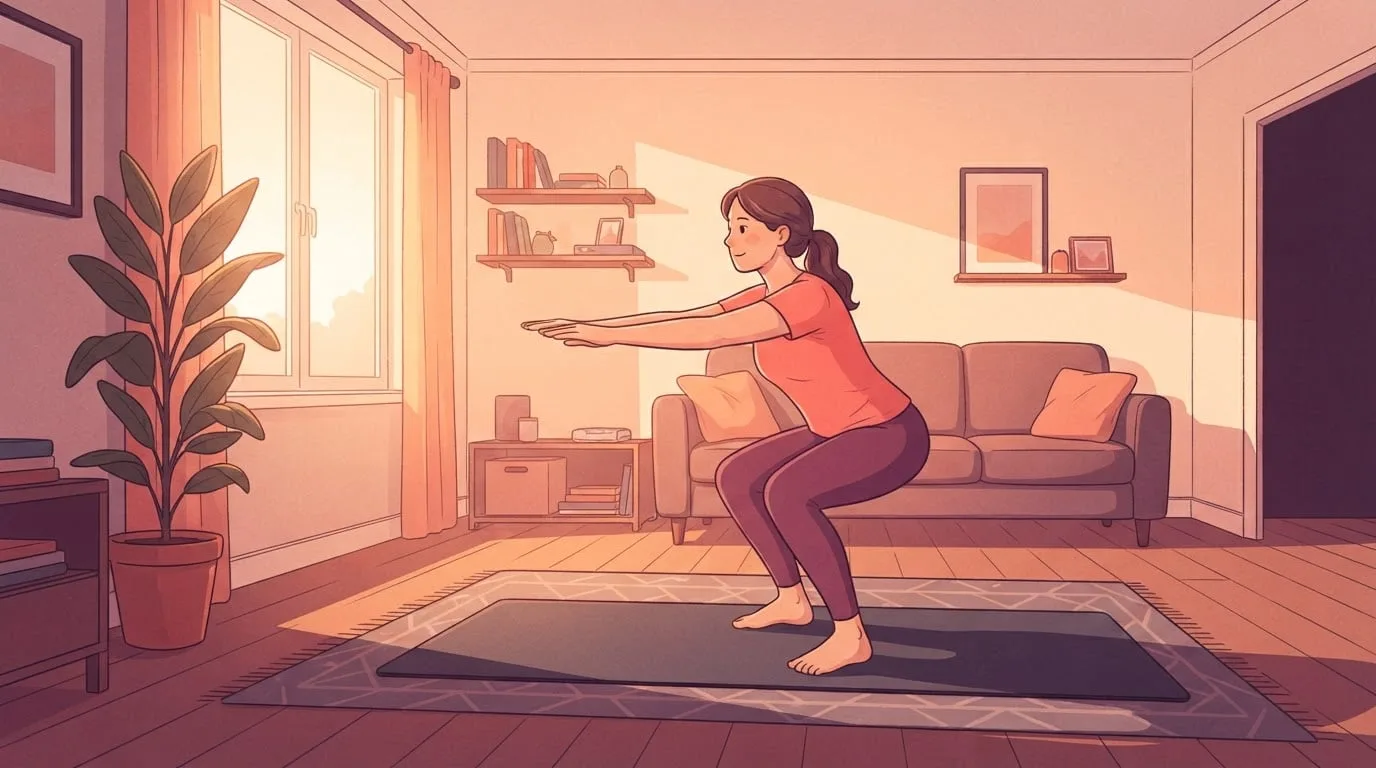
You meant to work out today. Then the morning ran long, the evening filled up, and the 45-minute session you planned never got a slot. A 10 minute workout fits the gap you actually have: before your shower, while the coffee brews, or after the kids are in bed. These are at home workouts you can follow along with, with or without dumbbells.
The hard part is the voice that says a short session doesn't count, so skipping it costs nothing. That all-or-nothing rule quietly ends more routines than any lack of time does, and every skipped day makes the next one easier to skip.
Ten minutes counts. Below are six follow-along routines sorted by goal and level, with exact work and rest times. Then you get the research on why sessions this short work, how to stack them into a week, and what changes when you have 15 minutes.
The 6 Best 10 Minute Workouts at Home
Pick by goal and by what you own. Every routine takes 10 minutes, and the first round doubles as your warm-up: do it at about 70 percent effort, then push the rest. Any interval timer works for keeping time.
| # | Workout | Best for | Level | Equipment | Format |
|---|---|---|---|---|---|
| 1 | Low-impact full body | Starting out, sore joints | Beginner | A sturdy chair | 40 sec on, 20 sec off, 5 moves, 2 rounds |
| 2 | Bodyweight full body | Strength and muscular endurance | Intermediate | None | 45 sec on, 15 sec off, 5 moves, 2 rounds |
| 3 | 30/30 cardio circuit | Conditioning and calorie burn | Intermediate | None | 30 sec hard, 30 sec easy, 10 rounds |
| 4 | One-minute sprint session | Aerobic fitness in the least time | Intermediate to advanced | None, or a staircase | 3 all-out 20-sec sprints inside 10 min |
| 5 | Dumbbell full-body EMOM | Strength and muscle | All levels | A pair of dumbbells | 5 moves, a new set each minute, 2 rounds |
| 6 | Dumbbell AMRAP | Conditioning with weights | Advanced | One or two dumbbells | As many rounds as possible in 10 min |
1. Low-impact full body (beginner, no equipment)
Work for 40 seconds, rest for 20, and go through the five moves twice. There's no jumping, and every move has an easier version.
- Chair squat. Stand in front of a sturdy chair, sit your hips back until you lightly touch the seat, then stand up tall. Our squat page covers foot position and depth.
- Incline push-up. Put your hands on a kitchen counter or a heavy table, walk your feet back until your body is straight, and lower your chest to the edge. The higher the surface, the easier the incline push-up gets.
- Glute bridge. Lie on your back with your knees bent, then press through your heels to lift your hips until your body makes a straight line from knees to shoulders. Pause for a second at the top of each glute bridge.
- Marching in place. Lift your knees toward hip height and swing your arms. Speed up for the last 10 seconds.
- Bird dog. On your hands and knees, reach one arm forward and the opposite leg back, hold for two seconds, and switch. Keep your back still while your arm and leg move.
This is the 10 minute workout for beginners at home that we'd hand anyone, women and men alike. The moves are the same for everyone, and you set the effort by how fast you move and how deep you go. When 40 seconds of each feels comfortable for a whole week, move up to workout 2.
2. Bodyweight full body (intermediate, no equipment)
Work for 45 seconds, rest for 15, two rounds. This 10 minute workout with no equipment trains every major muscle group except the upper back, which needs something to pull.
- Squat. Sit your hips back and down until your thighs are at least parallel to the floor, then drive up.
- Push-up. Hands under your shoulders, body straight from head to heels. Drop to your knees when your form slips, using the kneeling push-up.
- Alternating reverse lunge. Step one foot back, lower until both knees bend to about 90 degrees, and push back up. The reverse lunge is easier on the knees than a forward lunge.
- Plank shoulder tap. From a high plank, tap your left shoulder with your right hand, then switch, with your feet wide and your hips still.
- Superman hold. Lie face down and lift your arms, chest and legs a few inches off the floor for 3 seconds, then lower. Repeat for the full 45 seconds.
3. 30/30 cardio circuit (conditioning)
Ten rounds of 30 seconds hard and 30 seconds easy, cycling through these five moves twice. On the easy half, march in place rather than standing still. This is the at home cardio workout for days when you want to sweat.
- Jumping jacks.
- Mountain climbers. Drive your knees toward your chest from a high plank, fast.
- Squat jumps. Squat to parallel, jump, and land softly back into the next squat.
- High knees. Run in place with your knees at hip height.
- Burpees. Squat, jump or step back to a plank, return, and stand or jump up. Our burpee page shows the step-back version.
Low-impact swaps: step jacks instead of jumping jacks, slow mountain climbers, squats with a calf raise instead of jumps, marching high knees and step-back burpees. Our guide to low impact cardio at home has more swaps that keep your heart rate up with no landing.
If fat loss is your goal, intervals like these mainly save time. Wewege and colleagues (2017), in Obesity Reviews, pooled 13 trials in adults with overweight or obesity and found that high-intensity intervals and steady moderate cardio reduced body fat by similar amounts. The intervals simply got there in less time.
4. One-minute sprint session (intermediate to advanced)
This is a bodyweight version of the 10-minute protocol tested by Gillen and colleagues (2016), covered in the research section below. Only one minute is hard, so that minute has to be truly all-out.
| Time | What to do |
|---|---|
| 0:00 to 2:00 | Easy warm-up: march, then jog in place |
| 2:00 to 2:20 | All-out sprint 1: high-knee run in place as fast as you can, or run up a flight of stairs |
| 2:20 to 4:20 | Easy: walk or march |
| 4:20 to 4:40 | All-out sprint 2 |
| 4:40 to 6:40 | Easy: walk or march |
| 6:40 to 7:00 | All-out sprint 3 |
| 7:00 to 10:00 | Cool-down: walk, then slow your breathing |
The last five seconds of each sprint should feel like you couldn't hold it for ten more. If you have stairs, fast stair climbs work too. In a small trial, sedentary young adults who climbed three flights of stairs vigorously three times a day, three days a week, raised their aerobic fitness after 6 weeks (Jenkins et al., 2019). If you've been inactive for months, do the other routines for a few weeks before you try all-out sprints.
5. Dumbbell full-body EMOM (strength and muscle)
EMOM means every minute on the minute: start a set at the top of each minute and rest for whatever time is left. Five moves, two rounds, 10 minutes and 10 hard sets. This is the 10 minute workout with weights to choose if strength is your goal.
| Minute | Exercise | Reps |
|---|---|---|
| 1 and 6 | Goblet squat | 10 |
| 2 and 7 | Dumbbell chest press on the floor or a bench | 10 |
| 3 and 8 | One-arm dumbbell row | 8 per side |
| 4 and 9 | Dumbbell Romanian deadlift | 10 |
| 5 and 10 | Standing dumbbell shoulder press | 8 |
Pick dumbbells you could lift about 12 times. That way 10 reps end hard but clean, which is the range where short sessions still build muscle. When every set feels easy for two sessions in a row, add two reps or move up a weight.

6. Dumbbell AMRAP (conditioning with weights, advanced)
AMRAP means as many rounds as possible. Set 10 minutes and cycle through the four moves without planned rest, resting only when you need to. Note your rounds and try to beat them next time.
- 10 dumbbell swings, holding one dumbbell by one end and driving it forward with your hips.
- 8 dumbbell push presses, dipping your knees and using your legs to help press.
- 8 alternating reverse lunges, a dumbbell in each hand or one at your chest.
- 6 renegade rows, three per side, from a high plank on the dumbbells with your feet wide.
Use lighter dumbbells than in the EMOM. Your form on the last round should look like your form on the first, and a sloppy swing is the move most likely to tweak your lower back.
Can a 10 Minute Workout Be Effective?
Yes. A 10 minute workout improves fitness, strength and health markers when the effort is high enough, and some of the best trials on short training tested sessions this short or shorter.
Aerobic fitness: 10 minutes matched 50
Gillen and colleagues (2016), in PLOS ONE, trained 27 sedentary men three times a week for 12 weeks. One group did 10-minute sessions: a 2-minute warm-up, three 20-second all-out cycling sprints separated by 2 minutes of easy pedaling, and a 3-minute cool-down. The other group did 50-minute sessions built around 45 minutes of steady cycling at about 70 percent of maximum heart rate. Aerobic fitness rose 19 percent in both groups. Insulin sensitivity improved 53 percent after the short sessions and 34 percent after the long ones. The short group trained 30 minutes a week, the long group 150. The study was small, all men and done on bikes, and all-out sprints take real motivation, but it's the clearest evidence that a 10 minute workout can do a long session's job.
Bodyweight circuits: four minutes moved the needle
McRae and colleagues (2012), in Applied Physiology, Nutrition, and Metabolism, put 22 recreationally active women through 4 weeks of training, four days a week. One group did 30 minutes on a treadmill at about 85 percent of maximum heart rate. The other did 4-minute sessions: eight rounds of 20 seconds of burpees, jumping jacks, mountain climbers or squat thrusts with 10 seconds of rest. Aerobic fitness rose about 7 percent with the treadmill and about 8 percent with the 4-minute circuits. Only the circuit group improved muscular endurance, with push-ups up 135 percent and sit-ups up 64 percent. That's the logic behind workouts 2 and 3: a bodyweight circuit trains your heart and your muscles at once.
Strength: what a short session needs
Iversen, Norum, Schoenfeld and Fimland (2021), in Sports Medicine, reviewed how to train strength when time is short. Their advice: favor multi-joint exercises, include at least one squat-type leg exercise, one pull and one push, and do at least 4 hard sets per muscle group each week in the 6 to 15 rep range. Pairing exercises back to back roughly halves session time without losing volume. The dumbbell EMOM follows that design. Two sessions a week give each muscle group 4 hard sets.
Strength work also pays off well beyond the mirror. Momma and colleagues (2022), in the British Journal of Sports Medicine, pooled 16 cohort studies and found muscle-strengthening activity linked with a 10 to 17 percent lower risk of early death, cardiovascular disease, cancer and diabetes. The largest reduction sat at about 30 to 60 minutes a week, which is three to six 10-minute dumbbell sessions. These are associations from observational data, not proof of cause.
Our guide to quick workouts covers the broader research on 15 to 20 minute sessions and the minimum dose for strength, so this page sticks to the 10 minute format.
Find out what's really holding you back
FitCraft, our mobile fitness app, pairs you with an AI coach who builds you a personalized plan around your goals, schedule, and fitness level. Every FitCraft program is designed by Domenic Angelino, MPH (Brown University) and NSCA-CSCS, with research published in the Journal of Strength and Conditioning Research and Medicine & Science in Sports & Exercise.
Take the Free Assessment Free • 2 minutes • No credit cardIs 10 Minutes of Exercise a Day Enough?
For general health, 10 minutes of exercise a day gets you a large share of the benefit, though not all of it. Ten minutes a day is 70 minutes a week. The WHO 2020 guidelines (Bull et al., 2020) recommend 150 to 300 minutes of moderate activity or 75 to 150 minutes of vigorous activity a week, plus muscle strengthening on at least two days.
The first minutes count the most. Garcia and colleagues (2023), in the British Journal of Sports Medicine, pooled 94 cohorts with more than 30 million people. Compared with no activity, 75 minutes a week of moderate activity, half the guideline, was linked with a 23 percent lower risk of early death. The full 150 minutes was linked with 31 percent. So half the dose bought about three quarters of the benefit.
Intensity stretches your 10 minutes further. Routines 3 and 6 are vigorous throughout, and 70 vigorous minutes a week sits just under the WHO's 75-minute minimum. If your goal is fat loss or building muscle, more training helps, and it doesn't have to come in one block. Murphy and colleagues (2019) pooled 19 studies with 1,080 participants and found that splitting exercise into short bouts improved aerobic fitness and blood pressure as much as one continuous session of the same total time. A second 10 minute workout after dinner counts.
What Is the Shortest Most Effective Workout?
The shortest workout with strong trial evidence is about one minute of all-out effort inside a 10-minute session, which is workout 4 above. Below that, the evidence comes from everyday movement rather than training.
Stamatakis and colleagues (2022), in Nature Medicine, gave wrist devices to 25,241 adults in the UK Biobank who said they didn't exercise, and followed them for about 7 years. People who did a median of three short bursts of vigorous activity a day, each lasting 1 to 2 minutes, had a 38 to 40 percent lower risk of death from all causes and from cancer, and a 48 to 49 percent lower risk of death from heart disease, than people with no bursts. The bursts were things like fast stair climbing and brisk walking with shopping bags. It's observational data, so it can't prove the bursts caused the difference. Our page on exercise snacks and cancer risk covers the companion cancer study.
Short only works when it's hard. If all-out sprints aren't for you, a 10 minute workout at a steady hard effort, like workout 2 or 5, is the better trade.
How to Build a Week of 10 Minute Workouts
Rotate the routines so no muscle group or energy system gets hammered two days running. Here's a week that covers strength and cardio in 10 minutes a day:
| Day | Workout | What it trains |
|---|---|---|
| Monday | 5. Dumbbell EMOM | Strength, whole body |
| Tuesday | 3. 30/30 cardio circuit | Conditioning |
| Wednesday | 2. Bodyweight full body (or 1 if you're new) | Strength and endurance |
| Thursday | 4. One-minute sprint session | Aerobic fitness |
| Friday | 5. Dumbbell EMOM | Strength, second dose |
| Saturday | 6. Dumbbell AMRAP, or a long walk | Conditioning with weights |
| Sunday | Rest or an easy walk | Recovery |
That's about 30 minutes of strength work a week, the bottom of the range Momma's analysis linked with the largest benefit, plus two or three hard cardio sessions. If five days is too many right now, do Monday, Wednesday and Friday and nothing else. Three short sessions you actually do beat five you plan and skip.
Time of day matters less than you'd think. Our review of the best time to work out found little difference in strength or health gains between morning and evening training. What helps is doing it at the same point in your day, tied to something you already do, like your first coffee.
FitCraft's strength workouts use dumbbells and bodyweight, and an AI coach demonstrates each move on an interactive 3D model you can rotate and zoom. Workouts adjust as you progress, and streaks and leaderboards give you a reason to show up on the days 10 minutes feels like too much. If you're weighing apps for a packed schedule, our roundup of the best workout apps for busy professionals compares the options, FitCraft included.
How to Make a 10 Minute Workout Harder
A 10 minute workout stops working when it stops being hard. You don't need more time to keep progressing. Change one of these each week:
- The clock. Move from 40 seconds on and 20 off to 45 and 15, then 50 and 10.
- The move. Incline push-up to push-up to decline push-up. Chair squat to squat to split squat.
- The load. Heavier dumbbells, or the same dumbbells with a 3-second lowering phase.
- The score. Beat last week's AMRAP rounds by half a round.
- The rounds. Add a third round, and your 10 minute workout becomes a 15 minute workout.
15 Minute Workout: What Five More Minutes Buy You
A 15 minute workout is a 10 minute workout with a third round, and that round is 50 percent more work for 5 more minutes. Here's how to spend the extra time in each routine:
- Circuits 1, 2 and 3: do a third round. The first round is still your warm-up, so two of your three rounds are now hard.
- Dumbbell EMOM: run it for 15 minutes, three sets per move. Twice a week, that's 6 hard sets per muscle group, above the minimum of 4 in the Iversen review.
- Sprint session: keep the sprints at three and spend the extra 5 minutes walking or stretching. The trial didn't test more sprints, and more all-out efforts aren't automatically better.
- Dumbbell AMRAP: extend it to 15 minutes, or keep it at 10 and add 5 minutes of core work.
Parents juggling naps and school runs will find more 15-minute session plans in our guide to 15-minute workouts for busy parents.
Who Should Adjust These Workouts
- New to exercise or coming back after months off: start with workout 1 for two weeks, and add the sprint session only once the others feel routine.
- Sore knees, hips or a heavy body: use the low-impact swaps in workout 3 and skip squat jumps and burpee jumps.
- Pregnant or recently postpartum: get clearance from your own clinician first, and skip jumping and all-out sprints until they agree.
- Heart disease, high blood pressure or chest pain with effort: talk to your doctor before any all-out interval work.
The Bottom Line
A 10 minute workout is a real workout when it's hard enough and you repeat it. Pick the routine that matches your goal, do the first round as a warm-up, and rotate strength and cardio across the week. Ten minutes a day covers a large share of the health benefit of exercise, and a 15 minute workout adds a third round when you have the time.
Jim, 26, who lost 24 pounds in three months with FitCraft, described the moment most people miss: "I kept telling myself I'd start Monday. FitCraft made me start on a Wednesday and I haven't stopped." A 10 minute workout makes that kind of start possible, because there's always time for 10 minutes.
Frequently Asked Questions
Can a 10 minute workout be effective?
Yes, if the effort is high enough. In a 12-week trial, three 10-minute sessions a week containing one minute of all-out sprinting raised aerobic fitness by 19 percent, the same gain as three 50-minute sessions of steady cycling. Short dumbbell sessions build strength as long as each set ends close to failure.
What is the best 10 minute workout?
The best 10 minute workout depends on your goal. For strength and muscle, do a dumbbell EMOM of five compound moves. For conditioning, do 10 rounds of 30 seconds hard and 30 seconds easy. If you're starting out, do a low-impact bodyweight circuit of chair squats, incline push-ups, glute bridges, marching and bird dogs.
Is 10 minutes of exercise a day enough?
For general health, 10 minutes a day gets you a large share of the benefit. Ten minutes a day is 70 minutes a week, and a 2023 meta-analysis of 94 cohorts linked 75 minutes a week of moderate activity with a 23 percent lower risk of early death. The WHO still recommends 150 to 300 moderate minutes a week plus two strength days, so more is better if you can fit it.
What is the shortest most effective workout?
The shortest workout with strong trial evidence is three 20-second all-out sprints inside a 10-minute session, done three times a week. It matched 45 minutes of steady cycling for aerobic fitness over 12 weeks. It only works if the sprints are truly all-out, so it suits people who are already reasonably fit.
What exercise burns the most fat in the shortest time?
Hard intervals burn the most calories per minute, so they're the most time-efficient choice. A 2017 meta-analysis of 13 trials found high-intensity intervals and steady moderate cardio reduced body fat by similar amounts, with the intervals taking less time. Fat loss itself still depends on your total weekly energy balance, so diet matters more than the type of exercise.
What is the best time of day to exercise?
The best time of day to exercise is the time you can repeat. Reviews find little difference in strength or health gains between morning and evening training. A 10 minute workout is easiest to keep when it's tied to something you already do every day, like your morning coffee.
Is a 15 minute workout enough?
Yes. A 15 minute workout lets you add a third round to any 10-minute circuit, which is 50 percent more work. Three rounds of a five-move dumbbell routine, twice a week, gives each muscle group 6 hard sets a week, above the minimum of 4 that researchers recommend for building strength and muscle.
Can I do a 10 minute workout every day?
Yes, if you rotate the type. Alternate strength days and cardio days, and keep all-out sprint sessions to two or three a week with an easier day between them. A short walk or a low-impact circuit is fine every day.