Muscles Worked
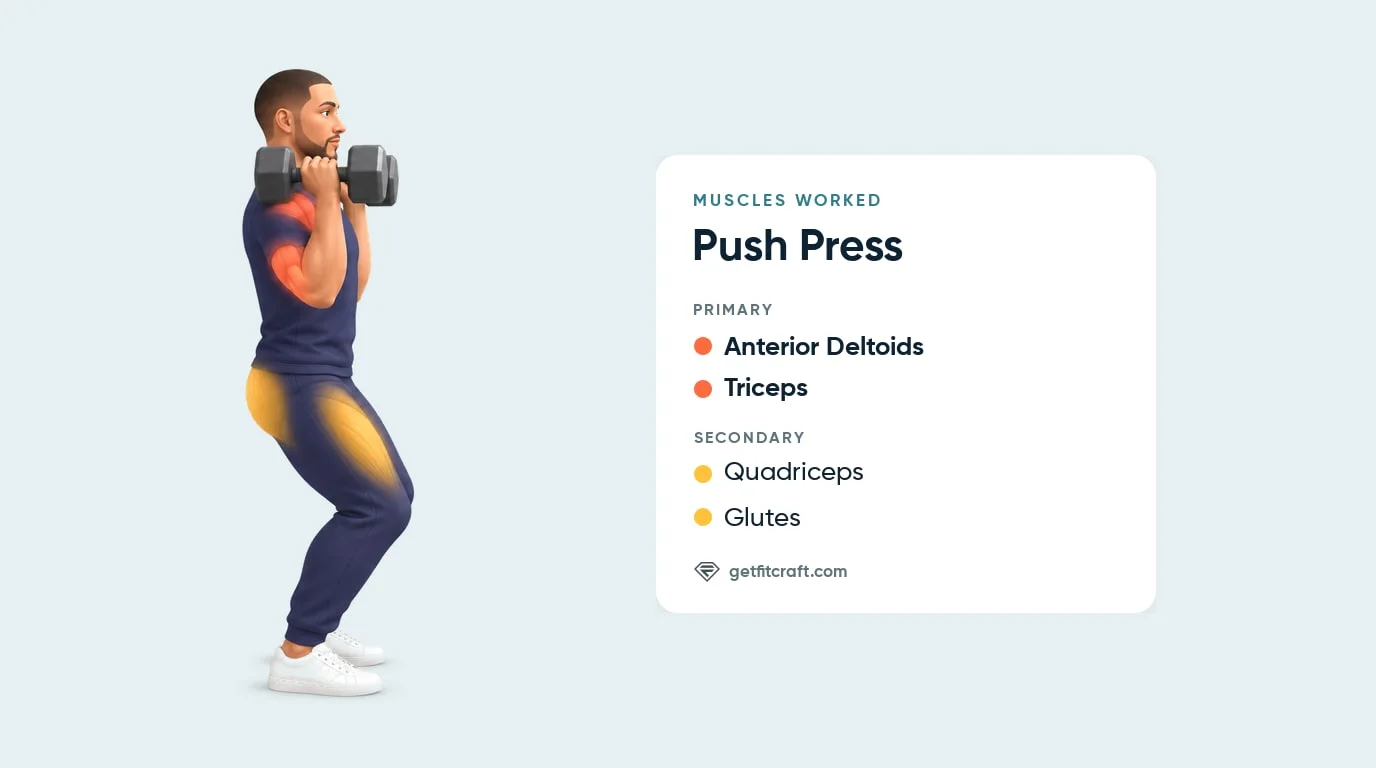
Primary movers. The anterior (front) deltoids and the triceps brachii do the overhead half of the movement. As the leg drive launches the dumbbells off your shoulders, the front of each shoulder lifts your upper arm up and overhead, and the triceps, at the back of your upper arm, straighten your elbow to finish the press. Both also control the dumbbells on the way back down to your shoulders.
Secondary movers: the leg drive. The quadriceps, at the front of your thighs, and the glutes control the short dip, then straighten your knees and hips fast to start the dumbbells moving off your shoulders. That fast leg drive is what separates the push press from a strict press.
Why the legs help. A strict press is hardest partway up. In the push press, the leg drive gets the dumbbells moving and helps them past that hardest part, and your shoulders and triceps finish the press overhead. So the exercise trains you to produce force fast and in sequence: legs first, arms second.
The push press trains you to produce force quickly, with a pair of dumbbells.
Timing matters most: your legs drive first and your arms press second, with your core braced. If you press too early it becomes a strict press, and if you dip too deep it becomes a squat. The steps below show the order.
Quick Facts: Dumbbell Push Press
- Equipment needed: A pair of dumbbells, or one dumbbell for the single-arm version
- Difficulty: Advanced (as rated in the FitCraft app); the single-arm version is rated Expert. Learn the standing shoulder press (Intermediate) first.
- Modality: Compound · Power · Vertical push
- Body region: Front of the shoulders and triceps, with the fronts of the thighs and the glutes driving the dip
How to Do the Dumbbell Push Press (Step-by-Step)
This guide covers the dumbbell version. If you train in a gym, the barbell push press follows the same dip-drive-press sequence with a single bar racked across the front of the shoulders.
- Set the rack position. Stand with your feet about hip- to shoulder-width apart and flat on the floor. Hold a dumbbell at the front of each shoulder with your palms facing each other (palms turned partly forward also works), elbows bent under your wrists and pointing down and forward. Stand tall, brace your core and keep your weight over your whole foot.
Breathe in and brace before every dip.
- Dip. Dip straight down into a short quarter squat, no deeper, by bending your knees and letting them travel forward over your toes. Your thighs stay angled steeply, far from level, while your torso stays vertical and your heels stay down. Think short and quick, and never sink toward a half squat.
Keep your knees in line with your toes and your heels on the floor.
- Drive. Reverse the dip at once, with no pause at the bottom, and drive up hard through your legs, pushing the floor away. The drive launches the dumbbells off your shoulders. Breathe out as you drive up.
Let your legs go first. Your arms start pressing as the weight lifts off your shoulders.
- Press overhead. As your legs straighten and the dumbbells leave your shoulders, press them straight overhead until your arms are straight or nearly straight and your biceps are near your ears. Squeeze your glutes and keep your ribs down so the finish is tall through the shoulders instead of arched through the lower back.
Finish tall with your ribs down, and never lean back to lock out. If you can only finish by leaning back, the dumbbells are too heavy.
- Lower and reset. Lower the dumbbells under control back to your shoulders in about a second (slower is fine), with straight legs or a slight knee bend. Never let them drop onto your shoulders. Stand tall for a moment to reset your brace if you need to, or flow straight into the next dip once the dumbbells are settled at your shoulders.
Use a weight you can move fast on every rep, and end the set when your reps slow down or your back arches.
Get this exercise in a personalized workout
FitCraft, our mobile fitness app, uses an AI coach to program compound strength exercises like this into your plan at the right volume and intensity, based on your level, goals, and equipment. Every FitCraft program is designed by Domenic Angelino, MPH (Brown University) and NSCA-CSCS, with research published in the Journal of Strength and Conditioning Research and Medicine & Science in Sports & Exercise.
Take the Free Assessment Free · 2 minutes · No credit card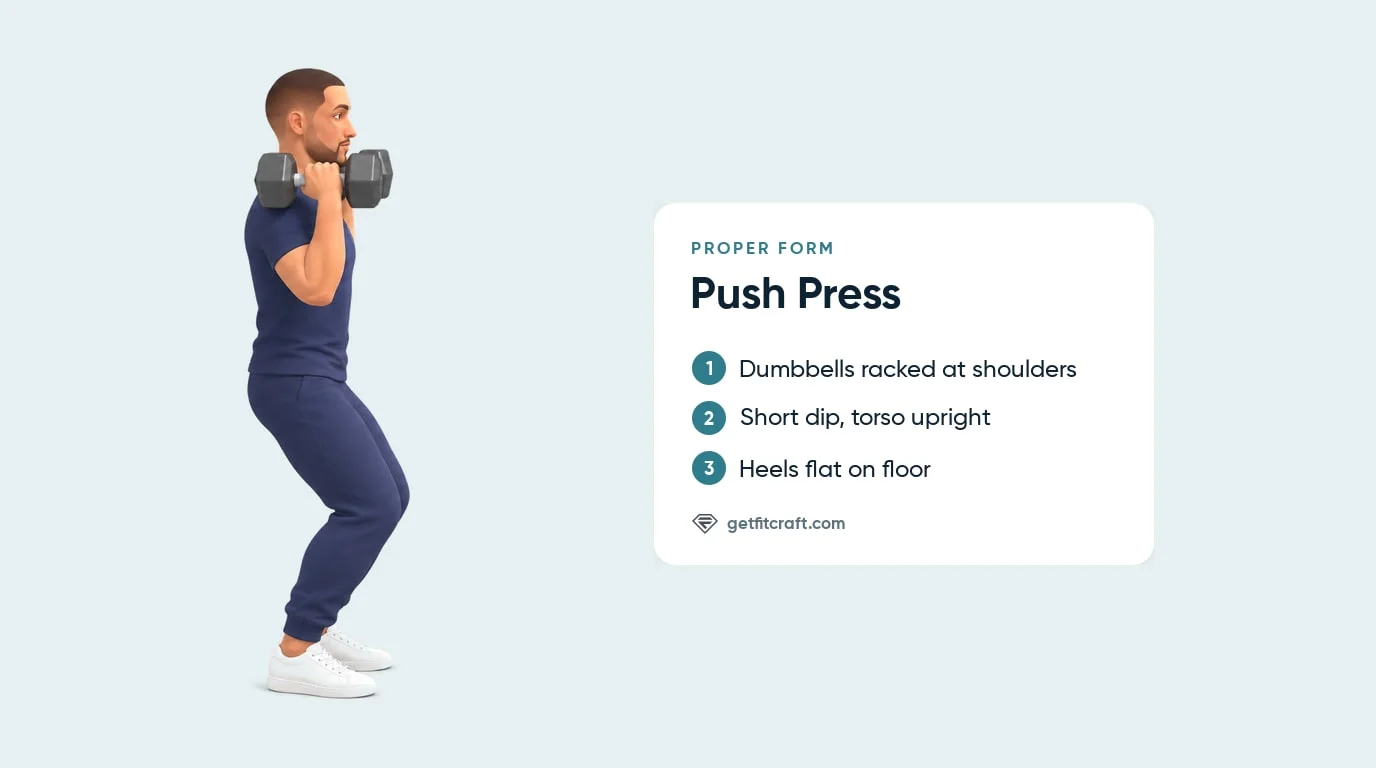
Common Mistakes to Avoid
These are six common push press mistakes and how to fix them.
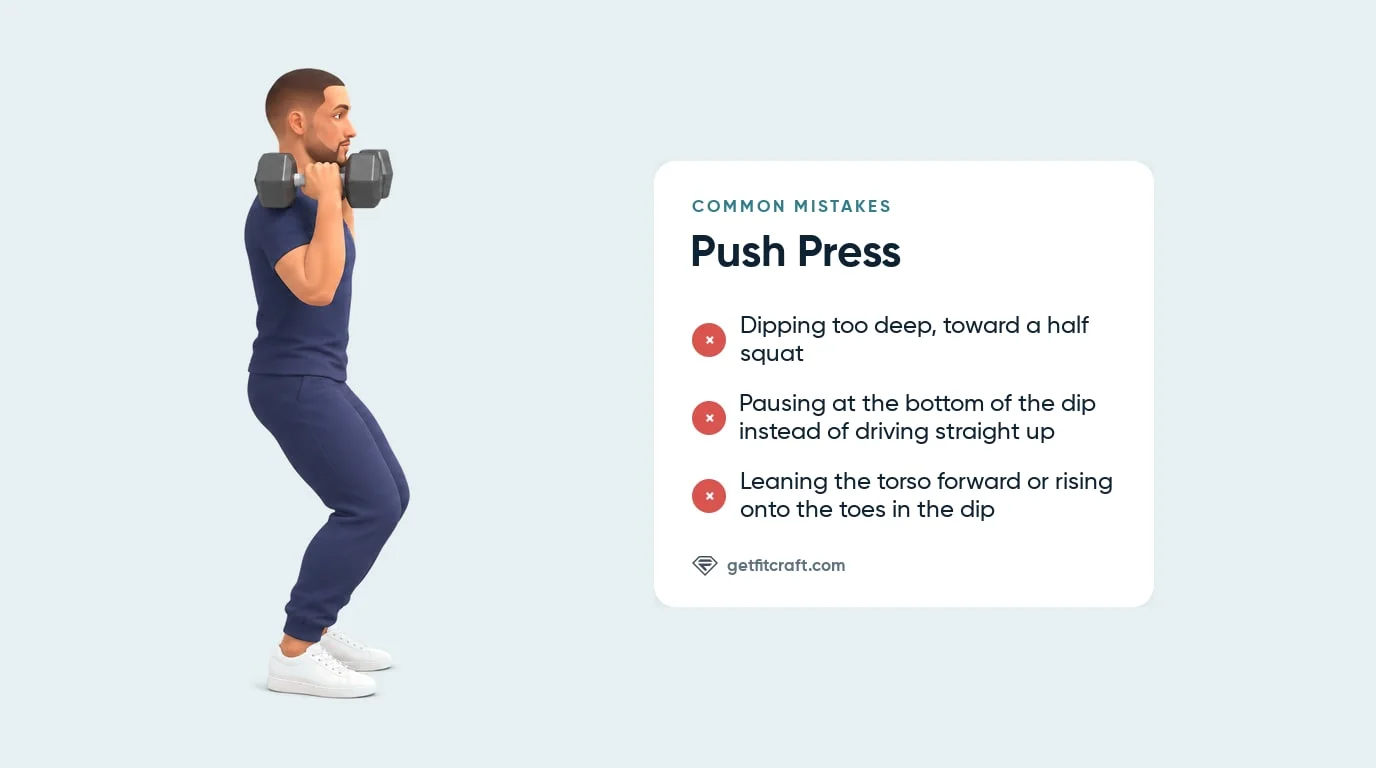
- Dipping too deep. Sinking toward a half squat before the drive slows the change of direction, so the legs can no longer launch the dumbbells quickly. Fix: keep the dip short, a quarter squat at most, with your thighs still angled steeply, and keep it quick.
- Pausing at the bottom of the dip. Stopping in the dip loses the quick change of direction that launches the dumbbells. Fix: dip and drive in one continuous, quick motion. A brief reset standing tall between reps is fine.
- Leaning forward or rising onto your toes in the dip. The torso tips forward or the heels lift, so the drive pushes the dumbbells forward instead of up. Fix: dip straight down with your knees travelling forward over your toes, your torso vertical and your heels on the floor.
- Pressing before the legs drive. The arms start pressing during the dip, before the legs have reversed and driven, which wastes the leg drive and turns the lift into a sloppy strict press. Fix: think "legs, then arms." Start pressing as your legs straighten and the dumbbells lift off your shoulders.
- Arching your lower back or leaning back to finish. The ribs flare and the lower back arches to get the dumbbells overhead. Fix: squeeze your glutes at the top, keep your ribs stacked over your pelvis, and finish with your arms straight or nearly straight and your biceps near your ears. If you can only finish by arching, the dumbbells are too heavy.
- Leaning sideways on the single-arm version. With one dumbbell, the body tips away from the weight or the shoulders tilt. Fix: brace your core and keep your shoulders level, stacked over your hips. If you still lean, use a lighter dumbbell.
Push Press Variations: Regressions and Progressions
Learn the strict press before you add speed.
Dumbbell Shoulder Press (Prerequisite / Regression)
The strict standing version with no dip and no leg drive, rated Intermediate in the FitCraft app. Get comfortable pressing smoothly overhead with no back arch before you add the dip and drive.
Seated Dumbbell Press (Regression)
Pressing from a bench with back support takes away the leg drive and most of the balance demand, so you can practice the press path. It is an easier option outside the FitCraft app, useful if you lose your balance or cannot keep your core braced standing up.
Standard Dumbbell Push Press (The Benchmark)
The version this guide describes: two dumbbells, a short dip, a fast drive and a tall finish overhead. The FitCraft app rates it Advanced.
Single-Arm Dumbbell Push Press (Progression)
Hold one dumbbell at the front of one shoulder and use the same dip and drive, while your free arm hangs relaxed or floats out a little to the side for balance. The FitCraft app rates it Expert. With the weight on one side, your body has to work harder to keep your shoulders level, so keep them level and do not lean away from the weight. Do all your reps on one side, then the same number on the other.
Dumbbell Push Jerk (A Different Lift)
Instead of finishing the press with your arms, you re-bend your knees and drop under the dumbbells to catch them overhead, then stand. It is a different lift that takes more skill, and it is not in the FitCraft app. Learn the push press timing first.
When to Avoid or Modify the Push Press
The conditions below call for a doctor's or physical therapist's advice before you do the push press. A burn in the fronts of your shoulders, the backs of your arms, the fronts of your thighs or your glutes is normal; any pain in a joint, your lower back or your neck means stop the exercise. Always consult your physician or a qualified physical therapist before starting or returning to any exercise program.
- Shoulder impingement or pain with overhead reach. Any pain or pinching in your shoulder means stop. Get checked by a doctor or physical therapist before you press overhead again, and follow their advice.
- Limited overhead mobility. If tight shoulders or a stiff upper back keep your arms from finishing overhead, your lower back arches to make up the range. Do not push press until you can press overhead without arching. Ask a physical therapist how to improve your overhead reach, and stop at any pain in a joint, your lower back or your neck.
- Uncontrolled hypertension or cardiovascular disease. Explosive overhead lifts with a hard brace can raise blood pressure. Ask your doctor or cardiologist before you do this exercise, and follow their advice. Never hold your breath: breathe out as you drive the weight up.
- Lower-back pain or a disc problem. Any pain in your lower back means stop. Get checked by a doctor or physical therapist before you do this exercise again.
- Pregnancy or recent childbirth. Ask your doctor, midwife or physical therapist before you do this exercise, and follow their advice.
- Recent shoulder, elbow, wrist, knee, or spine surgery. Do not do this exercise until your surgeon, doctor or physical therapist clears you for it.
Related Exercises
- Overhead pressing family: shoulder press, Arnold press, overhead tricep press
- Bodyweight vertical push: pike push-ups
- Leg-drive pattern builders: squats, goblet squats, jump squats
- Shoulder isolation accessories: lateral raises, front raises
- Core foundation for the overhead brace: deadbugs, forearm planks
- Pulling partner (for balanced programming): bent-over rows, pull-aparts
How to Program the Push Press
The ACSM Position Stand on resistance training (Ratamess et al., 2009) trains power with light loads moved fast, with an emphasis on multiple-joint exercises. It gives no push press ranges, so the table below is a practical starting point. Push presses reward speed and full recovery. Grinding slow reps to failure defeats the point of the exercise.
| Version | Sets × Reps | Rest between sets | Frequency |
|---|---|---|---|
| Easier (lighter dumbbells, learning the timing) | 2-3 × 8-10 | 90-120s | 2 sessions/week |
| Advanced (the two-dumbbell push press, as rated in the app) | 3-4 × 6-8 | 120-180s | 2-3 sessions/week |
| Expert (the single-arm push press, as rated in the app) | 3-5 × 5-8 | 120-180s | 2-3 sessions/week |
Where in your workout. Do push presses first or second in your session, while you are fresh, so every rep stays fast. Then do strict pressing or incline work, and finish with smaller shoulder exercises like lateral raises.
Stop when form slips. The set ends when the dip gets deep, your reps slow down, the finish needs a lean-back, or the two dumbbells stop finishing together. Any pain in a joint, your lower back or your neck means stop.
How FitCraft Programs This Exercise
FitCraft decides when your strict press is ready for the push press and where it fits next to your strength work.
FitCraft starts with a free assessment that maps your fitness level, goals, and available equipment, then builds a personalized plan. The app has the push press with two dumbbells, rated Advanced, and a single-arm version for each side, rated Expert, and can include them in your plan; its 3D demonstration shows the dip, the drive and the press.
The app also has the standing shoulder press, the strict version with no dip, rated Intermediate.
Frequently Asked Questions
Can I do the push press with shoulder pain?
No. Any pain in your shoulder means stop the exercise. A burn in the fronts of your shoulders or the backs of your arms is normal, but pain in the joint is not. Get checked by a doctor or physical therapist before you press overhead again, and follow their advice.
What is the difference between a push press and a shoulder press?
The difference is the leg drive. A strict shoulder press starts from a dead stop, and your shoulders and triceps do all the work. A push press adds a short knee dip and a fast leg drive that launches the dumbbells off your shoulders and helps them past the hardest part of the press, and then your arms finish it overhead. The push press also trains you to produce force fast, in sequence, from the legs up through the arms. The FitCraft app rates the standing shoulder press Intermediate and the two-dumbbell push press Advanced.
What muscles does the dumbbell push press work?
The anterior deltoids, at the front of your shoulders, and the triceps, at the back of your upper arms, are the main muscles: they press the dumbbells overhead and straighten your elbows to finish. The quadriceps, at the front of your thighs, and the glutes are the secondary muscles: they control the dip and then straighten your knees and hips fast to launch the weight. You should feel it mostly in the fronts of your shoulders and the backs of your arms, not in your lower back or neck.
How heavy should dumbbells be for the push press?
Use dumbbells you can move fast on every rep and still finish tall overhead with no lean back. Start light while you learn the timing of the dip and drive. Once the timing is smooth, move up to slightly heavier dumbbells only while every rep stays fast and finishes tall. End the set when your reps slow down or your back arches.
Is the push press good for building power?
Yes, that's its purpose. The push press trains your knees and hips to straighten fast and pass that force up through a braced body into the press, legs first and arms second. The ACSM position stand on resistance training builds power with light loads moved fast, with an emphasis on multiple-joint exercises, so program the push press with crisp, fast reps and full recovery between sets rather than grinding to failure.