
You've probably heard two opposite rules. One says breakfast is the most important meal of the day, so never skip it. The other says skip it, stretch your overnight fast and watch the weight come off. Both get repeated with total confidence, and they can't both be right.
So you second-guess the most routine meal of your day. You eat breakfast and worry about the calories, or you skip it and worry that you've slowed your metabolism. By 11 a.m. you're in the office snack drawer either way.
Breakfast happens to be one of the most carefully tested meals in nutrition research. Below is what the randomized trials found, what a breakfast that helps a calorie deficit looks like at different calorie levels, and how to tell whether skipping it works for you. If you came for a low calorie high protein breakfast, that's covered too.
Does Eating Breakfast Help You Lose Weight?
Not by itself. The belief that breakfast eaters stay slimmer comes mostly from observational studies, which compare people who already eat breakfast with people who don't. Breakfast eaters tend to differ in other ways too, from sleep to smoking to exercise, so those studies can't show that breakfast is the cause.
Randomized trials can. A 2019 review in the BMJ by Sievert and colleagues collected 13 of them from high-income countries. Seven measured body weight and ten measured calorie intake. On average, adults told to eat breakfast ended up 0.44 kg heavier than adults told to skip it, and they took in roughly 260 calories more per day. The authors concluded that adding breakfast may not be a good weight-loss strategy, whatever your usual habit.
Those numbers come with caveats. Follow-up averaged seven weeks for weight and two weeks for intake, and every trial had a high or unclear risk of bias in at least one area. So the 0.44 kg is small and uncertain. What the review doesn't contain is any sign that breakfast helps.
The largest single trial tested the advice itself. Dhurandhar and colleagues (2014) randomly assigned 309 adults with overweight or obesity who were trying to lose weight to one of three groups for 16 weeks: eat breakfast, skip breakfast, or no breakfast advice at all. More than 92% said they followed their assignment. Weight loss in every group landed between about 0.5 and 0.8 kg, with no meaningful difference between them, whether people started out as breakfast eaters or skippers.
What Happened When Adults Fasted Until Noon
The Bath Breakfast Project in England measured every part of energy balance, not just weight. In the first trial, Betts and colleagues (2014) randomized 33 lean adults to eat at least 700 calories before 11 a.m. every day or to eat nothing until noon, for six weeks.
The breakfast group ate about 539 more calories a day. Skipping breakfast didn't slow anyone's metabolism: resting metabolic rate stayed within 11 calories a day between the groups. The difference showed up in movement. The breakfast eaters burned about 442 more calories a day through physical activity, and body weight and body fat ended up the same in both groups. Blood sugar was steadier through the afternoon and evening on breakfast days.
The team then repeated the trial in 23 adults with obesity (Chowdhury and colleagues, 2016). This time breakfast raised activity only during the morning, by about 188 calories, and the people who fasted made up part of the missing food later in the day. Body weight and body composition still didn't differ, and resting metabolism stayed within 8 calories a day. One result favored breakfast: the insulin response to a glucose drink improved in the breakfast group and got worse in the fasting group.
Taken together, the Bath trials show that breakfast changes how you spend energy across the day more than how much you store. Breakfast eaters moved a little more, and skippers ate a little more later. Neither pattern came out ahead on the scale.

Does Breakfast Boost Your Metabolism?
Not in a way that shows up on the scale. Resting metabolism didn't change with breakfast in either Bath trial. Digestion is a different matter. Richter and colleagues (2020) gave 16 normal-weight men a large breakfast and a small dinner, or the reverse, for three days each. Digesting a meal burned 2.5 times more energy in the morning than the same meal in the evening, for both the big and the small meals. A small breakfast also left the men hungrier through the day and more drawn to sweets.
That sounds like a strong argument for big breakfasts. The longer trials don't find the effect in total daily burn, though. In the Ruddick-Collins trial described below, total energy expenditure measured with doubly labeled water was 2,871 calories a day on a big-breakfast diet and 2,846 on a big-dinner diet, a gap too small to be statistically meaningful.
Find out what's really holding you back
FitCraft, our mobile fitness app, pairs you with an AI coach who builds you a personalized plan around your goals, schedule, and fitness level. Every FitCraft program is designed by Domenic Angelino, MPH (Brown University) and NSCA-CSCS, with research published in the Journal of Strength and Conditioning Research and Medicine & Science in Sports & Exercise.
Take the Free Assessment Free • 2 minutes • No credit cardBig Breakfast or Big Dinner? What the Timing Trials Show
If your total calories are fixed, does it matter when you eat them? The most quoted trial says yes. Jakubowicz and colleagues (2013) put 93 women with overweight or obesity and metabolic syndrome on a 1,400-calorie diet for 12 weeks. One group ate 700 calories at breakfast, 500 at lunch and 200 at dinner. The other group swapped breakfast and dinner. The big-breakfast group lost 8.7 kg against 3.6 kg, their triglycerides fell by 33.6% while the big-dinner group's rose by 14.6%, and they reported less hunger.
That trial has a weakness. It reported the calories people were told to eat, not what they actually ate. If the big-breakfast plan was simply easier to follow, the extra loss could come from eating less rather than from timing itself.
Ruddick-Collins and colleagues (2022) tested that in a tightly controlled crossover trial. Thirty adults with overweight or obesity spent four weeks on each of two weight-loss diets with the same calories. One put 45% of the day's calories at breakfast and 20% at dinner, and the other did the reverse. Weight loss was the same, 3.33 kg on the big-breakfast diet and 3.38 kg on the big-dinner diet, and so was daily energy burn. The clear difference was appetite: people felt significantly less hungry on the big-breakfast diet.
The practical lesson is less exciting than the headlines, but it's useful. Front-loading your calories doesn't burn more fat. It may make a deficit easier to live with. If you're hungriest in the evening, a bigger breakfast and a lighter dinner are worth a two-week trial. If a big breakfast leaves you sluggish, or you simply aren't hungry in the morning, you lose nothing by eating more later.
How Many Calories Should Breakfast Be for Weight Loss?
There's no single number, because breakfast is a slice of your daily total. A practical range is 25 to 30% of the day's calories, or up to about 45% if you want to try the big-breakfast pattern from the Ruddick-Collins trial. If you don't know your daily number yet, the TDEE calculator estimates how much you burn, and a deficit starts below that.
| Daily calorie target | Breakfast at 25 to 30% | Big-breakfast pattern (about 45%) |
|---|---|---|
| 1,400 | 350 to 420 | about 630 |
| 1,600 | 400 to 480 | about 720 |
| 1,800 | 450 to 540 | about 810 |
| 2,000 | 500 to 600 | about 900 |
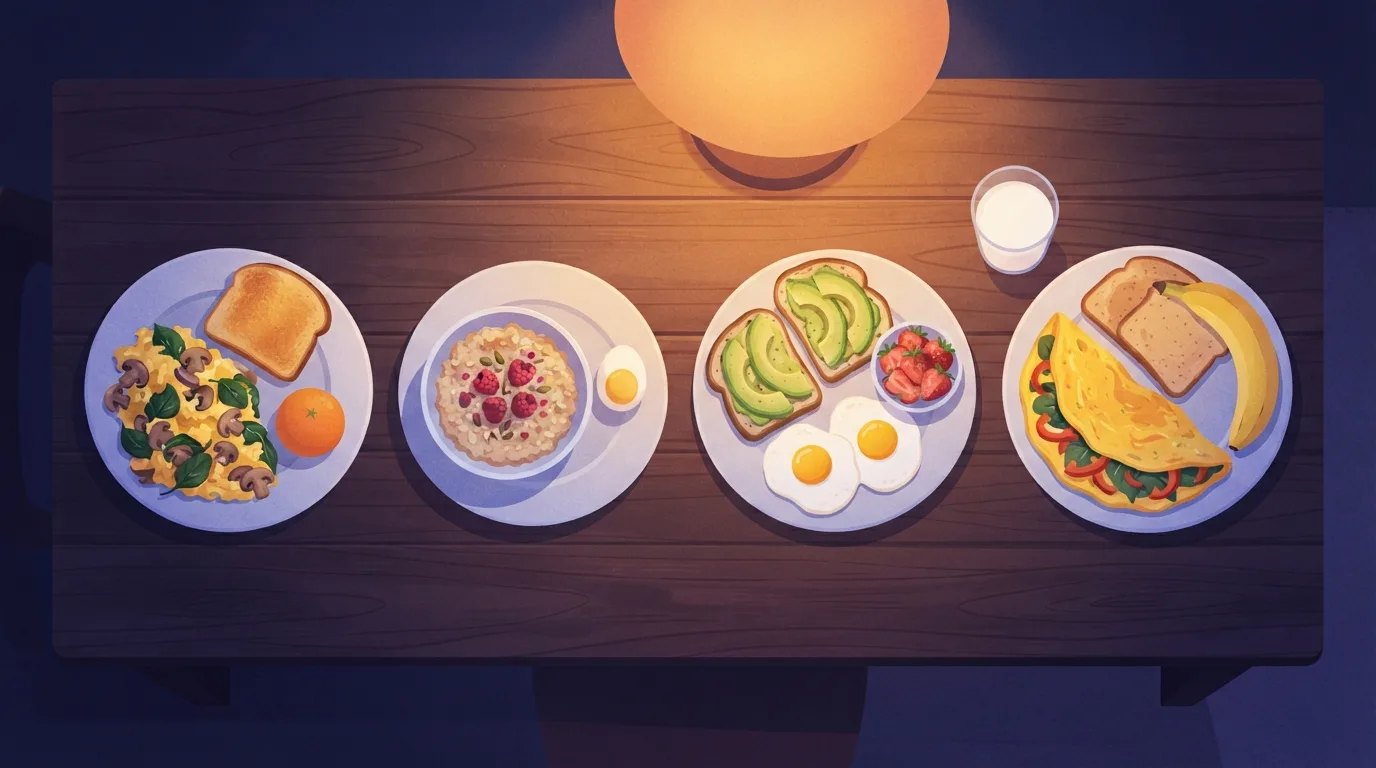
Within that budget, aim for 20 to 30 grams of protein and at least 5 grams of fiber, with fruit or vegetables for volume. Here are four breakfasts built to those rules at different budgets. The numbers are calculated from USDA FoodData Central.
- About 320 calories (19 g protein, 5 g fiber): two eggs scrambled in a teaspoon of olive oil with a cup of spinach and half a cup of mushrooms, one slice of whole-wheat toast and a small orange.
- About 390 calories (22 g protein, 10 g fiber): half a cup of rolled oats cooked in a cup of skim milk, topped with half a cup of raspberries and a tablespoon of ground flaxseed, with a hard-boiled egg on the side.
- About 500 calories (23 g protein, 11 g fiber): two slices of whole-wheat toast with half an avocado and two fried eggs, plus a cup of strawberries.
- About 720 calories (47 g protein, 9 g fiber): an omelet of two whole eggs and three egg whites with red pepper, spinach and an ounce of feta, two slices of whole-wheat toast with a teaspoon of butter, a banana and a glass of skim milk.
Is a 700-calorie breakfast okay? Yes, if the rest of the day makes room for it. The big-breakfast group in the Jakubowicz trial ate exactly 700 calories at breakfast on a 1,400-calorie day, with a 200-calorie dinner. The last plate above shows what that looks like. Eating a breakfast that size on top of a normal lunch and dinner is a different thing, and it's the pattern that pushed daily intake up in the BMJ review.
Low Calorie High Protein Breakfast Ideas
For more options, the quickest route to a low calorie high protein breakfast is a lean protein anchor plus fruit or vegetables. Our guide to high protein breakfast ideas lists 15 breakfasts with the protein and calories for each, and its leanest picks, an egg white omelet and baked egg bites with cottage cheese, land near 225 calories with 25 to 27 grams of protein. That guide also covers the research on protein at breakfast and fullness, so this page doesn't repeat it. For a high protein low fat breakfast, the same anchors work best: nonfat Greek yogurt, egg whites and 1% cottage cheese bring the protein with very little fat.
When Skipping Breakfast Is Fine (and When It Isn't)
For most healthy adults trying to lose weight, skipping breakfast is a legitimate choice. What matters is what it does to the rest of your day.
Changing the habit may matter more than the meal
An older trial by Schlundt and colleagues (1992) offers a clue. Fifty-two women with moderate obesity followed a 12-week weight-loss program with the same calories, eaten either as two meals without breakfast or as three meals with it, after their usual habit was recorded. Habitual breakfast eaters lost 8.9 kg when told to skip it and 6.2 kg when told to keep eating it. Habitual skippers lost 7.7 kg when told to start eating breakfast and 6.0 kg when they kept skipping. The women who had to change their routine lost the most. The result was only borderline significant, so treat it as a hint, not a rule. The breakfast eaters also did less impulsive snacking.
Skipping breakfast is how most people do 16:8
Most 16:8 intermittent fasting plans simply move the first meal of the day to around noon. The trials behind that approach find it works about as well as ordinary calorie cutting, and no better, which our review of 16:8 intermittent fasting results covers in detail.
When breakfast is the safer call
- You have type 2 diabetes or prediabetes. In a crossover trial of 22 adults with type 2 diabetes, Jakubowicz and colleagues (2015) found that skipping breakfast raised the blood sugar response to lunch by 36.8% and to dinner by 26.6%, compared with a day that included breakfast. If you take insulin or another glucose-lowering medication, talk to your doctor before changing when you eat.
- Skipping leaves you ravenous later. If a missed breakfast turns into a huge lunch and an endless evening of grazing, breakfast is the better tool for you. If you'd rather keep skipping, plan a mid-morning snack from our list of the best snacks for weight loss instead of leaving it to the vending machine.
- You train first thing and feel flat on an empty stomach. A small breakfast or snack before the session may help you train harder. Try your workouts both ways and keep whichever feels better.
- You have a history of disordered eating, or you're pregnant, breastfeeding or still growing. Long gaps without food aren't the right tool here. Get advice from a clinician or dietitian first.
If none of those apply and skipping feels easy, skip it. If breakfast keeps you steady until lunch, keep eating it. Part of finding the best breakfast for weight loss is finding out whether you need one at all.
What People Who Keep Weight Off Do in the Morning
The National Weight Control Registry tracks people who've lost at least 30 pounds and kept it off for at least a year. When Wyatt and colleagues (2002) surveyed 2,959 of its members, who had lost an average of 32 kg and kept it off for about six years, 78% said they ate breakfast every day and only 4% said they never did. The breakfast eaters reported slightly more physical activity than the non-eaters, but not fewer calories.
That's a survey of successful people, not a trial, so it can't show that breakfast caused their success, and the trials above suggest it doesn't on its own. What it does show is that most long-term maintainers keep a predictable morning. A breakfast you eat the same way most days is one less decision in a day that's already full of them.
Routine is the part most diets leave to willpower. If you're weighing a nutrition coaching app against a workout coach, our FitCraft vs Noom comparison lays out what each one actually does. FitCraft's side is training. Its 3D AI coaches demonstrate each dumbbell or bodyweight exercise, call you by name during the session and keep count of your streak, so a short morning workout can join breakfast in the same daily routine. Barry, 42, lost 28 pounds in four months with FitCraft by working out at breakfast time while his kids ate. In his words, it "worked around my life."
The Bottom Line
The best breakfast for weight loss is the one that fits your calorie budget and keeps you out of the snack drawer until lunch. For most people that means 300 to 500 calories built around 20 to 30 grams of protein, plus fruit, vegetables or whole grains for fiber.
Eating breakfast won't speed up your metabolism, and skipping it won't wreck your diet. A bigger breakfast may make your hunger easier to manage, and skipping is fine if it comes easily to you. Pick the pattern you can repeat most mornings, and let consistency do the rest.
Frequently Asked Questions
Is a 700 calorie breakfast okay?
Yes, if your other meals shrink to make room for it. In a 12-week trial, women eating a 700-calorie breakfast and a 200-calorie dinner on a 1,400-calorie diet lost more weight than women who ate the reverse (Jakubowicz 2013), though a tighter 2022 trial found equal weight loss and only lower hunger (Ruddick-Collins 2022). A 700-calorie breakfast added on top of a normal day just raises your total.
What is the best breakfast choice for people with prediabetes?
A breakfast built on protein and fiber with few refined carbohydrates, such as eggs with vegetables and whole-grain toast or oats cooked in milk with berries, is a sensible choice for prediabetes. Eating breakfast at all may matter too: in adults with type 2 diabetes, skipping it raised the blood sugar response to lunch by 36.8% (Jakubowicz 2015). Plan meal changes with your doctor or a dietitian.
Is it better to skip breakfast to lose weight?
On average, skipping breakfast is neither better nor worse for weight loss. In a 16-week trial of 309 adults, people told to skip breakfast, people told to eat it and people given no advice lost similar amounts of weight (Dhurandhar 2014). Choose the pattern that keeps your daily calories lowest without leaving you ravenous.
How many calories should breakfast be for weight loss?
A practical range is 25 to 30% of your daily calories, which works out to about 400 to 480 calories on a 1,600-calorie plan. You can push breakfast up to about 45% of the day if a bigger morning meal keeps your hunger down, as long as lunch and dinner shrink to match.
What should I eat for breakfast to lose belly fat?
No breakfast targets belly fat, because your body doesn't lose fat from one chosen spot. A breakfast with 20 to 30 grams of protein and some fiber, eaten inside a daily calorie deficit, helps you lose fat overall, and belly fat goes down along with it.
What is a healthy breakfast for weight loss on the go?
Good grab-and-go choices include a hard-boiled egg with an apple, a container of plain Greek yogurt with berries, oats soaked in milk overnight, or a whole-wheat wrap with eggs and vegetables. Most land between about 150 and 400 calories when you keep the portions in check, so they fit easily inside a calorie deficit.