It's 3:30 in the afternoon. Lunch was hours ago, dinner is hours away, and the vending machine down the hall is right there. A bag of chips later, you've eaten a few hundred calories and you're hungry again by five.
That cycle feels like a willpower problem. Usually it isn't. Most of the snacks within arm's reach are built to be easy to eat and quick to digest, so they add calories without buying you much fullness. You did eat something. It just didn't do its job.
The fix is a short list of snacks that work for you instead of against you. Below are 15 healthy snack ideas for weight loss with the calories, protein and fiber worked out, followed by what the research says about how often to snack and why some snacks hold you longer than others.
15 Best Snacks for Weight Loss, With Calories, Protein and Fiber
All values come from the USDA's FoodData Central database (SR Legacy release) for the exact portion shown. Snacks 1 to 7 lead with protein, 8 to 13 lead with fiber and volume, and 14 and 15 are nuts, which come with their own rules. Packaged versions differ a little, so check the label on yours.
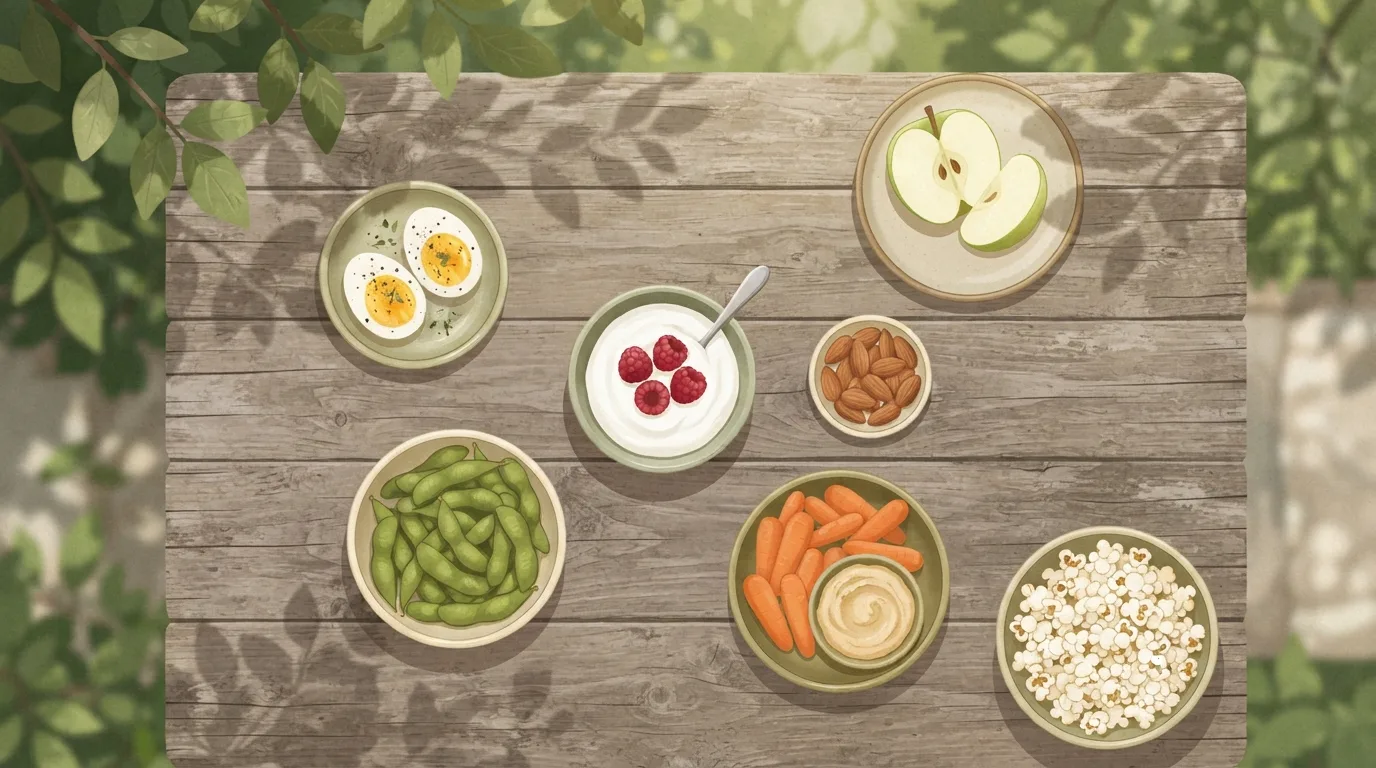
1. Plain Greek Yogurt With Raspberries
132 calories, 18 g protein, 4 g fiber. One 170-gram container of plain nonfat Greek yogurt topped with half a cup of raspberries. Raspberries carry 6.5 grams of fiber per 100 grams, one of the highest counts of any fruit, so this bowl covers both halves of the formula. Stir the fruit in yourself. Fruit-on-the-bottom cups add sugar without adding protein.
2. Cottage Cheese With Cucumber and Cherry Tomatoes
103 calories, 15 g protein, 1 g fiber. Half a cup of 1% cottage cheese with half a cup each of sliced cucumber and cherry tomatoes, finished with black pepper. It's a savory snack with a lot of protein for very few calories. The catch is salt: this bowl has about 460 milligrams of sodium, so pick a no-salt-added tub if you're watching your sodium.
3. Two Hard-Boiled Eggs
155 calories, 13 g protein, 0 g fiber. Boil a batch on Sunday and they'll keep for about a week in the fridge. Eggs bring the protein but no fiber, so add a handful of cherry tomatoes or a piece of fruit if you want them to carry you further. Salt and pepper are all they need.
4. Edamame
188 calories, 18.5 g protein, 8 g fiber. One cup of shelled edamame, cooked from frozen. No other snack here matches it on protein and fiber at the same time. Microwave a cup straight from the freezer bag, sprinkle on flaky salt and it's ready in a few minutes. Edamame in the pod takes longer to eat, which helps too.
5. Tuna on Cucumber Rounds
89 calories, 17 g protein, 0.5 g fiber. Three ounces of drained light tuna canned in water, spooned onto a cup of cucumber slices with a squeeze of lemon. At about 19 grams of protein per 100 calories, it's the leanest snack on this list. Canned light tuna is on the FDA's list of best choices for fish because it's lower in mercury than albacore.
6. String Cheese and a Mandarin
118 calories, 7.5 g protein, 1.6 g fiber. One stick of part-skim mozzarella and a medium mandarin orange. Both come in their own wrapper, so this is the snack to throw in a bag on the way out the door. It's also hard to overeat: the serving ends when the stick does.
7. Beef Jerky
116 calories, 9 g protein, 0.5 g fiber per ounce. Jerky is the most portable protein on the list, useful in a car, at a desk or on a hike. Watch two things. An ounce carries about 500 milligrams of sodium, and many brands sweeten the marinade. Read the label and stop at one ounce.
8. Air-Popped Popcorn
93 calories, 3 g protein, 3.5 g fiber. Three cups of air-popped popcorn. It's a whole grain that's mostly air, so a big bowl costs very few calories. A light mist of oil with salt or smoked paprika keeps it that way. Popcorn with butter topping from a movie theater is a very different food, as the popcorn section below explains.
9. Apple With Peanut Butter
190 calories, 4 g protein, 5 g fiber. A medium apple, sliced, with one level tablespoon of peanut butter for dipping. The apple brings fiber and crunch, and the peanut butter brings fat that slows you down. Measure the tablespoon, because two heaping spoonfuls can double the calories.
10. Baby Carrots and Hummus
181 calories, 5 g protein, 6 g fiber. Ten baby carrots with a quarter cup of hummus. Most of the calories sit in the hummus, so if you want a bigger plate for the same number, add cucumber, bell pepper strips or snap peas rather than more dip.
11. Roasted Chickpeas
174 calories, 7 g protein, 6 g fiber. Half a cup of cooked chickpeas tossed in a teaspoon of olive oil and roasted at 400°F for 25 to 35 minutes, until they crunch. They scratch the same itch as chips or crackers while bringing real fiber and some protein. Try cumin, chili powder or cinnamon on them.
12. A Pear
101 calories, 0.6 g protein, 5.5 g fiber. A medium pear has more fiber than a cup of cooked oatmeal, which has about 4 grams, and it takes a few minutes to eat. Whole fruit eaten before a meal has cut how much people eat at that meal in lab studies, which our guide to the best fruits for weight loss covers in detail.
13. Strawberries With a Square of Dark Chocolate
108 calories, 2 g protein, 4 g fiber. A cup of strawberry halves with a 10-gram square of 70 to 85% dark chocolate. When you want something sweet, this answers the craving for far fewer calories than a pastry, and the fruit does most of the filling.
14. Almonds
164 calories on the label, 6 g protein, 3.5 g fiber. One ounce is about 23 almonds. Your body absorbs fewer calories than the label says: a feeding study by Novotny and colleagues (2012) measured about 129 calories per ounce. Portion them into small containers ahead of time. Eating straight from the bag is how one ounce turns into three.
15. Pistachios in the Shell
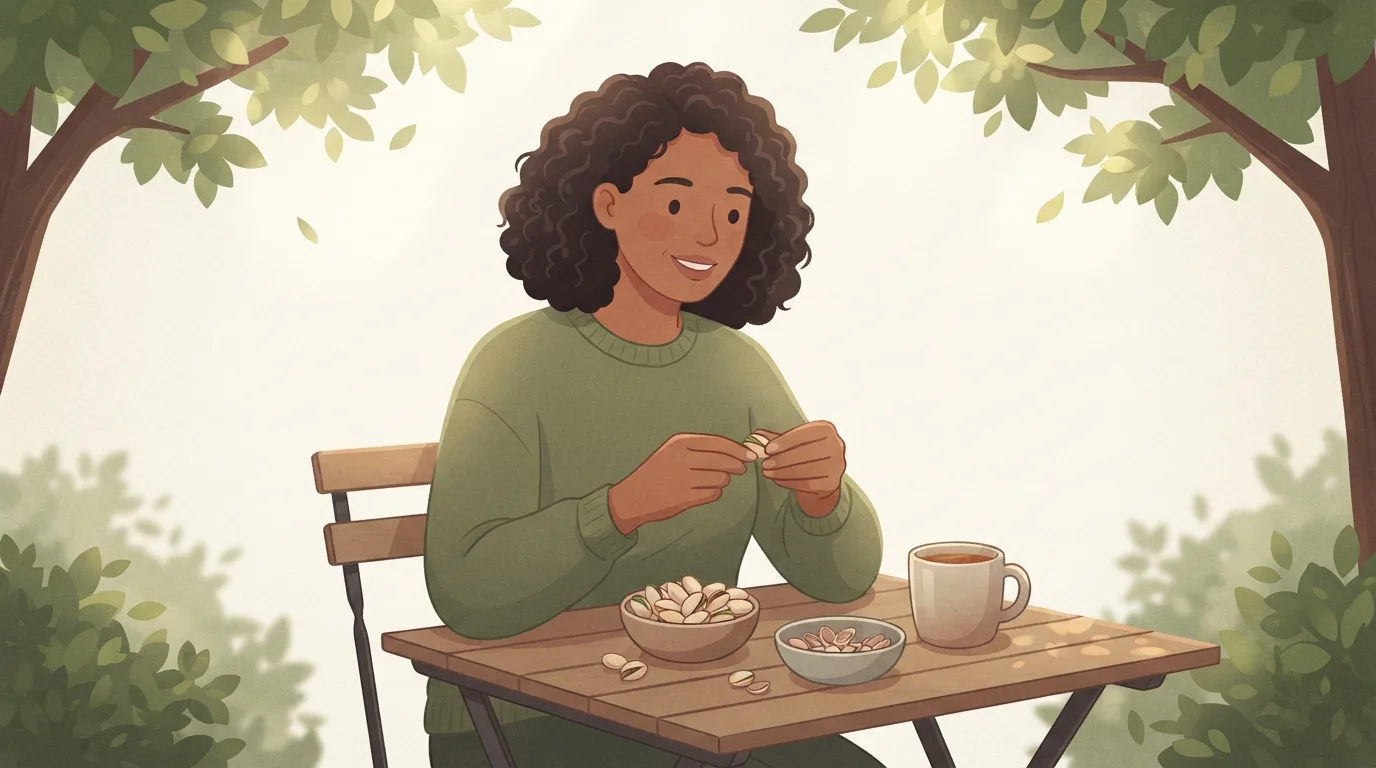
162 calories, 6 g protein, 3 g fiber. One ounce of dry-roasted, unsalted pistachios is 49 kernels, twice as many nuts per serving as almonds. Buy them in the shell. In a study by Kennedy-Hagan and colleagues (2011), 118 university staff ate 216 calories of pistachios over a workday when their empty shells stayed in view, against 264 when the shells were cleared away. Their fullness ratings didn't differ.
Healthy Snack Ideas for Weight Loss: The Numbers Side by Side
Here are all 15 snacks in one table, using the same USDA values. Calories for the almonds and pistachios are the label figures, which overstate what you absorb.
| Snack | Serving | Calories | Protein (g) | Fiber (g) |
|---|---|---|---|---|
| Greek yogurt with raspberries | 170 g yogurt, 1/2 cup berries | 132 | 18.1 | 4.0 |
| Cottage cheese with cucumber and tomatoes | 1/2 cup cheese, 1 cup vegetables | 103 | 15.0 | 1.2 |
| Hard-boiled eggs | 2 large | 155 | 12.6 | 0 |
| Edamame, shelled | 1 cup | 188 | 18.5 | 8.1 |
| Light tuna on cucumber | 3 oz tuna, 1 cup cucumber | 89 | 17.2 | 0.5 |
| String cheese and a mandarin | 1 stick, 1 medium | 118 | 7.5 | 1.6 |
| Beef jerky | 1 oz | 116 | 9.4 | 0.5 |
| Air-popped popcorn | 3 cups | 93 | 3.1 | 3.5 |
| Apple with peanut butter | 1 medium, 1 tbsp | 190 | 4.0 | 5.2 |
| Baby carrots and hummus | 10 carrots, 1/4 cup | 181 | 5.4 | 6.3 |
| Roasted chickpeas | 1/2 cup, 1 tsp oil | 174 | 7.3 | 6.2 |
| Pear | 1 medium | 101 | 0.6 | 5.5 |
| Strawberries and dark chocolate | 1 cup, 10 g | 108 | 1.8 | 4.1 |
| Almonds | 1 oz (23 nuts) | 164 | 6.0 | 3.5 |
| Pistachios, dry roasted | 1 oz (49 nuts) | 162 | 6.0 | 2.9 |
The dairy, egg, tuna and edamame snacks give you the most protein for their calories. The fruit, vegetables, popcorn and chickpeas give you fiber and bulk. Neither group beats the other. Either one will hold you longer than a snack with neither, like crackers or a bar made mostly of refined flour and sugar.
What Makes a Snack Good for Weight Loss?
A snack helps you lose weight when it takes the edge off your hunger for fewer calories than it saves you later. Four features make that more likely.
Protein
Protein is the most filling of the three macronutrients, and it costs the most to digest. A 2004 review by Westerterp puts the energy used to process protein at 20 to 30% of its calories, against 5 to 10% for carbohydrate and 0 to 3% for fat. Aim for 10 to 20 grams in a snack when you can.
Fiber and water
Foods full of fiber and water, like fruit, vegetables and popcorn, give you a big portion for few calories. Your stomach notices volume, not just calories, so a plate that looks full helps you feel full.
A built-in stopping point
An egg, a stick of cheese and a piece of fruit all end on their own. A family-size bag doesn't. Snacks with a natural portion, or ones you portion out before you start, take the guesswork out of when to stop.
A modest calorie count
Most snacks that help a deficit land between 100 and 200 calories. One or two of those a day fits inside almost any weight-loss plan, as long as you count them as part of the day rather than extra.
Find out what's really holding you back
FitCraft, our mobile fitness app, pairs you with an AI coach who builds you a personalized plan around your goals, schedule, and fitness level. Every FitCraft program is designed by Domenic Angelino, MPH (Brown University) and NSCA-CSCS, with research published in the Journal of Strength and Conditioning Research and Medicine & Science in Sports & Exercise.
Take the Free Assessment Free • 2 minutes • No credit cardDoes Snacking Help or Hurt Weight Loss?
On its own, snacking does neither. It's close to universal, though. Piernas and Popkin (2010) tracked U.S. adults from 1977 to 2006 and found that the share who snacked rose from 71% to 97%, while snacks' share of daily calories climbed from 18% to 24%. Desserts, salty snacks, candy and sweetened drinks drove much of the change.
When total calories are held equal, how often you eat doesn't move the scale. Cameron and colleagues (2010) put 16 adults with obesity on the same deficit of about 700 calories a day for 8 weeks, split either into three meals or into three meals plus three snacks. Weight loss averaged 4.7% of body weight, and the two patterns didn't differ on body fat, appetite or the hunger hormone ghrelin.
More eating occasions don't speed up fat burning either. In Ohkawara and colleagues (2013), 15 lean adults spent a day in a sealed metabolic chamber on two occasions, eating the same calories as three meals or six. They burned about 80 grams of fat over 24 hours either way, but they reported more hunger and a stronger desire to eat on the six-meal day.
What separates a helpful snack from a harmful one is quality. In the ZOE PREDICT study of 854 adults in the UK, Bermingham and colleagues (2024) found that 95% snacked, averaging 2.3 snacks and about a quarter of their calories a day. How often they snacked wasn't linked to their blood markers of heart and metabolic health. Lower-quality snacks were linked to higher triglycerides, higher insulin and more hunger, though the links were weak.
So keep a snack if it helps you eat less at the next meal, and drop it if it doesn't. A planned afternoon snack that stops you from walking into dinner starving is doing exactly what it should.
Protein Snacks Keep You Full Longer
A classic lab study shows the effect clearly. Marmonier and colleagues (2000) gave 11 young men, already full from lunch, an afternoon snack of about 240 calories that was mostly protein, mostly fat or mostly carbohydrate. Then they waited for each man to ask for dinner. The protein snack pushed that request back by 60 minutes, compared with 25 minutes for the fat snack and 34 for the carbohydrate snack. How much they ate at dinner didn't change.
Leidy and colleagues (2015) ran a similar test in 31 teenagers, three days per condition. A 260-calorie afternoon snack of soy foods with 26 grams of protein delayed their next eating occasion compared with no snack, which a high-fat snack of the same calories with 4 grams of protein didn't do. The protein snack also lowered appetite more than the high-fat one and cut evening snacking on high-fat, high-sugar foods. Total daily calories ended up about the same.
In practice, 10 to 20 grams of protein covers most snacks: a container of Greek yogurt, half a cup of cottage cheese, two eggs, a cup of edamame or 3 ounces of tuna. If your hunger hits hardest mid-morning, the fix may sit earlier in the day. Our list of high protein breakfast ideas gives 15 breakfasts with 23 to 38 grams each.
Is Popcorn a Healthy Snack Choice?
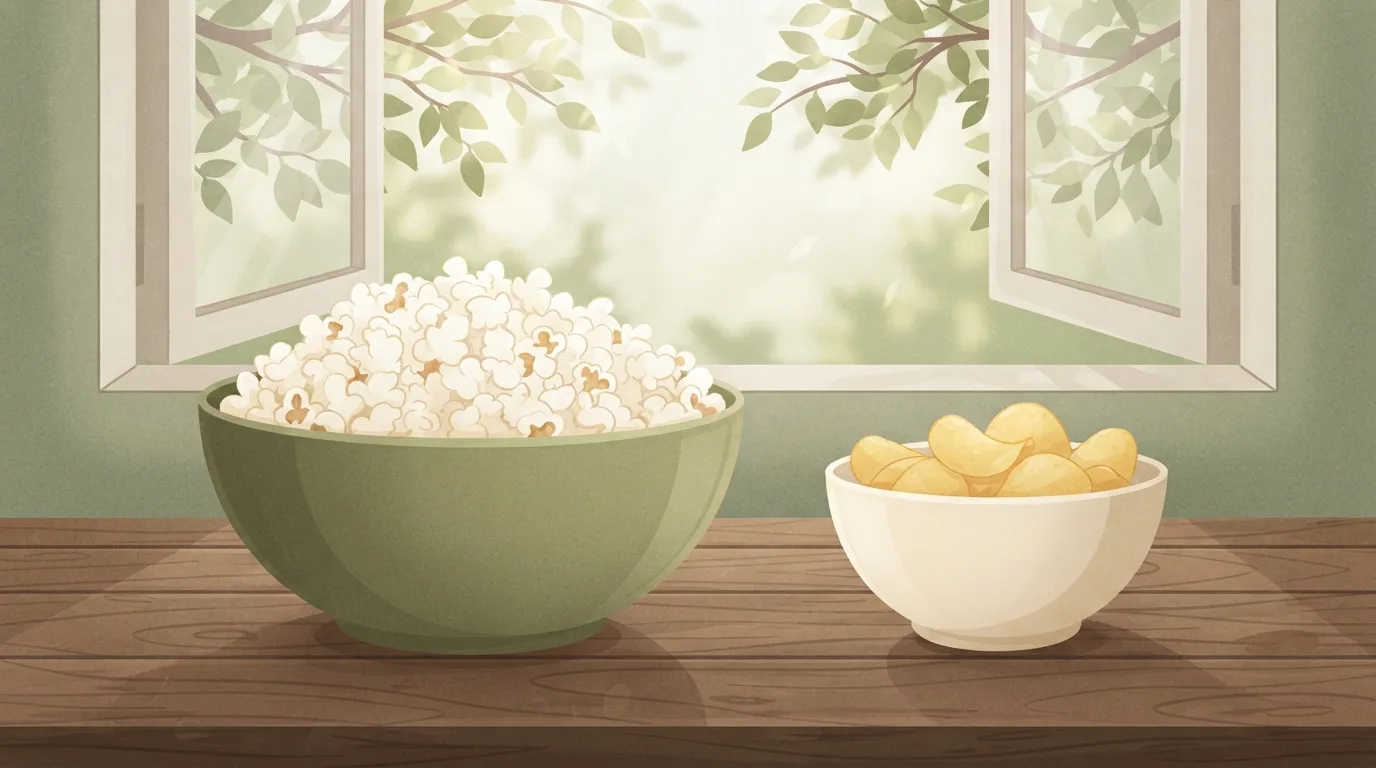
Yes, plain popcorn is one of the most filling snacks per calorie you can eat. In a trial by Nguyen and colleagues (2012), 35 adults ate either six cups of low-fat popcorn (100 calories) or one cup of potato chips (150 calories) before a meal. After the popcorn they reported less hunger and more satisfaction, and the snack plus the meal came to 739 calories, against 803 with the chips.
How you make it decides whether it stays healthy. Three cups come to about 93 calories air-popped, or about 133 popped in a teaspoon of oil. Butter, caramel and movie-theater toppings can multiply that many times over. Keep the toppings to salt, spices or a little grated Parmesan.
Do Nuts Make You Gain Weight?
Nuts are the snack people worry about most, since an ounce runs 160 to 185 calories. The trials say the worry is mostly misplaced. A meta-analysis of 55 nut-feeding trials by Guarneiri and Cooper (2021) found that eating nuts every day didn't change body weight, BMI or waist size, whether or not people were told to cut other foods to make room.
Part of the reason is that people eat less of everything else. In a 4-week trial, Tan and Mattes (2013) gave 137 adults at higher risk of type 2 diabetes 43 grams of almonds a day, about 1.5 ounces, with breakfast, with lunch, as a morning or afternoon snack, or not at all. After four weeks, body weight in the almond groups didn't differ from the no-almond group. Without any instructions, people cut back on other food to make room, and the snack groups reported less hunger and less desire to eat.
Hull and colleagues (2015) saw the same adjustment within a single day. When 32 women ate 28 or 42 grams of almonds mid-morning, they ate less at lunch and dinner in step with the dose, and their daily calories came out about even with a day without almonds.
The other part is absorption. Not all of the fat in whole nuts gets absorbed. In the Novotny feeding study, 18 adults absorbed about 129 calories from an ounce of almonds, while the standard calculation behind food labels predicted 168 to 170, an overestimate of 32%.
The limit is still the portion. An ounce is about 23 almonds or 49 pistachios, and a handful from a big bag is often two or three of those. Portion them before you eat, and if you buy pistachios in the shell, leave the shells where you can see them.
What Snacks Help You Burn Fat?
No snack burns fat. Fat loss comes from eating fewer calories than you burn for weeks at a time, and a snack helps only by making that deficit easier to hold. Protein comes closest to a metabolic edge because of its higher digestion cost, but on a 150-calorie snack the difference works out to a few dozen calories at most.
The same goes for belly fat. No food flattens your tummy or pulls fat from one spot. When you hold a deficit, fat comes off your whole body, not just the part you're focused on. Snacks that keep you full make the deficit easier to keep, and that's the only way any snack touches belly fat.
Healthy Snacks for Weight Loss at Night
An evening snack is fine when you plan it. The same rules apply: protein or fiber, a fixed portion, and a bowl or plate instead of the bag. Greek yogurt, cottage cheese, a pear or a measured ounce of pistachios all work. If night snacking feels less like a choice and more like a habit you can't shake, the cause usually starts earlier in the day, and our guide on how to stop eating late at night walks through the fixes in order.
How to Fit Snacks Into a Calorie Deficit
- Budget them. One or two snacks of 100 to 200 calories each fits most deficits. Count them inside the day's total, not on top of it.
- Pick protein or fiber every time. Use the table above. If a snack has neither, it's a treat, which is fine now and then but won't hold you.
- Portion before you eat. Small containers, single-serve cups and whole fruit do the measuring for you.
- Keep the good options in sight. A fruit bowl on the counter and a box of edamame at eye level in the freezer get eaten. Chips in the desk drawer get eaten too, so keep them somewhere else.
- Snack on hunger, not boredom. Before you reach for something, ask whether you'd eat an apple. If the answer is no, you probably aren't hungry.
- Plan the mid-morning snack if you skip breakfast. Skipping is fine for weight loss as long as it doesn't send you to the vending machine at 11, as our look at the best breakfast for weight loss explains.
Snacks shape the calories coming in. Exercise shapes what your weight loss is made of, because training helps you hold on to muscle while the fat comes off. If you want a training plan to go with your food plan, our roundup of the best workout apps for weight loss compares seven options, including FitCraft, where 3D AI coaches lead dumbbell and bodyweight workouts at home, say your name mid-workout and keep your streak going.
The Bottom Line
The best snacks for weight loss are simple foods: Greek yogurt, cottage cheese, eggs, edamame, tuna, fruit, vegetables with hummus, popcorn and a measured handful of nuts. Each one brings protein, fiber or both for 100 to 200 calories, and each one has a clear point where the serving ends.
Pick three or four you actually like, keep them where you'll see them, and let them carry you from lunch to dinner without a detour. As Sarah, 27, who lost 18 pounds in three months with FitCraft, put it: "First app that made exercise feel like something I chose, not forced." Food works the same way. The plan you choose is the one you'll keep.
Frequently Asked Questions
What are some easy snack ideas?
Easy snack ideas for weight loss that need no cooking include plain Greek yogurt with berries, string cheese with a mandarin, baby carrots with hummus, a can of light tuna and a pre-portioned ounce of almonds or pistachios. Each lands between about 90 and 190 calories, per USDA FoodData Central. Hard-boiled eggs and roasted chickpeas take one batch a week to prepare.
What are good snacks for weight loss?
Good snacks for weight loss give you protein, fiber or both for about 100 to 200 calories. By the USDA numbers, a cup of shelled edamame has 18.5 grams of protein and 8 grams of fiber for 188 calories, plain Greek yogurt with raspberries has 18 grams of protein for 132 calories, and three cups of air-popped popcorn have 3.5 grams of fiber for 93 calories.
How many calories should a snack be when you're trying to lose weight?
Most people do well with one or two snacks of 100 to 200 calories a day, counted inside the daily total rather than on top of it. On an 1,800-calorie day, two 150-calorie snacks use about a sixth of the budget. A bigger snack is really a small meal, which is fine as long as you plan for it.
What snacks help you burn fat?
No snack burns fat directly. Protein snacks come closest, because digesting protein uses about 20 to 30% of its calories compared with 0 to 3% for fat (Westerterp 2004), and a protein snack delayed the next meal longer than fat or carbohydrate snacks in a lab trial (Marmonier 2000). Fat loss still depends on a calorie deficit held for weeks.
What foods help flatten your tummy?
No food flattens your tummy by itself, because you can't choose where your body loses fat. Snacks high in protein and fiber, such as Greek yogurt, edamame, fruit and popcorn, make a calorie deficit easier to keep, and a steady deficit is what shrinks belly fat along with fat everywhere else.
Is it better to skip snacks to lose weight?
Not necessarily. When 16 adults ate the same calorie deficit for 8 weeks as either three meals or three meals plus three snacks, their weight loss didn't differ (Cameron 2010). Skip snacks that add calories without curbing your hunger, and keep the ones that stop you from arriving at dinner starving.