
Search for 16 8 intermittent fasting results and you'll find two kinds of stories. One is the before-and-after: someone tries 16:8, loses 20 pounds and feels sharper than ever. The other is the frustrated forum post: months of skipping breakfast, still no change on the scale. Both are real, and the randomized trials explain why the same schedule produces both.
If you're in the second group, it isn't because you lack discipline. You followed the rule you were given. The rule just doesn't do what the before-and-after posts imply, and nobody told you which part of it was doing the work.
This page sticks to the controlled trials of eating within an 8-hour window, plus a few close relatives. It covers realistic 16:8 fasting results at one week, one month, three months and a year, how much of the weight is fat and how much is muscle, why the results look so much like ordinary calorie restriction, and who shouldn't fast at all. Then it covers how to hold on to your muscle with dumbbell training while you do it.
What 16:8 Intermittent Fasting Actually Is
16:8 is a form of time-restricted eating: you fast for 16 hours and eat all of your food within an 8-hour window, every day. The most common window in the trials is noon to 8 p.m., which mostly means skipping breakfast. Early versions such as 7 a.m. to 3 p.m. or 8 a.m. to 4 p.m. exist too. During the fast you have water, black coffee or plain tea. Inside the window, most 16:8 trials put no limit on what or how much people ate, which matters for everything that follows.
16:8 Fasting Results by Week and Month
Here's what the trials suggest you can expect at each stage. The numbers are averages, and individual results spread widely around them.
| Time on 16:8 | What to expect | Where the number comes from |
|---|---|---|
| Week 1 | A quick drop of a pound or two, much of it water and food in transit | Glycogen is stored with three to four parts water (Kreitzman 1992) |
| Month 1 | About 0.5 to 1.5 kg (1 to 3 lb) of real loss without calorie counting | Trial rates of about 1 percent a month or less (Gabel 2018, Lowe 2020) |
| Months 2 to 3 | About 1 to 3 percent of body weight in total | 2.6 percent at 12 weeks (Gabel 2018); 0.94 kg at 12 weeks (Lowe 2020) |
| 1 year | About 4 to 5 percent below a control group without counting, more with calorie targets | 4.61 kg vs control (Lin 2023); 8.0 kg with calorie targets (Liu 2022) |
16:8 fasting results after 1 week
The first week usually brings the most satisfying number on the scale, and it's mostly not fat. Your body stores carbohydrate as glycogen, and Kreitzman, Coxon and Szaz (1992) in the American Journal of Clinical Nutrition described how each gram is held with three to four grams of water. Eat a bit less, and fewer carbs, and some of that water goes with it. Less food sitting in your gut lowers the number too. Enjoy the drop, but don't use it to predict the next month.
16:8 fasting results after 1 month
One month in, the trials point to roughly 0.5 to 1.5 kg of real loss for most people who simply eat inside the window. In a 12-week pilot by Gabel et al. (2018) in Nutrition and Healthy Aging, 23 adults with obesity who ate only between 10 a.m. and 6 p.m. cut about 341 calories a day without counting and lost 2.6 percent of their body weight compared with a matched historical control group. That's a little under 1 percent a month. Their systolic blood pressure also fell by about 7 mmHg. Fat mass, lean mass and blood sugar measures didn't differ significantly from the controls.
16:8 fasting results after 3 months
The largest trial of plain 16:8 eating is less encouraging. Lowe et al. (2020), the TREAT trial in JAMA Internal Medicine, randomized 116 adults with overweight or obesity to eat only between noon and 8 p.m. or to eat three structured meals across the day, for 12 weeks. The 16:8 group lost 0.94 kg and the comparison group lost 0.68 kg. The difference, 0.26 kg, wasn't statistically significant. The authors concluded that time-restricted eating on its own was no more effective for weight loss than eating throughout the day.
Stricter windows do more. Cienfuegos et al. (2020) in Cell Metabolism tested 4-hour and 6-hour eating windows in adults with obesity. After 8 weeks both groups had lost about 3 percent of their body weight compared with controls, because they ate about 550 fewer calories a day. Those are shorter windows than 16:8, and they show the same pattern: the bigger the calorie drop, the bigger the result.
16:8 fasting results after 1 year
Two year-long trials give the clearest long-term picture. Lin et al. (2023) in the Annals of Internal Medicine randomized 90 adults with obesity to a noon-to-8 p.m. window without calorie counting, to a 25 percent daily calorie cut, or to a control group. At 12 months, the 16:8 group had lost 4.61 kg (4.87 percent) more than the control group, and the calorie-cut group had lost 5.42 kg more. The difference between 16:8 and calorie restriction wasn't significant. Both groups ate about 400 to 425 fewer calories a day.
Liu et al. (2022) in the New England Journal of Medicine asked the follow-up question: does the window add anything when calories are already controlled? They gave 139 adults with obesity the same calorie target (1,500 to 1,800 a day for men, 1,200 to 1,500 for women) and randomized half to also eat only between 8 a.m. and 4 p.m. At 12 months, the window group had lost 8.0 kg and the calorie-only group 6.3 kg. The 1.8 kg difference wasn't statistically significant, and body fat, lean mass, blood pressure and metabolic markers lined up with the weight result.
Weight vs Fat vs Muscle: What 16:8 Results Are Made Of
The number on the scale hides the question that matters most: is it fat, or muscle? In TREAT, the researchers scanned 50 participants who lived near San Francisco. The 16:8 group in that subset lost 1.70 kg, of which 1.10 kg was lean mass and 0.51 kg was fat. The authors noted that this, about 65 percent of the weight lost, far exceeds the typical 20 to 30 percent. Appendicular lean mass, the muscle in your arms and legs, fell significantly more than in the comparison group.
That result comes with caveats worth knowing. The between-group difference in total lean mass didn't reach significance, protein intake wasn't measured, and the subset was small. One detail stands out, though: the 16:8 group's step count fell by about 2,500 a day over the 12 weeks. People ate on a schedule, moved less, didn't lift and may have eaten less protein. That's a recipe for losing muscle on any diet.
The trials that added training tell a different story. Moro et al. (2016) in the Journal of Translational Medicine put 34 resistance-trained men on either a 1 p.m. to 8 p.m. window or a normal meal pattern for 8 weeks, with calories and macronutrients matched and three training sessions a week. The 16:8 group's fat mass fell from 10.9 to 9.3 kg while fat-free mass, arm and thigh muscle size, and bench press and leg press strength held steady. Testosterone and IGF-1 also fell in the 16:8 group, though strength and muscle size didn't.
Women showed the same pattern. Tinsley et al. (2019) in the American Journal of Clinical Nutrition randomized 40 resistance-trained women to a noon-to-8 p.m. window or a normal eating pattern for 8 weeks of supervised training, with supplemental whey protein in every group. Protein intake landed at 1.6 g per kg of body weight a day across groups. Every group gained 2 to 3 percent fat-free mass and built muscle, and strength improved equally. Fasting didn't blunt the training response.
Why 16:8 Results Match Calorie Restriction
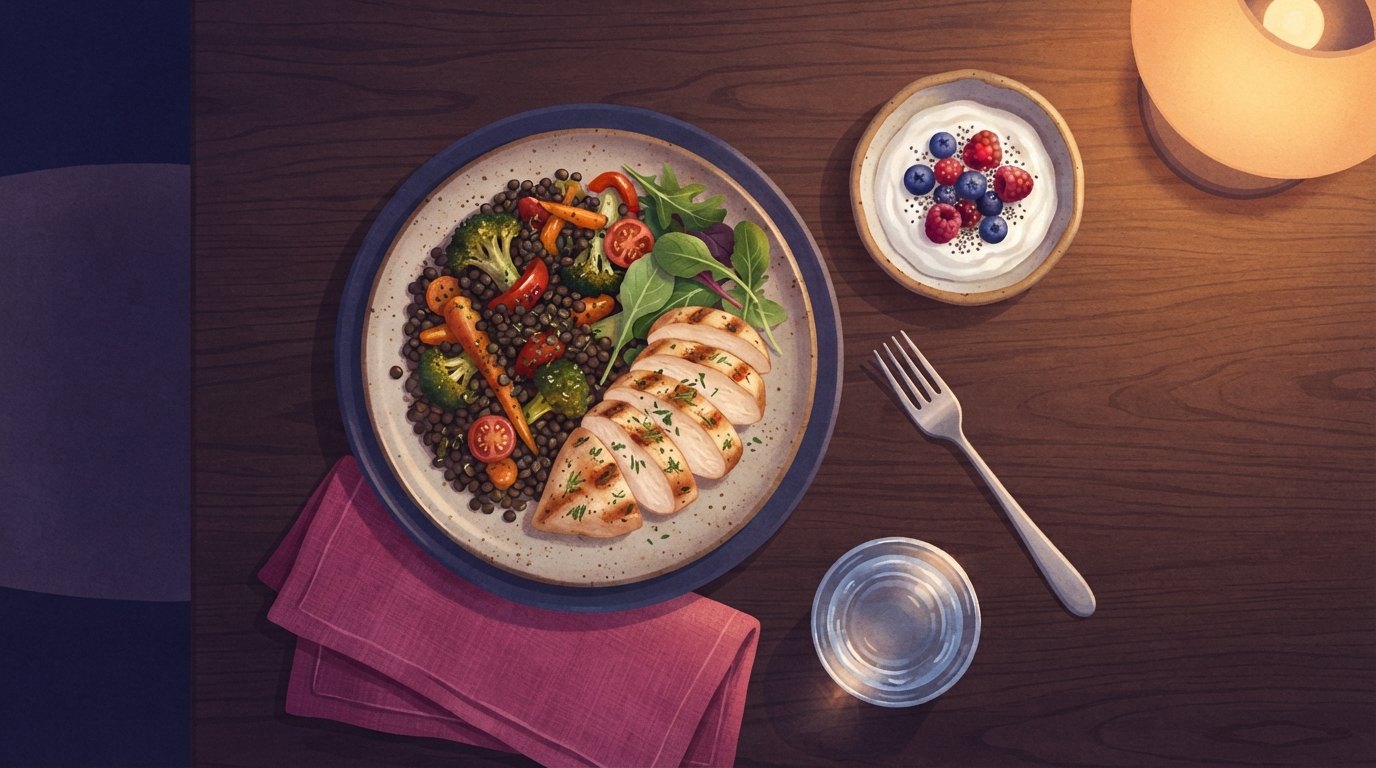
Put the trials side by side and one variable explains most of the results: how many calories the window removed. Gabel's participants ate about 341 fewer calories a day, Lin's about 425 and Cienfuegos's shorter windows about 550. In each trial, the window worked to the extent that it cut intake. In TREAT, the researchers found no difference in estimated calorie intake between groups, and there was no meaningful difference in weight either. That's the core of how a calorie deficit drives weight loss, and an eating window is one way to create it.
The largest pooled analysis agrees. Semnani-Azad et al. (2025) in The BMJ combined 99 randomized trials with 6,582 adults in a network meta-analysis. Every fasting approach and ordinary calorie restriction beat eating freely, and time-restricted eating performed about the same as continuous calorie restriction. Alternate-day fasting was the only fasting style with a small edge over calorie restriction, 1.29 kg, and only in shorter trials.
Timing may add a little. Jamshed et al. (2022) in JAMA Internal Medicine gave 90 adults with obesity the same weight-loss program and randomized half to eat between 7 a.m. and 3 p.m. Over 14 weeks the early-window group lost 2.3 kg more weight, though not significantly more body fat. The authors calculated the effect as equal to cutting about 214 more calories a day. An early window is harder to fit around work and family dinners, so the best window is the one you can keep.
Losses also slow down over time even when you stick with it. Hall et al. (2011) in The Lancet modelled how body weight responds to a lasting change in intake and found the response is slow, with a half-time of about a year. Most of the change arrives early, and the rest trickles in. A flat month at month five is normal physiology, not a broken diet.
Get an evidence-based plan built for you
FitCraft, our mobile fitness app, pairs you with an AI coach who builds you a personalized plan around your goals, schedule, and fitness level. Every FitCraft program is designed by Domenic Angelino, MPH (Brown University) and NSCA-CSCS, with research published in the Journal of Strength and Conditioning Research and Medicine & Science in Sports & Exercise.
Take the Free Assessment Free • 2 minutes • No credit cardWhy Am I Not Losing Weight Even Though I'm Doing 16:8 Fasting?
Usually because the window isn't shrinking your intake. These are the common reasons, in the order we'd check them:
- The window got bigger meals. Eight hours is plenty of time to eat a full day's food. If lunch and dinner grew to cover the missing breakfast, the deficit disappears, which is what TREAT's flat calorie estimates suggest happened there.
- You're moving less. TREAT's 16:8 group took about 2,500 fewer steps a day. Feeling low on energy in the morning can quietly cut your everyday movement, and that offsets part of the deficit.
- Calories leak into the fast. Milky coffee, juice, a handful of nuts and creamer all count. The fast only works as a fast if it's water, black coffee or plain tea.
- Weekends undo weekdays. Five tight days and two open ones can average out to no deficit at all.
- You're reading daily noise. Water, salt and food in your gut swing the scale by a kilo or more from day to day. Judge a weekly average over three or four weeks.
If all of that checks out and nothing's moving, the window may simply suit you less than another approach. Plenty of people do better with a calorie target, a protein target, or a routine that changes what they eat rather than when.
What Are the Signs That Intermittent Fasting Is Working?
The signs worth watching are slow and boring, which is exactly why they're reliable:
- Your weekly average weight trends down, even if only by a quarter of a kilo (about half a pound) a week.
- Your waist measurement shrinks, or your clothes fit differently.
- Your strength in the gym holds steady or climbs, a sign you're losing fat rather than muscle.
- Morning hunger settles after the first week or two, so the window takes less effort.
"Feeling lighter" and a big first-week drop are less useful signals. Both show up whether or not you're losing fat.
How to Keep Muscle on 16:8 With Dumbbell Training
The trials point to two habits that separate the 16:8 results that cost muscle from the ones that don't: lifting and protein. If you'd like the broader version of this plan, our guide on how to lose fat without losing muscle covers it in full. Here's how it fits inside an eating window.
Get enough protein inside the window
Aim for about 1.6 g of protein per kg of body weight a day, roughly 110 g for a 70 kg adult. Morton et al. (2018) in the British Journal of Sports Medicine pooled 49 trials with 1,863 participants and found that protein beyond about 1.62 g/kg/day produced no further gains in fat-free mass during resistance training. That's also the intake Tinsley's women reached while gaining muscle on 16:8. With only 8 hours to eat, split it across two or three meals of 30 to 40 g rather than trying to fit it all into dinner.
Lift two or three times a week
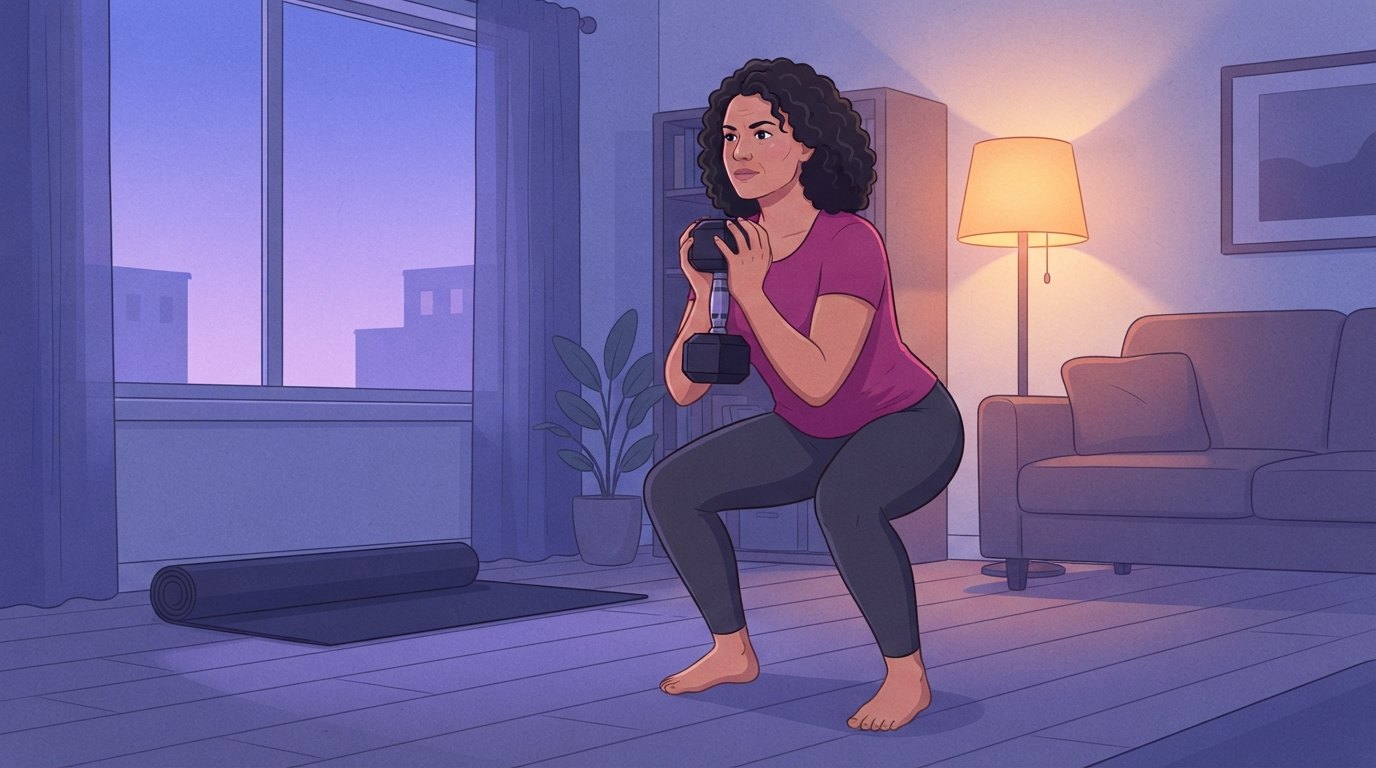
Dumbbells at home are enough. A full-body session that covers each major movement once looks like this:
- Goblet squat: 3 sets of 8 to 12
- One-arm dumbbell row: 3 sets of 8 to 12 per side
- Dumbbell floor press or push-up: 3 sets of 8 to 12
- Dumbbell Romanian deadlift: 3 sets of 8 to 12
- Seated dumbbell shoulder press: 2 to 3 sets of 8 to 12
- Split squat: 2 sets of 8 to 10 per side
Finish most sets with one or two reps left in the tank, and add a rep or a little weight when a set feels easy. Your goal while losing weight is to keep your strength, and keeping it is the best evidence that you're keeping muscle.
Can you do a morning workout on 16:8?
Yes. If your window opens at noon, a morning session means training fasted. The lifters in Moro's trial trained between 4 and 6 p.m., inside their window, so they ate before and after. A fasted morning workout is still fine for most people, and our review of fasted cardio research explains why training on an empty stomach doesn't change fat loss over weeks. If you lift in the morning, make the first meal of your window a protein-rich one, and consider shifting the window earlier so it opens soon after you train.
The hard part isn't knowing the routine. It's still doing it in week six, when the scale has slowed and the novelty of fasting has worn off. That's where most people fall away, and that's a design problem. FitCraft's dumbbell and bodyweight strength programs put a 3D AI coach beside you who shows each move as an interactive 3D demo and calls you by name, with streaks that make the next session easier to show up for, and our roundup of the best workout apps for weight loss compares the options. As Jim, a FitCraft user, put it: "I kept telling myself I'd start Monday. FitCraft made me start on a Wednesday and I haven't stopped."
Who Should Not Try 16:8 Intermittent Fasting
In their review of fasting for weight loss, Varady et al. (2022) in Nature Reviews Endocrinology set out who should avoid it or only try it with clinical supervision:
- Anyone with a history of an eating disorder. Rigid food rules can restart restrictive patterns.
- People who are underweight, with a body mass index below 18.5.
- Children. Fasting is considered unsuitable for children under 12, and opinions differ on supervised fasting in teenagers.
- Pregnant or breastfeeding women. Safety hasn't been tested, and both need a steady energy supply.
- Adults over 70, in whom fasting hasn't been evaluated, especially if appetite or muscle mass is already low.
- People with diabetes or on medications that must be taken with food. Insulin and some glucose-lowering drugs can cause dangerous lows during a fast.
Diabetes isn't an automatic no, but it needs a doctor. In Pavlou et al. (2023) in JAMA Network Open, 75 adults with type 2 diabetes who ate only between noon and 8 p.m. lost 3.56 percent of their body weight over six months compared with controls, and their HbA1c fell by 0.91 points, with no serious adverse events. That trial ran in a research clinic with close monitoring, which is the setting to copy if you have diabetes.
What the Research Suggests Going Forward
The evidence on 16:8 has matured quickly, and it now points one way: an eating window is a valid way to eat less, and it delivers about what eating less delivers. Most trials ran 8 to 14 weeks, a few reached a year, and nearly all enrolled adults with obesity, so results in leaner people and over several years are less certain. The lean-mass question deserves a proper trial that tracks protein and activity alongside 16:8 without training. And the most hyped ideas, from metabolic switching to slower aging, rest mostly on animal research, which the 2019 review by de Cabo and Mattson in the New England Journal of Medicine summarizes.
So the practical read is simple. Try 16:8 if a time rule is easier for you than counting. Expect about half a kilo to a kilo and a half in the first month, and a few percent of your body weight by three months. Eat enough protein, lift two or three times a week, keep your daily steps up, and judge it on the trend across a month rather than a daily weigh-in.
References
- Lowe DA, Wu N, Rohdin-Bibby L, et al. "Effects of time-restricted eating on weight loss and other metabolic parameters in women and men with overweight and obesity: the TREAT randomized clinical trial." JAMA Internal Medicine 180.11 (2020): 1491-1499. DOI: 10.1001/jamainternmed.2020.4153
- Liu D, Huang Y, Huang C, et al. "Calorie restriction with or without time-restricted eating in weight loss." New England Journal of Medicine 386.16 (2022): 1495-1504. DOI: 10.1056/NEJMoa2114833
- Lin S, Cienfuegos S, Ezpeleta M, et al. "Time-restricted eating without calorie counting for weight loss in a racially diverse population: a randomized controlled trial." Annals of Internal Medicine 176.7 (2023): 885-895. DOI: 10.7326/M23-0052
- Cienfuegos S, Gabel K, Kalam F, et al. "Effects of 4- and 6-h time-restricted feeding on weight and cardiometabolic health: a randomized controlled trial in adults with obesity." Cell Metabolism 32.3 (2020): 366-378. DOI: 10.1016/j.cmet.2020.06.018
- Gabel K, Hoddy KK, Haggerty N, et al. "Effects of 8-hour time restricted feeding on body weight and metabolic disease risk factors in obese adults: a pilot study." Nutrition and Healthy Aging 4.4 (2018): 345-353. DOI: 10.3233/NHA-170036
- Jamshed H, Steger FL, Bryan DR, et al. "Effectiveness of early time-restricted eating for weight loss, fat loss, and cardiometabolic health in adults with obesity: a randomized clinical trial." JAMA Internal Medicine 182.9 (2022): 953-962. DOI: 10.1001/jamainternmed.2022.3050
- Moro T, Tinsley G, Bianco A, et al. "Effects of eight weeks of time-restricted feeding (16/8) on basal metabolism, maximal strength, body composition, inflammation, and cardiovascular risk factors in resistance-trained males." Journal of Translational Medicine 14.1 (2016): 290. DOI: 10.1186/s12967-016-1044-0
- Tinsley GM, Moore ML, Graybeal AJ, et al. "Time-restricted feeding plus resistance training in active females: a randomized trial." American Journal of Clinical Nutrition 110.3 (2019): 628-640. DOI: 10.1093/ajcn/nqz126
- Semnani-Azad Z, Khan TA, Chiavaroli L, et al. "Intermittent fasting strategies and their effects on body weight and other cardiometabolic risk factors: systematic review and network meta-analysis of randomised clinical trials." BMJ 389 (2025): e082007. DOI: 10.1136/bmj-2024-082007
- Morton RW, Murphy KT, McKellar SR, et al. "A systematic review, meta-analysis and meta-regression of the effect of protein supplementation on resistance training-induced gains in muscle mass and strength in healthy adults." British Journal of Sports Medicine 52.6 (2018): 376-384. DOI: 10.1136/bjsports-2017-097608
- Kreitzman SN, Coxon AY, Szaz KF. "Glycogen storage: illusions of easy weight loss, excessive weight regain, and distortions in estimates of body composition." American Journal of Clinical Nutrition 56.1 Suppl (1992): 292S-293S. DOI: 10.1093/ajcn/56.1.292S
- Hall KD, Sacks G, Chandramohan D, et al. "Quantification of the effect of energy imbalance on bodyweight." The Lancet 378.9793 (2011): 826-837. DOI: 10.1016/S0140-6736(11)60812-X
- Varady KA, Cienfuegos S, Ezpeleta M, Gabel K. "Clinical application of intermittent fasting for weight loss: progress and future directions." Nature Reviews Endocrinology 18.5 (2022): 309-321. DOI: 10.1038/s41574-022-00638-x
- Pavlou V, Cienfuegos S, Lin S, et al. "Effect of time-restricted eating on weight loss in adults with type 2 diabetes: a randomized clinical trial." JAMA Network Open 6.10 (2023): e2339337. DOI: 10.1001/jamanetworkopen.2023.39337
- de Cabo R, Mattson MP. "Effects of intermittent fasting on health, aging, and disease." New England Journal of Medicine 381.26 (2019): 2541-2551. DOI: 10.1056/NEJMra1905136
Frequently Asked Questions
How much weight can I expect to lose in 1 month with 16:8 fasting?
Usually about 0.5 to 1.5 kg (1 to 3 pounds) of real loss, plus some water in the first week. In the trials, eating inside an 8-hour window without counting calories cut intake by roughly 340 to 425 calories a day. In one 12-week pilot that added up to 2.6 percent of body weight, a little under 1 percent a month. In the largest trial, the TREAT study, people lost only 0.94 kg in 12 weeks. A deliberate calorie target speeds things up, but the window itself adds little on top.
Is 16:8 intermittent fasting good for weight loss?
It works about as well as ordinary calorie restriction, no better and no worse. A 2025 network meta-analysis of 99 randomized trials found time-restricted eating and continuous calorie restriction produced similar weight loss, and a 12-month trial found a noon-to-8 p.m. window matched a 25 percent calorie cut. It's a good choice if a time rule is easier for you to follow than counting calories.
Does intermittent fasting burn muscle?
It can if you don't lift and don't eat enough protein. In the TREAT trial, where neither was prescribed, about 65 percent of the weight lost in a measured subgroup was lean mass. In trials that added resistance training and adequate protein, lifters on 16:8 held their fat-free mass and strength while losing fat. Train with weights two or three times a week and aim for about 1.6 g of protein per kg of body weight a day.
What foods can you eat while intermittent fasting?
During the 16-hour fast, stick to water, black coffee and plain tea. Inside the 8-hour window you can eat any foods, but the results depend on how much you eat, so build meals around protein, vegetables, fruit and whole grains. Two or three protein-rich meals in the window, rather than one large one, make it easier to reach your protein target.
What are the benefits of following the 16:8 intermittent fasting schedule?
The clearest benefit is modest weight loss from eating less without counting calories. Some trials also found lower blood pressure, such as a 7 mmHg drop in systolic pressure over 12 weeks. Many people find a time rule simpler than tracking food and it cuts out late-night snacking. Effects on blood sugar and cholesterol have been small or absent in most 16:8 trials.
Does intermittent fasting help with aging?
Not that anyone has shown in people. Fasting extends lifespan in some animal studies, and a 2019 review in the New England Journal of Medicine described the cellular stress responses behind that. Human trials of 16:8 last months, not decades, and measure weight, blood pressure and blood sugar, so there's no evidence yet that it slows aging.