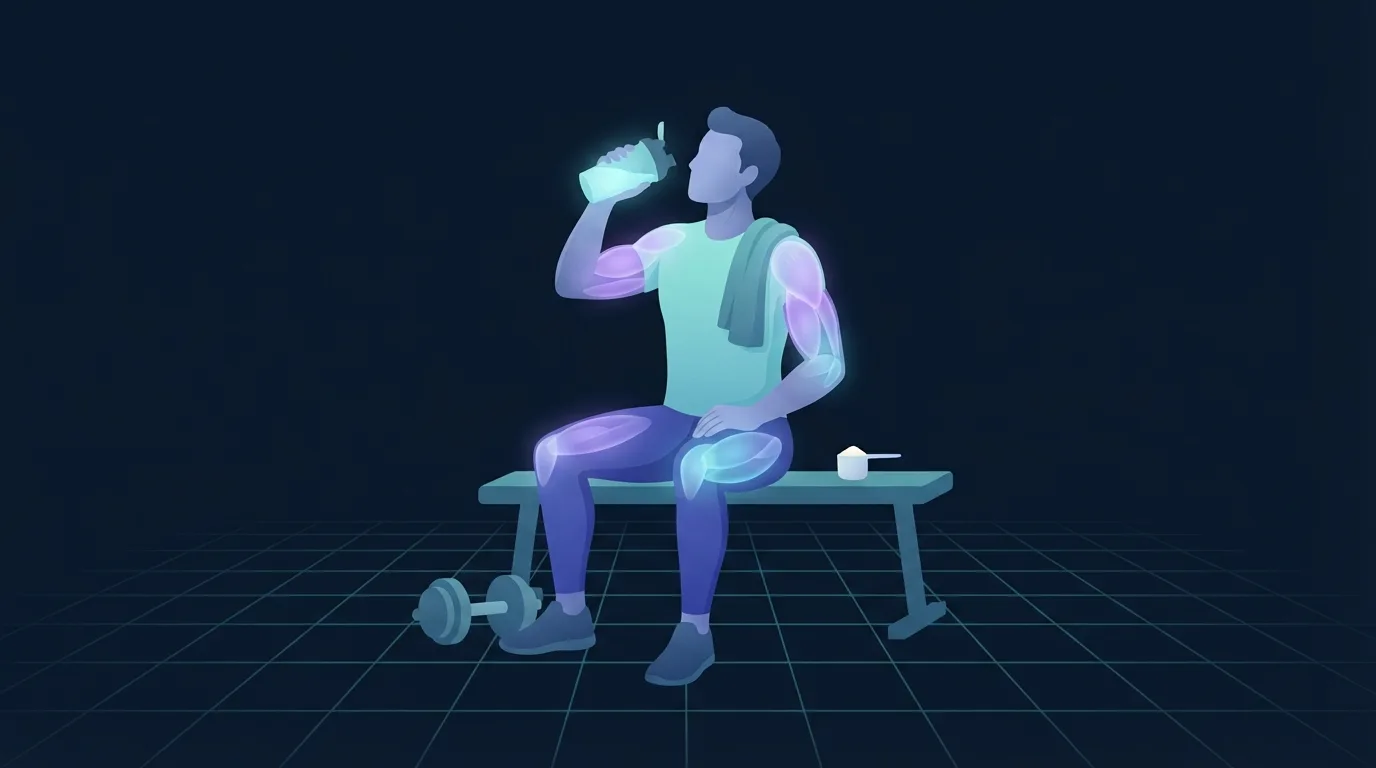
You bought the tub. Then you opened three tabs, and half an hour later you were reading an argument between strangers about whether a scoop at 4pm is wasted. Nobody had a number. Everybody had an opinion.
That's a frustrating place to be, because creatine is one of the few supplements with a large and boring evidence base behind it. The awkward part is that the timing question, the one people obsess over, sits in the smallest and least conclusive corner of that evidence. So the internet fills the gap with confidence.
Here's what the trials actually compared, what they found, and where the practical answer lands once you stop treating creatine like a pre-workout drink.
What Creatine Timing Can and Cannot Change
Creatine isn't a stimulant and it isn't an acute ergogenic aid. Your muscles hold a reservoir of phosphocreatine, a high-energy phosphate donor that regenerates ATP during the first 10 to 20 seconds of hard effort. Supplementing raises the size of that reservoir. A bigger reservoir means slightly more total work before the system runs dry, which across months adds up to more volume, more training stimulus and more muscle.
Filling the reservoir is slow. At a steady 3 to 5 grams per day it takes roughly three to four weeks to reach saturation. A creatine loading phase of about 20 grams per day, split into four doses, gets you there in five to seven days instead. Either way, the store is what does the work, and the store doesn't care what hour the powder arrived.
That's why creatine timing is a fundamentally different question from protein timing or caffeine timing. Caffeine has a half-life and a peak. Creatine has a tank level. Once the tank is full, a dose is topping up what you excreted yesterday, roughly 1 to 2 grams a day of turnover. So the honest framing of every timing study below is this: does the moment of top-up change the tank in any way that matters? Mostly, no.
Pre-Workout vs Post-Workout Creatine: What the Trials Found
Three trials have compared the same dose taken immediately before training against immediately after. They disagree in interesting ways, and the disagreement is the whole story.
Antonio and Ciccone 2013: the study everyone quotes
Nineteen recreational male bodybuilders took 5 grams of creatine either immediately before or immediately after their workouts for four weeks while following the same training program. Antonio and Ciccone (2013) reported that the post-workout group gained more fat-free mass and more bench press strength.
That result is the source of nearly every "take it after" recommendation online. It's also weaker than its reputation. The trial ran four weeks, there was no placebo group, the sample was 19 people, and the analysis leaned on magnitude-based inference rather than conventional significance testing. The authors framed it as preliminary themselves. Later reviews treat the difference as suggestive at best.
Candow 2015: 32 weeks in older adults
Candow and colleagues (2015) ran the longest version of this comparison: adults aged 50 to 71, randomised to creatine before training, creatine after training, or placebo, supervised across 32 weeks of resistance training. Everyone gained lean tissue mass and strength. Only the post-workout group gained significantly more lean tissue mass than placebo, 3.0 kg against 0.5 kg.
Read that carefully, because it's the most over-interpreted result in this literature. The post-workout group beat placebo. It did not beat the pre-workout group. With roughly a dozen people per arm, a trial like this can't separate two active conditions that differ by a hair. What it shows is that creatine plus resistance training works in older adults, which the wider literature already agreed on.
Dinan 2022: no difference at all
The most recent head-to-head is also the cleanest design. Dinan and colleagues (2022) randomised 34 male and female collegiate athletes to pre-exercise creatine, post-exercise creatine, or placebo in a double-blind parallel trial across 8 weeks of supervised training. Strength and body composition improved in all groups, and the authors concluded that the timing of creatine monohydrate did not exert any additional influence over the measured outcomes.
What the reviews conclude
Two reviews have tried to reconcile this. Ribeiro and colleagues (2021) in Nutrients found the pattern leans toward post-exercise being equal or slightly better, while noting that methodological limits across the trials prevent a firm conclusion and that the physiological mechanism for a timing effect hasn't been demonstrated. Candow and colleagues (2022), in a review titled Creatine O'Clock, put it more bluntly: the current body of research does not support timed creatine supplementation prescription.
So the honest ranking is that post-workout is a defensible default with a plausible story behind it, since blood flow to the trained muscle is elevated and you're likely eating soon anyway. The measured advantage over pre-workout sits somewhere between tiny and zero.
Should You Take Creatine on Rest Days?
Yes, and this matters far more than pre versus post. The point of supplementing is a saturated muscle store, and you lose roughly 1 to 2 grams a day to turnover whether or not you trained. Skip four rest days a month and you've quietly drifted below saturation for no reason.
The International Society of Sports Nutrition position stand (Kreider et al., 2017) describes maintenance as roughly 3 to 5 grams per day taken continuously, with no instruction to skip non-training days. Antonio and colleagues (2021), reviewing the common misconceptions, land in the same place and also dismiss the idea that you need to cycle off.
The practical upside is that rest-day timing is completely free. Nothing to coordinate, no workout to anchor to. Which is exactly why rest days are where the habit breaks. Attach the dose to a meal you never skip and the problem disappears.
Should You Take Creatine With Food or Carbs?
This is the one timing variable with a real, replicated mechanism, and it gets a fraction of the attention that pre versus post gets.
Green and colleagues (1996) gave men creatine with or without a large carbohydrate load and found the carbohydrate condition raised total muscle creatine accumulation by roughly 60 percent. The mechanism is insulin, which stimulates creatine transport into muscle. The catch was the dose: about 93 grams of simple carbohydrate per serving, four times a day, which is a lot of sugar to drink.
Steenge and colleagues (2000) then showed you don't need it. Roughly 50 grams of protein plus 47 grams of carbohydrate produced the same augmentation of whole-body creatine retention as 96 grams of carbohydrate alone. A normal mixed meal does the job.
Two consequences follow. Take creatine with food rather than on an empty stomach, which also removes the mild nausea some people get. And treat this as mostly a loading-phase concern: once the tank is full, uptake efficiency stops being the bottleneck, because you're only replacing daily turnover.
Find out what's really holding you back
FitCraft, our mobile fitness app, pairs you with an AI coach who builds you a personalized plan around your goals, schedule, and fitness level. Every FitCraft program is designed by Domenic Angelino, MPH (Brown University) and NSCA-CSCS, with research published in the Journal of Strength and Conditioning Research and Medicine & Science in Sports & Exercise.
Take the Free Assessment Free • 2 minutes • No credit cardMorning vs Night: Does the Time of Day Matter?
No trial has compared morning dosing against evening dosing for muscle or strength outcomes. Every timing study in this literature is anchored to a workout, not to a clock. Anyone telling you that 7am beats 9pm is extrapolating well past the data.
There's one small physiological wrinkle worth knowing and not worth acting on. Creatine uptake is helped by muscle contraction and by insulin, which is why "after training, with a meal" keeps showing up as the reasonable default. If your training is at 6am and your first real meal is at noon, you're choosing between two weak signals. Pick the meal.
Creatine also doesn't disturb sleep. It isn't a stimulant, and there's no pharmacological reason an evening dose would keep you up. For the wider picture on what creatine does above the neck, our review of the research on creatine and brain function covers the cognition trials, including the sleep-deprivation work.
Loading vs a Daily Dose, in One Paragraph
You don't have to load. Loading with about 20 grams a day for five to seven days saturates muscle stores in under a week, while 3 to 5 grams a day reaches the same ceiling in roughly three to four weeks. Same destination, different arrival time, and the loading phase is where most of the short-term water weight and the occasional stomach complaint come from. If you aren't chasing a competition date, skipping the load costs you a few weeks of patience and nothing else. Our full review of creatine loading vs maintenance works through the saturation curves and the trials behind that claim.
Creatine and Caffeine: The One Interaction Worth Knowing
In 1996, Vandenberghe and colleagues gave nine healthy men six days of creatine, or creatine plus 5 mg per kilogram per day of caffeine, and measured muscle phosphocreatine with magnetic resonance spectroscopy. Both groups raised phosphocreatine identically. Only the creatine-alone group improved on the fatigue test. Caffeine, the authors wrote, counteracted the ergogenic action of creatine loading.
That's a striking result, and it has been repeated online ever since. Three caveats. The sample was nine people. The caffeine dose was high, roughly 400 mg a day for an 80 kg adult, taken daily for six days. And the finding hasn't been reliably reproduced in the three decades since, including in acute co-ingestion studies. Creatine and caffeine sit together in most pre-workout formulas without an obvious cost.
If it bothers you, the fix is trivial: put your coffee and your creatine a few hours apart, which happens naturally if you take creatine with your post-training meal. Our review on caffeine and exercise performance handles the dosing side of the stimulant question separately.
The Best Time to Take Creatine, in Practice
Here's the whole thing collapsed into a schedule. Notice that every row lands on a meal, not on a clock.
| Your situation | When to take it | Why |
|---|---|---|
| You lift in the evening | 3 to 5 g with dinner, after the session | The default with the most support: post-training, with food |
| You lift early, before breakfast | 3 to 5 g with breakfast afterwards | Post-training and with a meal at the same time |
| You lift at lunchtime | 3 to 5 g with your post-workout lunch | Same logic, no coordination required |
| Rest day | 3 to 5 g with any meal you never skip | Store maintenance only, so timing is irrelevant |
| You keep forgetting | The same meal every day, training or not | Adherence beats every timing variable in this article |
| You are loading | 4 doses of about 5 g, each with food | Carbohydrate and protein improve uptake most during loading |
Creatine only pays off through the training it fuels, which means the thing most worth optimising is whether the sessions happen at all. If the lifting is the part that keeps slipping, our roundup of the best strength training apps compares how the main options handle progression, scheduling and getting you back after a missed week.

What Most People Get Wrong
Treating creatine like a pre-workout. If you take it 30 minutes before lifting expecting to feel something, you'll be disappointed, and you may conclude it doesn't work. Creatine doesn't produce an acute sensation. What it produces is a slightly higher ceiling on your fifth set, noticed over months.
Skipping rest days. This is the timing mistake that actually costs you something. Every missed non-training day lets the store drift down. If you only take creatine on gym days, you're running a lower average saturation than the people in the trials you read about.
Cycling on and off. There's no evidence that your body downregulates its own creatine production in a way that requires a break, and no evidence that cycling improves outcomes. Antonio and colleagues address this directly in their 2021 misconceptions review. Cycling just means spending a few weeks a year below saturation.
Quitting when the scale moves. Creatine pulls water into muscle cells, and the scale goes up by roughly one to two kilograms in the first week or two, especially if you load. That's intracellular water, not fat. Our review of whether creatine makes you gain weight separates the water from the tissue using the body-composition trials.
Optimising the hour while missing the day. The spread between the best and worst timing strategy in these trials is small enough that most studies can't detect it. The spread between taking creatine daily and taking it four days a week is not. Spend your attention accordingly.
The Bottom Line
If someone insists on a single answer, it's this: 3 to 5 grams, after training, with a meal that has carbohydrate and protein in it, and the same amount with a regular meal on rest days. That covers the post-workout lean, the co-ingestion mechanism and the saturation requirement all at once, and it takes no planning.
The bigger point is that you've already done the hard part by deciding to take it at all. Creatine is one of the most studied and most consistently effective supplements available, and nothing in the timing debate changes that. If you're still deciding whether it belongs in your routine, our honest answer to do I need creatine covers who actually benefits, and creatine for women handles the questions the general guides usually skip.
Frequently Asked Questions
What is the best time to take creatine?
The best time to take creatine is whatever time you will actually take it every single day, including rest days. Creatine works by slowly filling muscle phosphocreatine stores over weeks, so today's dose fuels the next several weeks of training rather than the session in front of you. If you want the marginal edge, take 3 to 5 grams with a meal that contains carbohydrate and protein, and if you train that day, make it the meal after training.
Is it better to take creatine before or after a workout?
Slightly after, on the weight of the evidence, but the effect is small and not consistent. Antonio and Ciccone (2013) found a modest post-workout advantage in 19 bodybuilders with no placebo group, Candow and colleagues (2015) found only the post-workout group beat placebo on lean tissue mass in older adults across 32 weeks, and Dinan and colleagues (2022) found no timing difference at all in 34 collegiate athletes over 8 weeks. The 2022 review by Candow and colleagues concluded the evidence does not support prescribing creatine by the clock.
Should you take creatine on rest days?
Yes. Rest days are where the daily habit either holds or breaks, and the goal of creatine supplementation is a saturated muscle store, not a pre-workout effect. The International Society of Sports Nutrition position stand describes a maintenance dose of roughly 3 to 5 grams per day taken continuously, with no instruction to skip non-training days. Timing on a rest day is completely free, so anchor it to a meal you never miss.
Does it matter if you take creatine in the morning or at night?
There is no trial evidence that morning or evening dosing changes muscle or strength outcomes. Every head-to-head timing study compares before training against after training, not clock times, and none of them found a difference large enough to build a rule on. Pick the time of day you are least likely to forget, which for most people is breakfast or the meal after training.
Should you take creatine with food or on an empty stomach?
With food. Green and colleagues (1996) found that adding carbohydrate to a creatine dose raised muscle creatine accumulation by roughly 60 percent, and Steenge and colleagues (2000) showed that a mix of protein and carbohydrate produced the same effect with far less sugar. A normal mixed meal does the job, and taking creatine with food also reduces the mild stomach upset some people get on an empty stomach.
Does caffeine cancel out creatine?
Probably not, though one well-known trial raised the question. Vandenberghe and colleagues (1996) gave nine men creatine with or without a large daily caffeine dose for six days and found the caffeine group lost the performance benefit despite identical muscle phosphocreatine levels. That result has not been reliably reproduced, the caffeine dose was high, and the two are routinely combined in pre-workout products. If you are worried, separate them by a few hours.