Every year the same question resurfaces on r/Fitness, r/nutrition, and every gym floor conversation about supplements. Do I need a loading phase? The tub says take 20 grams a day for a week. My friend says just take 5. My coach says loading is old science. Somebody on YouTube said loading is required or it won't work. Everyone sounds confident. Nobody agrees.
Here's the good news. The answer is one of the most well-settled questions in sports nutrition, and it has been for almost 30 years. The 1996 Hultman study answered it directly by measuring muscle creatine in biopsies from two dosing protocols. The 2017 ISSN position stand and the 2021 misconception review both restated the same conclusion. There is no meaningful disagreement in the primary literature. Loading is a speed optimization. It isn't a requirement.
Let's walk through what the studies actually measured, how the two protocols compare on real endpoints, and how to pick one. We'll also connect this to the broader creatine picture we've covered on the site: the brain-function research, the practical "do I even need creatine" question, and the specifics for women.
What does the research on creatine loading show?
Hultman 1996: The Study That Settled the Loading Question
The definitive experiment came from Hultman, Söderlund, Timmons, Cederblad, and Greenhaff (1996) in the Journal of Applied Physiology. The team ran 31 male subjects through four different creatine dosing protocols and took muscle biopsies before and after to measure total creatine and phosphocreatine concentrations directly.
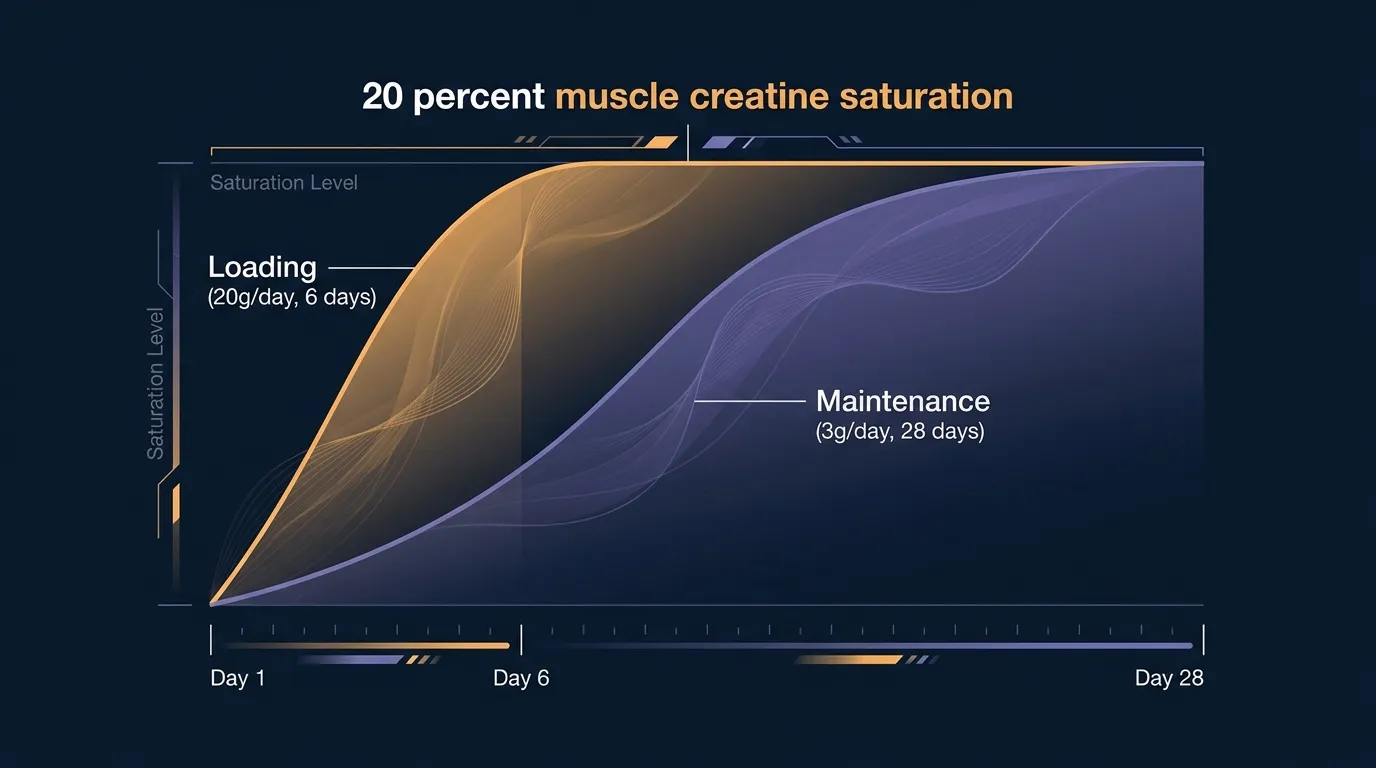
Group 1 took 20 grams per day (split into 4 daily doses of 5 grams) for 6 days. Muscle total creatine rose by about 20 percent. This was the classic loading protocol and it did exactly what the researchers hypothesized.
Group 2 took 3 grams per day for 28 days. Slow drip. No loading phase. At the end of the month, muscle total creatine had risen by roughly the same 20 percent. Different route. Same destination.
Group 3 loaded at 20 grams per day for 6 days, then continued at 2 grams per day for the next 30 days. Their elevated muscle creatine was maintained through the maintenance phase, indicating that once you're saturated, a small daily top-up is enough to hold the store.
Group 4 loaded at 20 grams per day for 6 days and then stopped taking creatine entirely. Muscle creatine washed out gradually over the following month, returning toward baseline by roughly 30 days.
The interpretation the authors laid out is worth quoting almost verbatim. Rapid loading works. Slow dosing works too. The two protocols converge on the same ceiling. And once saturated, a small daily dose maintains the elevated concentration. Everything downstream in the creatine literature is a footnote on this experiment.
Kreider 2017: The ISSN Position Stand
The 2017 International Society of Sports Nutrition position stand (Kreider, Kalman, Antonio, and 11 co-authors) reviewed over 500 primary studies and issued the field's most cited practical recommendations. On dosing:
- Fastest saturation: approximately 5 grams of creatine monohydrate 4 times a day for 5 to 7 days. After that, 3 to 5 grams a day is enough to maintain.
- Slow saturation without loading: 3 to 5 grams per day taken continuously. Muscle stores reach the same saturated concentration over 3 to 4 weeks.
- Bodyweight-scaled option: roughly 0.3 grams per kilogram of body weight per day for the loading phase, then 0.03 g/kg/day maintenance, for people who want dosing tied to body size.
The position stand explicitly states that the two protocols produce equivalent long-term performance outcomes. The fast route is a convenience for people who want the performance edge within a week. The slow route is a convenience for people who want to avoid the GI issues that occasionally accompany a 20-gram day and prefer a simpler daily habit.
Antonio 2021: The Misconception Review
Antonio and colleagues (2021), a group including several ISSN authors, published a review specifically targeting the most persistent creatine myths. Loading came up. The review's conclusion is direct: loading is not required. The evidence supports both protocols reaching the same saturation state, and there is no long-term performance advantage to loading over steady dosing.
The paper notes one practical wrinkle. Many people report GI discomfort at 20-gram-per-day loading doses if the daily total is taken as fewer than 4 split doses. Splitting the load into 4 servings of 5 grams substantially reduces that side effect. If you do load, split it.
Green 1996: Carbs Boost Uptake During Loading
A separate but related study from Green, Hultman, Macdonald, Sewell, and Greenhaff (1996) in the American Journal of Physiology looked at whether co-ingestion with carbohydrate changed the picture. 24 male subjects took either 5 grams of creatine 4 times daily, or the same creatine plus 93 grams of simple carbohydrate per dose, for 5 days.
The carbohydrate group accumulated roughly 60 percent more muscle creatine over the 5-day protocol. The mechanism is insulin. Insulin promotes creatine uptake into muscle cells, and carbohydrate spikes insulin. During a loading phase, when you are actively driving stores upward, that insulin boost helps.
The follow-up work by Steenge, Simpson, and Greenhaff (2000) showed you don't need 93 grams of carbs to get the effect. Roughly 50 grams of carb with about 50 grams of protein produced a similar insulin response and similar creatine retention. So a normal-sized post-workout meal or shake will accomplish the same thing.
For daily maintenance dosing (3 to 5 grams a day), the timing and food-pairing question matters much less. You're not driving big uptake anymore. You're topping up stores that are already saturated. If the timing question is the one you actually came for, our guide to the best time to take creatine works through the three pre-versus-post trials, rest-day dosing and the caffeine interaction.
Why This Matters for Your Fitness
The loading-versus-maintenance choice is a scheduling question, not a strategy question. Both work. The right one depends on your priorities over the first month.
| Loading protocol | Maintenance-only | |
|---|---|---|
| Daily dose | 20 g (4 doses of 5 g) for 5 to 7 days, then 3 to 5 g | 3 to 5 g from day one |
| Time to saturation | About 1 week | About 3 to 4 weeks |
| GI risk | Higher, mitigated by splitting doses | Minimal |
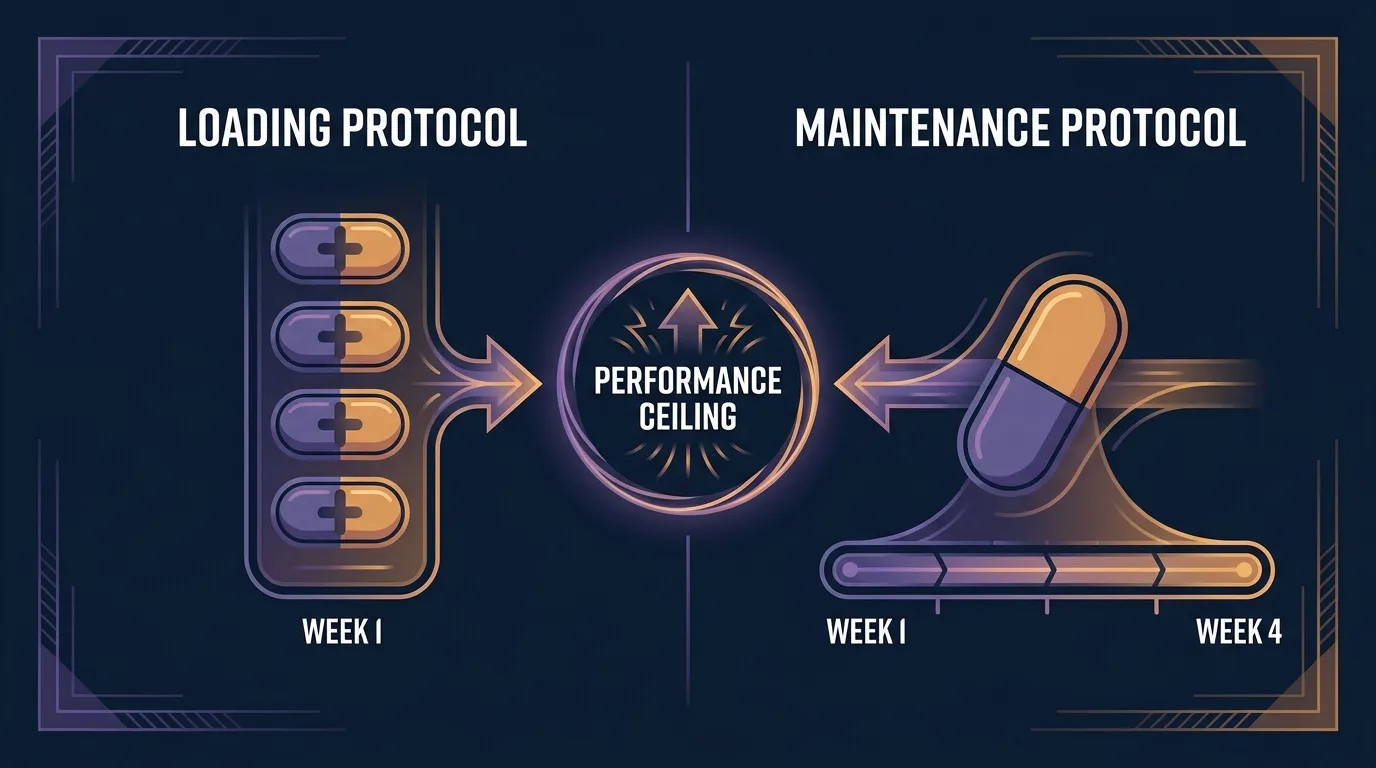
| Performance ceiling | Same 20% saturation | Same 20% saturation |
| Best for | Time-sensitive goals | Simplicity and sensitive stomachs |
If you're starting a new program and want to feel the strength and endurance edge quickly, load. The ISSN protocol saturates in 5 to 7 days. That means by the end of week 1, your phosphocreatine stores are topped up and the training-specific benefits (heavier sets, faster recovery between sets, slightly better volume tolerance) are available. If your fitness goal is time-sensitive, loading is worth the mild GI trade-off.
If you're patient, don't want to think about split dosing, or have had GI issues in the past, skip loading. Take 3 to 5 grams every morning with coffee or breakfast. By week 4 you're at the same saturation. The performance ceiling is identical. You just took longer to reach it.
A specific note for anyone doing a home workout program with dumbbells, bands, or bodyweight (the FitCraft user base). The performance benefits of creatine translate cleanly to any resistance modality. It isn't a barbell-only supplement. It works on high-rep bodyweight sets the same way it works on heavy squats, because the underlying ATP-phosphocreatine system is the same across modalities. If your training is 3 sets of dumbbell rows to near failure, saturated creatine stores give you extra reps in the tank on the last set. Multiply that across the training year and the volume adds up.
How do you run each creatine protocol?
The Loading Protocol (Fast)
Take 5 grams of creatine monohydrate 4 times per day for 5 to 7 days. Split the doses across meals: breakfast, lunch, snack, dinner. Mix it into water, juice, coffee, or a shake. Don't take all 20 grams in one shot. Single boluses of that size cause GI distress in a meaningful fraction of people and also increase urinary loss. Split it.
After the loading week, drop to 3 to 5 grams per day. Timing doesn't matter for maintenance. Any time of day is fine, with or without food. Consistency matters more than timing.
If you want to pair with carbohydrate for maximum uptake during the loading phase, do it during your normal meals. A typical breakfast or post-workout shake provides enough carb and protein to hit the insulin response the Steenge 2000 follow-up documented. You don't need a special sugar drink.
The Maintenance-Only Protocol (Simple)
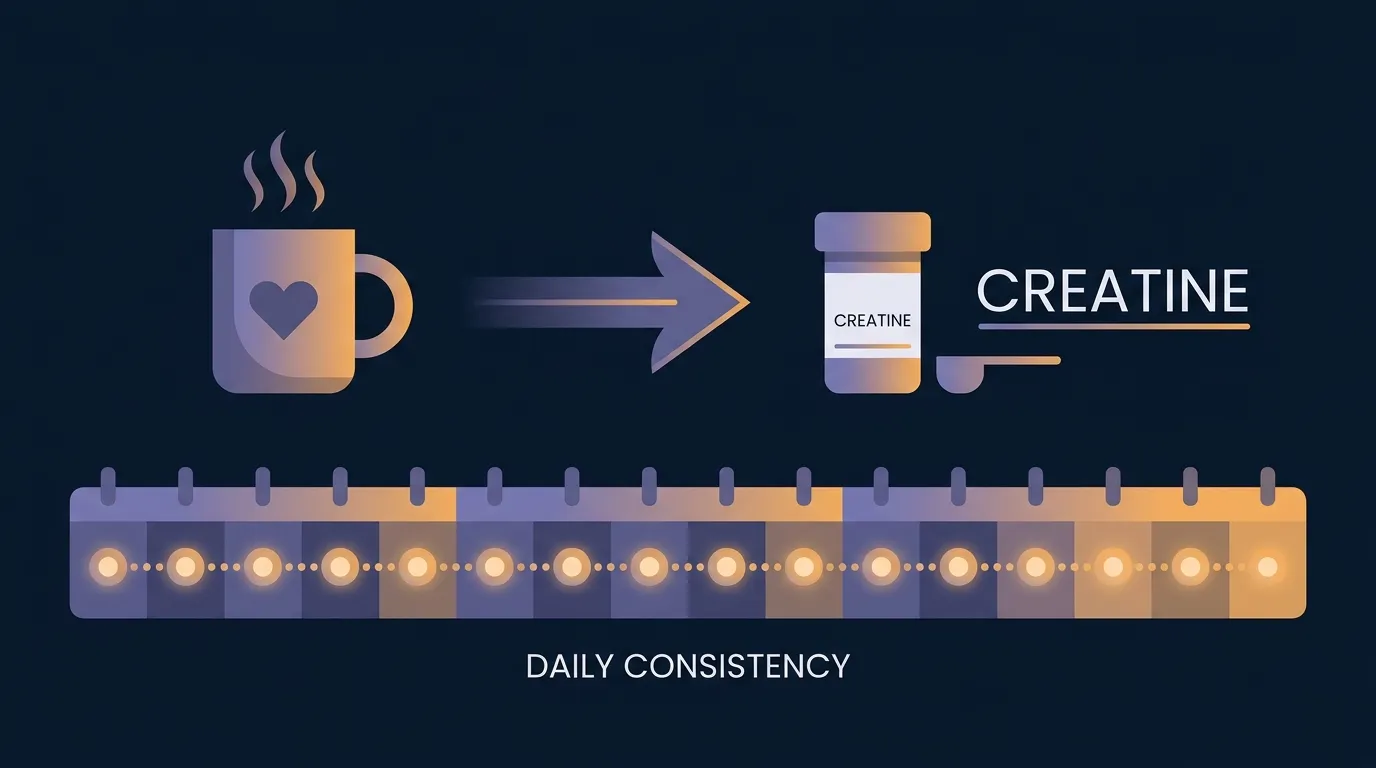
Take 3 to 5 grams of creatine monohydrate per day, every day. Pick a time you'll remember (with coffee, in your protein shake, after brushing your teeth) and stack it as a habit. Skip the loading phase entirely.
By day 21 to 28, your muscle creatine is saturated and the performance ergogenic effect is available. The endpoint is identical to loading. You just spent the first three weeks reaching it.
A common question: what if you miss a day? Miss one day and nothing happens. Muscle creatine washes out over roughly a month, so a single skipped dose has no measurable impact on saturation. Miss a week and you'll drop somewhat but you're still nowhere near baseline. Consistency compounds, but the system is forgiving.
Form and Product Selection
Every study cited above used creatine monohydrate. That's what's been tested. Other forms (HCl, ethyl ester, buffered, magnesium chelate) cost more and don't have equivalent evidence. The ISSN position stand is explicit: monohydrate is the reference form, and no alternative form has shown superior effects. Buy the cheapest quality-tested monohydrate powder you can find.
Get an evidence-based plan built for you
FitCraft, our mobile fitness app, pairs you with an AI coach who builds you a personalized plan around your goals, schedule, and fitness level. Every FitCraft program is designed by Domenic Angelino, MPH (Brown University) and NSCA-CSCS, with research published in the Journal of Strength and Conditioning Research and Medicine & Science in Sports & Exercise.
Take the Free Assessment Free • 2 minutes • No credit cardCommon Misconceptions
Misconception: "You have to load or creatine won't work"
The Hultman 1996 data disproved this directly. Both protocols hit the same 20 percent saturation. Both produce the same performance ceiling. If you skip the loading phase, you take longer to arrive, and that's the only difference. This claim usually comes from label copy on old supplement tubs written before the field consensus caught up. The tub is not the science.
Misconception: "Loading damages your kidneys"
Loading temporarily raises serum creatinine (a byproduct of creatine metabolism used as a kidney filtration marker), which superficially looks like a kidney flag on a blood test. The finding isn't kidney damage. It's the routine metabolism of the supplement you just took. The Antonio 2021 review covers this specifically. Long-term studies in healthy adults tracking actual kidney function (glomerular filtration rate, not just creatinine) find no impairment even with years of supplementation.
If you have pre-existing kidney disease, talk to a physician before starting any supplement. That guidance is universal to sports nutrition, not specific to creatine.
Misconception: "You need to cycle off creatine"
Cycling is a bodybuilding-culture holdover from anabolic-steroid protocols and it has no basis in creatine research. Creatine doesn't downregulate its own transporters in any way that requires a break, and long-term studies have followed users continuously for years without adverse effects or diminishing returns. If you want to save money by taking a break, fine. If you want continuous saturation, take it continuously. Both are supported by the evidence.
What the Research Suggests Going Forward
The loading-versus-maintenance question is one of the settled ones in the creatine literature. The primary trial is 29 years old, the position stands have restated it consistently, and the practical guidance hasn't changed. Loading is a runway optimization. Maintenance-only reaches the same runway a few weeks later. Neither is superior in the long run.
What's still evolving is the picture at higher and lower doses. A few recent trials have tested 8 to 10 grams per day as a chronic maintenance dose, particularly for cognitive and older-adult outcomes where higher intake may help. Those studies are early. The safety signal is fine, the efficacy signal is mixed. For most healthy adults training for general fitness, 3 to 5 grams per day remains the evidence-based default.
The single most important thing is consistency once you're saturated. The Hultman washout data shows creatine leaves the muscle steadily over about 30 days if you stop. Take it. Skip it for a week. Come back. That's fine. Stop for a month and you're starting over.
If you want the deeper picture on how creatine fits with strength training, energy systems, and long-term muscle adaptation, our light weights and hypertrophy research and resistance band training guide both connect the dots.
References
- Hultman E, Söderlund K, Timmons JA, Cederblad G, Greenhaff PL. "Muscle creatine loading in men." Journal of Applied Physiology 81.1 (1996): 232-237. doi:10.1152/jappl.1996.81.1.232.
- Kreider RB, Kalman DS, Antonio J, et al. "International Society of Sports Nutrition position stand: safety and efficacy of creatine supplementation in exercise, sport, and medicine." Journal of the International Society of Sports Nutrition 14 (2017): 18. doi:10.1186/s12970-017-0173-z.
- Antonio J, Candow DG, Forbes SC, et al. "Common questions and misconceptions about creatine supplementation: what does the scientific evidence really show?" Journal of the International Society of Sports Nutrition 18.1 (2021): 13. doi:10.1186/s12970-021-00412-w.
- Green AL, Hultman E, Macdonald IA, Sewell DA, Greenhaff PL. "Carbohydrate ingestion augments skeletal muscle creatine accumulation during creatine supplementation in humans." American Journal of Physiology 271.5 Pt 1 (1996): E821-E826. doi:10.1152/ajpendo.1996.271.5.E821.
- Steenge GR, Simpson EJ, Greenhaff PL. "Protein- and carbohydrate-induced augmentation of whole body creatine retention in humans." Journal of Applied Physiology 89.3 (2000): 1165-1171. doi:10.1152/jappl.2000.89.3.1165.
Frequently Asked Questions
Do you need to do a creatine loading phase?
No. Loading is a speed optimization. Hultman et al. (1996) showed 20 g/day for 6 days and 3 g/day for 28 days produced the same 20 percent muscle creatine saturation. Both endpoints are identical. Loading gets there in a week. Skipping the load gets there in a month.
What is the standard creatine loading protocol?
20 grams of creatine monohydrate per day, split into 4 daily doses of 5 grams, taken for 5 to 7 days. Then drop to 3 to 5 grams per day for maintenance. Split dosing matters. Single 20-gram boluses cause GI distress and increased urinary loss.
What is the standard creatine maintenance dose?
3 to 5 grams per day of creatine monohydrate. The ISSN position stand notes maintenance can drop to about 2 g/day in some individuals, but 3 to 5 g/day is the reliable default. Timing doesn't matter.
Does taking creatine with carbs actually help?
During loading, yes. Green et al. (1996) found roughly 60 percent greater muscle creatine accumulation when creatine was co-ingested with about 93 grams of simple carbohydrate per dose. Insulin drives uptake. For maintenance, the effect is minor since stores are already saturated.
How long does creatine take to work?
With loading, about a week. Without loading, about 3 to 4 weeks. Neither produces day-1 hypertrophy gains. Those adaptations require training with saturated stores. Loading buys you a faster runway.
Does FitCraft account for creatine or supplementation in its programs?
FitCraft builds your training plan around your goals, schedule, and equipment. Supplementation is a personal choice and isn't required by any FitCraft program. If you take creatine, the performance benefit compounds cleanly with the progressive resistance work in the app. If you don't, the programs still deliver strength and hypertrophy adaptations. Take the free FitCraft assessment to get a plan built around your training reality.