
Creatine monohydrate has been studied in humans for more than thirty years, which puts it in rare company. Most supplements have a handful of small trials and a lot of confident copywriting. Creatine has hundreds of randomized trials, several generations of meta-analysis, and a position stand from a professional body. That volume of evidence is the good news. It's also why the claims have drifted so far from what the data support.
Read a label and you'll find promises about recovery, endurance, hydration, joint health, and mental clarity. Read the pooled trials and the picture narrows fast. Creatine does two things well and reliably. It lets you do slightly more work in short, hard efforts, and over months of training that extra work turns into measurably more strength and a little more lean tissue. Almost everything else on the label is either much weaker or is an effect of training that creatine happened to be present for.
Below is what the evidence supports on strength, lean mass, dosing, cognition, sex differences, recovery and safety. Where a claim is genuinely uncertain, this page says so. If you want the protocol question specifically, our review of creatine loading versus maintenance covers it in more depth, and our guide to the best time to take creatine handles timing.
What Creatine Monohydrate Actually Does Inside a Muscle
Your muscles store creatine as phosphocreatine, which sits there as a rapid-access phosphate donor. When a hard set starts, the muscle burns through its small pool of ATP in a few seconds. Phosphocreatine regenerates that ATP faster than any other pathway, which is why the phosphocreatine system dominates efforts lasting roughly up to ten seconds and still contributes during the back half of a heavy set of eight.
Supplementing raises how much creatine the muscle holds. Hultman and colleagues (1996) measured this directly with muscle biopsies in 31 men and found total muscle creatine rose by about 20% after six days at 20 grams a day, and that the same 20% rise appeared after 28 days at just 3 grams a day. A bigger store means the muscle refills ATP faster between reps and between sets. That's the entire mechanism. No hormones involved, no stimulant effect, and no tissue built without training to build it.
Which explains the pattern you'll see running through every section below: creatine's benefits are almost always benefits of training a bit harder, accumulated over weeks. Give someone creatine and no training program and very little happens.
The Research: Strength and Power Benefits
Rawson and Volek 2003: About 8 Percentage Points More Strength
Rawson and Volek (2003) in the Journal of Strength and Conditioning Research reviewed 22 studies that combined creatine supplementation with resistance training. Across those trials, the average increase in maximal strength was 20% in the creatine groups versus 12% in the placebo groups, a difference of about 8 percentage points. Weightlifting performance, measured as maximum repetitions at a fixed percentage of one-rep max, rose 26% versus 12%. Individual bench press results ranged from a 3% to a 45% increase, which is a useful reminder that group averages hide enormous variation between people.
Read that carefully, because the framing matters. The placebo groups still got 12% stronger. Training did most of the work. Creatine made the same training a bit more productive.
The Lanhers Meta-Analyses: Small but Consistent Effect Sizes
Lanhers and colleagues (2015) in Sports Medicine pooled 60 randomized controlled trials covering 1,297 people and found a global lower limb strength effect size of 0.235 for efforts under three minutes. Squat and leg press effect sizes were 0.336 and 0.297. Their 2017 companion analysis pooled 53 trials with 1,138 people and found a global upper limb effect size of 0.317, with bench press at 0.265.
Those are small effect sizes in statistical terms, and they're also remarkably consistent. Both meta-regressions found the effect held regardless of age, sex, training status, dose, or protocol. When a small effect replicates that reliably across a hundred-plus trials, it's a real effect. It's just not a large one.
Branch 2003: Where the Effect Shows Up, and Where It Doesn't
Branch (2003) in the International Journal of Sport Nutrition and Exercise Metabolism ran the broadest analysis of the early literature, pulling 100 studies from 96 peer-reviewed papers. The effect sizes sorted themselves in an informative way. Upper body exercise showed the biggest effect (0.42) compared with lower body (0.21) and total body (0.13). Repeated-bout exercise beat single-bout. Laboratory resistance tasks beat field tasks. And Branch's blunt conclusion was that creatine "does not appear to be effective in improving running and swimming performance."
That last line is the one most often left out. If your training is mostly steady-state cardio, the strongest single reason to take creatine largely does not apply to you.
Does Creatine Build Muscle? The Lean Mass Evidence
This is where the claims get slipperiest, because the measurement itself is confounded. Creatine pulls water into muscle cells. Dual-energy X-ray absorptiometry reads that intracellular water as lean tissue, so some of the "lean mass" in a creatine trial is fluid, not new contractile protein.
Desai and colleagues (2025) in Nutrients designed a trial specifically to separate the two. Sixty-three adults took either 5 grams of creatine a day or no supplement across a seven-day wash-in plus 12 weeks of resistance training. After the wash-in alone, before any training, the creatine group had already gained 0.51 kg more measured lean body mass. Then both groups trained, and both gained the same 2 kg, with no significant between-group difference. The authors' read is that the early bump is a measurement artifact of cell water, and that 5 grams a day may be too small a maintenance dose to drive additional hypertrophy on top of training.
That's a strong result and it deserves to be sat with. It also isn't the whole picture. Delpino and colleagues (2022) pooled 35 randomized trials with 1,192 participants and found creatine added about 1.10 kg of lean body mass when combined with resistance training, with no significant effect when combined with mixed exercise (0.74 kg) or with no exercise at all (0.03 kg). That last number is the important one. Without training, creatine does essentially nothing to lean mass.
Burke and colleagues (2023) in Nutrients went after the water problem from the other direction, restricting their analysis to 10 trials that measured muscle size directly with MRI, CT or ultrasound rather than whole-body scans. The pooled effect was small, 0.11 standardized, with regional muscle thickness gains of 0.10 to 0.16 cm and a slightly larger benefit in younger adults than older ones. Small, real, and not the transformation the category sells.
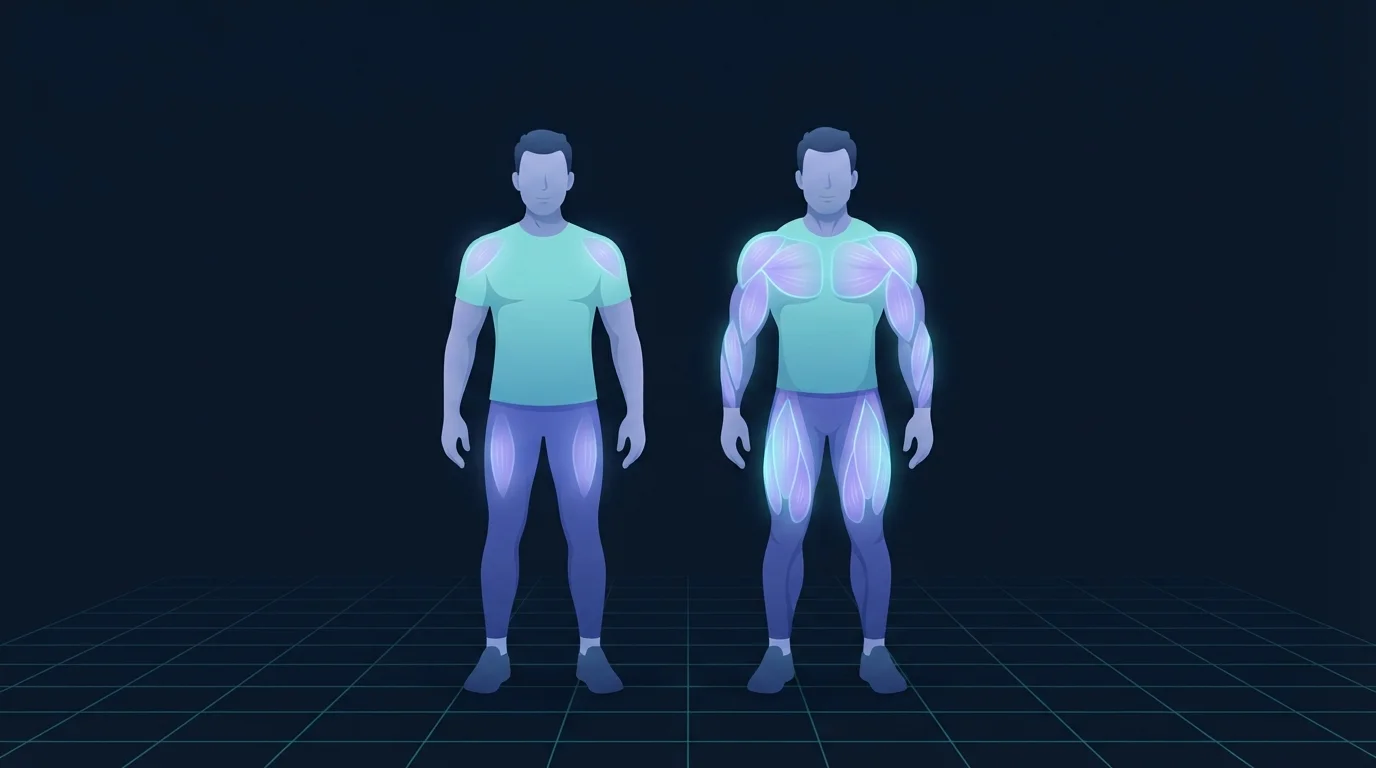
Where the Lean Mass Effect Is Largest: Older Adults
The clearest lean-tissue result in the whole literature comes from older lifters. Chilibeck and colleagues (2017) pooled 22 randomized trials with 721 participants, mean ages 57 to 70, who trained two to three days a week for anywhere from 7 to 52 weeks. Creatine added 1.37 kg of lean tissue mass over resistance training alone, plus significant improvements in chest press and leg press strength.
That matters more than the number looks, because age-related muscle loss is the mechanism behind a lot of late-life frailty. Our review of sarcopenia and resistance training covers why lean tissue in the seventh and eighth decade is worth more than the same kilogram at twenty-five.
Get an evidence-based plan built for you
FitCraft, our mobile fitness app, pairs you with an AI coach who builds you a personalized plan around your goals, schedule, and fitness level. Every FitCraft program is designed by Domenic Angelino, MPH (Brown University) and NSCA-CSCS, with research published in the Journal of Strength and Conditioning Research and Medicine & Science in Sports & Exercise.
Take the Free Assessment Free • 2 minutes • No credit cardCreatine Loading vs Maintenance: The Dose the Trials Used
Nearly every trial cited on this page used one of two protocols, and Hultman's biopsy data explain why either works. Creatine loading means roughly 20 grams a day, split into four doses, for five to seven days, which saturates the muscle in under a week. A plain maintenance dose means 3 to 5 grams a day from the start, which reaches the same saturation point in about four weeks. Hultman and colleagues (1996) measured both and found the same roughly 20% rise in muscle total creatine either way.
So the choice is about speed, not ceiling. Load if you want the effect inside a week and don't mind the higher chance of stomach upset at the larger dose. Skip loading if you'd rather take one scoop a day and wait a month. Our full breakdown of creatine loading versus maintenance covers the trade-offs, including what happens on rest days and after you stop.
One practical note the trials agree on: consistency beats timing. Taking it every day is what keeps the store full. Whether you take it before or after training is a much smaller question, which is why our timing guide ends up recommending whatever you'll remember.
Creatine Brain Benefits: The Most Interesting Open Question
Creatine isn't only stored in muscle. The brain runs its own creatine and phosphocreatine system, and the same logic that applies to a working muscle applies to neurons under metabolic stress. That's why creatine has been studied for cognition under sleep deprivation, for mood, and in traumatic brain injury.
The evidence there is genuinely promising and genuinely less settled than the strength evidence, with the clearest signals appearing when the brain is already stressed rather than in rested, well-fed young adults. We keep that literature on a separate page: our review of creatine brain benefits walks through the cognition and sleep-deprivation trials, the dose questions, and the vegetarian subgroup finding. It does not repeat this page, and this page will not repeat it.
Creatine for Women: What the Sex-Disaggregated Data Show
Strength first, because it's the least ambiguous. Branch (2003) found no difference in effect size between men and women across 100 studies, and both Lanhers meta-analyses reported that the strength effect held independent of sex. Creatine works for women's strength.
Lean mass is murkier. The sex-disaggregated analysis in Delpino and colleagues (2022) found men on creatine gained 1.46 kg of lean mass during resistance training while the 0.29 kg gain in women wasn't statistically significant. Interestingly, the Desai 2025 trial found the opposite pattern during its wash-in phase, where only the women showed a significant lean mass increase. Two plausible explanations sit behind the inconsistency: far fewer trials have enrolled women, and most used a flat dose designed around larger bodies.
Smith-Ryan and colleagues (2021) in Nutrients argue that the strongest case for creatine in women isn't the twenty-something lifter at all. It's the perimenopausal and postmenopausal window, where the combination of falling estrogen, accelerating bone loss and declining lean tissue makes any small preservation effect worth more. Our post on creatine for women goes deeper on that lifespan framing, including the questions the research still hasn't answered.
Recovery and Soreness: The Claim That Doesn't Survive Pooling
Creatine is sold hard on recovery, and this is where the pooled data are least kind. Northeast and Clifford (2021) in the International Journal of Sport Nutrition and Exercise Metabolism meta-analyzed 13 randomized trials with 278 participants, looking at recovery from exercise-induced muscle damage at five time points out to 96 hours. Creatine did not improve strength recovery, muscle soreness, range of motion, or inflammation at any time point. The one signal was reduced creatine kinase activity at 48 hours, a blood marker of muscle membrane disruption, with no matching improvement in how people actually felt or performed.
The authors were direct: creatine does not accelerate recovery following exercise-induced muscle damage, though they note the trials were heterogeneous and mostly small. If soreness is your main complaint, the interventions with better evidence are sleep, protein intake, and sensible load progression, which our guide on recovering faster from a workout covers in order of effect size.
Safety: What Thirty Years of Trials Show
The International Society of Sports Nutrition position stand (Kreider et al., 2017) reviewed the full safety literature and concluded that short-term and long-term creatine supplementation, at doses up to 30 grams a day for as long as five years, is safe and well tolerated in healthy people and in clinical populations ranging from infants to older adults. That's a stronger safety record than most things sold in the same aisle.
Antonio and colleagues (2021) took the recurring worries one at a time and found the evidence didn't support them: creatine does not damage healthy kidneys, does not cause dehydration or cramping (the heat-tolerance data actually point the other way), is not an anabolic steroid, and doesn't require cycling. Creatinine, the blood marker clinicians watch for kidney function, can read slightly higher on creatine simply because you're eating more of its precursor, which is worth mentioning to a doctor before a routine panel so a normal result doesn't get misread.
Two genuine caveats remain. Anyone with existing kidney or liver disease, or on prescription medication, should clear creatine with a clinician rather than assume the healthy-population data apply. And the weight gain is real: the water shift typically shows up as 1 to 2 kg on the scale in the first week, which our review of whether creatine makes you gain weight separates into water, muscle and fat.
Common Misconceptions
Misconception: "A fancier form of creatine works better"
Creatine monohydrate is the form used in essentially every trial cited on this page, and the ISSN position stand found no evidence that hydrochloride, ethyl ester, buffered or liquid forms outperform it. They cost more and are studied less. When a supplement has thirty years of trials behind one specific molecule, using a different molecule means giving up the evidence.
Misconception: "Creatine builds muscle by itself"
Delpino's 2022 analysis settled this cleanly. Creatine plus resistance training added 1.10 kg of lean body mass. Creatine without exercise added 0.03 kg, which is statistical noise. Creatine is a training amplifier. With no training to amplify, there's nothing for it to do.
Misconception: "You have to load, or it won't work"
Hultman's biopsy data say otherwise. Three grams a day for 28 days reached the same muscle creatine concentration as 20 grams a day for six days. Loading is faster. It isn't better, and the larger doses are where most of the reported stomach upset comes from.
Misconception: "Creatine helps endurance performance"
Branch's analysis found creatine ineffective for running and swimming performance, and the mechanism explains why. Phosphocreatine powers efforts measured in seconds. An hour-long run is fueled by pathways creatine doesn't touch. The added body water can even work against you in events where carrying an extra kilogram costs something.
What the Research Suggests Going Forward
The strength and lean mass literature is mature enough that the effect sizes are unlikely to move much. The open questions have shifted elsewhere.
Dose is the live one. The Desai 2025 finding that 5 grams a day didn't add hypertrophy on top of training, paired with the authors' suggestion that larger maintenance doses may be needed, points at a question the field mostly skipped: the standard 3 to 5 gram dose was set by muscle saturation studies in the 1990s, not by dose-response hypertrophy trials. Whether body-size-scaled dosing changes the result is genuinely unknown.
Sex-disaggregated data is the second gap. Women are underrepresented across the whole literature, and the handful of trials that do separate results disagree with each other. Until more trials enroll women at adequate power, the honest position is that the strength benefit is well established and the lean mass benefit in women is not.
Third, most trials run 6 to 12 weeks. The Chilibeck pool included studies out to 52 weeks in older adults, which is the exception. Multi-year data in healthy trained adults is thin, and most of what exists is safety monitoring rather than performance tracking.
For anyone deciding today, the summary is unglamorous. Creatine monohydrate is cheap, well studied, safe in healthy people, and worth roughly a few extra percentage points of strength progress over a training block that you were going to do anyway. It's the supplement most worth taking, and it's still worth far less than the training it amplifies. If the training program is the part that keeps falling apart, that's the higher-leverage problem, and our roundup of the best strength training apps compares the tools that help most with the consistency side.

References
- Kreider RB, Kalman DS, Antonio J, Ziegenfuss TN, Wildman R, Collins R, Candow DG, Kleiner SM, Almada AL, Lopez HL. "International Society of Sports Nutrition position stand: safety and efficacy of creatine supplementation in exercise, sport, and medicine." J Int Soc Sports Nutr. 2017;14:18. doi:10.1186/s12970-017-0173-z
- Rawson ES, Volek JS. "Effects of creatine supplementation and resistance training on muscle strength and weightlifting performance." J Strength Cond Res. 2003;17(4):822-831. PMID: 14636102
- Lanhers C, Pereira B, Naughton G, Trousselard M, Lesage FX, Dutheil F. "Creatine Supplementation and Lower Limb Strength Performance: A Systematic Review and Meta-Analyses." Sports Med. 2015;45(9):1285-1294. doi:10.1007/s40279-015-0337-4
- Lanhers C, Pereira B, Naughton G, Trousselard M, Lesage FX, Dutheil F. "Creatine Supplementation and Upper Limb Strength Performance: A Systematic Review and Meta-Analysis." Sports Med. 2017;47(1):163-173. doi:10.1007/s40279-016-0571-4
- Branch JD. "Effect of creatine supplementation on body composition and performance: a meta-analysis." Int J Sport Nutr Exerc Metab. 2003;13(2):198-226. doi:10.1123/ijsnem.13.2.198
- Delpino FM, Figueiredo LM, Forbes SC, Candow DG, Santos HO. "Influence of age, sex, and type of exercise on the efficacy of creatine supplementation on lean body mass: A systematic review and meta-analysis of randomized clinical trials." Nutrition. 2022;103-104:111791. doi:10.1016/j.nut.2022.111791
- Chilibeck PD, Kaviani M, Candow DG, Zello GA. "Effect of creatine supplementation during resistance training on lean tissue mass and muscular strength in older adults: a meta-analysis." Open Access J Sports Med. 2017;8:213-226. doi:10.2147/OAJSM.S123529
- Burke R, Piñero A, Coleman M, Mohan A, Sapuppo M, Augustin F, Aragon AA, Candow DG, Forbes SC, Swinton P, Schoenfeld BJ. "The Effects of Creatine Supplementation Combined with Resistance Training on Regional Measures of Muscle Hypertrophy: A Systematic Review with Meta-Analysis." Nutrients. 2023;15(9):2116. doi:10.3390/nu15092116
- Desai I, Pandit A, Smith-Ryan AE, Simar D, Candow DG, Kaakoush NO, Hagstrom AD. "The Effect of Creatine Supplementation on Lean Body Mass with and Without Resistance Training." Nutrients. 2025;17(6):1081. doi:10.3390/nu17061081
- Northeast B, Clifford T. "The Effect of Creatine Supplementation on Markers of Exercise-Induced Muscle Damage: A Systematic Review and Meta-Analysis of Human Intervention Trials." Int J Sport Nutr Exerc Metab. 2021;31(3):276-291. doi:10.1123/ijsnem.2020-0282
- Hultman E, Söderlund K, Timmons JA, Cederblad G, Greenhaff PL. "Muscle creatine loading in men." J Appl Physiol. 1996;81(1):232-237. doi:10.1152/jappl.1996.81.1.232
- Antonio J, Candow DG, Forbes SC, Gualano B, Jagim AR, Kreider RB, Rawson ES, Smith-Ryan AE, VanDusseldorp TA, Willoughby DS, Ziegenfuss TN. "Common questions and misconceptions about creatine supplementation: what does the scientific evidence really show?" J Int Soc Sports Nutr. 2021;18(1):13. doi:10.1186/s12970-021-00412-w
- Smith-Ryan AE, Cabre HE, Eckerson JM, Candow DG. "Creatine Supplementation in Women's Health: A Lifespan Perspective." Nutrients. 2021;13(3):877. doi:10.3390/nu13030877
Frequently Asked Questions
What are the proven benefits of creatine monohydrate?
Three benefits hold up across meta-analyses. Strength: Rawson and Volek (2003) pooled 22 resistance training trials and found average strength gains about 8 percentage points greater with creatine than with placebo (20% versus 12%). Lean mass: Delpino and colleagues (2022) pooled 35 randomized trials with 1,192 participants and found roughly 1.10 kg more lean body mass when creatine was combined with resistance training. Repeat-effort performance: Branch (2003) reviewed 100 studies and found the clearest effects in short, repeated high-intensity bouts rather than in running or swimming. Benefits for muscle soreness and injury recovery are much weaker in the trial data.
How much creatine monohydrate should you take per day?
Three to five grams of creatine monohydrate per day, taken every day, is the dose almost every trial used. Hultman and colleagues (1996) showed that 3 g per day for 28 days raised muscle creatine by about 20%, the same ceiling reached by loading with 20 g per day for six days. Loading gets you to a full muscle store in under a week; a plain daily dose gets you to the same place in roughly a month. Neither route is more effective once the muscle is saturated, so the choice is about how quickly you want the effect.
Does creatine monohydrate actually build muscle, or is it just water?
Both, and the water part comes first. Desai and colleagues (2025) ran a 13-week randomized trial and found that a seven-day creatine wash-in alone added about 0.51 kg of measured lean body mass before any training started, which is intracellular water rather than new contractile tissue. After that, the creatine group gained the same 2 kg as the control group over 12 weeks of resistance training. Longer pooled data still favor creatine: Burke and colleagues (2023) used direct MRI and ultrasound imaging across 10 trials and found a small real hypertrophy benefit of roughly 0.10 to 0.16 cm of muscle thickness. So the effect is genuine but modest, and it's smaller than the first week on the scale suggests.
Is creatine monohydrate safe to take long term?
The International Society of Sports Nutrition position stand (Kreider et al., 2017) concluded that short-term and long-term creatine supplementation, at doses up to 30 g per day for as long as five years, is safe and well tolerated in healthy people and in clinical populations from infants to older adults. Antonio and colleagues (2021) reviewed the recurring worries individually and found no evidence that creatine damages healthy kidneys, causes dehydration or cramping, or functions as an anabolic steroid. Anyone with kidney or liver disease, or who takes prescription medication, should clear it with a clinician first.
Does creatine work as well for women as for men?
The strength evidence says yes, and the lean mass evidence is less settled. Branch (2003) found no difference in effect size between men and women across 100 studies, and the Lanhers meta-analyses found creatine effective for both upper and lower limb strength regardless of sex. But Delpino and colleagues (2022) found that men added 1.46 kg of lean mass while the 0.29 kg gain in women was not statistically significant, likely because fewer trials have enrolled women and most used doses scaled to larger bodies. Smith-Ryan and colleagues (2021) argue the case for creatine in women is strongest around menopause, for bone and lean tissue preservation.
Do you need to cycle off creatine?
No. There is no trial evidence that cycling creatine improves its effect or protects natural creatine production long term. Hultman and colleagues (1996) showed that muscle stores fall back to baseline roughly 30 days after you stop, so cycling off mostly means spending a month at a lower muscle creatine concentration for no measured benefit. The simpler approach the research supports is a steady daily dose for as long as you want the effect.