
It's a familiar find. You're clearing out a cupboard and there it is behind the rice: a half-used tub of creatine, bought during a burst of motivation, with a date on the label that passed sometime last spring. Throwing it out feels wasteful. Taking it feels like a small gamble. So it goes back on the shelf for another year.
The hesitation makes sense, because "expired" means different things for different products. For milk it means spoiled. For some medicines it means weaker. For a dry crystalline powder like creatine monohydrate, it mostly means the manufacturer stopped vouching for it on that day. Creatine's chemistry happens to be unusually well mapped, and it points at one thing to worry about. That thing is water.
Below: what the date on a creatine tub actually means, what the stability studies found for powder, how capsules and ready-to-drink liquids compare, how long creatine can sit in water, whether expired creatine is safe, the signs that a tub really has gone bad, how to store it, and how long creatine lasts in your body after you stop.
Does Creatine Go Bad? What the Date on the Tub Means
Start with the label. In the United States a dietary supplement doesn't have to carry an expiration date at all. The FDA's compliance guide for supplement manufacturers answers both halves of the question: the manufacturing rule doesn't require an expiration, shelf or "best if used by" date, and a company that prints one should have data to support it. So the date on your tub is the manufacturer's own promise, set by whatever stability testing it chose to run. For a powder this stable, that promise usually stops well short of how long the contents actually keep.
Then the chemistry. Creatine has only one realistic way to go bad. The molecule can curl around and close into a ring, shedding a molecule of water as it does, and the ring it forms is creatinine. Your body makes creatinine constantly (more on that below), your kidneys clear it, and it does nothing for your muscles. Uzzan, Nechrebeki, Zhou and Labuza (2009) put it bluntly in Drug Development and Industrial Pharmacy: creatinine has no biological activity. That turns "has my creatine expired?" into a narrower question. How much of the tub has turned into creatinine? For a dry powder, close to none.
How Long Does Creatine Last? What the Powder Stability Data Show
Creatine monohydrate, the form used in nearly every study and sold in most tubs, has been stress-tested for years at a time. Jäger, Purpura, Shao, Inoue and Kreider pulled the results together in 2011 while comparing creatine forms:
- Room temperature and 40 °C (104 °F): no sign of degradation after more than three years. Creatinine stayed below the detection limit of 67 parts per million.
- 60 °C (140 °F): creatinine first became measurable after 44 months, at 106 parts per million.
- What that means in a scoop: 106 parts per million is about 0.01%, roughly half a milligram of creatinine in a 5 gram serving. The rest of the scoop is still creatine.
The crystal's physical chemistry explains why. Dash, Mo and Pyne (2002) heated creatine monohydrate step by step for the Journal of Pharmaceutical Sciences. The crystal only began shedding its bound water at around 97 to 125 °C, and solid creatine didn't convert to creatinine until the temperature passed 230 °C. Between your pantry and those numbers there's a lot of room. Even a car parked in summer sun stays well below them.
The one real threat is moisture. Uzzan's group tested creatine across a wide range of water activity, a measure of how much free water a material holds, at 4, 23 and 35 °C. In contact with liquid, creatine broke down at predictable rates that climbed with temperature. In crystal form they confirmed stability is very high, as long as the powder never reaches deliquescence: the point where it pulls in enough moisture from the air to start dissolving in it. That's the whole story of creatine shelf life. Kept dry, creatine monohydrate powder lasts years beyond its printed date. Kept damp, it may not make it to the date at all.
Powder, Capsules or Liquid: Which Forms of Creatine Actually Expire
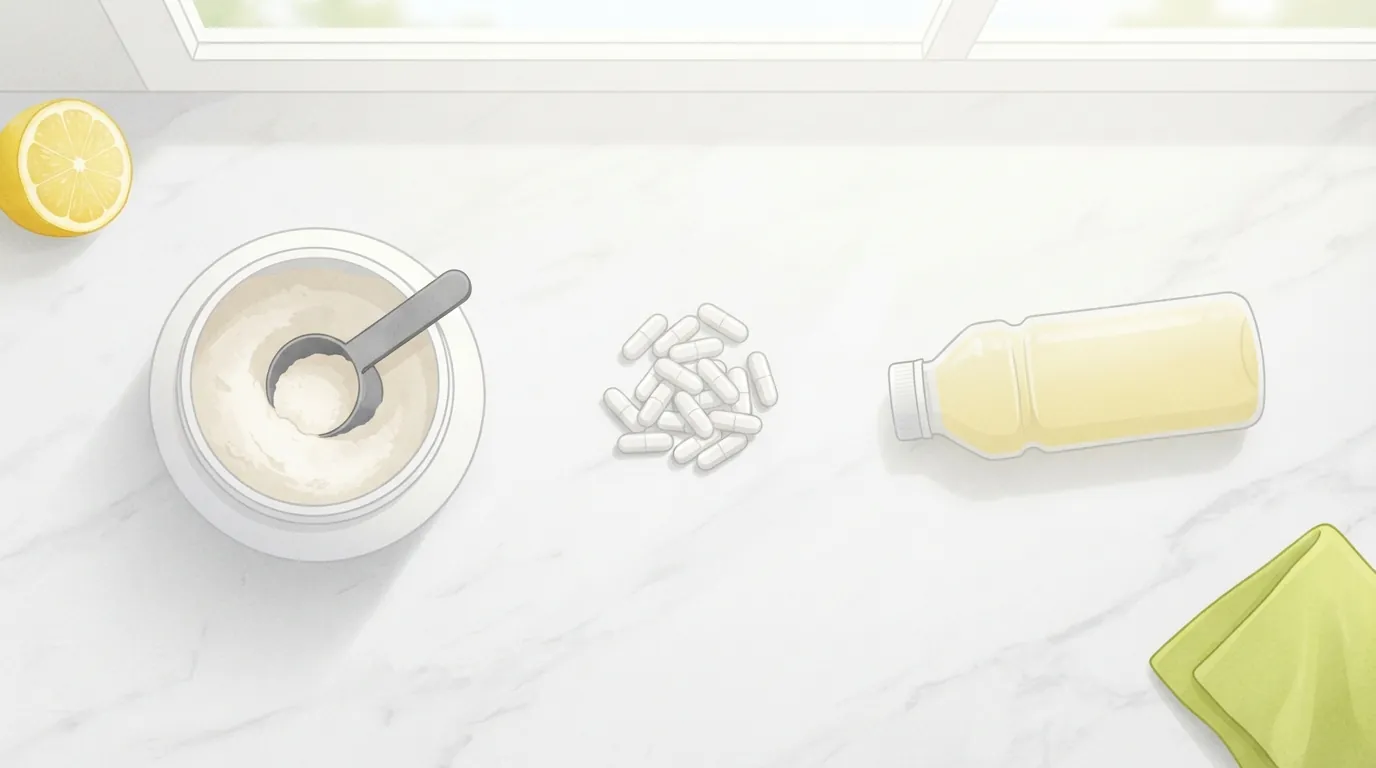
The molecule is the same in every format. The shelf life isn't, because some formats keep creatine dry and one keeps it in water.
| Format | What goes wrong | How long it realistically keeps |
|---|---|---|
| Monohydrate powder | Moisture from a wet scoop, a loose lid or a steamy room | Years past the printed date if it stays dry |
| Capsules and tablets | The same powder; gelatin capsules can soften or stick in humidity | As long as the powder, while the container stays sealed and dry |
| Flavoured powders and blends | The date also has to cover the flavourings, sweeteners and other ingredients | Go by the date; the creatine itself is as stable as plain powder |
| Ready-to-drink liquids and "serums" | Creatine converting to creatinine inside the bottle | Unreliable from the start; one tested product held almost none |
| Creatine ethyl ester | Converts to creatinine in water almost instantly near neutral pH | A poor bet even before its date |
Liquid creatine is where expiry stops being theoretical. Harris, Almada, Harris, Dunnett and Hespel (2004) sent three samples of a commercial "creatine serum" to four independent laboratories for the Journal of Sports Sciences. A 5 ml serving, sold as the equivalent of 2.5 grams of creatine monohydrate, contained less than 10 milligrams of creatine and about 90 milligrams of creatinine. When six men drank it, the creatine in their blood didn't budge. The same 2.5 grams of monohydrate dissolved in water roughly quadrupled it.
Ganguly, Jayappa and Dash (2003) showed how quickly the conversion runs once creatine sits in a bottle. They dissolved an effervescent creatine product in water and stored it for 45 days. At room temperature, 90% of the creatine broke down. In the fridge the loss was still 80%. The effervescent formula made the drink acidic, pH 3.6 at the start, and acid speeds the reaction, which matters because most flavoured drinks are acidic too.
The same chemistry sank creatine ethyl ester, a form once sold as an upgrade on monohydrate. Giese and Lecher (2009) found that in mild, water-based conditions it closes into creatinine, and that the change becomes nearly instantaneous as the pH approaches 7.4, the pH of your blood. Their conclusion was that it delivers creatinine rather than creatine.
Capsules are the same dry powder in a shell, so they keep as well as a tub while the container stays closed. Humidity is their weak spot: in a steamy bathroom cabinet the shells go soft or stick together long before the creatine inside changes.
How Long Can Creatine Sit in Water?
This is the everyday version of the same question, and two things decide it: temperature and acidity. The International Society of Sports Nutrition position stand on creatine (Kreider and colleagues, 2017) sums up the rule. Creatine is stable as a solid but not in solution, and it converts to creatinine faster the lower the pH and the higher the temperature. In neutral water it's relatively stable. After three days at 25 °C (77 °F), the losses in more acidic liquids were:
- pH 5.5, mildly acidic: 4%
- pH 4.5: 12%
- pH 3.5, about as acidic as many fruit juices: 21%
In practice that gives you plenty of slack. A scoop stirred into water and drunk within the hour loses nothing worth measuring, and a bottle mixed the night before and kept cold is fine too. The losses that matter come from mixing several days of creatine into juice at once, or leaving a mixed bottle in a warm gym bag. Warm water helps the powder dissolve, and over the few minutes it takes to drink, the extra heat can't do much damage.
Your stomach, oddly, is safe ground. Very strong acid, below about pH 2.5, locks creatine in a form that can't close into a ring, so the conversion slows right down again. The position stand notes that breakdown in the gut is minimal whatever the transit time, and that absorption is close to 100%. Juice is a worse place for creatine to spend a week than your stomach is to spend an hour.
Knowing what to do is the easy part.
FitCraft, our mobile fitness app, pairs you with an AI coach who builds you a personalized plan around your goals, schedule, and fitness level. Every FitCraft program is designed by Domenic Angelino, MPH (Brown University) and NSCA-CSCS, with research published in the Journal of Strength and Conditioning Research and Medicine & Science in Sports & Exercise.
Take the Free Assessment Free • 2 minutes • No credit cardIs Expired Creatine Safe to Take?
For plain creatine monohydrate powder that has stayed dry and still looks and smells normal, the evidence says yes. The worst figure in the stability data, 106 parts per million after 44 months at 60 °C, works out to about half a milligram of creatinine per 5 gram scoop. Put that next to what your body does on its own. Roughly 1 to 2% of the creatine in your muscles breaks down into creatinine and leaves in your urine, which is why, per the ISSN position stand, your body has to replace about 1 to 3 grams of creatine a day just to keep its stores level. Half a milligram from an old tub is a rounding error on top of that.
Is expired creatine less effective? Only in proportion to how much has converted, and for a dry powder that's next to nothing. The products that genuinely lose potency are the ones that hold creatine in liquid, and those can be weak long before any date.
What a date can't protect you from is contamination. Dry powders are too dry for mould or bacteria to grow in. Wet powder isn't, and wet creatine has also been converting, so a tub that got water in it fails on both counts. Three rules cover it:
- Plain, dry, normal-looking monohydrate past its date: fine to use.
- Anything that got wet, smells off, changed colour or grew something: throw it out, whatever the date says.
- Liquids, and flavoured blends well past their date: replace them. The creatine in a flavoured powder may be fine, but the date also covers every other ingredient.
And if you have kidney disease, take medication that affects your kidneys, or are pregnant or breastfeeding, talk to your doctor about whether creatine suits you at all before you think about the date. One practical point for everyone else: Antonio and colleagues (2021) note that creatine supplements can raise blood and urine creatinine without that reflecting any drop in kidney function, so tell whoever orders your bloodwork that you take it.
Creatine Out of Date? How to Tell If a Tub Has Gone Bad
Start with the frustrating fact: you can't see creatinine. It's a white, odourless powder, just like creatine, so a tub that has partly converted looks identical to a fresh one. What you can see are the signs that water got in, and water is the only thing that makes creatine go bad. Look for these:
- Soft clumps that crumble under a dry spoon. Some moisture reached the powder, but not enough to dissolve it. Use it, reseal the tub properly and finish it sooner.
- A solid brick that won't break apart. The powder has taken on real water and some of it has probably spent time in solution. Throw it out.
- A wet, sticky or pasty texture, or liquid pooled in the tub. Throw it out.
- Yellowing, brown spots, dark specks or anything fuzzy. Discolouration or mould means contamination. Throw it out.
- A sour, musty or chemical smell. Plain creatine monohydrate has almost no smell, so a new one is a warning. Throw it out.
- Flavoured powder that tastes flat or has faded. The flavourings have aged even if the creatine hasn't. Go by the date.
- Capsules that are soft, stuck together or cracked. Humidity got into the container. Replace them.
If none of those apply and the tub has been closed and dry, an out-of-date label on its own isn't a reason to throw creatine away.
How to Store Creatine So It Outlasts the Date
Everything above comes down to one instruction, keep water away from it, and six habits that do the job:
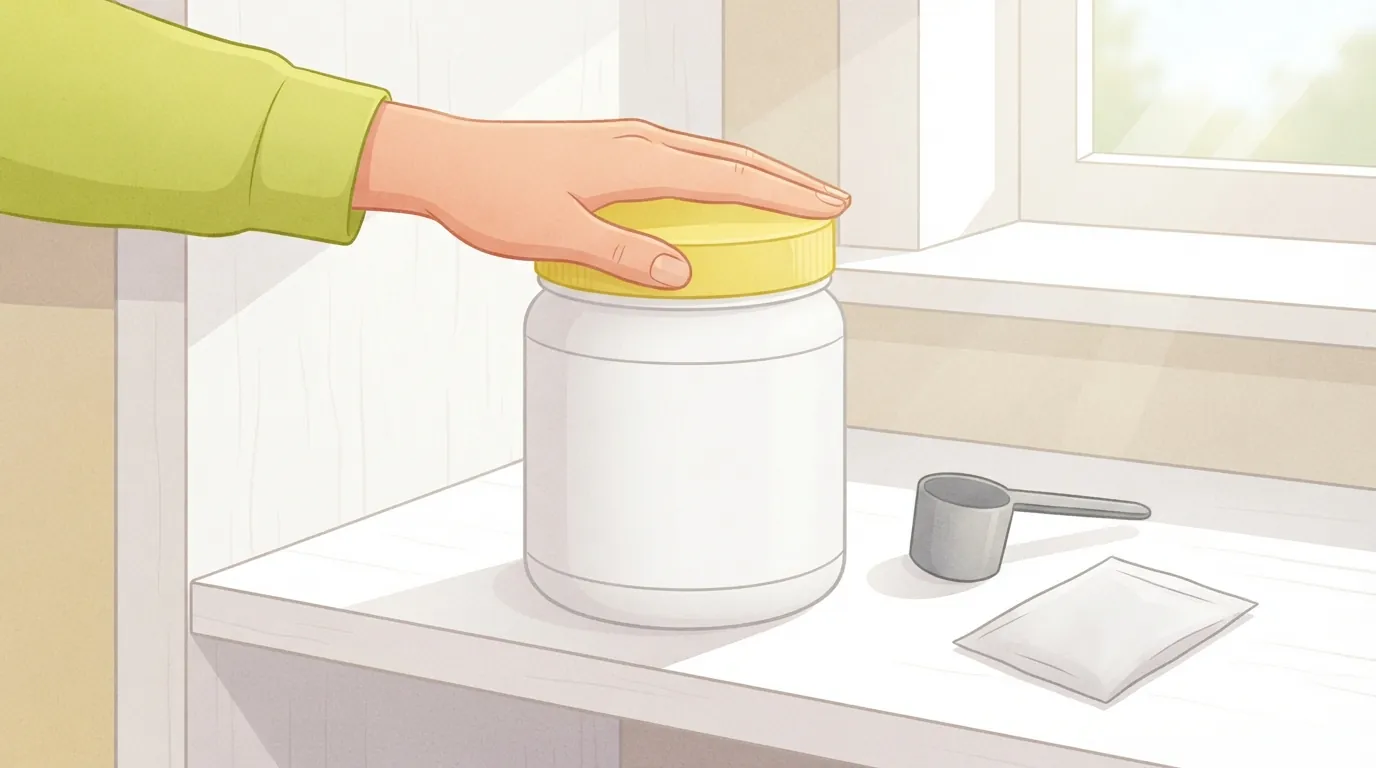
- Lid on tight, every time. A loose lid on a humid day is how most clumping starts.
- Dry scoop only. A scoop that has touched a wet shaker carries water straight into the powder.
- Keep the desiccant sachet if the tub came with one. It's there to soak up the moisture that gets in each time you open the lid.
- Store it cool and dry: a cupboard or pantry shelf, away from the kettle, the stove, the dishwasher and bathroom steam.
- Skip the fridge. A cold tub opened in a warm kitchen collects condensation on the powder, which is the opposite of what you want.
- Buy a size you'll finish. At 3 to 5 grams a day, a 300 gram tub lasts two to three months and a kilogram lasts most of a year, well inside the shelf life of a tub that's stored properly.
Heat on its own matters far less than people assume. A tub that spends a summer afternoon in a hot car is still nowhere near the temperatures where dry creatine starts to change. Humidity is the thing to protect it from.
How Long Does Creatine Last in Your Body?
The other half of "how long does creatine last" is what happens once you stop taking it. Hultman and colleagues (1996) followed 31 men in the Journal of Applied Physiology. A loading phase of 20 grams a day for six days raised muscle creatine by about 20%. When supplementation stopped, stores drifted down, and 30 days later they were back where they started. The ISSN position stand puts the usual washout at four to six weeks and notes there's no evidence that stores fall below their original level afterwards.
There isn't one tidy half-life for creatine. Blood levels peak about an hour after a dose, and the creatine then leaves the blood mostly by moving into muscle. Persky, Brazeau and Hochhaus (2003), reviewing its pharmacokinetics in Clinical Pharmacokinetics, describe that "trapping" by muscle as a clearance route in its own right, alongside the kidneys and conversion to creatinine, and note that clearance changes once muscle stores are full. For training purposes the number that matters is the muscle store, and it's measured in weeks.
And here's the neat link back to the tub. The reaction that ruins wet creatine runs inside you all day. Muscle is warm and mostly water, and it converts about 1 to 2% of its creatine to creatinine every day, which is why you need a steady supply from food and your own synthesis just to stand still. Sitting dry on a shelf, the same molecule barely changes in three years.
What This Means for You
If the tub is plain monohydrate, it stayed closed and dry, and it looks and smells the way it did when you bought it, use it. The date was set by testing that stopped long before the powder would have. Take 3 to 5 grams a day, mixed fresh, and keep the lid tight, the scoop dry and the desiccant sachet in the tub. Our guide to the best time to take creatine covers timing, meals and rest days, and if an earlier round of creatine upset your stomach, our post on whether creatine makes you bloated explains why it happens and how to avoid it.
If it's a liquid, a product that got wet, or a flavoured blend long past its date, replace it. A fresh tub is a small outlay next to months of wondering whether the old one is doing anything.
And if the tub's real story is that it outlasted your training, that's the bigger fix. Creatine adds to training that's already happening, and our review of the creatine monohydrate evidence shows how much of its benefit depends on the sessions themselves. If consistency is the part that slipped, our roundup of the best strength training apps ranks the options by whether beginners are still using them at week eight, which is the number that decides results.
Frequently Asked Questions
Does creatine expire?
It carries a printed date, usually a few years after manufacture, but dry creatine monohydrate powder is far more stable than that date suggests. In stability testing summarised by Jäger and colleagues (2011), the powder showed no measurable breakdown after more than three years at 40 °C, and after 44 months at 60 °C only 106 parts per million had turned into creatinine. What breaks creatine down is water, so a tub that has stayed sealed and dry is usually fine well past its date.
Does creatine go bad?
Only when water gets to it. Dissolved creatine slowly converts into creatinine, a waste product with no performance benefit, and the conversion speeds up as a liquid gets warmer and more acidic. Ganguly and colleagues (2003) found 90% of the creatine in an acidic ready-mixed solution had broken down within 45 days at room temperature. Powder that has stayed dry doesn't go bad in any meaningful way. Powder that got wet, set into a brick, changed colour or smells musty should be thrown out.
How long does creatine last?
As a dry powder, years: well beyond the date on most tubs if it's kept sealed and dry. Once mixed into water, drink it the same day. Creatine is relatively stable in neutral water, but the ISSN position stand reports losses of 4%, 12% and 21% after three days at 25 °C at pH 5.5, 4.5 and 3.5. In your body, raised muscle creatine stores take about four to six weeks to return to baseline after you stop taking it.
Is expired creatine safe to take?
Plain creatine monohydrate powder that has stayed dry and still looks and smells normal is very likely safe past its date. The worst case in the stability data works out to about half a milligram of creatinine per 5 gram serving, a tiny fraction of the creatine your own muscles break down into creatinine every day, which the ISSN position stand puts at 1 to 3 grams. Throw out anything that got wet, smells off, changed colour or grew mould, and talk to a doctor first if you have kidney disease or are pregnant.
How long can creatine sit in water?
In plain water, a day is no problem. Creatine is relatively stable at neutral pH, so a drink mixed in the morning and finished that afternoon, or mixed the night before and kept cold, is fine. Losses climb with acidity and warmth: after three days at 25 °C, creatine lost 4% at pH 5.5, 12% at pH 4.5 and 21% at pH 3.5, according to the ISSN position stand. Avoid pre-mixing several days of creatine in juice or leaving a mixed bottle somewhere warm.
Is clumpy creatine still good?
Usually, yes. Clumps mean some moisture reached the powder, and creatine monohydrate stays stable as long as it doesn't absorb enough water to start dissolving, which Uzzan and colleagues (2009) confirmed in storage tests. If the clumps crumble under a dry spoon and the powder looks and smells normal, use it, reseal the tub tightly and finish it sooner. If it has set into a solid brick, turned sticky, changed colour, grown anything fuzzy or smells musty, throw it out.
How long does creatine stay in your body?
Blood levels peak about an hour after a dose and fall as muscle takes the creatine up, so there's no single useful half-life. The muscle store is what lasts. In Hultman and colleagues' 1996 study, muscle creatine was back to its starting level 30 days after supplementation stopped, and the ISSN position stand puts the usual washout at four to six weeks. There's no evidence that stores drop below where they were before you started.