Nobody quits creatine because a meta-analysis disappointed them. They quit because their stomach felt wrong in week one, or the scale jumped two kilos in five days, or somebody on a forum posted before-and-after photos of a waistline. The supplement with the best evidence base in the aisle gets abandoned over a feeling, usually in the first ten days, usually on a protocol nobody needed to run.
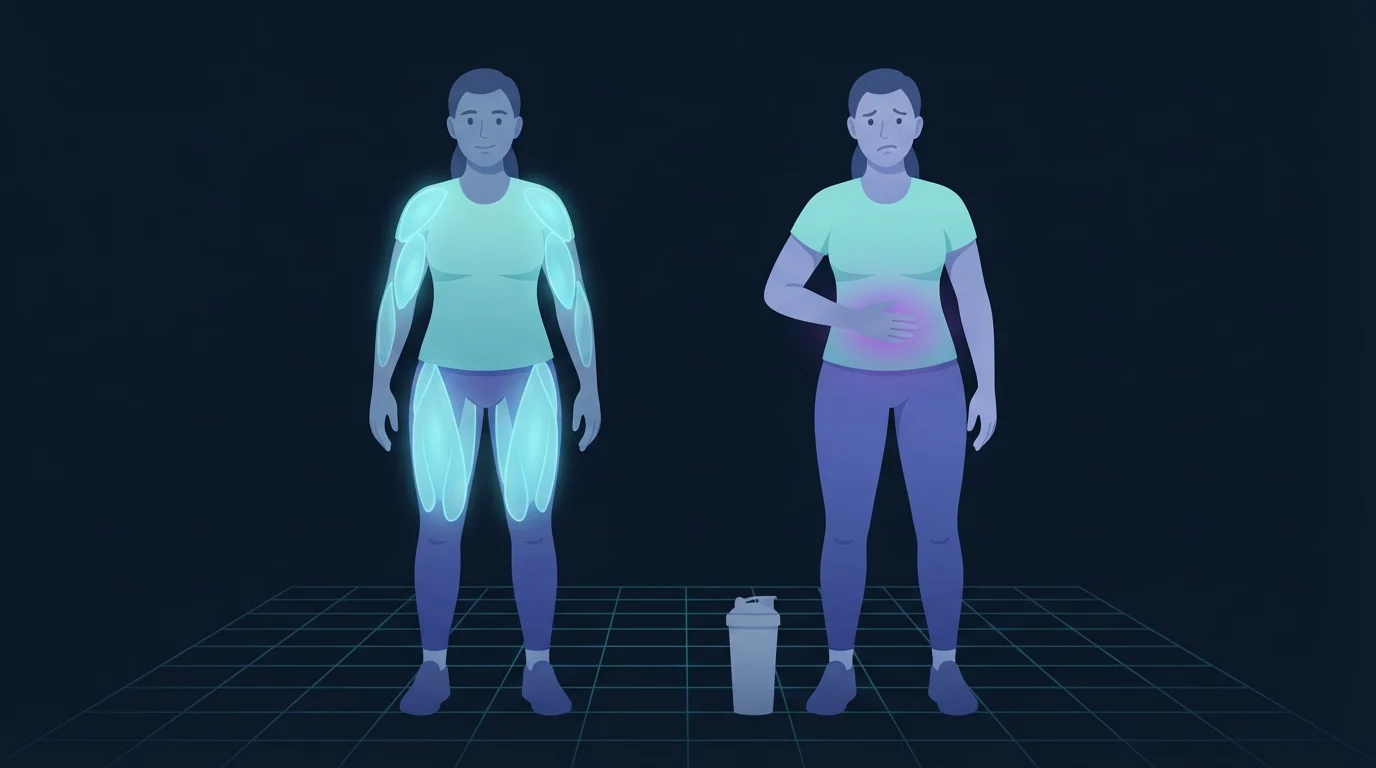
The problem is that "bloating" is doing two jobs in that sentence. It means abdominal distension, gas and gut discomfort. It also means a general sense of looking puffy and holding water. Those have separate causes, separate timelines and separate fixes, and almost every confusing answer online comes from treating them as one thing.
So this page splits them. What the gastrointestinal trials actually measured, why the loading phase is where nearly all of it lives, whether creatine makes you gassy, how long each version lasts, what the female-specific trials found, whether any "no bloat" formulation earns the premium, and the protocol that sidesteps the whole question. The separate argument about whether creatine makes the number on the scale go up, and whether that number is fat, is covered in full in our research review of whether creatine makes you gain weight and is not repeated here.
Bloating and Water Retention Are Two Different Things
Creatine is osmotically active, which means it pulls water toward itself. That single property produces both effects, in two different compartments, and the compartment is what matters.
When creatine is absorbed and transported into muscle, water follows it into the muscle cell. Powers, Arnold, Weltman and colleagues (2003) in the Journal of Athletic Training ran 28 days of supplementation with a 7 day load at 25 grams and measured total body water, extracellular water and intracellular water directly. Total body water and body mass rose. The distribution between compartments didn't shift, meaning the extra fluid was not pooling in the space around your cells the way it does in the kind of puffy swelling people picture. That fluid is inside working muscle. It shows up as fuller-looking arms, shoulders and thighs. It doesn't show up as a distended abdomen, because there's no meaningful skeletal muscle mass in the way it would need to be.
The other effect happens before absorption. Creatine monohydrate is only modestly soluble, roughly 14 grams per litre in room-temperature water. A 20 gram dose in 300 millilitres doesn't go into solution. What doesn't dissolve travels into the intestine, holds water there by the same osmotic property, and produces exactly what you'd expect: distension, cramping, urgency. That's real bloating, it's uncomfortable, and it's entirely a function of how much you put in one glass.
What the Loading Dose Actually Does to Your Gut
The best trial on this question was designed specifically to ask whether creatine side effects are dose dependent. Ostojic and Ahmetovic recruited 59 top-level male soccer players and ran a double-blind design over 28 days with three arms: 10 grams a day as two 5 gram doses, 10 grams a day as one 10 gram dose, and placebo. Participants logged gastrointestinal symptoms throughout.
Two findings, and both matter.
First, overall gastrointestinal complaints were infrequent, mild and statistically no different from placebo. At a sensible daily total, most people get nothing. Second, diarrhea specifically was significantly more common in the single-dose arm than the split-dose arm. Same daily total of creatine, same 28 days, same athletes. The only variable was whether it arrived in one glass or two, and that variable moved the outcome. Longobardi and colleagues, reviewing this trial in 2025, report the split as 55.6% of the single-dose group against 28.6% of the split-dose group, and attribute it to undissolved creatine reaching the gastrointestinal tract.
Antonio, Candow, Forbes and colleagues (2021) in the Journal of the International Society of Sports Nutrition put the practical threshold at the same place, noting that single doses above 10 grams may cause gastrointestinal distress. The 2017 International Society of Sports Nutrition position stand reaches the same conclusion across the broader safety literature.
Now put that next to what a loading phase asks of you: 20 to 25 grams a day for five to seven days. Even split into four servings, that is four times the exposure, and plenty of people take it as two large ones. Loading is where the bloating reports come from, and Antonio and colleagues also note that muscle creatine ends up at the same place, roughly a 20% increase, whether you load or simply take 3 grams a day for 28 days. You get there three weeks later and skip the part that upsets your stomach. Our review of creatine loading versus maintenance works through that trade-off in detail.

Does Creatine Make You Gassy?
Gas is the same story as bloating with one extra step. Undissolved creatine that reaches the colon gives gut bacteria something to work on, and fermentation produces gas. That is why gassiness clusters in the same people, on the same doses, at the same point in a protocol as the distension does.
Three things reduce it, in order of how much they help:
- Smaller single doses. 3 to 5 grams, never 10 in one glass. This is most of the fix.
- Actually dissolving it. Warm water rather than cold, stirred until the cloudiness clears, drunk reasonably soon after rather than left to settle. A micronized monohydrate is milled to a smaller particle size and dissolves faster, which is the one product feature with a clear mechanism behind it.
- Taking it with food. Slower gastric emptying gives absorption more time, and a meal dilutes the osmotic load.
One suspect worth ruling out before you blame the creatine: flavoured and sweetened creatine products frequently contain sugar alcohols such as sorbitol, maltitol or erythritol, which are well-documented causes of gas and bloating at modest doses. If your gas started with a fruit-punch tub and not with a plain one, switch to unflavoured monohydrate before you conclude creatine disagrees with you.
How Long Creatine Bloating Lasts, and When It Goes Away
The two versions have two different clocks, which is why the internet can't agree on an answer.
| What you are feeling | Where it is | How long it lasts |
|---|---|---|
| Stomach distension, gas, urgency | Gastrointestinal tract, from undissolved powder | Gone in 1 to 2 days once the single dose drops to 3 to 5 g |
| Fuller arms, shoulders and thighs | Inside the muscle cell | Builds over roughly week 1, then flat for as long as you supplement |
| Scale up 1 to 3 kg in week one | Total body water, mostly intracellular | Plateaus once muscle stores saturate; reverses in 4 to 6 weeks after stopping |
The key point is that neither version compounds. Muscle creatine stores have a ceiling, so once they are full the water that came with them stops increasing. Longobardi and colleagues put the loading-phase gain at 1 to 3 kilograms of body weight over five days at 20 grams a day, almost all of it total body water. Somebody who is still gaining water weight in month three is gaining something else, and that something is worth looking at honestly rather than blaming the tub.
Knowing what to do is the easy part.
FitCraft, our mobile fitness app, pairs you with an AI coach who builds you a personalized plan around your goals, schedule, and fitness level. Every FitCraft program is designed by Domenic Angelino, MPH (Brown University) and NSCA-CSCS, with research published in the Journal of Strength and Conditioning Research and Medicine & Science in Sports & Exercise.
Take the Free Assessment Free • 2 minutes • No credit cardCreatine Bloating in Women: What the Female-Specific Trials Show
This is where the fear is loudest and the data is most reassuring, which is an unusual combination.
Moore, Gordon, Cabre, Hackney and Smith-Ryan (2023) in Nutrients ran a randomized controlled trial in 30 moderately active women aged 18 to 40, half naturally menstruating and half on hormonal contraceptives, using a five-day load of 20 grams a day split into four 5 gram doses with a four-week washout between menstrual phases. In the luteal phase, the creatine group gained 0.83 litres of total body water against a 0.62 litre drop in placebo. Intracellular fluid rose 0.74 litres and extracellular 0.46 litres. And the headline for anyone worried about the mirror: there were no significant changes in body mass across the menstrual cycle or following supplementation.
Avon, Levers, Wasilcyzk and colleagues (2025) ran the comparison people actually want, putting a 20 gram loading protocol against a 5 gram daily maintenance dose in female recreational athletes over 14 days. Intracellular and extracellular water were unchanged in every group. Body mass, body fat percentage, fat mass and lean soft tissue were unchanged. The one meaningful signal was a small drop in the ratio of extracellular to total body water in the loading group, which is fluid moving into cells rather than out of them. The sample was small, 11 participants, so treat it as supportive rather than definitive.
The gut side is not sex-specific. It tracks the size of each single dose in women the way it does in men, and the same 3 to 5 gram rule applies. Our companion post on whether creatine is safe for women covers the broader safety picture, including the kidney question and the perimenopause evidence.
"No Bloat" Creatine: Do HCl, Buffered and Micronized Forms Help?
An entire product category exists on this promise, and it's worth being specific about what has and has not been tested.
Buffered creatine was sold on the claim of better retention and fewer side effects at lower doses. Jagim, Oliver, Sanchez and colleagues (2012) tested exactly that claim against monohydrate and placebo over 28 days in resistance-trained men. There was no advantage in side effects, and none in muscle creatine content, strength or body composition either. The efficacy claim and the tolerance claim failed in the same trial.
Creatine HCl dissolves far more readily than monohydrate, which is a genuine chemical difference and the one plausible reason an alternative form might sit easier. What doesn't exist is a controlled trial comparing HCl with monohydrate on bloating or gastrointestinal symptoms as an outcome. The mechanism is reasonable, the evidence is absent, and the price premium is real.
Micronized monohydrate is the same molecule milled to a smaller particle size so it dissolves faster and settles less. It costs slightly more than standard monohydrate and nothing like the specialty forms. If a plain monohydrate genuinely bothers your stomach at 5 grams, this is the sensible next thing to try.
The honest summary: no form has beaten monohydrate on gut symptoms in a head-to-head trial, and the dose change that does work costs nothing.
How to Take Creatine Without Bloating
Five rules, and the first one does most of the work:
- Skip the loading phase. 3 to 5 grams a day from day one. You reach full saturation in three to four weeks instead of one, and you remove the entire window where almost every bloating complaint originates.
- One dose, 5 grams maximum. If you have a reason to take more, split it across meals rather than stacking it into one serving.
- Dissolve it properly. Warm water, stir until it clears, drink it rather than letting it settle. Grit at the bottom of the glass is the dose that causes trouble.
- Take it with food. Timing doesn't change the result, so anchor it to a meal you never skip. Our guide to the best time to take creatine covers why the clock matters less than the habit.
- Unflavoured monohydrate. It removes sugar alcohols and other additives from the list of suspects, and it is the form every trial in this article used.
If you are already bloated on a loading protocol, the fix is the same protocol without the loading. Drop to 5 grams, split it if you want, and give it two days. Symptoms that persist past that are probably not the creatine.
When the Bloating Is Not the Creatine
Creatine usually starts alongside other changes, and the other changes are frequently the culprit. Worth ruling out before you abandon a supplement that works:
- A big jump in protein powder or fibre at the same time. Whey causes bloating in people with lactose sensitivity, and a sudden fibre increase reliably produces gas for a week or two.
- Sugar alcohols in flavoured products, pre-workouts and protein bars.
- New training volume. Heavier lifting means more intra-abdominal pressure, more breath-holding and more swallowed air, and beginners notice it.
- Eating more, and eating later. A surplus that arrives with a new program shows up in the mirror before it shows up anywhere useful.
And a genuine caution: bloating that does not track your creatine dose, persists for weeks, or comes with weight loss, blood, severe pain or a change in bowel habits has nothing to do with supplements and needs a clinician. Creatine is a convenient thing to blame, and that convenience is exactly why it's worth ruling out properly.
What This Means for You
If you haven't started yet, start at 3 to 5 grams and never run a loading phase. You'll almost certainly feel nothing at all, and you will get to the same muscle creatine level by the end of the month. The fuller-looking arms are the point, not a side effect.
If you started with a load and your stomach is unhappy, you haven't discovered an intolerance. You've discovered what the 2008 trial found, on schedule. Cut to 5 grams, dissolve it properly, take it with a meal, and reassess in two days.
And if the reason you're reading a creatine article at all is that progress has stalled, keep the supplement in perspective. Creatine is a modifier on training that is already happening. It can't manufacture sessions. If the sessions are the part slipping, a personalized training program built around the days you actually have is the higher-leverage change, and the powder can wait until the schedule holds.

Frequently Asked Questions
Does creatine make you bloated?
It can, and it is the dose rather than the creatine. Ostojic and Ahmetovic (2008) gave 59 top-level soccer players 10 grams of creatine a day for 28 days, either split into two 5 gram doses or taken as one 10 gram dose, and found gastrointestinal complaints infrequent and mild overall, but diarrhea significantly more common on the single large dose. Take 3 to 5 grams a day with no loading phase, and stomach bloating becomes unlikely. What most people call creatine bloat is a separate thing entirely: water drawn into the muscle cell, which makes limbs look fuller rather than making the stomach swell.
Does creatine make you gassy or cause gas?
Sometimes, and for the same reason it causes bloating: creatine is only modestly soluble in water, so powder that has not dissolved arrives in the intestine, pulls water in after it and gets fermented. Longobardi and colleagues (2025) in Frontiers in Nutrition identify undissolved creatine in the gastrointestinal tract as the likely mechanism and recommend keeping any single dose at or below 5 grams. Fully dissolving the powder in warm water, taking it with a meal and using a micronized product all reduce the amount that survives to your intestine. Flavoured or sweetened creatine products can also cause gas through their sugar alcohols rather than through the creatine.
How long does creatine bloating last?
Gastrointestinal bloating usually settles within a day or two of dropping the dose to 3 to 5 grams, because it is caused by undissolved powder that is no longer arriving. The intracellular water that fills the muscle is a different timeline: it builds over roughly the first week and then stays flat for as long as you keep taking creatine, because saturated muscle cannot hold any more. It reverses over four to six weeks once you stop, as muscle creatine returns to baseline. Neither effect keeps growing month after month.
Is there a creatine that does not cause bloating?
No form has been shown to beat plain monohydrate on gut symptoms in a controlled trial. Jagim and colleagues (2012) tested a buffered creatine sold on exactly that claim against monohydrate and placebo over 28 days in resistance-trained men and found no advantage in side effects, and none in muscle creatine content, strength or body composition either. Creatine HCl and other alternative salts dissolve more readily but have not been trialled head to head for bloating. Micronized monohydrate, which is milled finer and dissolves faster, is the cheapest sensible answer, and dropping the loading phase does more than any form ever will.
Does creatine bloating happen in women?
The fluid response looks smaller. Moore and colleagues (2023) in Nutrients gave 30 moderately active women 20 grams of creatine a day for five days and found total body water rose by 0.83 litres against placebo, with no significant change in body mass. Avon and colleagues (2025) compared a 20 gram loading protocol with 5 grams a day in female recreational athletes over 14 days and found intracellular and extracellular water unchanged in both groups, with no change in body mass. The gut side is not sex-specific: it tracks the size of each single dose, exactly as it does in men.
What is creatine belly?
It is a nickname for two unrelated things that get blamed on the same tub. One is genuine abdominal distension from a large undissolved dose, which is a gut symptom and resolves within days at 3 to 5 grams. The other is the scale moving 1 to 3 kilograms in the first week of a loading phase, which Longobardi and colleagues (2025) attribute almost entirely to total body water, most of it inside muscle cells. Water inside a muscle cell does not sit in your abdomen. If your midsection specifically looks different, look at the dose, the additives and what else changed in your week.
Does creatine help with bloating?
There is no evidence that creatine relieves bloating from any other cause, and no mechanism that would make it do so. Creatine is osmotically active, so the plausible direction of effect is the opposite one. If your bloating improved after starting creatine, the likeliest explanation is something else that changed at the same time, such as eating more regularly around training, drinking more water or cutting a food that was causing it. Persistent bloating that does not track your dose deserves a conversation with a clinician rather than a supplement change.