"Get in shape" is probably the most common fitness goal, and one of the least useful. It has no number and no finish line. On a Tuesday in week three, it can't tell you whether you're winning.
That vagueness costs more than it seems. When the only measure is how you feel, every skipped session reads as proof that you're not a fitness person, and the guilt piles up faster than the progress. Most people quit at that point, convinced it was a willpower problem.
It's a design problem. A goal you can measure gives every workout a job and every week a verdict you can see. Below are 36 fitness goals examples you can copy, grouped by aim. After them come the steps to set your own, track them and recover when one slips.
36 Fitness Goals Examples, Grouped by Aim
Each goal below is one measurable result with a time frame. Treat the numbers as starting points and scale them to where you are today. Almost all of them need only bodyweight or a pair of dumbbells, so you can work on them at home. Pick one or two from different groups rather than ten at once.
Strength Goals
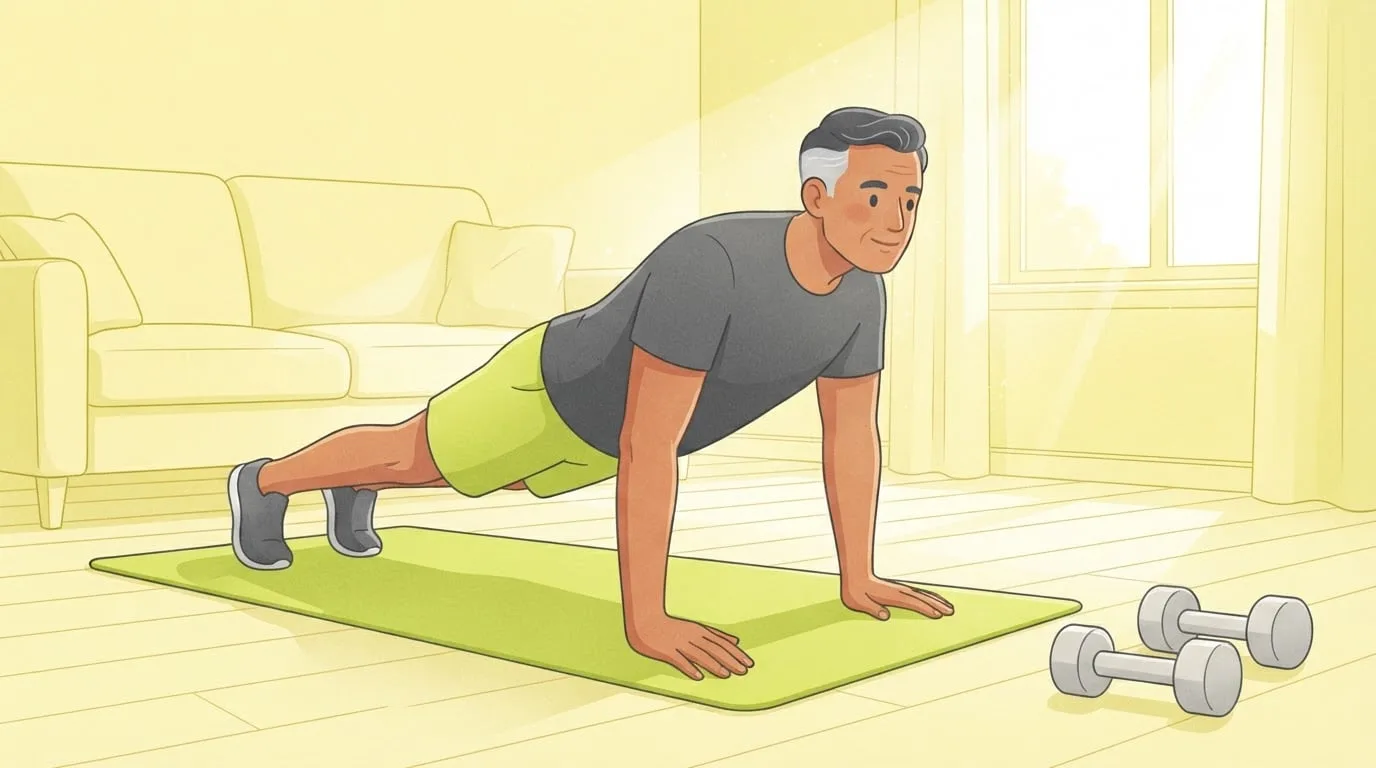
- Do 10 full push-ups in a row within 8 weeks. Start with incline push-ups against a counter or sturdy bench and lower the incline every two weeks. Push-ups are a useful test as well as an exercise. In a 10-year study of 1,104 active male firefighters, Yang and colleagues (2019) found that men who could do more than 40 push-ups had a 96 percent lower rate of cardiovascular events than men who managed fewer than 10. That's an association, not proof that push-ups protect the heart, but it shows what the number tracks.
- Hold a forearm plank for 60 seconds within 6 weeks. Add 5 to 10 seconds a week and stop each hold when your hips start to sag.
- Goblet squat a dumbbell 10 pounds (about 5 kg) heavier for 3 sets of 10 within 10 weeks. Find the weight you can squat for 10 clean reps in week one. Move up when all three sets feel smooth.
- Walk for 60 seconds holding your two heaviest dumbbells, without setting them down, within 8 weeks. This farmer's carry builds grip, shoulders and trunk strength at the same time.
- Do your first full pull-up within 16 weeks. You'll need a doorway or gym bar. Train band-assisted pull-ups and slow lowering reps two or three times a week.
Cardio and Endurance Goals
- Run a 5K without a walking break within 9 weeks. Use run-walk intervals three times a week and make the running stretches a little longer each week.
- Walk briskly for 150 minutes a week for 8 weeks in a row. That's the minimum aerobic dose in the US Physical Activity Guidelines, which call for 150 to 300 minutes of moderate activity a week plus muscle-strengthening work on at least 2 days (Piercy 2018). Brisk means you can talk but not sing.
- Cut 60 seconds off your 1-mile time within 8 weeks. Time a walk or run on the same flat route in week one and retest every four weeks.
- Jog for 30 minutes without stopping within 10 weeks. Keep the pace easy enough to hold a conversation.
- Climb four flights of stairs at a steady pace without stopping within 6 weeks. Use the same staircase each time so the test stays fair.
Weight and Body Composition Goals
- Lose 5 percent of your body weight over 6 months. For a 200-pound person, that's 10 pounds. The 2013 AHA/ACC/TOS obesity guideline (Jensen 2014) states that keeping off just 3 to 5 percent brings clinically meaningful drops in triglycerides, blood sugar and diabetes risk. It recommends a daily energy deficit of about 500 to 750 calories to get there.
- Take 1 inch (2.5 cm) off your waist in 8 weeks. Measure at the same spot, first thing in the morning, with your stomach relaxed.
- Gain 4 pounds (about 2 kg) over 4 months while your waist grows by no more than half an inch. Slow gain plus regular strength training keeps most of it as muscle.
- Eat a palm-sized portion of protein at 3 meals a day, 6 days a week, for 4 weeks. This process goal supports both losing fat and building muscle.
Mobility and Flexibility Goals
- Touch your toes with straight knees within 8 weeks. Stretch your hamstrings for 2 or 3 holds of 30 seconds, 5 days a week.
- Sit in a deep squat with your heels down for 30 seconds within 6 weeks. Hold a door frame for balance at first and let go as it gets easier.
- Do 10 minutes of mobility work after every workout for 30 days. Hips, hamstrings and upper back cover most people's stiff spots.
- Touch your fingertips behind your back, one hand over the shoulder and one from below, on both sides within 10 weeks. It's a simple, repeatable shoulder mobility test.
Consistency Goals
- Work out 3 times a week for 8 weeks: 24 sessions in total. Count sessions, not intensity.
- Never miss two planned workouts in a row for 12 weeks. One miss is life. Two in a row is the start of a new habit you don't want.
- Schedule next week's workouts every Sunday for 10 weeks. Put each one on your calendar with a time and a place.
- Build a 30-day streak of at least 10 minutes of movement a day. A walk counts. The streak is the point.
- Train at the same time and place on 3 set days a week for 6 weeks. The same cue every time helps the habit become automatic.
Health Marker Goals
- Lower your average home systolic blood pressure by 4 to 5 points in 12 weeks, with your doctor involved. A 2023 network meta-analysis by Edwards and colleagues pooled 270 randomized trials with 15,827 people. Aerobic training lowered resting systolic pressure by about 4.5 points, and isometric exercise such as wall sits and handgrip squeezes lowered it the most.
- Lower your morning resting heart rate by 3 to 5 beats a minute over 12 weeks of regular cardio. A meta-analysis of 191 studies by Reimers and colleagues (2018) found endurance training and yoga both lowered resting heart rate. In the endurance trials it fell by roughly 3 to 6 beats a minute, and the typical program lasted about 12 weeks.
- Bring your waist below half your height within 6 months. A waist under half your height is a common rule of thumb. A meta-analysis of 31 studies covering more than 300,000 adults found waist-to-height ratio flagged diabetes, high blood pressure and heart disease risk better than BMI or waist size alone (Ashwell 2012).
- Average 8,000 steps a day for 8 weeks. In a meta-analysis of 15 cohorts and 47,471 adults, Paluch and colleagues (2022) found the risk of death kept falling as steps rose, up to about 6,000 to 8,000 a day in adults 60 and older and 8,000 to 10,000 in younger adults.
Fitness Goals for Beginners
- Finish 12 workouts in your first 4 weeks. Short sessions count. Showing up is the skill you're building.
- Learn five basic movements with good form in 6 weeks: squat, hip hinge, push-up, row and plank. Most strength exercises are versions of these.
- Do 20 bodyweight squats in a row within 4 weeks. Sit back to a chair at first if you need a depth guide.
- Walk for 30 minutes without stopping, 5 days a week, by week 6. Start with 10 or 15 minutes and add 5 minutes a week.
- Hold a 30-second plank by week 4. Start on your knees if a full plank shakes after 10 seconds.
Fitness Goals Over 50
- Stand on one leg for 10 seconds on each side within 4 weeks. Practice next to a counter. Araujo and colleagues (2022) tested 1,702 adults aged 51 to 75, and 20.4 percent couldn't hold the stance. Over a median of 7 years, 17.5 percent of that group died, compared with 4.6 percent of those who passed.
- Add 3 reps to your 30-second chair-stand count within 8 weeks. Cross your arms, then stand up and sit down as many times as you can in 30 seconds. Retest every four weeks.
- Strength train twice a week for 6 months. Two muscle-strengthening days a week is the guideline minimum for adults of every age, and it's how you hold on to muscle as you get older.
- Get down to the floor and back up using one hand or none within 10 weeks. Getting up from the floor without help is a practical everyday strength test.
Find out what's really holding you back
FitCraft, our mobile fitness app, pairs you with an AI coach who builds you a personalized plan around your goals, schedule, and fitness level. Every FitCraft program is designed by Domenic Angelino, MPH (Brown University) and NSCA-CSCS, with research published in the Journal of Strength and Conditioning Research and Medicine & Science in Sports & Exercise.
Take the Free Assessment Free • 2 minutes • No credit cardShort-Term vs Long-Term Fitness Goals
Short-term fitness goals run about 4 to 12 weeks. Long-term goals run 6 to 12 months or more. The two work best stacked: a long-term goal gives you a direction, a short-term goal gives you a checkpoint, and a weekly process goal tells you what to do on Monday.
| Aim | Long-term goal | Short-term goal | This week |
|---|---|---|---|
| Weight | Lose 5% of body weight in 6 months | 1 inch off the waist in 8 weeks | 150 minutes of brisk walking and 2 strength sessions |
| Strength | First full pull-up in 16 weeks | 10 push-ups in 8 weeks | 3 upper-body sessions with one more rep than last week |
| Cardio | Jog 30 minutes non-stop in 10 weeks | 5K without walking in 9 weeks | 3 run-walk sessions |
| Over 50 | Strength train twice a week for 6 months | 10-second one-leg stand in 4 weeks | 2 strength sessions and daily balance practice |
How to Set Fitness Goals That You'll Keep
Goal setting is one of the better-tested tools in exercise psychology. McEwan and colleagues (2016) pooled 52 goal-setting interventions with 5,912 participants in Health Psychology Review and found a medium, positive effect on physical activity compared with control groups who set no goals. A broader meta-analysis of 141 papers by Epton and colleagues (2017) found goal setting worked best when the goal was difficult, set publicly or shared by a group. Even a small study shows the size of the difference: in Annesi's 2002 trial of 100 new exercisers, 30 percent of the goal-setting group dropped out, compared with 74 percent of the control group.
Start With SMART Fitness Goals
SMART stands for specific, measurable, achievable, relevant and time-bound. It's a checklist for turning a wish into something you can test:
- Specific: "Do push-ups" becomes "do full push-ups from the floor."
- Measurable: you pick a number, here 10 in a row.
- Achievable: it's a stretch from where you are now, not a leap. If you can do 2 today, 10 is fair. If you can do 0, start with incline push-ups.
- Relevant: it serves something you care about, like carrying your kids or groceries more easily.
- Time-bound: 8 weeks, with a retest at week 4.
Every goal in the list above passes that checklist. So do most smart workout goals that last, because a number and a date turn a hope into a test.
Pair Every Outcome Goal With a Process Goal
SMART has limits. A 2023 review by Swann and colleagues in Health Psychology Review argued that the acronym isn't based on scientific theory, doesn't fit all the evidence and ignores what type of goal you set. That matters most for beginners. An outcome goal, such as losing 10 pounds, depends on things you only partly control. A process goal, such as three 30-minute workouts on Monday, Wednesday and Saturday, is fully in your hands.
Use both. The outcome goal tells you where you're going, and the process goal is what you check off each week. When the outcome stalls, the process goal still gives you something to win.
Phrase Goals as Something to Do, Not Something to Avoid
"Stop skipping workouts" and "work out three times a week" describe the same aim, but they don't work the same. In a study of 1,066 people's New Year's resolutions, Oscarsson and colleagues (2020) found that 58.9 percent of people with approach goals, phrased as something to do, rated themselves successful after a year. Only 47.1 percent of people with avoidance goals, phrased as something to stop, said the same. Most resolutions in that study were about physical health, weight and eating.
Make the Goal Hard Enough, and Make It Yours
Easy goals don't move much, which is why Epton's review found difficult goals worked better. The other half is ownership. In the ENGAGE trial of 500 adults, published in JAMA Cardiology, only the group that chose its own step goal and started on it right away increased daily steps significantly, by 1,384 a day compared with controls (Patel 2021). Our review of the research on self-chosen vs assigned fitness goals covers that trial and the psychology behind it in detail. Use the list above as a menu, then choose the goal that matters to you.
How to Track Your Fitness Goals
Tracking is where most goals quietly die, because nobody checks them until the deadline. Harkin and colleagues (2016) analyzed 138 experiments with 19,951 people in Psychological Bulletin. Prompting people to monitor their progress raised goal attainment, and the effect was larger when progress was physically recorded or shared with others.
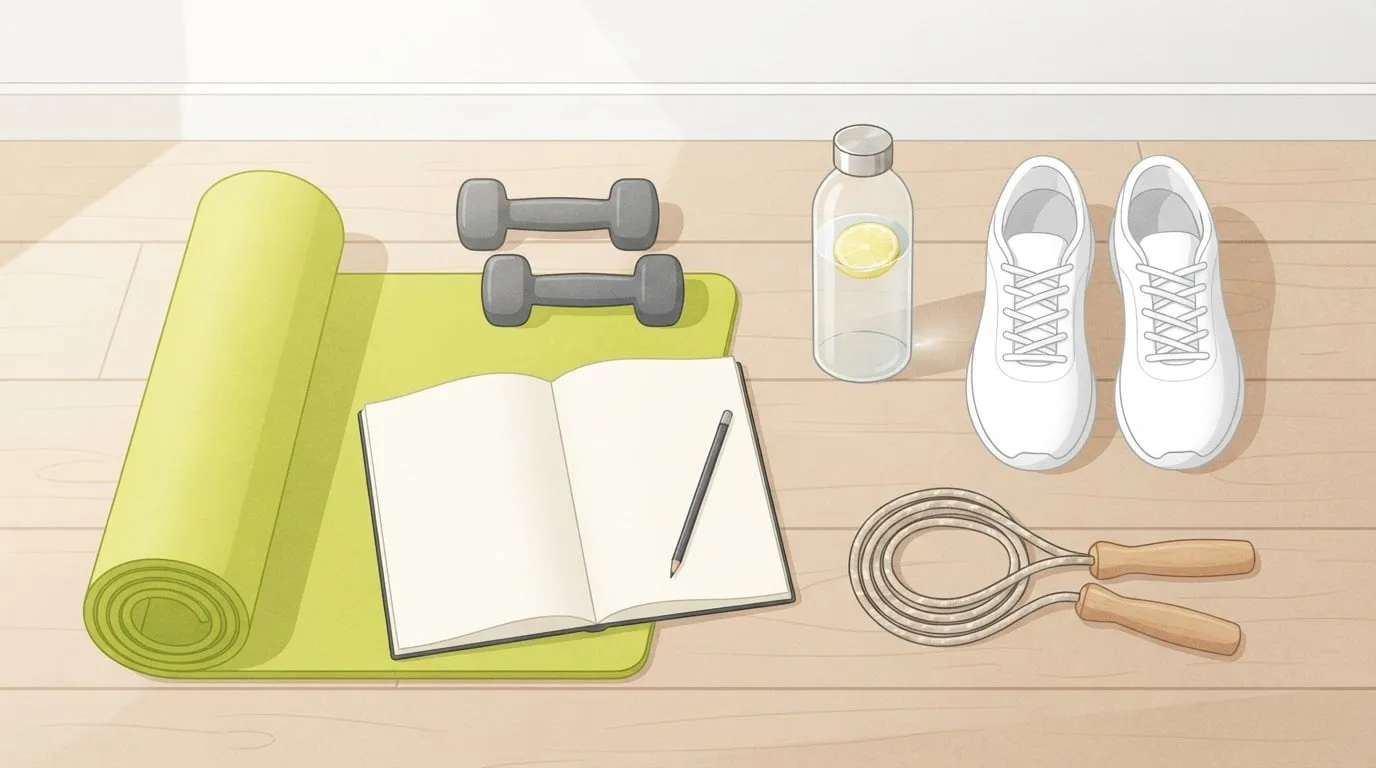
A simple system covers it:
- Pick one number per goal. Reps, minutes, steps, inches or sessions. One number is easier to track than five.
- Log every session the day you do it. A notebook works. So does your phone's notes app or a fitness app.
- Retest every four weeks under the same conditions. Same time of day, same route, same warm-up. A fair test is the only kind that tells you anything.
- Review for five minutes once a week. Did you hit the process goal? If not, what got in the way?
- Tell one person. Sharing progress strengthened the effect in Harkin's analysis, and public goals worked better in Epton's.
If you train with FitCraft, its calendar tracking and streaks show which days you trained, which covers a consistency goal on its own. Write outcome numbers such as push-up reps or waist size in your own log next to it.
What to Do When You Miss a Fitness Goal
Missing a goal is normal, and it doesn't erase the work you did. Lally and colleagues (2010) followed 96 people building a new daily habit and found it took anywhere from 18 to 254 days to become automatic, with a median of 66. Missing one opportunity did not materially affect the process. A single miss isn't the problem. A string of them is.
When a deadline passes and you're short, work through these steps:
- Separate a missed week from a missed goal. Three missed sessions in an 8-week block is a dip. Count what you did, not what you didn't.
- Find the cause. Was the goal too big, the timing wrong, or did life get in the way with an illness, a work crunch or travel? Each one has a different fix.
- Change one thing. Extend the deadline, shrink the number, or switch to a process goal for a month. Keep the direction.
- Restart within two days. The rule of never missing twice in a row works because it stops one bad day from turning into a bad month. Our guide to staying consistent with working out builds a full four-week plan around it.
- Plan for low-motivation days. Decide in advance what the minimum session is, such as 10 minutes of bodyweight work. Our guide on how to motivate yourself to work out has ten tactics for the days you don't feel like it.
If the same consistency goal keeps slipping because nothing in your week holds you to it, structure helps more than willpower. FitCraft's programs are multi-week structured plans, your AI coach demonstrates every exercise on an interactive 3D model and says your name as you train, and streaks reward the days you show up. Workouts adjust as you progress. You can compare it with other fitness apps built for staying consistent before you pick one.
The Bottom Line
The best fitness goals examples have three parts: a specific result, a number and a deadline. Pick one outcome goal from the list above, pair it with a weekly process goal, write your progress down and retest every four weeks.
You don't need more discipline to reach a fitness goal. You need a goal you can measure, a week that makes room for it, and a plan for the day you miss. Start with one, finish it, then pick the next.
Frequently Asked Questions
What are the top fitness goals?
The top fitness goals are losing weight, getting stronger, improving cardio endurance, moving with less stiffness and working out consistently. Each one works better with a number and a deadline attached, such as 10 full push-ups in 8 weeks, a 5K without walking in 9 weeks, or 3 workouts a week for 8 weeks straight.
What are some SMART goals for losing weight?
Good SMART goals for losing weight include losing 5 percent of your body weight over 6 months, taking 1 inch off your waist in 8 weeks, and walking briskly for 150 minutes a week plus 2 strength sessions for 12 weeks. Pair the outcome goal with a weekly habit you control, such as eating a palm-sized portion of protein at 3 meals a day.
What are good goals to work towards?
Good fitness goals to work towards are ones that matter to you, are hard but reachable, and can be measured on a set date. Write one outcome goal for the next 8 to 12 weeks, such as holding a 60-second plank, and one process goal for this week, such as 3 workouts on set days.
What are 10 good fitness goals?
Ten good fitness goals are: 10 full push-ups in 8 weeks, a 60-second plank in 6 weeks, a 5K without walking in 9 weeks, 150 minutes of brisk walking a week, 5 percent weight loss in 6 months, touching your toes in 8 weeks, 3 workouts a week for 8 weeks, a 30-day movement streak, 8,000 daily steps for 8 weeks, and a 10-second one-leg stand on each side.
What is a good fitness goal for a beginner?
A good fitness goal for a beginner is about showing up rather than performance, such as finishing 12 workouts in your first 4 weeks. Add one small skill goal next to it, like 20 bodyweight squats in a row or a 30-second plank by week 4, so you can see progress early.
What are good fitness goals for women?
Good fitness goals for women are the same measurable goals that work for anyone, chosen around what you want to improve. A strength goal is worth including, such as 2 strength sessions a week for 12 weeks or 10 full push-ups in 8 weeks, because muscle and bone both decline with age and strength training helps slow both.