
You've probably told yourself some version of this: I just need more discipline. You set the alarm for 6 a.m., you swear off the snacks, you promise this is the week you start working out. It holds for four days, maybe ten. Then a late night or a bad week breaks the chain, and the voice in your head says the problem is you.
That voice is working from an old model of self-discipline, one where disciplined people have a bigger tank of willpower and simply grit their teeth harder. Two decades of research point somewhere else. People who look disciplined mostly have fewer fights with themselves, because their habits and surroundings make the decision for them. That's good news, because habits and surroundings are things you can change this week.
Below you'll find what self discipline actually means, why the willpower-tank idea fell apart when labs tried to repeat it, seven strategies with real studies behind them, a worked example using exercise, a 30-day plan and a rule for setbacks. If you want to know how to be more disciplined starting today, jump to the plan, then come back for the reasons it works.
What Is Self-Discipline? The Meaning in Plain Words
Self-discipline is the ability to keep doing what serves your long-term goals when a short-term pull points the other way. Psychologists usually call it self-control and measure it as a trait: how reliably you follow through, manage impulses and stick to plans. In everyday speech, self-discipline and self-control mean nearly the same thing. Discipline in general can come from outside, from a coach, a boss or a deadline. Self-discipline is the version you supply yourself.
It matters. In two studies of university students, Tangney, Baumeister and Boone (2004) found that higher self-control went with better grades, better psychological adjustment, less binge eating and alcohol abuse, and healthier relationships. A study that followed 1,000 children in Dunedin, New Zealand, from birth to age 32 (Moffitt and colleagues, 2011) found that childhood self-control predicted adult health, wealth, substance dependence and criminal convictions, even after accounting for intelligence and social class.
When researchers looked at how people with high self-control actually behave, they found very little heroic resisting. A meta-analysis of 102 studies and 32,648 participants (de Ridder and colleagues, 2012) found that trait self-control was more strongly linked to automatic, habitual behaviors than to deliberate ones. Self-discipline shows up mostly as good routines, not as daily battles.
What Self-Discipline Is Not: A Tank of Willpower
For years, the popular explanation was ego depletion: willpower is a limited fuel, and every act of self-control burns some of it. In the classic experiment (Baumeister and colleagues, 1998), hungry students who had to eat radishes while a plate of fresh cookies sat in front of them gave up sooner on an unsolvable puzzle than students who were allowed the cookies. The idea spread into books and advice about saving your willpower for what matters.
Then labs tried to repeat it at scale. A preregistered replication across 23 laboratories and 2,141 participants (Hagger and colleagues, 2016) found an effect so small that its confidence interval included zero (d = 0.04). A second attempt led by researchers from the original theory's own camp, run across 36 laboratories with 3,531 participants (Vohs and colleagues, 2021), found a nonsignificant effect (d = 0.06). Its data were about four times more likely if there was no depletion effect at all. Earlier work had hinted at one reason: in Job, Dweck and Walton (2010), people who believed willpower wasn't limited didn't show the depletion effect.
You still get tired, hungry and stressed, and those states make good choices harder. But a fuel gauge you must ration is a poor model, and a poor basis for a plan.
What replaced it is more useful. In a week-long study where 205 adults reported their desires whenever a beeper went off, adding up to 7,827 reports (Hofmann and colleagues, 2012), people high in self-control reported weaker desires, less inner conflict and fewer attempts at resisting. Across six studies with 2,274 people, Galla and Duckworth (2015) found the same pattern. Good habits for exercise, sleep, healthy snacks and studying explained much of why self-control predicted better outcomes. Disciplined people aren't winning more fights. They've arranged to have fewer of them.
What Causes a Lack of Self-Discipline?
If you feel undisciplined, one of these is usually the real cause. Each has a fix later in this guide.
- A goal too big to start. "Get fit" gives you nothing to do at 7 a.m. on a Tuesday. A tiny, specific action does (strategy 1).
- No decided moment. When the time and place are left open, the decision gets made in the moment, against whatever is more appealing right then (strategies 2 and 4).
- A setup that favors the temptation. The phone is on the nightstand and the running shoes are buried in a closet. Your surroundings cast a vote every time (strategy 3).
- No reward you can feel today. The payoff from most good habits arrives months later, while the temptation pays out now (strategies 5 and 6).
- All-or-nothing rules. One missed day becomes "I've blown it," and then a missed week (strategy 7).
- Tiredness, stress and short sleep. These make everything harder for everyone. Fix what you can, and lower the bar on hard days instead of skipping.
If you struggle with focus and follow-through in every part of life, not just with one habit, conditions such as ADHD or depression can be part of the picture. That's worth raising with a doctor, because both are treatable, and no habit trick replaces treatment.
How to Build Self Discipline: 7 Strategies With Evidence
Each strategy below takes some weight off willpower. They work best together, because each one closes a different gap.
1. Start With One Tiny Habit
Pick one behavior that matters to you and shrink it until it's almost too easy to skip: ten squats, one page, putting on your workout clothes. The smaller the action, the less effort it takes to start, so the habit can survive your worst days. In the best-known study of real-world habit formation, Lally and colleagues (2010) asked 96 volunteers to repeat a new eating, drinking or exercise behavior every day in the same setting. Reaching peak automaticity took a median of 66 days, with a huge range of 18 to 254 days. Simple habits, such as drinking a glass of water, tended to get there faster than demanding ones, such as doing 50 sit-ups.
Work on one habit at a time. Once it runs on its own, it can grow, and you can add a second.
2. Write an If-Then Plan
Decide in advance exactly when and where you'll act, in the form "If it's [situation], then I'll [action]." Psychologists call this an implementation intention. A meta-analysis of 94 independent tests with more than 8,000 participants (Gollwitzer and Sheeran, 2006) found these plans had a medium-to-large effect on reaching goals (d = 0.65).
Exercise is a good test case. In a trial with 248 students (Milne, Orbell and Sheeran, 2002), information about the health risks of inactivity raised people's intentions to exercise but didn't change how much they exercised. Adding a written plan naming the day, time and place had what the authors called a dramatic effect: more than twice as many students in that group exercised the following week.
Make your plan concrete: "When I get home from work and put my keys in the bowl, I'll change into my workout clothes." Write it down. A vague plan such as "I'll exercise in the evenings" hands the decision back to your mood.
3. Add Friction to Temptations and Remove It From Good Habits
Every extra step between you and a behavior makes it less likely, and that works in both directions. Duckworth, Gendler and Gross (2016) argue that self-control works best early, before a temptation has grown strong, by choosing and changing your situation. Their example is the student who goes to the library without a phone and so never has to resist checking it. Make the good habit the path of least resistance and the bad habit a little annoying.
- Lay out tomorrow's workout clothes and shoes tonight.
- Charge your phone outside the bedroom so the day doesn't start with a scroll.
- Keep the snacks you want to eat less of out of sight or out of the house, and put fruit and water where you'll see them.
- Log out of the apps that swallow your evenings, so opening them takes a password.
- Keep your dumbbells or mat where you'll walk past them, not in a garage or under the bed.
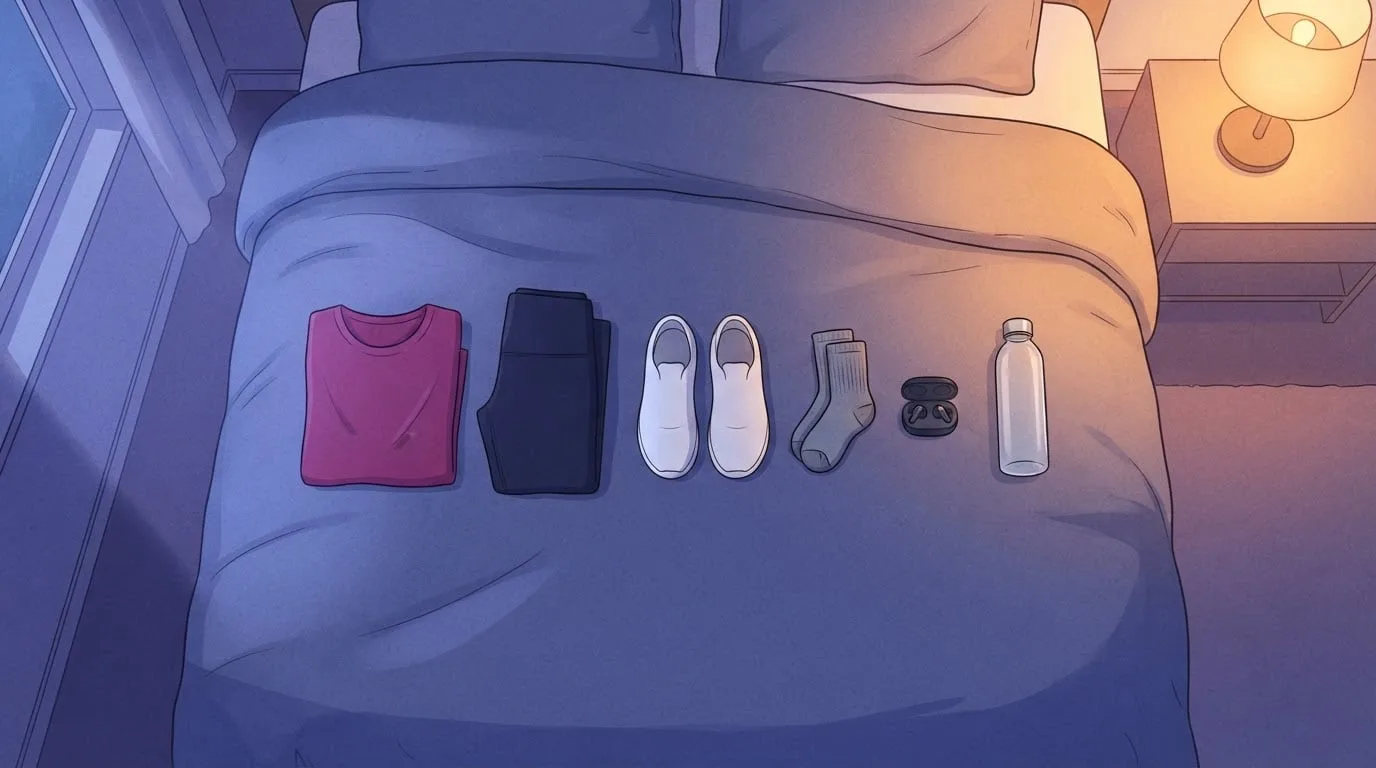
4. Attach the New Habit to an Existing Routine
Habits are set off by context: a place, a time of day, the action you just finished. A review of habit research by Wood and Rünger (2016) explains that repeating an action in a stable context links the two in memory, until the context starts the behavior with little conscious thought. So hang your new habit on a routine you already do every day: after you pour your morning coffee, after you brush your teeth, when you walk in the door from work. This is often called habit stacking. It's an if-then plan whose cue never fails to show up.
Find out what's really holding you back
FitCraft, our mobile fitness app, pairs you with an AI coach who builds you a personalized plan around your goals, schedule, and fitness level. Every FitCraft program is designed by Domenic Angelino, MPH (Brown University) and NSCA-CSCS, with research published in the Journal of Strength and Conditioning Research and Medicine & Science in Sports & Exercise.
Take the Free Assessment Free • 2 minutes • No credit card5. Pair the Hard Thing With Something You Enjoy
Temptation bundling means allowing yourself a guilty pleasure only while you do the thing you keep putting off. In the original study (Milkman, Minson and Volpp, 2014), gym members who could only listen to gripping audiobooks at the gym initially visited 51% more often than a control group. The effect faded over the following weeks, especially after the Thanksgiving break. A much larger follow-up with 6,792 gym members (Kirgios and colleagues, 2020) found that handing people an audiobook and encouraging them to bundle raised average weekly workouts by about 10 to 12% during a four-week program.
That's a modest effect, but it costs you almost nothing. Save one podcast, show or playlist for workouts only, and let the next episode pull you toward the mat.
6. Track It and Keep a Streak
What gets recorded gets done more often. A meta-analysis of 138 experiments with 19,951 participants (Harkin and colleagues, 2016) found that prompting people to monitor their progress improved goal attainment (d = 0.40). The effect was larger when progress was physically recorded or made public. A tick on a paper calendar counts. So does a streak in an app.
Streaks add a pull of their own. Across seven studies, Silverman and Barasch (2023) found that seeing an intact streak made people more likely to keep going than seeing a broken one, because keeping the streak alive became a goal in itself. That cuts both ways, which is why the last strategy matters.
7. Plan for the Missed Day Before It Happens
Everyone misses. What matters is the day after. In Lally's habit study, missing a single opportunity didn't materially set back the habit. The damage comes from the story you tell yourself afterwards: "I've already blown it, so why bother?"
Being kind to yourself helps here, even though it sounds soft. In a lab study by Adams and Leary (2007), restrictive eaters who heard a self-compassionate message after eating a doughnut later ate less candy than those who didn't. Set your rule now: never miss twice. If you skip Monday, Tuesday's session happens, even if it lasts five minutes.
Worked Example: Self-Discipline for an Exercise Habit
Exercise is the habit most people mean when they say they lack discipline, and it shows all seven strategies at work. Here's how they fit together for someone who wants to work out but keeps stopping around week three.
- Tiny habit: a 10-minute bodyweight or dumbbell workout, not an hour at the gym. On a bad day the floor is one set of squats.
- If-then plan: "On Monday, Wednesday and Friday, when I get home and put my keys in the bowl, I'll change and do my workout in the living room."
- Friction: clothes laid out and dumbbells by the sofa the night before, phone in another room until the workout is done.
- Anchor: the keys in the bowl are the cue, every time.
- Bundle: one podcast that only plays during workouts.
- Track: a mark on the calendar or a streak in an app after every session.
- Plan for the miss: never miss twice, so a missed Monday becomes a five-minute Tuesday.
How long before it sticks? In a 12-week study of 111 new gym members, Kaushal and Rhodes (2015) found that about four sessions a week for six weeks was the minimum needed to form an exercise habit. Small rewards for coming back help too. In a megastudy that tested 54 different programs on 61,293 gym members (Milkman and colleagues, 2021), the best performer gave small rewards for returning to the gym after a missed workout. Getting back after a miss was the behavior worth rewarding.

For the days you just don't feel like it, our guide on how to motivate yourself to workout has ten tactics for the moment itself. Our guide to staying consistent with working out lays out a 4-week protocol that puts showing up ahead of going hard. And if you'd rather build the whole routine on cues and setup, see how to make exercise a habit without willpower.
An app can carry several of these strategies for you. Our roundup of the best fitness apps for staying consistent compares the options built for the weeks when motivation fades. FitCraft is one of them: a 3D AI coach demonstrates each exercise and says your name during the workout, while streaks, calendar rewards and leaderboards turn tracking into something you want to keep going. As one user, Mike, put it: "The streak system got me hooked. I didn't want to break my chain."
A 30-Day Self-Discipline Plan
Thirty days won't make a habit automatic for most people, since the median in Lally's study was 66 days. It's long enough to build the system and get through the first few weeks, when most new routines fall apart. Use it for one habit at a time.
| Days | Focus | What to do |
|---|---|---|
| 1 to 7 | Choose and shrink | Pick one habit and shrink it to 2 to 10 minutes. Write your if-then plan and put it where you'll see it. Do it on every planned day, even when you feel like doing more. |
| 8 to 14 | Fix the setup | Add one bit of friction to your main temptation and remove one from your habit. Anchor the habit to a routine you already have. Start tracking. |
| 15 to 21 | Make it enjoyable | Add a temptation bundle. Expect your enthusiasm to dip around now, and lower the bar instead of skipping. |
| 22 to 30 | Grow it slowly | If the habit feels easy, add a few minutes or one more day a week. Review your tracker: note which days you missed and why, and fix the setup rather than blaming your character. |
On day 30, keep the habit at its current size for a few more weeks before you add a second one. Starting several new habits at once is the fastest way back to square one.
How to Handle Setbacks Without Starting Over
A setback is information about your setup, not proof that you lack self-discipline. Three moves get you back on track fast.
- Restart with the smallest version. After a miss, do the tiny version of the habit the next day. One set counts. The goal is to stay someone who shows up.
- Ask what broke, not what's wrong with you. Did the cue disappear because of travel or a new schedule? Was the habit too big for a bad day? Was the temptation too close? Change that one thing.
- Use a fresh start. People are more likely to work toward goals at the start of a new week, month or year, or after a birthday. Dai, Milkman and Riis (2014) found that gym visits rose at those landmarks. You don't need to wait for January. Monday works, and so does the first of the month.
If your streak breaks, don't let the broken streak become the reason you stop. The streak research above found that people tend to disengage after a break, and that the effect was weaker when people could repair a broken streak. So repair yours: count your "never miss twice" run as the streak that matters, or start a new one the same day. Our article on how long it takes to break a habit covers the other side of the coin, when the habit you're fighting is one you want to lose.
The Bottom Line
You build self discipline the way you build any skill: by making the right action easy, then repeating it. Start with one tiny habit, give it a time and place, put the temptation slightly out of reach, enjoy the process where you can, track it, and plan your comeback before you need it. The science moved on from the willpower tank years ago. The people who seem most disciplined mostly have better systems.
You're not lazy and you're not broken. You've been fighting battles that a better setup can remove.
Frequently Asked Questions
How to be more disciplined?
To be more disciplined, lean less on willpower and more on setup. Pick one small habit, decide exactly when and where you'll do it, put what you need within reach and the temptations out of sight, and mark each day you follow through. When you miss a day, do the smallest version the next day so one slip never turns into two.
Is self-discipline something you can learn?
Yes. People do differ in trait self-control, but the behaviors that make someone look disciplined are mostly habits and smart setups, and anyone can learn those. Across six studies with 2,274 people, Galla and Duckworth (2015) found that good habits explained much of the link between self-control and better outcomes, and that people with high self-control reported less effortful resisting, not more.
How does discipline affect success?
Self-discipline predicts success across many areas of life. A study that followed 1,000 children in Dunedin, New Zealand, to age 32 found that childhood self-control predicted adult health, finances, substance dependence and criminal convictions, even after accounting for intelligence and social class. In students, higher self-control has been linked to better grades, better adjustment and healthier relationships.
What are the benefits of self-discipline?
The benefits of self-discipline that research has measured include better grades and psychological adjustment, less binge eating and alcohol abuse, healthier relationships, and better adult health and finances. People high in self-control also report weaker temptations and less inner conflict, so for them sticking to a plan often feels easier rather than harder.
What are 8 small things to do daily for more discipline?
Eight small daily actions that build discipline are: pick tomorrow's most important task tonight, lay out your workout clothes, keep your phone in another room for the first hour of the day, do a short workout at a fixed time, tie one new habit to something you already do, mark each completed habit on a tracker, keep tempting snacks out of sight, and go to bed at a set time. Start with one or two, not all eight.
How long does it take to build self-discipline?
Plan on about two months for one habit. In a study of 96 volunteers, a new daily behavior took a median of 66 days to become automatic, with a range of 18 to 254 days, and missing a single day didn't set the process back. For exercise, a study of 111 new gym members found that about four sessions a week for six weeks was the minimum needed to form a habit.