Your smart scale said 22 percent body fat on Monday and 19 percent on Wednesday. You didn't lose three points of fat in two days, so which number is real? Maybe neither. And if you can't trust the number, it's hard to know whether all those workouts are doing anything.
That uncertainty is discouraging, and it's one of the quiet reasons people give up. The scale bounces, the mirror looks the same, and the effort starts to feel pointless.
No home method gives you a lab-grade number, and none of them has to. What you can get at home is a consistent trend. This guide ranks the four main ways to measure body fat at home by how accurate and how consistent they are, shows you how to calculate body fat percentage with each, and explains how to read the trend so the number finally means something.
How to Measure Body Fat at Home in 5 Steps
Whichever method you choose, the routine is the same. Consistency matters more than the tool.
- Pick one method you can repeat. A tape, calipers with a partner, or a smart scale. Use the same tool and, for calipers, the same person every time.
- Fix the conditions. Measure first thing in the morning, after using the bathroom and before eating, drinking or exercising.
- Take two or three readings and average them. One reading carries the full error of the method. An average of several carries less.
- Write it down with your weight and waist. Three numbers together tell you far more than body fat alone.
- Compare month to month. Check every two to four weeks and judge the direction over two or three months, not the change since last week.
The 4 Home Methods, Ranked by Accuracy and Consistency
Accuracy is how close a method gets to your true body fat. Consistency is whether it gives the same answer when nothing has changed, and whether it moves when something has. For tracking progress at home, consistency matters more.
| Rank | Method | How far off it can be | Consistency | Best for |
|---|---|---|---|---|
| 1 | Skinfold calipers, with a practiced partner | About 3 to 4 points from lab methods; much worse if you pinch yourself | High, especially as a sum in millimeters | Tracking fat loss over months |
| 2 | Smart scale (bioimpedance) | Average error of -3.5 to +11.7 points, depending on the device | Very high under fixed conditions; meals and fluids shift it | Daily convenience and month-to-month trends |
| 3 | Tape formula (US Navy method) | Often 2 to 6 points off a DEXA scan | Measurements repeat well, but the formula can miss real change | A free first estimate |
| 4 | Progress photos | No number; expert visual guesses differ by about 3 points | High if lighting and pose stay the same | Seeing change the numbers miss |
"Points" here means percentage points of body fat, so a 4-point error on a reading of 25 percent means your true number could be anywhere from about 21 to 29. The sections below explain where each figure comes from.
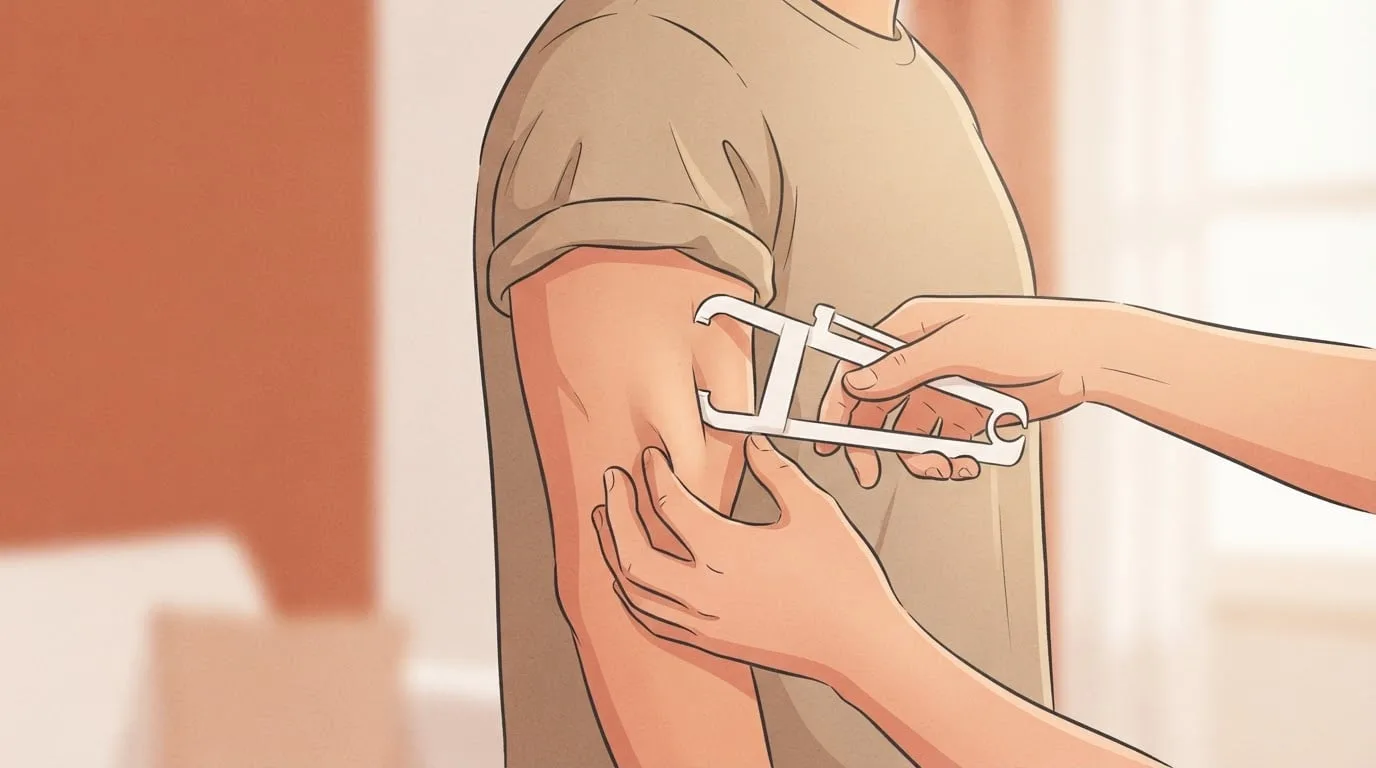
1. Skinfold Calipers: The Most Reliable Home Method With a Partner
Calipers measure the thickness of a pinched fold of skin and the fat just under it. An equation turns the total from several sites into a body fat estimate. The most widely used equations come from Jackson and Pollock (1978), in the British Journal of Nutrition, and with a practiced tester they typically land within about 3 to 4 percentage points of laboratory methods.
The three-site version is the one to use at home. Sites are on the right side of the body:
- Men: chest (a diagonal fold between the nipple and the front of the armpit), abdomen (a vertical fold about an inch to the right of the belly button) and thigh (a vertical fold on the front of the thigh, halfway between hip and knee).
- Women: triceps (a vertical fold on the back of the upper arm, halfway between shoulder and elbow), suprailiac (a diagonal fold just above the front of the hip bone) and thigh.
- Pinch the skin and fat firmly between thumb and forefinger and lift it away from the muscle underneath.
- Place the caliper jaws about half an inch from your fingers, at the marked site.
- Release the caliper grip, keep pinching with your fingers, and read it after about two seconds.
- Measure each site two or three times and average the readings.
The catch is that skinfolds depend on skill, and pinching yourself is hard. Beam and Szymanski (2010), in the Journal of Strength and Conditioning Research, tested a self-administered caliper on 50 college students against DEXA scans. Individual readings could miss by up to 8.6 points in men and 7.5 in women. The authors recommended a standard three-site measurement taken by a tester instead. So recruit a partner, and keep it the same partner.
Better still, skip the conversion to a percentage when you're tracking. Sports scientists reviewing body composition methods (Kasper and colleagues, 2021, in Nutrients) concluded that skinfolds are the method least affected by day-to-day swings, and they advised reporting the sum of the skinfolds in millimeters instead of converting it into a percentage. If your three-site sum drops from 60 mm to 52 mm, you've lost fat, whatever the equation says.
2. Smart Scales and Bioimpedance
Body fat scales and handheld analyzers send a small, painless electrical current through your body. Lean tissue holds a lot of water and conducts it easily, while fat resists it, so the device estimates your body fat from how much the current is slowed.
One of the largest tests of consumer devices comes from Siedler and colleagues (2023), in the British Journal of Nutrition. They measured 73 healthy adults on 15 devices, 14 of them consumer models, and compared each with a four-compartment model, a laboratory method that combines several measurements and is more accurate than any single one.
- Repeatability was excellent. Back-to-back readings on the same device differed by less than half a percentage point.
- Accuracy varied a lot. Average errors ranged from 3.5 points too low to 11.7 points too high, depending on the device.
- Tracking was better than single readings. When 37 people came back 12 to 16 weeks later, the devices followed their real change with errors of about 1.7 to 2.6 points. Models with hand and foot electrodes, and some foot-only scales, did best.
The biggest threat to a scale's consistency is your water and food. Slinde and Rossander-Hulthén (2001), in the American Journal of Clinical Nutrition, measured 18 adults 18 times over 24 hours. Every meal lowered impedance for two to four hours, and the calculated body fat varied by roughly 9 to 10 percent between the highest and lowest readings of the day. Nothing about their bodies had changed.
So use a scale the same way every time: first thing in the morning, after using the bathroom, before eating, drinking or exercising, with bare, dry feet, on a hard floor. Don't compare a morning reading with one taken after a workout or a big dinner.
Find out what's really holding you back
FitCraft, our mobile fitness app, pairs you with an AI coach who builds you a personalized plan around your goals, schedule, and fitness level. Every FitCraft program is designed by Domenic Angelino, MPH (Brown University) and NSCA-CSCS, with research published in the Journal of Strength and Conditioning Research and Medicine & Science in Sports & Exercise.
Take the Free Assessment Free • 2 minutes • No credit card3. How to Measure Body Fat at Home With a Tape
The US Navy method estimates body fat from your height and a few circumferences. The equations were developed by Hodgdon and Beckett at the Naval Health Research Center in 1984 against underwater weighing in Navy personnel. All you need is a soft tape and about five minutes:
- Neck: just below the Adam's apple, with the tape angled slightly down at the front.
- Waist: men measure level with the belly button. Women measure at the narrowest point of the torso.
- Hips (women only): around the widest part of the buttocks.
- Read each after a normal breath out, with the tape level and snug, twice, and average.
- Enter the numbers with your height into our body fat calculator, which runs the Navy equations and shows the error range next to the result.
It's the easiest method on this list, and the tape measurements themselves repeat well. The weak link is the formula, which assumes your body stores fat like the people it was built on. Studies that check it against DEXA scans keep finding the same pattern:
- It reads off in predictable directions. In 609 fit US Marines, Potter and colleagues (2022) found a waist-based military equation underestimated men by about 2.5 points and overestimated women by 1.3 to 2.3 points. Lean people tended to be overestimated and people with more fat underestimated.
- It can miss real change. Foulis and colleagues (2023) followed 1,407 Army recruits through eight weeks of basic training. The tape equations read about 6 points under DEXA at the start. DEXA then showed body fat falling 4.0 points in women and 3.3 in men. The tape caught about two-thirds of the men's drop and didn't detect the women's at all.
- It trailed newer tools. In 57 Air Force ROTC cadets, Graybeal and colleagues (2026) found the circumference equations produced the largest errors of every method they compared with DEXA.
Two other tape formulas are worth knowing. Relative fat mass, from Woolcott and Bergman (2018), needs only your height and waist: 64 minus 20 times your height divided by your waist, plus 12 if you're a woman. A man 70 inches tall with a 35-inch waist gets 64 minus 40, or 24 percent. It was built and checked against DEXA scans in more than 16,000 US adults, and it beat BMI at estimating body fat. The US Army's newer one-site equation uses your waist and weight. Tested against a four-compartment model in 96 adults (Florez and colleagues, 2024), it was close on average, but individual readings could miss by close to 10 points.
The practical upshot: a tape formula is a fine free first estimate. For tracking, write down the raw waist measurement too, because it moves even when the formula doesn't. Our guide to how to measure your waist covers the landmarks and the mistakes that throw the tape off.
4. Progress Photos and the Mirror
Photos don't give you a number, but they catch changes that every number on this list can miss. They're also easy to give up on too early, because day-to-day differences are invisible. Month-to-month differences usually aren't.
How good is the human eye? Eckerson and colleagues (1992), in Medicine & Science in Sports & Exercise, had two experienced raters estimate body fat in 35 lean men by eye. One rater was as accurate as a skinfold equation. The two raters' guesses differed by 2.7 points on average, so the authors still recommended skinfolds. Use photos to see the change, not to put a number on it.
To make photos comparable:
- Same spot, same light and same time of day, ideally morning before eating.
- Same camera height and distance. Prop the phone on a shelf rather than holding it.
- Front, side and back, relaxed, in the same fitted clothing.
- Every four weeks. Compare month one with month three, not this week with last week.
Phone apps that estimate body fat from photos are the newest option. In 929 adults, Nana and colleagues (2022) found one 2D photo app came within about 3 points of DEXA on average, closer than the foot-to-foot scale they also tested. A separate comparison of two apps against a four-compartment model (Graybeal and colleagues, 2022) found both repeatable but only one close to the laboratory value. The evidence is promising and still thin, and it varies from app to app.
How Accurate Are Home Methods Compared With a DEXA Scan?
DEXA (also written DXA) uses low-dose X-rays at two energies to split your body into fat, lean tissue and bone. It's the reference most of the studies above used, and it repeats very well: Hind and colleagues (2011) scanned 52 adults twice in a row and found a precision error of just 0.86 percent for body fat percentage. Different machines and software can disagree with each other, though, so even DEXA is best repeated on the same machine.
Set against that, the home methods line up like this:
- Calipers with a practiced tester: about 3 to 4 points.
- Calipers on yourself: up to about 8 points.
- Smart scales: from about 3 to over 11 points, depending on the device, but about 2 points when tracking change on the better ones.
- Tape formulas: commonly 2 to 6 points, with a tendency to miss change.
- Photo apps: about 3 points in the largest study, with wide differences between apps.
These errors are a reason to measure the same way each time and to treat any single reading as a range.
How to Get Consistent Readings
Most of the swings people see at home come from changing conditions, not changing bodies. Lock these down and your method gets far more useful.
- Time: first thing in the morning, every time.
- Food and fluid: before eating or drinking. This matters most for scales.
- Exercise: before your workout, never right after it.
- Tester: the same partner for calipers, the same person holding the tape.
- Landmarks: the same sites, marked with a washable pen the first few times.
- Repeats: two or three readings per check, averaged.
- Equipment: the same scale on the same hard floor, the same tape, the same calipers.
Women may also notice that readings drift with the menstrual cycle, because water retention changes across the month. Measuring at the same point in your cycle each time removes that wobble.
How to Track the Trend
A trend needs three things: enough readings, enough time and more than one number.
- Log three numbers together: body weight, waist and body fat (or your skinfold sum). If your weight is flat but your waist and skinfolds are falling, you're probably losing fat and gaining muscle.
- Average before you compare. If you weigh in daily on a smart scale, compare weekly averages rather than single days.
- Trust a change when it's bigger than the method's error or holds for two or three checks in a row. For the better smart scales that's about 2 points; for a tape formula, give it longer.
- Turn the percentage into pounds. At 180 pounds and 25 percent body fat you carry 45 pounds of fat. At 175 pounds and 22 percent you carry about 38.5. That's 6.5 pounds of fat gone and about 1.5 pounds of lean mass gained, even though the scale moved only 5.
That last point is why strength training matters for body fat. Lifting two or three times a week helps you keep or build muscle while you lose fat, so your percentage falls faster than your weight. FitCraft's programs are built on dumbbell and bodyweight strength work, led by a 3D AI coach who demonstrates every exercise, and the workouts adjust as you progress. If you want that structure at home, a dumbbell workout app takes the planning off your plate, and streaks make it easier to keep showing up between measurements.
What Your Body Fat Number Means
The most cited healthy ranges come from Gallagher and colleagues (2000), in the American Journal of Clinical Nutrition. For adults aged 20 to 39, they put healthy body fat at about 8 to 20 percent for men and 21 to 33 percent for women, rising a few points with age. That answers some of the most common questions:
- Is 18% body fat chubby? No. For a man under 40 it's inside the healthy range. For a woman it's lean.
- Is 30% body fat chubby? For a woman, 30 percent is healthy at any adult age. For a man, it's in the obese range under 60.
- Is 7% a good body fat percentage? For most men it's leaner than health requires and hard to keep. For women it's below essential fat and unsafe.
- What does 20% body fat look like? On most men, fit in clothes with a soft midsection. On most women, lean and athletic.
Remember the error ranges above when you compare yourself with a chart. A home reading of 24 percent could be 20 or 28. Our post on what is a healthy body fat percentage has the full ranges by age and sex, the American Council on Exercise chart and how low is too low.
The Bottom Line
You can measure body fat at home well enough to track real progress. Calipers with a practiced partner are the most reliable home method, smart scales are the most convenient and repeat well under fixed conditions, tape formulas are the easiest free estimate, and photos show what the numbers miss. Whichever you choose, measure in the morning, average a few readings and judge the trend over months.
The number only moves if the training keeps happening. As Mike, 23, put it after four months of getting visibly stronger: "The streak system got me hooked. I didn't want to break my chain."
Frequently Asked Questions
What's the easiest way to measure body fat?
The easiest way to measure body fat at home is a tape-based formula such as the US Navy method. You need a soft tape, your height and two or three measurements, and it takes about five minutes. Expect the result to be a few percentage points off a DEXA scan, so use it as a starting estimate and track the trend.
How to measure body fat at home with tape?
Measure your neck just below the Adam's apple and your waist at the belly button if you're a man, or your neck, your waist at its narrowest point and your hips at their widest if you're a woman. Take each reading twice after a normal breath out, then enter them with your height into a US Navy body fat calculator.
How do I calculate my body fat percentage?
Body fat percentage is your fat mass divided by your total weight, times 100. At home you estimate it with a formula: the US Navy method uses your height and your neck and waist measurements (plus hips for women), and the relative fat mass formula uses only height and waist: 64 minus 20 times height divided by waist, plus 12 for women.
How accurate are smart scales for body fat?
Smart scales repeat themselves almost perfectly, but their accuracy depends on the model. In a 2023 test of 15 bioimpedance devices against a laboratory reference, average errors ranged from 3.5 percentage points too low to 11.7 points too high. The better devices tracked change over three to four months within about 2 points, so use one for trends under identical conditions.
Is 18% body fat chubby?
No. For a man under 40, 18 percent body fat sits inside the healthy range of about 8 to 20 percent in the widely used Gallagher ranges. For a woman, 18 percent is below the healthy range of about 21 to 33 percent and in the lean, athletic band.
Is 30% body fat chubby?
It depends on your sex. For a woman, 30 percent body fat is in the healthy range at every adult age. For a man, 30 percent is in the obese range under age 60 and at the obese line from 60 to 79, so it's a good reason to start working on it.
Is 7% a good body fat percentage?
For most men, 7 percent is lower than needed for health and hard to keep. It's just under the healthy range for men under 40 and close to essential fat, which is about 2 to 5 percent. For a woman, 7 percent is below essential fat and unsafe, and a home method can easily be several points off at that level anyway.
What does 20% body fat really look like?
On a man, 20 percent body fat usually looks fit in clothes with a soft midsection and little visible ab definition, and it's the top of the healthy range under 40. On a woman, 20 percent usually looks lean and athletic, often with some visible muscle definition. Where your body stores fat changes the look a lot, so two people at 20 percent can look quite different.