
You've probably measured your waist before and gotten a number you didn't trust. Maybe it was two inches off your jeans size. Maybe it changed depending on where the tape landed, how hard you pulled or whether you'd just eaten. So you stopped bothering and went back to the scale.
That's a shame, because the scale can't tell you where your weight sits, and your waist can. A waist measurement tracks the fat around your middle, including the deeper visceral fat packed around your organs. A consensus statement from an international panel of obesity researchers (Ross and colleagues, 2020, in Nature Reviews Endocrinology) argued that doctors should treat it as a vital sign alongside blood pressure, because it adds risk information that BMI misses.
Knowing how to measure your waist properly is the difference between a number you can use and one you'll ignore. Below are the steps, where the waist is measured according to the main health guidelines, the mistakes that throw readings off, what your number means and how often to measure it again.
How to Measure Your Waist in 7 Steps
This is the World Health Organization method from its 2008 expert consultation on waist circumference, adapted for doing it yourself at home. It takes about two minutes.
- Get a soft tape that doesn't stretch. A cloth or vinyl sewing tape is ideal. A metal carpenter's tape won't wrap cleanly around your body. Old sewing tapes do stretch over time, so check yours against a ruler once.
- Bare your middle and stand relaxed. Lift or remove your top and lower any waistband. Stand tall with your feet close together, arms loose at your sides and your weight on both feet.
- Find your lowest rib. Run your fingers down the side of your ribcage until you feel the bottom edge of the last rib.
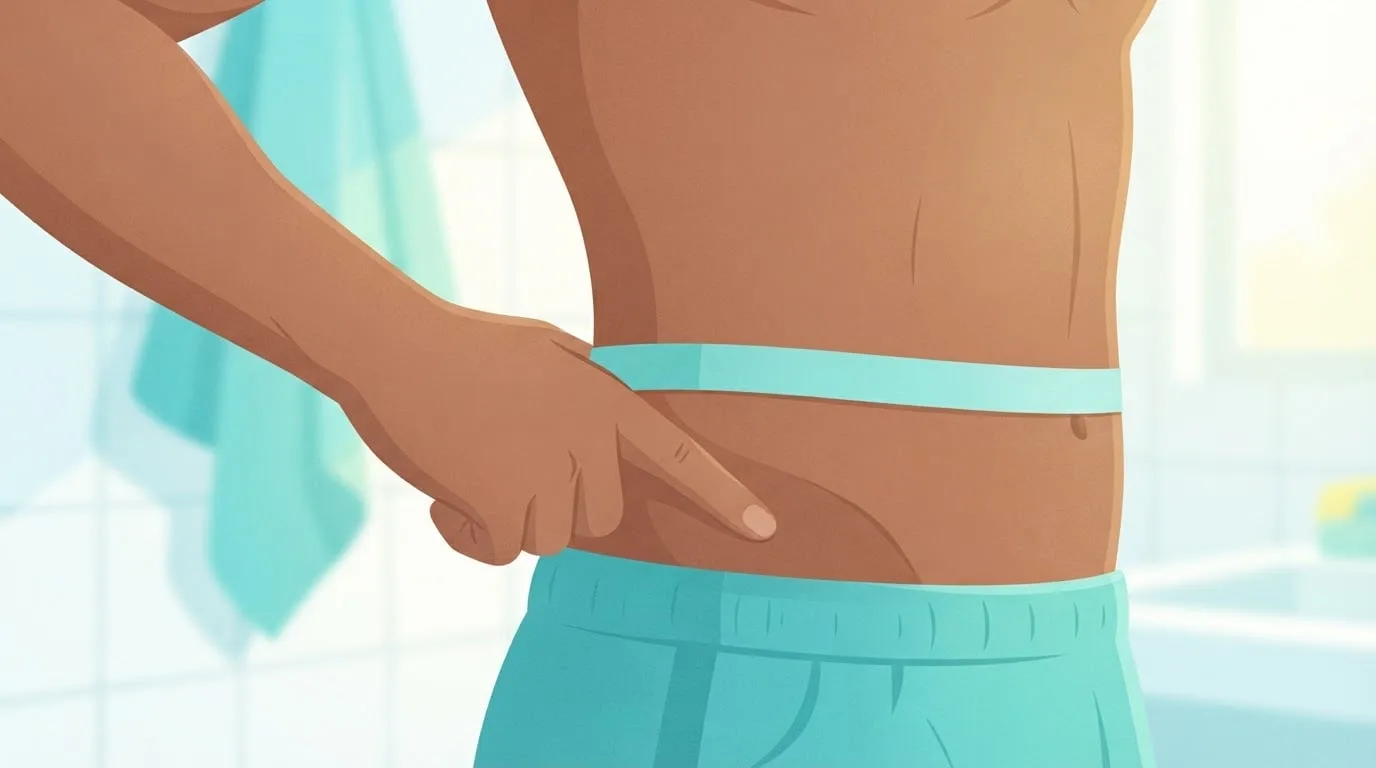
- Find the top of your hip bone. Press in at your side, below the ribs, and slide your fingers down until you hit the bony ridge of your pelvis, called the iliac crest. It's where your hands rest when you put them on your hips.
- Wrap the tape halfway between the two. That midpoint is your waist. For most people it's a little above the belly button. Keep the tape level with the floor all the way round, and check the back in a mirror, because that's where it slips down.
- Breathe out normally and read the tape. Don't suck in and don't hold your breath. The tape should sit flat on your skin, snug but not pressing in, and you read it at the end of a normal breath out.
- Measure twice and average. If the two readings are within 1 cm (about 3/8 inch), average them. If they differ by more, measure both again. Write down the number, the date, the time and the landmark you used.
That's the whole method. Most of the skill is in step 5: the same landmark every time, and a tape that stays level.
Where to Measure Your Waist: Midpoint, Hip Bone or Belly Button?
If you've searched where to measure your waist and found different answers, that's because health organizations genuinely use different spots. These are the four you'll run into.
| Landmark | Where the tape goes | Who uses it | Worth knowing |
|---|---|---|---|
| Midpoint | Halfway between the lowest rib and the top of the hip bone | World Health Organization | The default for this guide, and one of the two sites an expert panel recommends |
| Top of the hip bone | Just above the iliac crest | US National Institutes of Health guidelines | The other recommended site, and usually the largest reading in women |
| Belly button | Level with the navel | US Navy body fat formula (men), about a quarter of studies | The navel isn't fixed to bone, so it can sit lower on a larger belly |
| Narrowest point | The thinnest part of the torso | Clothing sizes, US Navy body fat formula (women), about a third of studies | Usually the smallest reading, and hard to find if your waist doesn't narrow |
Do the different sites give different numbers? Yes, especially in women. Wang and colleagues (2003), in the American Journal of Clinical Nutrition, measured 111 people at all four sites with a heavy-duty tape. In women, the narrowest point gave the smallest reading and the top of the hip bone the largest, with the midpoint in between. In men, the narrowest point was smaller than the other three. Every site was highly repeatable, and all four tracked body fat measured by a DXA scan.
The good news is that the choice barely matters for health. Ross and colleagues (2008), in Obesity Reviews, reviewed 120 studies covering 236 samples and found that the measuring site made no substantial difference to how strongly waist size predicted heart disease, diabetes and death. A later consensus statement led by the same author recommended the WHO midpoint or the NIH hip-bone site as the most reliable for professionals and the public alike. It noted that the two sites give the same reading in men on average and differ by about 2 cm in women.
So, is the waist at your belly button? For many people the midpoint lands close to it, but the belly button is a soft landmark that moves with your belly. Use the bones. Pick the midpoint or the top of the hip bone, write down which one you chose, and use the same one every time. The one exception is a formula that names its own site, like the US Navy method in our body fat calculator, which needs the navel for men and the narrowest point for women. Our guide to how to measure body fat at home compares that tape formula with calipers, smart scales and progress photos.
Common Mistakes That Throw Off Your Waist Measurement
Most bad readings come from a handful of habits. Each one can move the number by an inch or more, which is enough to hide real progress or invent some.
- Sucking in. Pulling your stomach in or holding your breath can shave off an inch or two. Breathe out normally, then read.
- A tape that dips at the back. The tape tends to slide down over your lower back while the front stays put. Check it in a mirror or ask someone to look.
- Pulling too tight or leaving it loose. The tape should lie flat on the skin without denting it. If it digs in, it's too tight. If it sags anywhere, it's too loose.
- Measuring over clothes. Even a thin waistband adds width and pushes the tape off the landmark.
- Bending forward to read it. Leaning over folds your belly and shortens the reading. Stand tall and look down with your eyes, or use a mirror.
- Measuring after a big meal. Food, drinks and bloating can add to your waist through the day. Mornings are easiest to repeat.
- Changing the landmark. Navel one week, jeans line the next, and the numbers stop meaning anything. Use the same bony landmark every time.
Find out what's really holding you back
FitCraft, our mobile fitness app, pairs you with an AI coach who builds you a personalized plan around your goals, schedule, and fitness level. Every FitCraft program is designed by Domenic Angelino, MPH (Brown University) and NSCA-CSCS, with research published in the Journal of Strength and Conditioning Research and Medicine & Science in Sports & Exercise.
Take the Free Assessment Free • 2 minutes • No credit cardWhat Your Waist Measurement Means
A waist measurement is a screening number. It doesn't diagnose anything, but a larger waist reliably means more abdominal fat, and abdominal fat is linked with higher blood sugar, worse cholesterol and higher blood pressure. These are the lines most guidelines use.
| Waist size | Men | Women | What it signals |
|---|---|---|---|
| Increased risk (WHO) | Over 94 cm (37 in) | Over 80 cm (31.5 in) | Worth watching and working on |
| Substantially increased risk (WHO) | Over 102 cm (40 in) | Over 88 cm (34.6 in) | Worth raising with your doctor |
| US guideline (NIH) | Over 40 in | Over 35 in | Higher risk of heart disease and type 2 diabetes |
| Asian adults (IDF and WHO) | 90 cm (35.4 in) or more | 80 cm (31.5 in) or more | Lower line, because risk rises at smaller waists |
The US line comes from the National Heart, Lung, and Blood Institute's guidance on assessing your weight and health risk, which measures just above the hip bones. The Asian line is the one listed in a 2009 joint statement on the metabolic syndrome from six international health bodies (Alberti and colleagues, 2009, in Circulation), which noted that national waist cut-offs still vary and need more work.
The strongest evidence that the number matters comes from a pooled analysis of 11 cohort studies and 650,386 adults. Cerhan and colleagues (2014), in Mayo Clinic Proceedings, found that every extra 5 cm (2 in) of waist raised the risk of death by 7 percent in men and 9 percent in women. That held at every BMI from 20 to 50, including the normal-weight range. Men with waists of 110 cm (43 in) or more had 52 percent higher mortality than men under 90 cm, and women at 95 cm (37 in) or more had 80 percent higher mortality than women under 70 cm.
In plain terms, your waist tells your doctor something your weight doesn't. Two people with the same BMI can carry very different amounts of fat around their organs, and the tape is the cheapest way to see it.
What Should Your Waist Be for Your Height?
Fixed cut-offs treat a 5'2" woman and a 5'10" woman the same. Waist-to-height ratio fixes that by scaling the waist to your frame. Divide your waist by your height in the same units, and aim for under 0.5. Put simply, keep your waist less than half your height.
The case for it is strong. Ashwell, Gunn and Gibson (2012) pooled 31 studies covering more than 300,000 adults and found waist-to-height ratio picked out diabetes, high blood pressure and heart disease better than waist size or BMI, in men and women. England's health guideline body now uses it: NICE guideline NG246 calls 0.4 to 0.49 healthy, 0.5 to 0.59 increased and 0.6 or more high, for adults with a BMI under 35.
| Your height | Keep your waist under |
|---|---|
| 5'0" (152 cm) | 30 in (76 cm) |
| 5'3" (160 cm) | 31.5 in (80 cm) |
| 5'5" (165 cm) | 32.5 in (82.5 cm) |
| 5'7" (170 cm) | 33.5 in (85 cm) |
| 5'10" (178 cm) | 35 in (89 cm) |
| 6'0" (183 cm) | 36 in (91.5 cm) |
| 6'3" (191 cm) | 37.5 in (95 cm) |
So what should your waist be at 5'7"? Under 33.5 inches, whether you're a man or a woman. If you'd rather not do the division, our BMI calculator works out your waist-to-height ratio alongside your BMI and flags it when the two disagree.
Is a 32 Inch Waist Big or Small?
A 32-inch waist is 81 cm. Whether that's small or large depends on your height and sex, which is why questions like "is a 32 waist skinny?" or "what is a chubby waist size?" don't have one answer.
- For most men, 32 inches is comfortably healthy. It's well under the 37-inch line, and for a 5'10" man it gives a waist-to-height ratio of 0.46.
- For most women, 32 inches sits just above the WHO's 31.5-inch increased-risk line but under half the height of anyone 5'4" or taller.
- There's no medical "chubby" line. The useful lines are the risk cut-offs above and the half-your-height rule. A number above them is a reason to start working on your waist, and nothing more.
Is a 34 Waist Actually 34 Inches? Pants Size vs Your Real Waist
Often not. A pants size is a label each brand sets for its own cut, and many brands make the waistband a little bigger than the number on the tag. Men's trousers also sit lower than the health landmark, usually at or below the top of the hip bones, so your health waist measurement is often bigger than your jeans size, sometimes by a few inches.
If you need to know how to measure your waist for pants, measure where the waistband will actually sit rather than at the health landmark. Or lay a pair of pants that fit you well flat on a table, measure straight across the top of the waistband and double it. Keep the two numbers separate. Your jeans size is for shopping. Your health waist is for tracking.
How to Measure Your Hips for the Waist-to-Hip Ratio
If you're measuring your hips and waist together, the hips are simpler. Stand with your feet together and wrap the tape around the widest part of your buttocks, looking side-on in a mirror to find it. Keep the tape level and snug, and take two readings as you did for the waist.
Divide your waist by your hips and you have your waist-to-hip ratio, a measure of whether you carry more weight around your middle or on your hips and thighs. The WHO treats 0.90 or more in men and 0.85 or more in women as a substantially increased risk. Our guide to the waist to hip ratio covers what the large studies found, how it compares with BMI, and why it moves more slowly than your waist alone.
Can You Measure Your Own Waist Accurately?
Yes, with a little instruction. In a study by Barrios and colleagues (2016), in BMC Medical Research Methodology, 41 mothers watched a short online video, printed and cut out a paper tape at home, and measured their own waists. When trained technicians measured them later, the agreement for the waist was 0.97 on a scale where 1.0 is perfect, and the average differences were a tenth of an inch or less.
The 2020 consensus statement adds one caution. Across several studies, people measuring themselves tended to come in about 1 to 3 cm under a technician's reading. That's the sucking-in and tape-tilting problem from the mistakes list. Three habits close the gap:
- Use a mirror to check the tape is level at the back before you read it.
- Read at the side, where you can see the tape without bending forward.
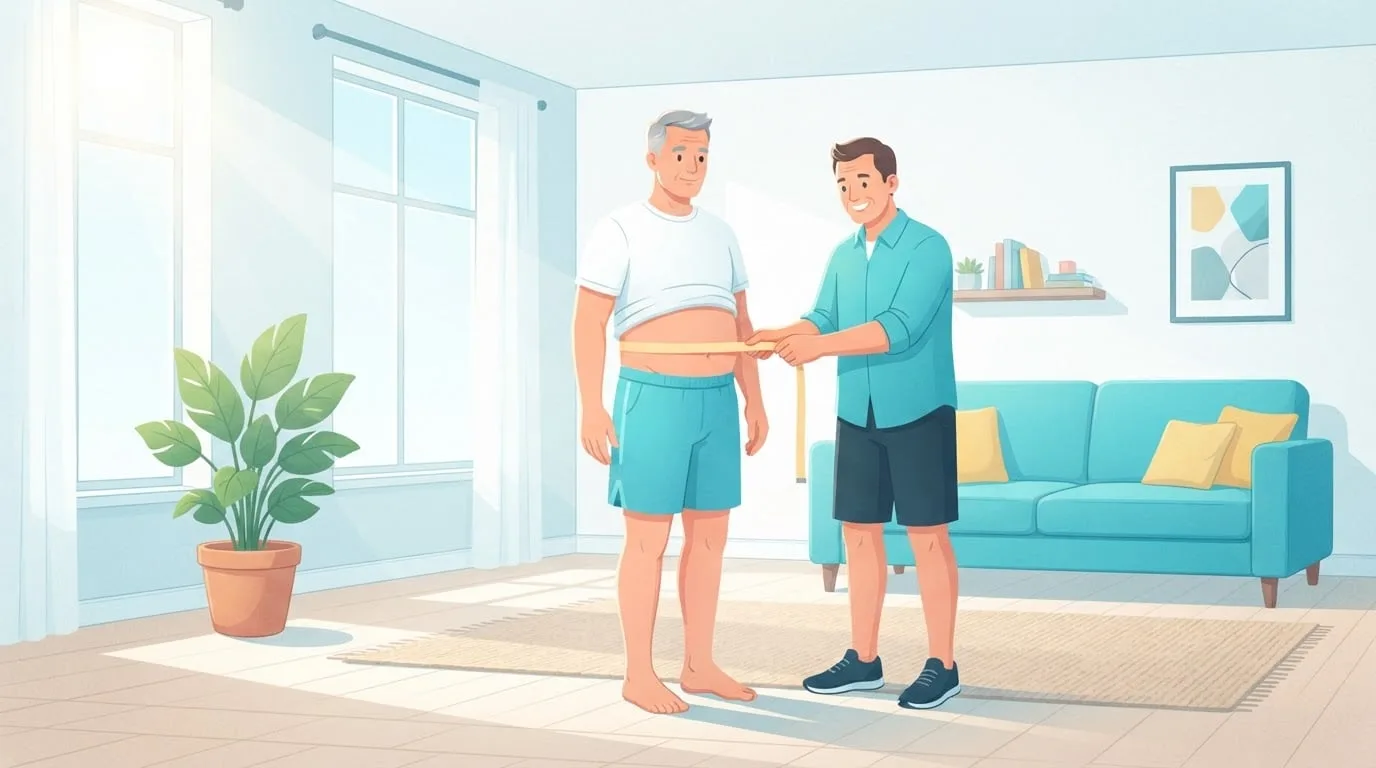
- Ask someone to help now and then. A partner can see the back of the tape and the landmark better than you can.
No tape? Wrap a piece of string or a charging cable around your waist at the midpoint, pinch it where the ends meet, then lay it flat along a ruler. A printed paper tape works too, as the Barrios study showed, as long as you check its scale against a ruler first.
How Often Should You Re-Measure Your Waist?
Every two to four weeks is plenty. Your waist changes slowly, and a single measurement can wobble by a centimeter or so from the tape alone. In the Barrios study, the typical error between careful repeat readings ran as high as about three-quarters of an inch for some measurements. Measuring daily mostly records that noise.
Make each check match the last one:
- Same time of day, ideally in the morning after using the bathroom and before eating.
- Same landmark, same tape and the same breath-out reading.
- Two readings, averaged, written down with the date.
Treat a change smaller than about half an inch as noise until the next check confirms it. A drop that holds across two or three checks is real. And the waist often moves when the scale doesn't: the 2020 consensus statement noted that regular exercise shrinks waist size with or without weight loss. That makes the tape one of the best progress markers you can own, especially in the weeks when the scale is stuck.
How to Shrink Your Waist Once You've Measured It
You can't choose where you lose fat, so crunches and side bends won't trim your waist on their own. What does work is regular exercise, especially aerobic exercise, plus a modest calorie deficit. The 2020 consensus panel found that in trials, exercise reduced waist size substantially regardless of the amount or intensity, which means the plan you'll keep doing beats the perfect plan you'll drop. Strength training two or three times a week helps you keep muscle while the fat comes off. Our guide to the best exercises to lose belly fat lays out which training reduces abdominal fat and in what order it tends to come off.
The hard part is month three, when the novelty has worn off and the tape has moved less than you hoped. That's a design problem, and design problems have fixes. FitCraft's dumbbell and bodyweight programs are led by a 3D AI coach who demonstrates every exercise and says your name mid-workout. The workouts adjust as you progress, and streaks and leaderboards make the next session easier to start. If you're comparing options, our roundup of the best workout apps for weight loss sets FitCraft beside the alternatives.
The Bottom Line
Measure your waist on bare skin, halfway between your lowest rib and the top of your hip bone, with the tape level and snug, after a normal breath out. Take two readings, average them and write the number down. Compare it with the cut-offs for your sex and with half your height, then remeasure the same way every few weeks.
The tape won't judge you, and it doesn't need to be perfect. It needs to be the same each time. As Jim, 26, put it after losing 24 pounds in three months: "I kept telling myself I'd start Monday. FitCraft made me start on a Wednesday and I haven't stopped."
Frequently Asked Questions
Where is your waist on a man?
For health purposes, a man's waist is halfway between his lowest rib and the top of his hip bone, which is usually at or a little above the belly button. That's higher than where most men wear their trousers. In men, the midpoint and the top of the hip bone give almost the same reading, so either landmark works if you use it every time.
Is the waist at your belly button?
Often it's close, but not always. The health landmark is halfway between your lowest rib and the top of your hip bone, which sits a little above the belly button for most people. The belly button isn't attached to bone and tends to sit lower on a larger belly, so it makes a less reliable marker.
How do you measure your waist without a tape measure?
Wrap a piece of string or a phone charging cable around your waist at the midpoint between your lowest rib and hip bone, pinch or mark where it meets, then lay it flat along a ruler or a carpenter's tape. A printed paper tape also works if you check its scale against a ruler first. Keep the string level and snug, just as you would a tape.
What should my waist be at 5'7"?
At 5 feet 7 inches (67 inches, or 170 cm), a healthy waist is under 33.5 inches (85 cm), which keeps your waist less than half your height. That waist-to-height ratio of under 0.5 is the boundary NICE uses for healthy central fat in adults, and the same line applies to men and women.
How do you measure abdomen vs waist?
A waist measurement goes halfway between your lowest rib and the top of your hip bone, or at the top of the hip bone in US clinical guidelines. An abdominal circumference is usually taken at the belly button, which is the site the US Navy body fat formula uses for men. On a larger belly the navel reading is often the bigger of the two, so note which one you took.
Should you measure your waist in the morning?
Yes, if you can. First thing in the morning, after using the bathroom and before eating or drinking, is the easiest time to repeat exactly. Meals, drinks and bloating can add to your waist over the day, so the time matters less than measuring at the same time on every check.
Is a 32 waist skinny?
It depends on your height and sex. A 32-inch (81 cm) waist is under half the height of anyone 5 feet 4 inches or taller, so it sits in the healthy waist-to-height range for most adults, and it's well under the men's increased-risk line of 37 inches (94 cm). For a woman it sits just above the 31.5-inch (80 cm) line that marks slightly increased risk in the WHO cut-offs.