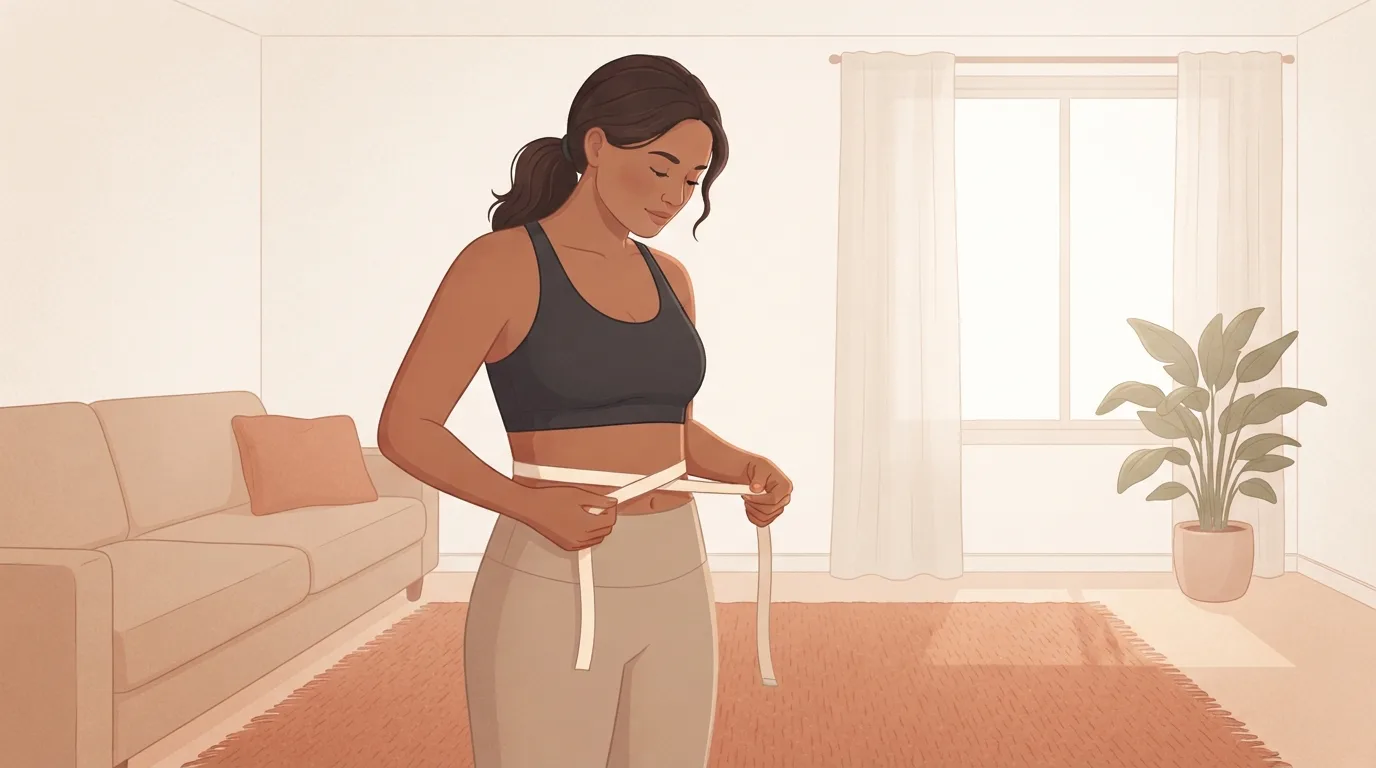
You can weigh the same as a friend, wear the same jeans size and have the same BMI, and still carry your weight in a very different place. One of you stores it around the middle. The other stores it on the hips and thighs. Your waist to hip ratio, also called the waist hip ratio or, the other way round, the hip to waist ratio, is the quickest way to tell which pattern is yours.
That matters because the scale can't see it. Plenty of people who've been told their weight is fine are surprised to find their waist measurement isn't, and plenty of people who feel discouraged by the scale would be encouraged by what a tape shows after a few months of training.
Below you'll find what the ratio is, the World Health Organization's measuring protocol step by step, a worked example table, the cut-offs for men and women, what the big studies actually found, how it compares with BMI and waist-to-height ratio, and how exercise changes it.
What Is the Waist to Hip Ratio?
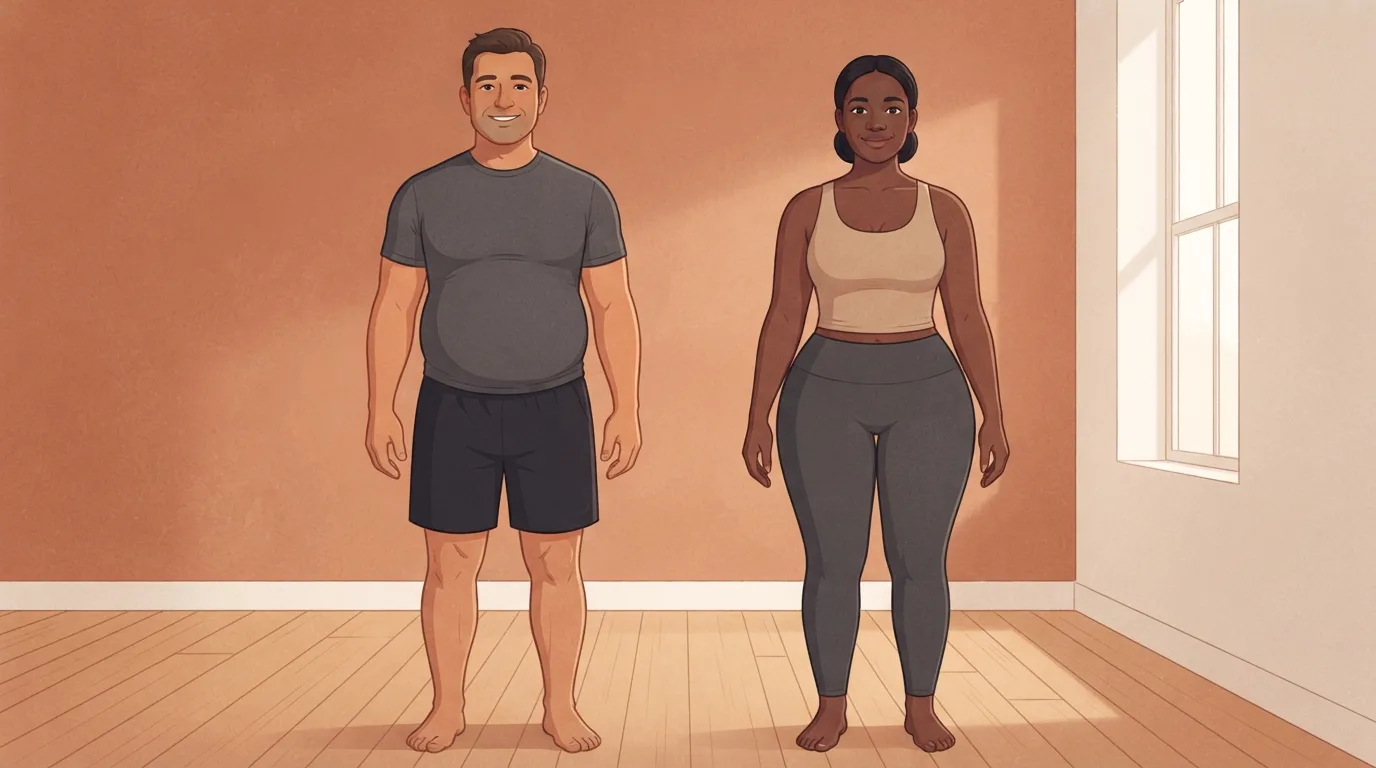
The waist to hip ratio (WHR) is your waist circumference divided by your hip circumference. It's a measure of fat distribution, not of how much fat you have. A high ratio means a large waist relative to your hips, the pattern people describe as apple-shaped. A low ratio means narrower at the waist and wider at the hips, the pear shape.
The waist matters most because it tracks abdominal fat, including visceral fat, the fat packed around the liver, intestines and other organs. The WHO's 2008 expert consultation summarized why: abdominal fat is linked with poorer glucose tolerance, reduced insulin sensitivity and adverse blood lipids, which are the risk factors for type 2 diabetes and heart disease. Fat on the hips and thighs behaves differently, and in some studies it even looks protective, which is why the ratio adds something a waist measurement alone doesn't.
A quick note on wording. The standard ratio is waist divided by hips, so it's usually below 1. If you divide your hips by your waist, the "hip to waist ratio" some calculators show, you get the same information as a number above 1, and the cut-offs below won't apply to it.
How to Measure Your Waist and Hips
The protocol below comes from the WHO report Waist circumference and waist-hip ratio (WHO expert consultation, 2008, published 2011). It takes two minutes, and the details are what make your number comparable with the research.
- Use a stretch-resistant tape. A soft sewing tape is fine. A metal carpenter's tape isn't.
- Strip down to light clothing or bare skin. Thick waistbands add an inch without trying.
- Stand relaxed. Feet close together, arms at your sides, weight spread evenly on both feet.
- Find your waist landmark. Feel for the lowest rib on your side, then the top of your hip bone (the iliac crest). The tape goes at the midpoint between them, which for most people sits a little above the belly button.
- Measure at the end of a normal breath out. Don't hold your breath and don't pull your stomach in. The tape should be snug against the skin without pressing in.
- Measure your hips around the widest part of your buttocks. Look side-on in a mirror to find it, and keep the tape parallel to the floor all the way round.
- Take each measurement twice. If the two readings are within 1 cm (about 3/8 inch), average them. If they differ by more, measure both again.
Two mistakes cause most bad readings: a tape that dips at the back, and a waist taken at the narrowest point you can find rather than the landmark. Ask someone to check the back of the tape if you can.
One more source of confusion. Different tools use different waist landmarks. The US National Institutes of Health protocol measures at the top of the hip bone, and the US Navy body fat formula used by our body fat calculator measures men at the navel. Those are fine for their own purposes. For the waist to hip ratio, use the WHO midpoint, and use the same landmark every time you remeasure.
How to Calculate Your Waist to Hip Ratio
Divide your waist by your hips, in the same unit. A 32-inch waist and 40-inch hips give 32 ÷ 40 = 0.80. In centimeters, an 80 cm waist and 100 cm hips also give 0.80, because the ratio has no units.
The table shows how the same arithmetic plays out across different bodies. Notice that the gap in inches doesn't tell you much on its own: a 10-inch difference gives 0.74 on a small frame and 0.80 on a larger one.
| Waist | Hips | Difference | Ratio | Where it sits (WHO cut-offs) |
|---|---|---|---|---|
| 28 in (71 cm) | 38 in (97 cm) | 10 in | 0.74 | Below both cut-offs |
| 32 in (81 cm) | 40 in (102 cm) | 8 in | 0.80 | Below both cut-offs |
| 34 in (86 cm) | 40 in (102 cm) | 6 in | 0.85 | At the women's cut-off, below the men's |
| 36 in (91 cm) | 40 in (102 cm) | 4 in | 0.90 | At the men's cut-off, above the women's |
| 40 in (102 cm) | 50 in (127 cm) | 10 in | 0.80 | Below both cut-offs |
| 42 in (107 cm) | 42 in (107 cm) | 0 in | 1.00 | Above both cut-offs |
Ratios are rounded to two decimals. A reading that lands right on a cut-off is worth remeasuring, because a half-inch error on either tape moves the ratio by about 0.01.
Healthy Waist to Hip Ratio for Men and Women
The cut-offs most often attributed to the WHO, and restated in its 2008 expert consultation report, treat a ratio of 0.90 or more in men and 0.85 or more in women as a substantially increased risk of metabolic complications. Under those lines is the healthy waist to hip ratio range.
| Measure | Men | Women | What it signals |
|---|---|---|---|
| Waist to hip ratio | 0.90 or more | 0.85 or more | Substantially increased risk |
| Waist circumference | Over 94 cm (37 in) | Over 80 cm (31.5 in) | Increased risk |
| Waist circumference | Over 102 cm (40 in) | Over 88 cm (34.6 in) | Substantially increased risk |
Three things the table doesn't say, and the WHO report does.
- The waist circumference lines were an example. They came from a Dutch sample of 2,183 men and 2,698 women aged 20 to 59, and the report notes they were offered as an example, not as formal WHO recommendations. That's the answer to the common question about the WHO waist circumference classification: it's widely used, and it's European in origin.
- Ethnicity shifts the picture. The consultation found relatively consistent evidence that Asian populations carry more visceral fat at a given waist size, so lower thresholds may suit them. African populations and possibly Pacific Islanders tend to carry less, and may need higher ones.
- The consultation didn't set new cut-offs. Choosing definitive cut-off points was outside its scope. Its job was to judge whether the measures predict disease, and the answer was a clear yes.
So what's the ideal waist to hip ratio? There isn't a single number below the cut-off that research shows is best for everyone. Being under 0.90 as a man or under 0.85 as a woman puts you in the lower-risk group, and a ratio that's falling over time, because your waist is shrinking, is a better sign than any one reading.
What Is an Attractive Waist to Hip Ratio?
It's one of the most searched questions about this measurement, so here's what the research says. In a series of studies led by Singh (1993), men of college age and men aged 25 to 85 rated drawings of normal-weight women with a lower waist-to-hip ratio as more attractive and healthier-looking. Popular articles usually quote 0.7 as the "hourglass" figure from that line of work.
Those studies measured reactions to line drawings, and preferences vary across cultures and over time. They don't tell you what's healthy. For health, the useful line is the cut-off: under 0.85 for women and under 0.90 for men. A lower number below that line isn't a health target, and no amount of training will reshape the bone structure that sets much of your hip width.
Find out what's really holding you back
FitCraft, our mobile fitness app, pairs you with an AI coach who builds you a personalized plan around your goals, schedule, and fitness level. Every FitCraft program is designed by Domenic Angelino, MPH (Brown University) and NSCA-CSCS, with research published in the Journal of Strength and Conditioning Research and Medicine & Science in Sports & Exercise.
Take the Free Assessment Free • 2 minutes • No credit cardWhat the Research Links It To
Heart attacks: the INTERHEART study
The strongest single case for the ratio comes from Yusuf and colleagues (2005) in The Lancet. INTERHEART compared 12,461 people who'd had a first heart attack with 14,637 controls across 52 countries. Risk climbed with every fifth of waist-to-hip ratio: compared with the lowest fifth, the odds ratios were 1.15, 1.39, 1.90 and then 2.52 for the highest fifth, after adjusting for age, sex, region and smoking.
BMI looked much weaker side by side. Its top fifth carried odds of 1.44 before adjustment, which shrank to 1.12 once waist-to-hip ratio was accounted for and stopped being significant after other risk factors were added. The authors estimated that a ratio in the top two fifths accounted for 24.3 percent of heart attacks, against 7.7 percent for the top two fifths of BMI. Hip size pulled the other way: a larger hip circumference was linked with lower odds after adjusting for BMI.
Death from any cause: the EPIC cohort
Pischon and colleagues (2008) followed 359,387 adults in nine European countries for an average of 9.7 years, during which 14,723 died. After adjusting for BMI, people in the highest fifth of waist-to-hip ratio had a 68 percent higher risk of death if they were men and 51 percent higher if they were women. Waist circumference showed an even steeper pattern, at 2.05 and 1.78 times the risk. BMI stayed linked with mortality too, so the authors concluded that the waist measures should be used alongside BMI, not instead of it.
Why larger hips may help
In the Danish MONICA cohort of 2,987 adults, Heitmann and colleagues (2004) found that women with larger hips, relative to their body size and waist, had fewer heart events and deaths over 10 to 13 years. Men didn't show the same protection. One likely explanation is that fat and muscle stored around the hips and thighs are metabolically quieter than fat stored in the abdomen.
Don't read that as a reason to build bigger hips for your health. When the same group checked whether changes in hip size over six years predicted outcomes, they didn't (Lanfer and colleagues, 2014). The protection seems to be a baseline trait, not something you can add.
The honest caveat
The ratio is good at flagging risk. It's less good at predicting it once your doctor already has your blood numbers. The Emerging Risk Factors Collaboration (Wormser and colleagues, 2011) pooled 221,934 people from 58 cohorts. BMI, waist circumference and waist-to-hip ratio all predicted heart disease about equally, and none of them improved prediction once blood pressure, diabetes status and cholesterol were known. The same analysis found the ratio was the least reproducible of the three when people were remeasured years later, which is one more reason to measure carefully and repeat it.
How Exercise Changes Your Waist to Hip Ratio
You lower your ratio by shrinking your waist, and the most reliable way to shrink the visceral part of it is regular aerobic exercise. Vissers and colleagues (2013) pooled 15 studies of 852 adults with overweight who exercised without dieting. Aerobic training at a moderate or high intensity cut visceral fat by more than 30 square centimeters on CT scans in women and more than 40 in men, with changes visible after 12 weeks.
Strength training matters for a different reason. In Ismail and colleagues' (2012) meta-analysis of 35 randomized trials, aerobic exercise reduced visceral fat significantly and resistance training on its own didn't. What strength work does is protect the muscle you'd otherwise lose as the scale comes down, so more of what you lose is fat. Pair the two.
Why the ratio moves slowly
When you lose fat, your hips usually lose some too. That's good news for your health and bad news for the arithmetic. Say your waist drops from 36 to 34 inches over a few months. If your hips stay at 41 inches, your ratio falls from 0.88 to 0.83. If your hips also drop to 40 inches, it only falls to 0.85. You lost the same two inches of waist either way, so track your waist measurement alongside the ratio and don't judge a month of work by the second decimal place.
A simple week that targets the waist
This plan needs nothing more than a pair of dumbbells, walking shoes and some floor space.
- Aerobic work, 150 minutes or more a week. Brisk walking, cycling or a home cardio circuit, five sessions of 30 minutes. Make one or two sessions harder once the routine is steady.
- Strength work, two or three sessions a week. Goblet squats, dumbbell Romanian deadlifts, reverse lunges, glute bridges, push-ups and one-arm dumbbell rows, 2 to 3 sets of 8 to 15 reps each. Add reps or weight when the last set feels easy.
- Skip the waist-only fixes. Crunches, side bends and waist trainers don't remove abdominal fat from that spot. Our guide to the best exercises to lose belly fat explains which training actually reduces it and in what order it comes off.
- Remeasure every four weeks. Same time of day, same landmark, same tape, two readings each.
Food matters as much as training for a smaller waist, because the waist follows total fat loss. A modest, steady deficit that you can live with beats a crash diet you'll abandon by week three.
What to Expect
In the first month, the tape may barely move while the scale bounces around with water. That's normal, and it's where most people quit. By around week 12 of consistent aerobic and strength work, visceral fat is usually falling, often before the mirror shows it. Waist changes you can measure tend to follow over the next few months, and the ratio trails behind your waist because your hips change too.
The hardest part isn't knowing what to do. It's still doing it in month three, when the novelty is gone and the progress is slow. That's a design problem, and design problems have fixes. Build in what brings you back: a fixed time, sessions short enough to survive a bad day, and a streak you don't want to break. FitCraft's dumbbell and bodyweight programs are led by a 3D AI coach who demonstrates every exercise, says your name mid-workout and counts your streak, and our roundup of the best workout apps for weight loss compares it with the other options built to keep you training through the slow weeks.
Waist to Hip Ratio vs BMI vs Waist-to-Height Ratio
Each of the three common body measures answers a different question, and none of them measures body fat directly.
| Measure | What you need | What it captures | Main weakness |
|---|---|---|---|
| BMI | Scale and height | Overall size | Can't tell muscle from fat or see where fat sits |
| Waist to hip ratio | Tape, two sites | Fat distribution, belly versus hips | Hardest to measure the same way twice |
| Waist-to-height ratio | Tape and height | Abdominal fat relative to frame | Single line for everyone, newer evidence base |
Waist-to-height ratio has the strongest recent case. Ashwell, Gunn and Gibson (2012) pooled 31 studies covering more than 300,000 adults and found it picked out people with diabetes, high blood pressure and heart disease better than waist circumference or BMI, in men and women. The widely used healthy boundary is a ratio under 0.5, which means keeping your waist less than half your height. Our BMI calculator works out your BMI and waist-to-height ratio together and flags it when the two disagree.
So which should you track? If you're only going to use one tape measurement, waist-to-height ratio is the simplest and has the best screening evidence, and the WHO report itself favoured waist circumference over the waist to hip ratio because it's easier to measure. The ratio earns its place when you want to know your shape, or when your waist is large but so are your hips. None of these tells you your actual body fat, and our post on what is a healthy body fat percentage covers the ranges by age and the methods that estimate it.
The Bottom Line
Your waist to hip ratio is a two-minute tape measurement that shows where you store fat. Measure the waist at the WHO midpoint and the hips at their widest, divide one by the other, and compare it with 0.90 for men and 0.85 for women. If you're over the line, you're not broken and you're not out of options: regular aerobic exercise shrinks the visceral fat behind a high ratio, strength training protects your muscle, and the waist follows.
As Stacy, 41, put it after losing 22 pounds in four months: "After my second kid, I needed something stupidly simple." Simple, repeated for months, is what moves this number.
Frequently Asked Questions
What's my waist-to-hip ratio?
Divide your waist measurement by your hip measurement, using the same unit for both. A 32-inch waist and 40-inch hips give 32 divided by 40, which is 0.80. Measure the waist halfway between your lowest rib and the top of your hip bone after a normal breath out, and the hips around the widest part of your buttocks.
What is a good waist-to-hip ratio for a woman?
Under 0.85. The cut-offs restated in the World Health Organization's 2008 expert consultation treat a ratio of 0.85 or more in women as a substantially increased risk of metabolic complications. A lower ratio below that line isn't proven to be healthier for every woman, so treat 0.85 as the threshold to stay under rather than a target to chase.
What is a healthy waist-to-hip ratio for a man?
Under 0.90. The WHO cut-offs treat 0.90 or more in men as a substantially increased risk of metabolic complications. Men store more fat around the middle than women do, which is why their threshold is higher, and the ratio tends to creep up with age even when body weight stays the same.
How do I measure my waist to height ratio?
Measure your waist with a tape and your height without shoes, in the same unit, then divide the waist by the height. A 34-inch waist at 68 inches tall gives 0.50. The widely used healthy boundary is a ratio under 0.5, which means keeping your waist less than half your height, and the same line applies to men and women.
Is a 10 inch waist-to-hip difference good?
Usually, yes, but the ratio is what counts, not the gap in inches. A 28-inch waist with 38-inch hips gives 0.74, and a 40-inch waist with 50-inch hips gives 0.80. Both are under the WHO cut-offs for men and women, even though the difference is 10 inches in each case.
What is an attractive waist-to-hip ratio?
Research on attractiveness, led by Devendra Singh's 1993 studies, found that men rated drawings of normal-weight women with a lower waist-to-hip ratio as more attractive, and popular articles usually quote 0.7. Those studies measured preferences for drawings, not health. For your health, the line that matters is staying under 0.85 for women and 0.90 for men.
Can you change your waist-to-hip ratio?
Yes, mainly by shrinking your waist. Regular aerobic exercise reduces the visceral fat packed around your organs even without dieting, and strength training helps you keep muscle while you lose fat. Your hips usually shrink a little too as you lose fat, so the ratio moves more slowly than your waist measurement does.