
You signed up for a HYROX, or you're about to, and the station list is the part that worries you. It includes a sled push, a sled pull, a ski machine and a rowing machine. You don't own any of them, the nearest gym that does is a drive away, and your training happens before work in a garage or a living room.
So the plan stays vague. You run when you can and lift when you remember, and with every skipped week the fear grows that race day will find you out. That's a planning problem, and it has a fix.
The stations test what your body can do, and none of that needs the machines. They ask for leg drive, pulling, grip and the ability to keep moving while you breathe hard, and a pair of dumbbells, a resistance band, a towel and a backpack train all of it. Below you'll find a stand-in and a dose for each station, how to train the running, a normal HYROX training week and a 12-week progression you can follow from your front door.
What HYROX Training Has to Build
A HYROX race is eight 1 km runs, and after each one you complete a station: a 1,000 m ski erg, a 50 m sled push, a 50 m sled pull, 80 m of burpee broad jumps, a 1,000 m row, a 200 m farmers carry, 100 m of sandbag lunges and 100 wall balls. Our guide to what HYROX is covers the divisions, the race weights and typical finish times, so this page sticks to how to train for one.
The first lab study of the full race sets the priorities. Brandt and colleagues (2025) put 11 recreational HYROX athletes through a simulated race in the Open division. They needed a median of 86.5 minutes, and 51.2 of those minutes were spent running. The athletes with the highest aerobic fitness and the most endurance training tended to finish fastest. Their normal week held a median of 3 hours of endurance training and 4 hours of resistance training.
That gives your HYROX training three jobs:
- An aerobic base. Running fills most of the race clock, and a fitter engine also recovers faster between stations.
- Strength endurance. The stations ask for moderate loads moved many times while you breathe hard, so you need lots of squats, lunges, pulls and carries rather than one heavy lift.
- Running on tired legs. Every kilometre after the first starts with legs that a station has just worked. You train that by putting runs and station stand-ins in the same session.
The 8 HYROX Exercises and How to Train Each One at Home
Each stand-in below trains the same muscles for about as long as the station it replaces. The dose column shows weeks 4 to 6 of the plan. The 12-week table further down shows where to start and how to build.
| # | Station | What it asks of you | Home stand-in | Weeks 4-6 dose |
|---|---|---|---|---|
| 1 | Ski erg, 1,000 m | 4 to 5 minutes of pulling down with your arms while you hinge | Band straight-arm pulldown | 4 x 60 sec, 20 sec rest |
| 2 | Sled push, 50 m | Heavy leg drive at a forward lean | Wall drives, or a backpack floor push | 6 x 20 sec |
| 3 | Sled pull, 50 m | Pulling with your back and grip from a low stance | Towel drag of a loaded backpack | 4 x 45 sec |
| 4 | Burpee broad jumps, 80 m | Floor to jump, again and again | The real thing, or step-back burpees with a long stride | 3 x 15 reps |
| 5 | Row, 1,000 m | 4 to 5 minutes of leg drive, hinge and pull | Dumbbell deadlift to bent-over row | 3 x 90 sec |
| 6 | Farmers carry, 200 m | Grip and posture under a heavy load | Farmer's carry with your heaviest dumbbells | 4 x 50 m |
| 7 | Sandbag lunges, 100 m | Walking lunges with a load on your shoulders | Dumbbell walking lunges, or a loaded backpack | 3 x 30 steps |
| 8 | Wall balls, 100 reps | Squat and push overhead, over and over | Dumbbell thrusters, or one-dumbbell squat to press | 4 x 20 reps |
1. Ski erg: band straight-arm pulldown
Anchor a long resistance band high on a closed door or a sturdy beam and step back until it's taut. Keep your arms straight and pull your hands down to your thighs while you bend your knees a little and tip your hips back, the same shape as a ski erg stroke, then let your arms rise. Hold a steady rhythm for the whole interval instead of sprinting the first 20 seconds. If you don't have a band, do light, fast dumbbell bent-over rows for the same time.
2. Sled push: wall drives and a backpack floor push
For a wall drive, put your hands on a wall at shoulder height and walk your feet back until your body leans at about 45 degrees. Drive one knee up and put that foot down, then the other, as fast as you can for 20 seconds. That's the forward-leaning leg drive of the push. On a smooth hard floor, you can also set a loaded backpack on a folded towel and push it across the room with your hands on top and your hips low. Heavy dumbbell split squats on your strength days give your legs the strength behind the drive.
3. Sled pull: towel drag
Tie a rope or a long towel to the handle of a loaded backpack and set the bag on a smooth floor or short grass. Stand at the far end of the rope, sit into a quarter squat and pull the bag toward you hand over hand, then walk it back and go again. Your back, arms and grip do the pulling while your legs hold the low stance, which is how the race pull feels. One-arm dumbbell rows on strength days build the same muscles with more load.
4. Burpee broad jumps: train the real movement
This station needs no kit, so practice it on a patch of grass or down a long hallway. Lower your chest to the floor, push back up, jump forward with both feet and go straight into the next rep. Pace matters more than speed here. A rhythm you can hold for 80 metres beats a fast start that falls apart. If jumping bothers your knees, step your feet back and up for the burpee and take one long stride forward instead of the jump until your legs are ready. On days with no space for it, a HIIT workout at home trains the same up-and-down effort.
5. Row: dumbbell deadlift to bent-over row
A rowing machine links a leg push, a hip swing and an arm pull into one stroke. With two dumbbells, deadlift them to standing, then hinge back down until your torso tips forward with a flat back, pull both dumbbells to your ribs, lower them and stand up again. That's one rep. Keep an even rhythm for 90 seconds at a time, because the race row is a long, steady effort. Pick dumbbells you could row about 15 times when you're fresh.
6. Farmers carry: your heaviest dumbbells
Pick up your heaviest pair, stand tall with your shoulders down, and walk laps of a driveway, a yard or a hallway with short, quick steps. Grip usually gives out before your legs do, so put this stand-in near the end of a session, when your hands are already tired. Home dumbbells are often lighter than the race loads. If yours are, carry them farther than 50 metres per set, or stop at each turn and hold them still for 10 seconds.
7. Sandbag lunges: dumbbell walking lunges
Hold a dumbbell in each hand at your shoulders, or wear a backpack loaded with books and hug the straps, and take long walking lunge steps. Lower your back knee until it lightly touches the floor, or a folded towel on a hard floor, and keep your chest up. A hundred metres of lunges takes a lot of steps, so build toward it in sets of 20 to 50. Do them after a run or a round of wall drives, when your thighs are already working, because that's how they arrive in the race.
8. Wall balls: dumbbell thrusters
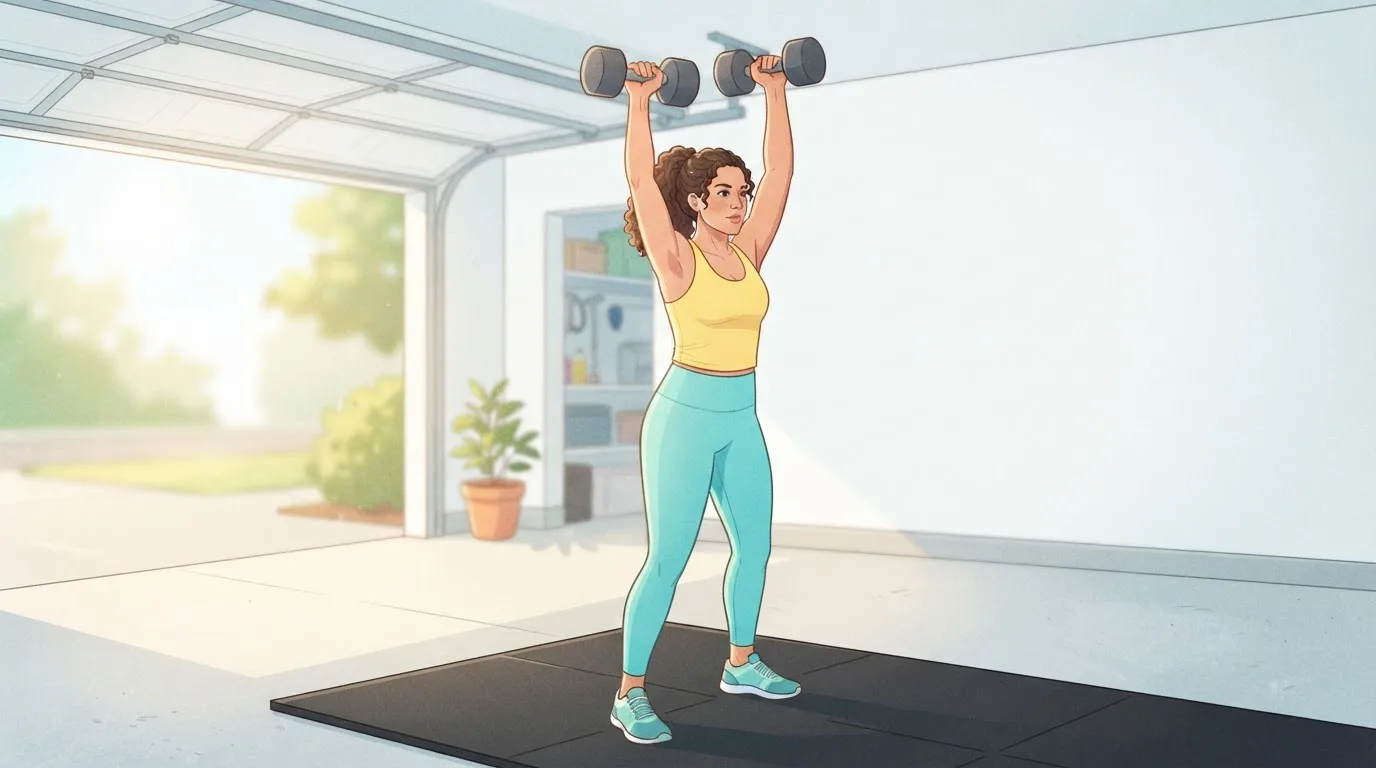
A thruster is a full squat that flows straight into an overhead press. Hold a light dumbbell in each hand at your shoulders, squat until your hips drop below your knees, then drive up and use that momentum to press both dumbbells overhead. With one dumbbell, hold it by the ends at your chest like a goblet squat and press it up with both hands. The race ball is light, so this station tests how long you can keep going. Choose dumbbells that let you finish 20 reps with three or four left in reserve.
Find out what's really holding you back
FitCraft, our mobile fitness app, pairs you with an AI coach who builds you a personalized plan around your goals, schedule, and fitness level. Every FitCraft program is designed by Domenic Angelino, MPH (Brown University) and NSCA-CSCS, with research published in the Journal of Strength and Conditioning Research and Medicine & Science in Sports & Exercise.
Take the Free Assessment Free • 2 minutes • No credit cardHow to Train the Running Half of HYROX
Treat the 8 km as the main event, because it takes up most of the clock. Keep most of your running easy enough to hold a conversation. In a 10-week trial of 30 recreational runners, Muñoz and colleagues (2014) compared a plan with 77 percent of training at an easy effort against one that spent 35 percent at a moderately hard effort. The mostly easy group cut its 10 km time by 5.0 percent and the other group by 3.6 percent, and the gap between them wasn't statistically significant. So a mostly easy week did at least as well, and easy runs leave your legs fresher for the station work in the rest of your week.
A HYROX training week needs three kinds of run:
- An easy run. 30 to 45 minutes at a pace where you can talk in full sentences. A treadmill is fine on bad-weather days.
- A long easy run. It builds from about 30 minutes toward 60 minutes over the plan, still slow enough to talk.
- Race-effort kilometres. Inside the hybrid session below, you run 1 km repeats at the effort you plan to hold on race day. If you want a separate speed session on a free week, our interval running workout guide has sessions from run-walk to 1 km repeats.
Build the distance slowly. Frandsen and colleagues (2025) tracked 5,205 runners with an average age of 46 through 588,071 runs over 18 months. Overuse injuries became more common when a single run was more than 10 percent longer than the longest run of the previous 30 days, and runs more than twice that long carried about 2.3 times the injury rate. So if your longest run this month was 5 km, keep this weekend's run to 5.5 km or less.
If you can't run for 30 minutes yet, start with run-walk intervals: 1 to 2 minutes of easy running and 1 minute of walking, repeated for 20 to 30 minutes, three times a week. Stretch the running parts each week until you can run the whole 30 minutes, then start the 12-week plan.
A HYROX Training Schedule for a Normal Week
This week has five sessions: two strength days built around the station stand-ins, two easy runs and one hybrid session that mixes running with stations. It takes about 4 to 5 hours, less than the 3 hours of endurance and 4 hours of resistance training the athletes in the Brandt study reported, which suits a first race. Keep at least one full rest day.
| Day | Session | Time |
|---|---|---|
| Monday | Strength A: legs and pushing, then a station block | 40-45 min |
| Tuesday | Easy run | 30-45 min |
| Wednesday | Hybrid session: race-effort runs plus stations | 45-60 min |
| Thursday | Rest, or a 20-minute walk and some stretching | 0-30 min |
| Friday | Strength B: pulling, hinging and grip, then a station block | 40-45 min |
| Saturday | Long easy run | 30-60 min |
| Sunday | Rest | None |
Only have three days? Keep the hybrid session and the long run, and combine the strength days into one: the first two exercises of Strength A, the first two of Strength B, and four station stand-ins of your choice.
Run or lift first?
If a run and a strength session land on the same day, lift first unless the run is the day's key session. In a meta-analysis of trials that compared the two orders within one session, Murlasits and colleagues (2018) found that doing strength work first gave bigger gains in lower-body strength, about 4 kg more on a one-rep max, while aerobic fitness improved the same either way.
Strength A: legs and pushing
| Exercise | Sets x reps | Rest |
|---|---|---|
| Dumbbell split squat | 3 x 8-10 per leg | 90 sec |
| Push-up, hands on a bench if needed | 3 x 8-15 | 60 sec |
| Dumbbell overhead press | 3 x 8-10 | 60 sec |
| Station block: wall drives, burpee broad jumps, walking lunges, thrusters | This week's dose from the 12-week table | 60 sec between stations |
Strength B: pulling, hinging and grip
| Exercise | Sets x reps | Rest |
|---|---|---|
| Dumbbell Romanian deadlift | 3 x 10 | 90 sec |
| One-arm dumbbell row | 3 x 10 per arm | 60 sec |
| Side plank | 2 x 30 sec per side | 30 sec |
| Station block: band pulldowns, towel drags, deadlift to row, farmer's carry | This week's dose from the 12-week table | 60 sec between stations |
Warm up for 5 to 10 minutes before both sessions, and stop every strength set with two or three good reps left. Run the station blocks in race order, so the carry and the lunges come late, when you're tired. If you'd rather keep moving through the strength work as rounds, our guide to circuit training at home shows how to build circuits from moves like these.
The hybrid session: a HYROX workout example
This is the session that makes the plan HYROX training rather than running plus lifting. Warm up with 10 minutes of easy running and a few practice reps of each stand-in, then do the rounds the 12-week table gives for this week. Each round is:
- Run 1 km at the effort you plan to hold on race day.
- Walk briskly for 30 seconds, the way you'll move through the transition area.
- Do one set of one station stand-in, using this week's set size from the 12-week table (20 thrusters in weeks 4 to 6, for example), then rest for up to 2 minutes in the early weeks and less as the plan goes on.
Rotate the stations: use the second half of the race order (row, carry, lunges, thrusters) one week and the first half the next. Finish with 5 minutes of walking. If you don't have a safe 1 km loop, run for the time your kilometre usually takes at the same effort.

A 12-Week HYROX Training Plan for Beginners
This plan assumes you can run for 30 minutes without stopping and do 15 bodyweight squats with good form. Keep the weekly schedule above the same every week and change only the numbers in this table. Each station builds toward its full race volume in week 10, then backs off for the taper.
| Session or station | Weeks 1-3 | Weeks 4-6 | Weeks 7-9 | Week 10 (rehearsal) | Weeks 11-12 |
|---|---|---|---|---|---|
| Long easy run | 30-40 min | 40-50 min | 50-60 min | 50-60 min | 30-40 min |
| Hybrid session rounds | 3 x (500 m + station) | 4 x (1 km + station) | 5 x (1 km + station) | Home rehearsal: 8 x (1 km + station) | 3 x (1 km + station) |
| Band pulldown (ski erg) | 3 x 45 sec | 4 x 60 sec | 3 x 90 sec | 5 min straight | 2 x 90 sec |
| Wall drives (sled push) | 4 x 15 sec | 6 x 20 sec | 8 x 20 sec | 8 x 25 sec | 4 x 20 sec |
| Towel drag (sled pull) | 3 x 30 sec | 4 x 45 sec | 4 x 60 sec | 3 x 90 sec | 2 x 60 sec |
| Burpee broad jumps | 3 x 8 | 3 x 15 | 2 x 25 | 40 unbroken | 2 x 10 |
| Deadlift to row (row) | 3 x 60 sec | 3 x 90 sec | 2 x 2 min | 4 min straight | 2 x 90 sec |
| Farmer's carry | 3 x 40 m | 4 x 50 m | 3 x 80 m | 200 m, short rests allowed | 2 x 50 m |
| Dumbbell walking lunges | 3 x 16 steps | 3 x 30 steps | 2 x 50 steps | 100 m unbroken | 2 x 20 steps |
| Dumbbell thrusters (wall balls) | 4 x 10 | 4 x 20 | 4 x 25 | 100, in sets of 20-25 | 2 x 20 |
Move to the next column only when the current one feels controlled for two sessions in a row. If you miss a week, repeat the week before rather than jumping ahead. A missed week costs you very little, but trying to make it up with double sessions is how people get hurt.
The home rehearsal. In week 10, swap the hybrid session for one full run-through at home: all eight stand-ins in race order, each after a 1 km run and each at the week 10 volume in the table, at about 80 percent of race effort. It shows you where your pacing breaks while there's still time to fix it. Once is enough. That week, keep both strength days but use the weeks 7-9 numbers for their station blocks, so the full race volume happens only once, in the rehearsal.
The taper. Weeks 11 and 12 cut the volume and keep the effort. In a meta-analysis of 27 tapering studies, Bosquet and colleagues (2007) found the best results came from a two-week taper that reduced training volume by 41 to 60 percent while the intensity and the number of sessions stayed the same. So keep your training days, shorten every session, and keep a few race-effort kilometres in the hybrid session. Do your last hybrid session at least four days before the race.
How Long Does It Take to Train for a HYROX?
Most beginners need about 12 weeks of HYROX training if they can already run for 30 minutes, and 16 to 20 weeks if they're starting with little or no running. In the longer version, spend the first 4 to 8 weeks on run-walk intervals and the two strength days, then start the 12-week plan. If you already run or lift regularly, 8 weeks can be enough when you put the extra time into the half you've been skipping.
For a first race, finishing is the goal. A good target is to get through every station without long stops and to still be jogging on the eighth run.
HYROX Training Tips for Race Day
- Start slower than feels right. Run the first kilometre a little faster than your easy pace and no more. Adrenaline makes a fast start feel easy, and the stations make you pay for it later.
- Break the long stations early. Plan the 100 wall balls as five sets of 20 with a few breaths between sets, and the lunges as stretches of 20 to 25 steps. Short planned pauses cost less than one long forced stop.
- Look after your grip. Shake your hands out on the run after the sled pull, and after any rest in the farmers carry, pick the weights straight back up.
- Keep moving between stations. Walk briskly through every transition instead of standing still to catch your breath.
- Try the real kit two or three times. If a gym near you has a sled and a rowing machine, book sessions in the last six weeks so the handles and the rope feel familiar on the day.
- Rehearse your race breakfast. Eat it before a long run or the home rehearsal, so nothing on race morning is new.
HYROX Training in Your 30s and 40s
If you're fitting this around a job and a family, plan your recovery as carefully as your training. These adjustments help:
- Make the hybrid session your only very hard day, and leave two or three reps in reserve on strength days.
- Warm up for 10 minutes before every session with easy jogging, leg swings, bodyweight squats and a few light practice reps.
- If your knees complain, swap walking lunges for reverse lunges and burpee broad jumps for step-back burpees with a stride for two or three weeks, then bring them back gradually.
- Sleep matters most in the week of your longest run and the home rehearsal. Move the session rather than cutting the sleep.
If planning the strength days is the part that keeps slipping, FitCraft can take it over. Its strength workouts use dumbbells and bodyweight plus a few band exercises, your AI coach demonstrates each exercise on an interactive 3D model and says your name during workouts, and your workouts adjust as you progress. Zone 2 cardio workouts cover easy aerobic days indoors, and streaks and calendar tracking help you keep the week together. A personalized training program built around your goal and schedule can run alongside the runs and the hybrid session from this page.
The Bottom Line
HYROX training at home works when the running comes first and every station gets a stand-in that lasts about as long as the real thing. Run three times a week, with one of those runs being the hybrid session that puts race-effort kilometres and stations together, keep the other two easy, and lift twice with a station block at the end. Build each station toward race volume over 10 weeks, then cut back for the last two.
Working out consistently is hard, but it doesn't have to be. As Katie put it, "I've tried everything. This is the first time I've stuck with something past two weeks." Put this week's five sessions on your calendar today, and start with the dumbbells, band and backpack you already own.
Frequently Asked Questions
How hard is HYROX for beginners?
HYROX is hard for beginners mainly because it's long: in a simulated race, recreational athletes needed a median of 86.5 minutes to cover the 8 km of running and the eight stations. None of it needs special skill, so a beginner who trains for about 12 weeks with three runs and two strength sessions a week can finish. Expect the last three stations, the carry, the lunges and the wall balls, to feel hardest.
What is a good HYROX workout for beginners?
A good beginner HYROX workout is 3 rounds of a 500 m run followed by one station stand-in, such as 10 dumbbell thrusters, 16 walking lunge steps or a 40 m farmer's carry, with 2 minutes of rest between rounds. It teaches you to run on tired legs at a dose you can recover from. Build to 4 rounds of 1 km as the weeks go on.
How many days a week should you train for HYROX?
Train four or five days a week for HYROX: two runs, two strength sessions and one session that mixes running with stations, with at least one full rest day. Three days still works if you keep the long run, the mixed session and one full-body strength day.
Should you lift or run first when training for HYROX?
Lift first when both land on the same day, unless the run is that day's key session. A 2018 meta-analysis found that doing strength work before endurance work in the same session gave bigger lower-body strength gains, while aerobic fitness improved the same in either order (Murlasits 2018).
Is HYROX tougher than CrossFit?
HYROX is longer and more running-heavy than a typical CrossFit workout, but it asks for no barbell lifts or gymnastics skills. Which one feels tougher depends on you: if you run well, the stations will feel like the hard part, and if you lift well, the 8 km will. Our guide to what HYROX is compares the two formats in more detail.