
Maybe you've finished a slow run and wondered whether it even counted. Someone glides past you on the path, and "just jogging" starts to sound like an excuse. Or you're about to start and can't decide whether to jog or run, how fast each one is, or which one actually burns more.
That doubt causes more trouble than your pace does. People who think easy runs don't count tend to push every run too hard, then end up sore, hurt or burned out within a few weeks. Others never start at all, because running looks like something for people who are already fit.
Jogging and running are the same movement at different speeds, and the label matters far less than whether you keep going. This guide covers what a jog is, where the line between running and jogging sits, how each one feels, what changes in your stride when you speed up, which is better for weight loss and belly fat, and how to mix the two in a normal week.
Jogging vs Running at a Glance
| Jogging | Running | |
|---|---|---|
| Typical pace | Slower than about 6 mph (a 10-minute mile, 6:13 per km) | About 6 mph and faster |
| Talk test | Full sentences, a little breathy | A few words at a time, then a breath |
| Energy cost (2024 Compendium) | 7.5 METs at a self-paced jog | 10.5 METs at a self-paced run; 9.3 at 6 mph, 12.0 at 8 mph |
| Calories per hour at 70 kg (154 lb) | About 525 | About 650 at 6 mph to 840 at 8 mph |
| Calories per mile at 70 kg | About 110 to 120 | About 105 to 110 |
| Stride | Shorter strides, longer contact with the ground | Longer strides, shorter contact, slightly quicker cadence |
| Landing | Force builds more slowly after each foot strike | Similar peak force, but it builds about 30 percent faster |
| Intensity class | Vigorous | Vigorous |
| Best for | Beginners, easy days and building an aerobic base | Speed, race fitness and short sessions |
Two rows surprise most people. The CDC lists jogging, not just running, among its examples of vigorous activity, so an easy jog already counts double toward the weekly guidelines. And a mile costs about the same at either pace, so running's calorie advantage only shows up per minute.
What Is a Jog?
A jog is a slow, relaxed run that you could keep up for a long time while holding a conversation. Like any run, it has a moment on every stride when both feet are off the ground, which is what separates it from a fast walk. So jogging is the same movement as running, and the word simply describes how fast and how hard you're going.
Exercise scientists rarely use the word. The 2024 Compendium of Physical Activities by Herrmann and colleagues, the reference researchers use to assign energy costs, names every standard level-ground speed from 4 mph upward "running." It saves "jogging" for looser entries, such as a general self-chosen pace, jog-walk mixes, jogging in place and speeds below 4 mph. In everyday terms, your jog is the pace you settle into when nobody is timing you.
If you're coming from walking, there's a gray zone between a very fast walk and a slow jog. Our power walking guide compares power walking vs jogging on calories and impact, so it's the place to start if a jog still feels like too big a step.
Difference Between Jogging and Running: Where the Line Sits
Most coaches and running brands draw the line at about 6 miles per hour, a 10-minute mile or roughly 6:13 per kilometer. Slower than that is a jog and faster is a run. It's a handy convention, but nothing in your body flips at 6 mph. For someone in their first month of running, 5.5 mph can be a hard run. For a trained runner, 7 mph can be an easy jog.
| Speed | km per hour | Minutes per mile | Minutes per km | Usual label |
|---|---|---|---|---|
| 4.0 mph | 6.4 | 15:00 | 9:19 | Slow jog |
| 5.0 mph | 8.0 | 12:00 | 7:27 | Jog |
| 6.0 mph | 9.7 | 10:00 | 6:13 | The usual dividing line |
| 7.0 mph | 11.3 | 8:34 | 5:20 | Run |
| 8.0 mph | 12.9 | 7:30 | 4:40 | Run |
So how many km per hour is jogging? For most adults it's roughly 6.5 to 9.5 km/h. The number on your watch matters less than the effort, though, and effort has a better test.
Jogging vs Running Heart Rate and Effort
The CDC's talk test is the simplest way to tell a jog from a run. At moderate intensity you can talk but not sing. At vigorous intensity you can't say more than a few words without pausing for a breath. An easy jog sits near the top of the talking range: full sentences, a little breathy. A run, in effort terms, is any pace where your sentences shrink to a few words.
Heart rate follows effort, not a label, so there's no fixed jogging heart rate. The same 5.5 mph that keeps one person chatting can push a beginner close to their maximum. The CDC still lists jogging as vigorous because of its energy cost, even when an easy jog feels moderate to a fit runner, and that matters for your weekly target. The US guidelines ask adults for 150 to 300 minutes of moderate activity or 75 to 150 minutes of vigorous activity a week, plus muscle strengthening on two or more days (Piercy and colleagues, 2018). Three 25-minute jogs reach the 75-minute vigorous mark.
How Your Stride Changes When a Jog Becomes a Run
Speeding up from a jog to a run is mostly a matter of longer strides. Leacox and colleagues (2025) had 30 experienced runners run on an instrumented treadmill at seven speeds, from a 10-minute mile up to a 7-minute mile. Speed rose 43 percent. Cadence rose only about 5 percent, from 169 to 178 steps a minute, while each stride got about a third longer and each foot spent less time on the ground, 0.24 seconds instead of 0.28.
The landing changed in a less obvious way. Peak vertical ground reaction force rose only 9 percent, from 2.33 to 2.54 times body weight. The loading rate, meaning how quickly that force builds after your foot touches down, rose about 30 percent, from roughly 37 to 48 body weights per second.

So a jog is easier on your legs mostly because each landing loads more slowly. The peak force itself is only a little lower than in a run. If you're working on speed, keep your foot landing close under your body rather than reaching out in front to lengthen your stride.
Is Running or Jogging Good for Losing Weight?
Both are good for losing weight. Running burns more calories per minute, while per mile the two are about even. Using the 2024 Compendium, a 70 kg (154 lb) adult burns about 525 calories an hour at a self-paced jog and about 735 at a self-paced run. Per mile, the same person burns roughly 105 to 120 calories at any speed from 4 to 8 mph, by our arithmetic from the Compendium's running rows. The slow mile just takes longer.
Lab measurements back that up. Batliner and colleagues (2018) measured 10 recreational runners on a treadmill. Their energy cost per kilometer fell 7.9 percent between about 4 mph and 6 mph, then didn't change between 6 and 8 mph. A very slow jog is, if anything, slightly less economical per mile than a steady run.
So the choice depends on what's fixed. If your time is fixed, running burns more. If your route is fixed, jogging it burns nearly as much as running it. And if harder running means you skip sessions or get hurt, jogging wins, because the calories come from the sessions you actually finish.
Can I Lose Tummy Fat by Running?
Yes, running and jogging both shrink the deep visceral fat around your organs, but the weekly amount matters more than the pace. In the STRRIDE trial, Slentz and colleagues (2005) randomly assigned 175 sedentary, overweight adults to stay inactive or to one of three exercise plans, and measured their belly fat with CT scans.
- No exercise: visceral fat rose 8.6 percent in six months.
- The equivalent of walking 12 miles a week, or of jogging 12 miles a week at a harder effort: both kept visceral fat from rising significantly.
- The equivalent of jogging 20 miles a week: visceral fat fell 6.9 percent, and the fat under the skin of the belly fell 7.0 percent.
At 12 miles a week, the harder effort didn't produce a loss either. Only the larger weekly total did. No exercise trims fat from one spot, so your waist gets smaller when your running, your other activity and what you eat add up to a steady deficit.
Find out what's really holding you back
FitCraft, our mobile fitness app, pairs you with an AI coach who builds you a personalized plan around your goals, schedule, and fitness level. Every FitCraft program is designed by Domenic Angelino, MPH (Brown University) and NSCA-CSCS, with research published in the Journal of Strength and Conditioning Research and Medicine & Science in Sports & Exercise.
Take the Free Assessment Free • 2 minutes • No credit cardWhich Is Safer? Jogging, Running and Injury Risk
Slowing down doesn't automatically protect you from injury. In ProjectRun21, Damsted and colleagues (2019) followed 784 healthy runners through a 14-week half-marathon plan, with their training logged by GPS. Runners whose usual pace was faster than 6 minutes per kilometer, about a 9:40 mile, had a 17.4-point lower cumulative injury risk than slower runners. The confidence interval crossed zero, so the gap could be chance, but the slower pace clearly didn't lower the risk.
A randomized trial points the same way. In Run Clever, Ramskov and colleagues (2018) put 447 recreational runners on a 16-week plan that built up either the amount of fast running or the total weekly volume. Thirty-six runners in the speed group and 44 in the volume group were injured, and the risk of the injuries each schedule was expected to cause didn't differ between them.
What hurts runners more than pace is load that rises faster than tendons and bones can adapt. Jog while you build your weekly time, then add faster running in small doses once your current week feels routine.
Jogging vs Running Benefits: Which Is Better?
Neither is better across the board, and most good training uses both. Jogging builds your aerobic base at a cost you recover from quickly, so you can do a lot of it. Faster running trains speed and the top end of your fitness, and it packs more work into a short session.
Even serious runners jog most of the time. Esteve-Lanao and colleagues (2005) tracked eight well-trained runners by heart rate for six months. About 71 percent of their training time, 4,581 of roughly 6,400 minutes, was spent below their first ventilatory threshold, an easy pace for them. The runners who logged more of those easy minutes ran a 10 km cross-country championship faster.
For long-term health, slow is plenty. The large studies of runners found most of the benefit in people who ran slowly and not very often, and our slow jogging research review covers those studies one by one.
How Long Should a Beginner Jog?
A beginner should jog for about 10 to 20 minutes in total per session at first, split into 1- to 3-minute jogs with walking in between, three times a week. Over about eight weeks, build toward 25 to 30 minutes of continuous easy jogging. Our 8-week plan for starting running lays it out week by week. Three rules matter more than the exact minutes:
- Keep the jog conversational. If you can't finish a sentence, slow down or walk.
- Add time before speed. Get to 30 minutes of easy jogging before you make any of it fast.
- Leave a day between sessions at first. Rest days give your legs time to get used to the impact.
Is Jogging Better Than Walking?
For fitness and calories per minute, yes, and for your joints and injury risk, walking is easier on you. A self-paced jog costs 7.5 METs against 4.8 for brisk walking at 3.5 to 3.9 mph in the Compendium, so a jog burns roughly half again as much per minute. Walking still delivers similar heart benefits if you walk long enough to spend the same energy. Our article on whether running is better than walking compares the two goal by goal.
Is Running in Place the Same as Running?
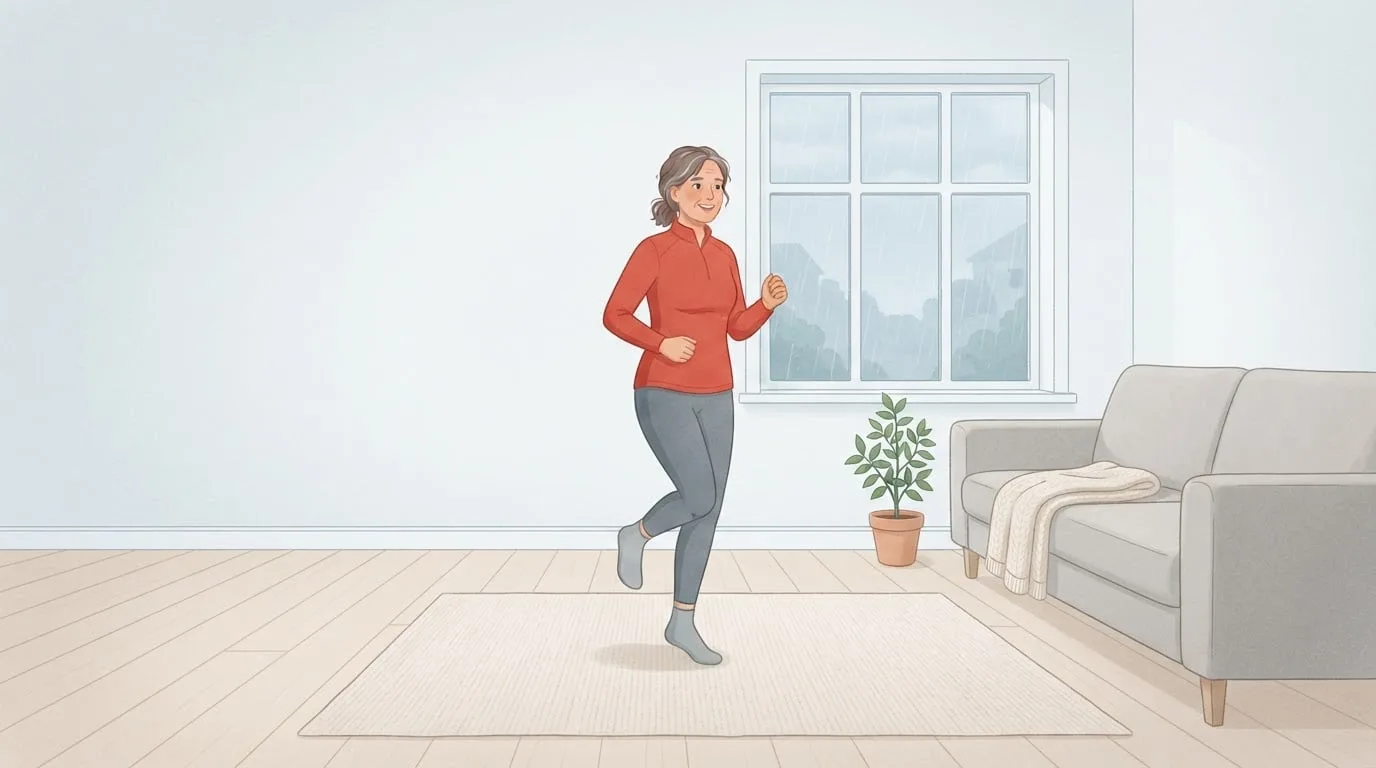
No. Running in place burns much less than running forward. The 2024 Compendium rates jogging in place at 4.8 METs, the same as a brisk walk, against 7.5 for a self-paced jog and 9.3 for running at 6 mph. Without forward travel, each step is short and low, and you don't have to drive your body down the road. Running in place is still useful as a warm-up or an indoor option when the weather turns, but count it like a brisk walk rather than a run.
Jog or Run: How to Use Both in a Week
For most people, the best answer to "jog or run?" is both: mostly jogging, a little running, and strength work on two other days. Here's a week that fits the guidelines.
| Day | Session | Why it's there |
|---|---|---|
| Monday | Easy jog, 25 to 35 minutes | Builds your base at a talking pace |
| Tuesday | Strength, bodyweight and dumbbells, 30 minutes | The muscle work running alone won't give you |
| Wednesday | Easy jog, 20 minutes, then six relaxed 20-second faster runs, each followed by a minute of easy jogging | A small dose of real running speed |
| Thursday | Rest or an easy walk | Recovery |
| Friday | Strength, 30 minutes | Your second strength session of the week |
| Saturday | Longer easy jog, 40 to 50 minutes | Endurance at a pace you can hold |
| Sunday | Rest | Recovery |
Strength days are the ones runners drop first, even though the guidelines ask for them on top of your cardio. In FitCraft, a 3D AI coach demonstrates each bodyweight and dumbbell exercise, and your program adapts as you progress, so those two sessions are planned for you while you jog or run on your own. If showing up is the hard part, a workout app that keeps you motivated can carry the habit with streaks and a plan built around your schedule.
The Bottom Line
Jogging vs running is a choice of pace within one sport. A jog is slower than about 6 mph and easy enough to talk through, and a run is faster and leaves you short of words. Per mile they burn about the same, per minute a typical run burns about 40 percent more, and speeding up mostly lengthens your stride and makes each landing load faster.
Practical rule: jog most of your weekly minutes, run a small share of them faster, and judge your pace by the talk test rather than your watch.
Your jog counts. The runner who passes you is doing the same sport at a different pace, and what changes your fitness is a week like the one above, repeated for months. As Sarah put it: "First app that made exercise feel like something I chose, not forced."
Frequently Asked Questions
Is it better to walk for 1 hour or run for 30 minutes?
They come out close to even. Using the 2024 Compendium, a 70 kg adult burns about 335 calories in an hour of brisk walking at 3.5 to 3.9 mph and about 325 in 30 minutes of running at 6 mph, and the US guidelines count each vigorous minute as two moderate ones. Run when time is short and your legs feel good, and walk the hour when impact bothers you or you want an easy day.
How many km per hour is jogging?
Jogging is usually about 6.5 to 9.5 km per hour, roughly 4 to 6 mph, which is a pace of about 9:15 to 6:20 per kilometer. Above about 9.7 km per hour, a 10-minute mile, most people call it running. The talk test is a better guide than the number: if you can still speak in full sentences, you're jogging.
Is a 10-minute mile jogging or running?
A 10-minute mile, 6 mph, sits right on the usual line between jogging and running. Whether it feels like a jog depends on your fitness. If you can talk in full sentences at that pace, it's a jog for you, and if you're down to a few words, it's a run.
Do you need different shoes for jogging and running?
No. Running shoes cover both, and there's no separate jogging category you need to buy. A review in the British Journal of Sports Medicine by Nigg and colleagues (2015) concluded that impact forces and foot pronation haven't reliably predicted running injuries, and suggested choosing shoes by comfort instead. Pick the pair that feels best on a short test jog.
What heart rate is jogging vs running?
There's no fixed heart rate for either, because the same pace feels easy to a trained runner and hard to a beginner. A jog usually feels like you can still talk in full sentences, and a run like you can manage only a few words before a breath, which are the CDC's talk-test markers for moderate and vigorous effort. If you train with a heart rate monitor, keep most jogs in the lower part of your range and save the top for short bouts of faster running.