Romanian deadlift vs deadlift is one of the most common questions in strength training, and it's a fair one. The two lifts share half a name, both have you hold a weight and bend forward, and coaches use them for overlapping jobs. Look up the difference between a deadlift and a Romanian deadlift and you'll mostly find the same opinions repeated without numbers.
So you guess. Maybe you skip deadlifts because the floor start looks risky, or you do RDLs every week without knowing whether they cover what a regular deadlift would. Then a stiff lower back or a flat week makes you wonder if you picked the wrong lift, and that doubt makes the next session easier to skip.
The choice is simpler than it looks. Each lift has a clear mechanical job, and the studies that measured both side by side show where they overlap and where they don't. Pick by the job you need done, keep doing it, and either lift will pay you back.
RDL vs Deadlift at a Glance
Here's the comparison in one table. The sections below explain each row and the research behind it.
| Romanian deadlift (RDL) | Conventional deadlift | |
|---|---|---|
| Where each rep starts | Standing tall, weight at your hips | On the floor, from a dead stop |
| First phase of the rep | Lowering | Lifting |
| Knee bend at the bottom | Small, about 34 degrees in Lee 2018 | Large, about 85 degrees in Lee 2018 |
| Movement pattern | Hip hinge with soft knees | Hip hinge plus knee straightening |
| What ends the descent | The stretch in your hamstrings, often around mid-shin | The floor |
| Main muscles | Hamstrings, glutes, spinal erectors | Glutes, hamstrings, quadriceps, spinal erectors |
| Front-thigh (quadriceps) work | Low | High |
| Typical weight | Lighter | Heavier |
| Best for | Hamstring size and strength, learning the hinge | Whole-body pulling strength, lifting things off the floor |
| Dumbbell version | Dumbbells slide down the front or sides of your legs and stay off the floor | Dumbbells at your sides, from the floor beside your feet (mid-shin while learning) |
What Is the Difference Between an RDL and a Deadlift?
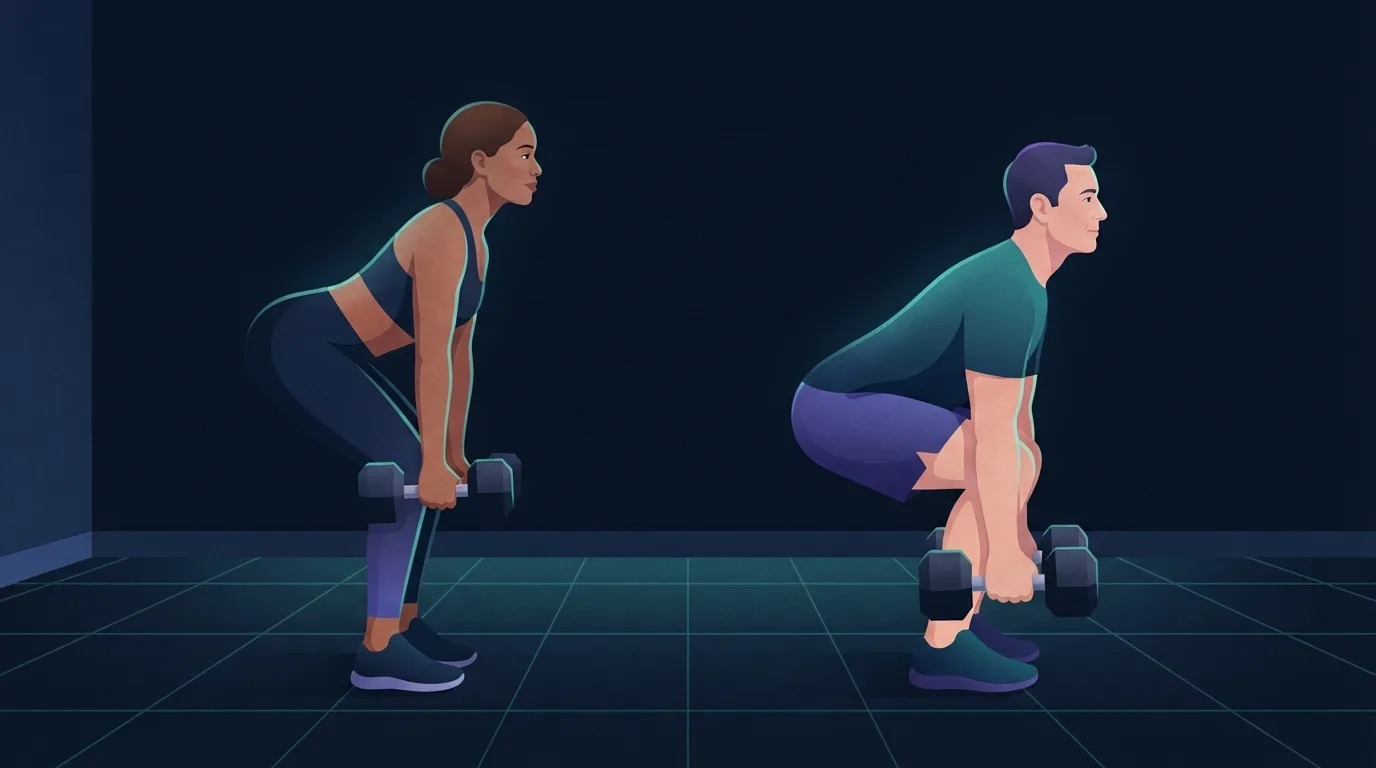
Both lifts are hip hinges. You push your hips back, tip your torso forward with a flat back, and stand up by driving your hips forward. The difference is what your knees do and where the rep begins.
The RDL starts at the top
An RDL begins standing, so the first thing you do is lower the weight. Your knees take a soft bend and barely change as your hips travel back. You stop when the backs of your thighs are fully stretched, and the weight never needs to touch the floor. Then you reverse the movement and stand tall.
The deadlift starts on the floor
A conventional deadlift begins with the weight on the floor. You bend your hips and knees to reach it, then straighten both together to stand up. Every rep starts from a dead stop, with no lowering phase before it.
Lee and colleagues (2018), in the Journal of Exercise Science & Fitness, measured both lifts in 21 men who had trained both for at least three years. At the bottom, the knees bent to about 85 degrees in the deadlift and about 34 degrees in the RDL. The hips bent a little less in the RDL too, about 80 degrees against 91. Those two numbers tell most of the story. The RDL is mainly a hip movement, and the deadlift is a hip-and-knee movement.
Names cause the rest of the confusion. A stiff-leg deadlift keeps the knees straighter still and usually returns to the floor. "Dumbbell deadlift" can mean either pattern, depending on how much you bend your knees. If your knees bend a lot and the weights head for the floor, you're deadlifting. If your knees stay soft and your hips do the traveling, you're doing an RDL.
RDL vs Deadlift Muscles Worked: What the EMG Studies Show
Electromyography (EMG) measures how strongly your nervous system drives a muscle during a lift. It doesn't measure growth, but it shows where the work goes.
In Lee's study both lifts used the same weight, 70 percent of each man's RDL one-rep max. The researchers expressed muscle activity as a share of the peak recorded in the deadlift and compared the two lifts:
- Front of the thigh (rectus femoris): 58.6 percent in the deadlift against 25.3 percent in the RDL, more than twice as much.
- Glutes (gluteus maximus): 51.5 percent against 46.9 percent, a small but significant edge for the deadlift.
- Hamstrings (biceps femoris): 57.5 percent against 56.7 percent, no difference.
The joint forces matched. The torque at the hip was almost identical in the two lifts. At the knee, only the deadlift needed the quadriceps to straighten the leg against the load. In the RDL the knee never had to do that job. So both lifts load your hips equally, and the deadlift adds a knee extension on top.
The study had limits worth knowing. It tested only men, used one moderate weight and measured just one of the three hamstring muscles.
A wider view comes from a 2020 systematic review by Martín-Fuentes and colleagues in PLoS One, which pooled the EMG research on the deadlift and its variants. Across the variants, the spinal erectors and the quadriceps usually showed more activation than the glutes and hamstrings. The RDL was the exception: it drew less spinal-erector activity than hamstring activity. Within the hamstrings, the semitendinosus on the inner back of the thigh generally worked a little harder than the biceps femoris on the outer side.
One more study puts the RDL in context with other hamstring exercises. McAllister and colleagues (2014), in the Journal of Strength and Conditioning Research, compared four exercises in 12 trained men at 85 percent of their max. Hamstring activity was highest in the RDL and the glute-ham raise, ahead of the leg curl and the good morning.
Put together, the RDL is a hamstring exercise that also trains your glutes and back. The deadlift is a whole-lower-body lift with much more quadriceps work and slightly more glute work.
Are RDLs Good for Glute and Hamstring Growth?
Yes, and especially for the hamstrings. Two lines of evidence point that way.
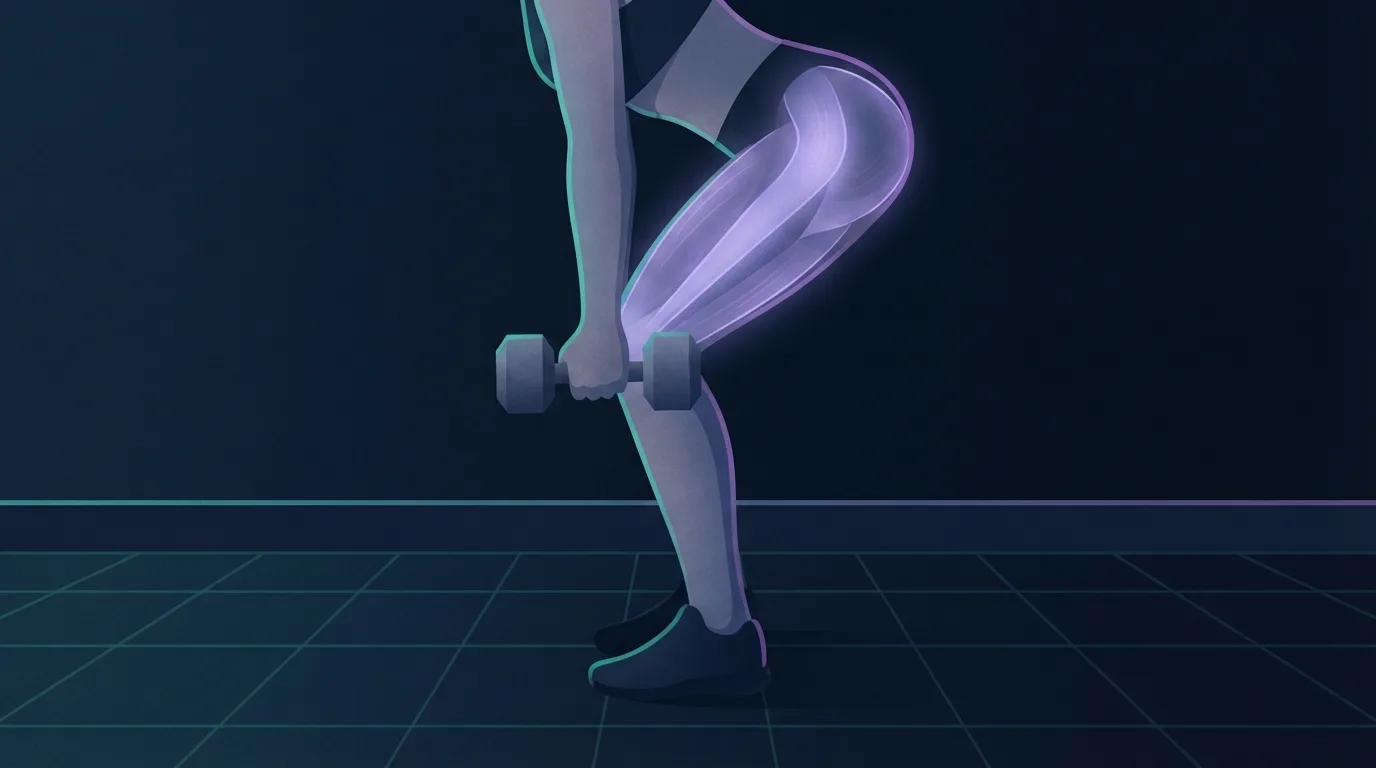
First, the RDL loads your hamstrings while they're long. The hamstrings cross both the hip and the knee, so bending at the hips with nearly straight knees stretches them under the weight. Maeo and colleagues (2021), in Medicine & Science in Sports & Exercise, trained 20 adults on leg curls for 12 weeks. One leg trained seated, with the hips bent and the hamstrings long. The other trained lying face down, with the hips straight and the hamstrings shorter. Whole-hamstring volume grew 14 percent in the seated leg and 9 percent in the lying leg. That was a leg curl, not a hinge, but the principle carries over: hamstrings trained at long lengths grew more.
Second, the RDL produces high hamstring activity, as McAllister's comparison showed, without the quadriceps taking a share of the job.
For the glutes the picture is closer. The deadlift drew slightly more glute activity in Lee's study, and both lifts move the hips through a big range. Glute growth comes mainly from doing enough hard sets each week, so either lift counts toward it. For more glute work you can do in a living room, see our list of the best glute exercises at home.
One honest caveat: we found no training study that compares the RDL and the deadlift head to head for muscle growth. The activation data and the long-length principle are the best guide available.
Find out what's really holding you back
FitCraft, our mobile fitness app, pairs you with an AI coach who builds you a personalized plan around your goals, schedule, and fitness level. Every FitCraft program is designed by Domenic Angelino, MPH (Brown University) and NSCA-CSCS, with research published in the Journal of Strength and Conditioning Research and Medicine & Science in Sports & Exercise.
Take the Free Assessment Free • 2 minutes • No credit cardRDL vs Deadlift Form: Where the Two Lifts Split
The full step-by-step cues live on our exercise pages: the Romanian deadlift guide and the dumbbell deadlift guide. This section covers only the four checkpoints that tell the two lifts apart, so you know which one you're actually doing.
- Where the rep begins. The RDL begins at the top and lowers first. The deadlift begins on the floor and lifts first.
- What your knees do. In the RDL you set a soft bend and keep it. In the deadlift you bend them as much as you need to reach the floor, with your hips still above your knees.
- What ends the descent. In the RDL it's the stretch in your hamstrings. In the deadlift it's the floor.
- How you stand up. In the RDL you drive your hips forward. In the deadlift you push the floor away so your hips and knees straighten together.
The common mistake is drifting between the two. An RDL whose knees keep bending turns into a half squat and loses the hamstring stretch. A deadlift with locked knees turns into a stiff-leg pull. Pick one pattern for each set and keep it from the first rep to the last.
Romanian Deadlift vs Deadlift Weight Difference
You'll lift more in the deadlift. It uses more muscle, because the quadriceps add their force as your knees straighten, and that extra muscle moves extra weight.
There's no study-backed ratio between the two lifts. Lee's team set both at 70 percent of each man's RDL max, so the same weight was a lighter effort in the deadlift. Coaches commonly see RDL working weights well below deadlift working weights, but the gap depends on your hamstring flexibility, your grip and how practiced you are at each lift.
With dumbbells the question usually flips. Your grip and the heaviest pair you own tend to run out before your hips do. Use these starting points:
- RDL: a pair you can lower for 8 to 12 slow reps with a flat back, feeling a strong stretch on each one.
- Deadlift: a pair you can lift for 6 to 10 clean reps from mid-shin or the floor.
- When your heaviest pair gets easy: slow the lowering to three seconds, add a one-second pause at the bottom, or move to the single leg deadlift, which puts the whole load on one leg.
Dumbbell Deadlift vs RDL: How Each Works With Dumbbells
FitCraft's strength training uses dumbbells and bodyweight only, so here's how each lift translates. A barbell follows the same two patterns if you train in a gym.
The dumbbell RDL
Hold the dumbbells in front of your thighs or at your sides and let them slide down close to your legs as your hips go back. Each hand carries its own weight, so a side that tires early or drifts away from your leg shows up within a few reps instead of hiding behind a bar.
The dumbbell deadlift
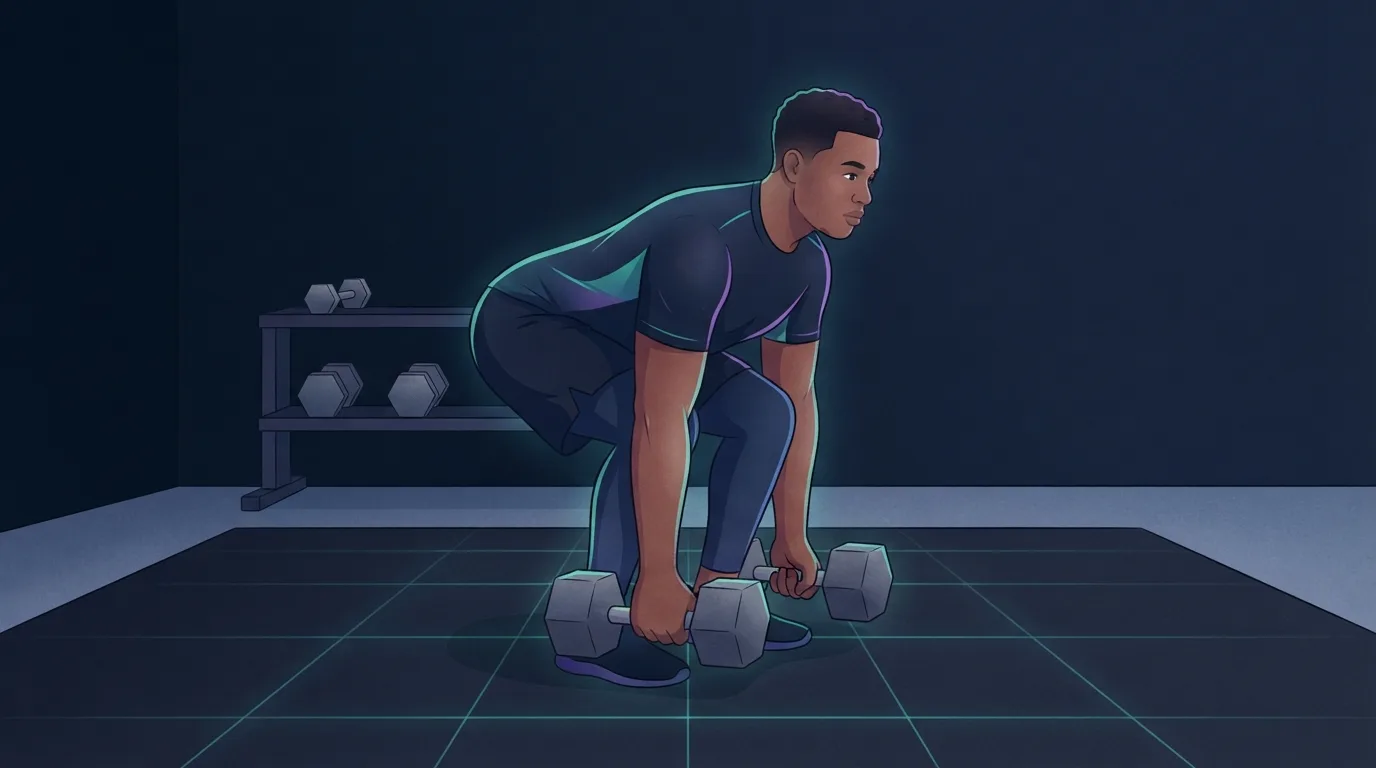
Hold the dumbbells at your sides. With no bar in front of your shins, the weights can travel straight down beside your legs, and you choose how far: to mid-shin while you learn the lift, then to the floor beside your feet once your back stays flat all the way down. That adjustable range is the dumbbell version's main advantage.
The barbell option
In a gym, a barbell lets both lifts go much heavier, and the plates fix the height of the deadlift's floor start. If maximal pulling strength is your goal, that's where the barbell earns its place. For building muscle and a strong, well-practiced hinge, dumbbells cover the job.
Which Is Better: RDL or Deadlift?
Neither is better overall. They do different jobs, so pick by your goal:
| Your goal | Better pick | Why |
|---|---|---|
| Bigger, stronger hamstrings | RDL | Same hamstring activity, loaded at long muscle lengths |
| Learning to hinge for the first time | RDL | You start standing, and mostly one joint moves |
| Whole-body pulling strength | Deadlift | More muscle per rep and more weight on the bar or dumbbells |
| Glutes | Either | The deadlift has a small activation edge; weekly hard sets matter more |
| Front of the thighs | Deadlift, or the RDL plus squats | The RDL barely uses the quadriceps |
| Short sessions | Deadlift | Overall muscle activity was higher in the deadlift |
Most people do best with both: one deadlift day and one RDL day a week. If your hamstrings are the priority, an RDL in every lower-body session works too.
A Simple Week That Uses Both Lifts
Two lower-body sessions, at least two days apart. Stop each set with one or two reps left in the tank and rest about two minutes between hard sets.
| Session | Hinge | Pair it with |
|---|---|---|
| Day 1 | Dumbbell deadlift, 3 sets of 6 to 10 | Split squats and a plank |
| Day 2 | Dumbbell RDL, 3 sets of 8 to 12 | Squats and glute bridges |
If you'd rather not plan the week yourself, FitCraft's strength workouts use dumbbells and bodyweight, and an AI coach demonstrates each exercise on an interactive 3D model you can pinch to zoom. The workouts adjust as you progress, and streaks keep the hinge days from slipping. See how the dumbbell workout app lays out a training week.
Are RDLs Better Than Squats?
They aren't substitutes. A squat bends your knees through a big range and loads the quadriceps. An RDL keeps your knees soft and loads the hamstrings. Lee's front-thigh numbers make the point: when the knees barely bend, the quadriceps barely work. Do one hinge and one squat in each lower-body session and you cover the whole leg.
The Bottom Line
The RDL and the deadlift are two versions of the same hinge. The RDL keeps your knees soft and loads your hamstrings at long lengths. The deadlift adds a deep knee bend and brings in your quadriceps, so it moves more weight. Your hips work equally hard in both.
You don't have to choose forever. Pick the lift that fits this block of training, do it twice a week with a weight you control, and your hinge gets stronger whichever name it carries. The hard part is showing up for week six. As Mike, a FitCraft user who got visibly stronger in four months, put it: "The streak system got me hooked. I didn't want to break my chain."
Frequently Asked Questions
Are RDLs as effective as deadlifts?
For the hamstrings, yes. In a 2018 study of 21 trained men lifting the same weight, hamstring activity was the same in the RDL and the deadlift, and the torque at the hip was nearly identical. The deadlift wins for the front of the thigh, with more than twice the rectus femoris activity, and by a small margin for the glutes, so it trains more total muscle per rep.
Can I replace RDL with deadlift?
You can swap one for the other, but the work shifts. Replacing RDLs with deadlifts adds quadriceps work and more weight while keeping similar hamstring activity. Replacing deadlifts with RDLs keeps your hamstrings and hips busy but drops most of the quadriceps work, so make sure squats or split squats cover the front of your thighs.
Are RDLs good for glute growth?
Yes. RDLs load the glutes through a long range as your hips straighten, and they work the glutes nearly as hard as a deadlift: 46.9 versus 51.5 percent of peak activity in a 2018 comparison. Glute growth depends mostly on doing enough hard sets each week, so RDLs, deadlifts and glute bridges can all count toward it.
Which is harder, an RDL or a deadlift?
The deadlift is harder in absolute terms, because you lift more weight from a dead stop on the floor. The RDL often feels harder on the hamstrings, because they lengthen under the load on every rep, and it can leave the backs of your thighs sore for a few days when it's new to you.
Which is better for your back, an RDL or a deadlift?
Neither one is safer by itself. Both ask the muscles along your spine to hold your back flat under load, and the better lift is the one you can keep flat on every rep with a weight you control. If your lower back hurts, skip both and see a doctor or physical therapist before you return to hip hinges.
Is a stiff-leg deadlift the same as an RDL?
Not quite. A stiff-leg deadlift keeps the knees straighter than an RDL and usually returns the weight to the floor on each rep, so the hamstrings stretch further. An RDL keeps a soft knee bend and stops wherever your hamstrings are fully stretched, which for most people is around mid-shin.