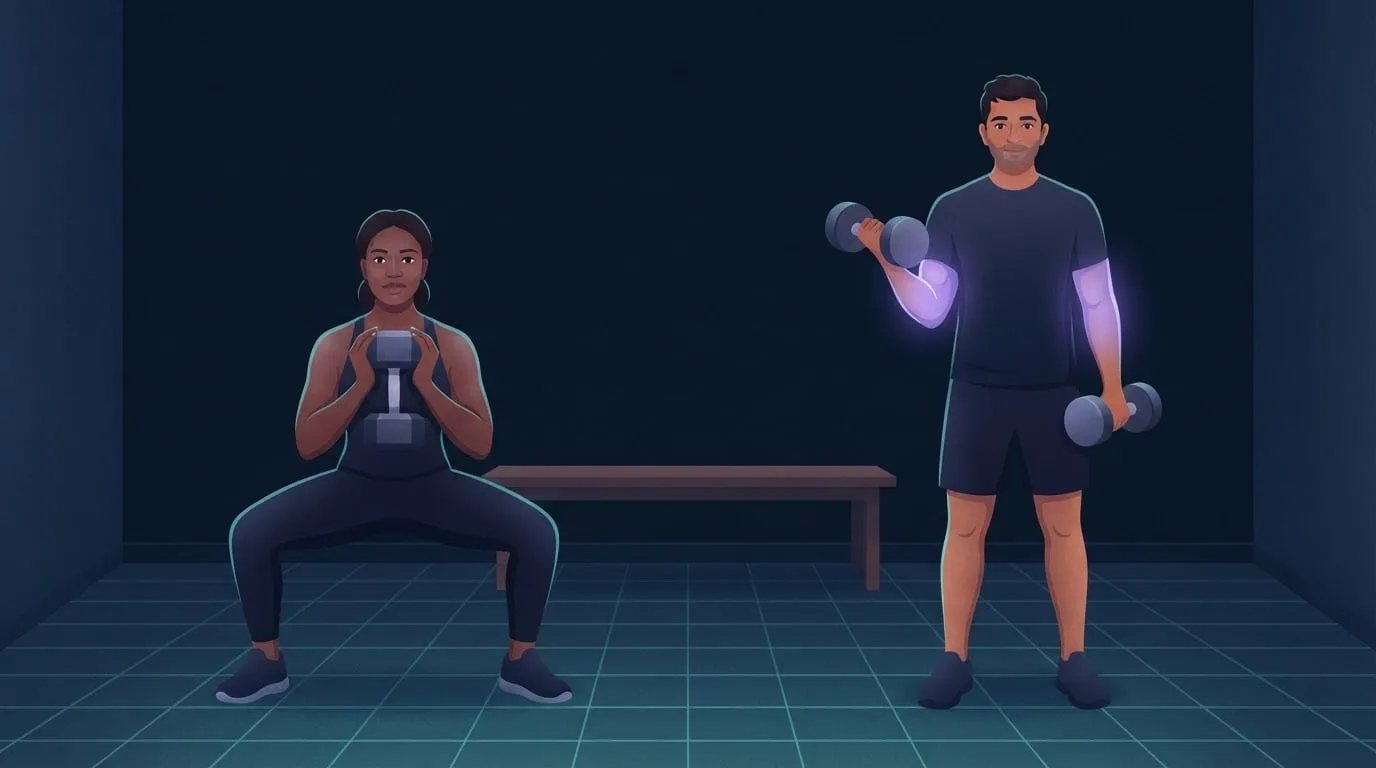
Hypertrophy vs strength training uses the same squats, rows and presses with different settings. Strength training uses heavier loads, fewer reps, longer rests and lots of practice in the lift you want to improve. Hypertrophy training uses more hard sets across a wider range of loads, each taken close to failure, so the muscle itself grows.
If you've read that you must lift heavy to get strong and light to get big, and then wondered whether your dumbbell workouts count for either, you're in good company. Gym advice turns this into a rulebook. The research is more useful than that. The two goals share most of the work, and a handful of choices decide which one moves faster.
Strength vs Hypertrophy at a Glance
| Strength training | Hypertrophy training | |
|---|---|---|
| What improves | The force you can produce in a specific lift | The size of the muscle fibers |
| Main driver | Heavy loads, practiced often, plus muscle over time | Enough hard sets per muscle each week |
| Typical reps | About 3 to 6 on the main lifts | Anywhere from about 6 to 30, as long as sets get hard |
| How close to failure | Usually a rep or two short | Close to failure, 0 to 3 reps short |
| Rest between sets | 2 to 5 minutes | About 2 to 3 minutes on big lifts, less on small ones |
| Weekly volume | Modest; extra sets pay off less | Higher; extra sets keep paying off, with shrinking returns |
| Frequency | Practice each main lift 2 to 3 times a week | Matters less once weekly sets are equal |
| How you measure it | A one-rep max, or the most clean reps with a fixed weight | Tape measure, photos, ultrasound or MRI |
| First visible change | Within 2 to 4 weeks | Usually after 2 to 3 months |
What Is the Difference Between Strength and Hypertrophy?
Strength is how much force you can produce in a specific movement. You measure it as a one-rep max or as the most clean reps with a set weight. Hypertrophy is growth in the size of your muscle fibers, measured with a tape, photos, ultrasound or MRI. The two are related, but they respond to different parts of a program.
The cleanest demonstration comes from a 2017 study by Mattocks and colleagues in Medicine & Science in Sports & Exercise. Thirty-eight untrained adults trained the knee extension and chest press for eight weeks. One group did four sets to failure at roughly 8 to 12 reps. The other group only practiced the strength test, with up to five one-rep max attempts per session. The high-volume group grew more muscle at most measurement sites. One-rep max strength improved by the same amount in both groups.
That's the heart of the question. Muscle size comes from hard sets, and enough of them. Maximal strength comes from lifting heavy in the exact movement you want to be strong in, with muscle size adding to it over the long run.
Hypertrophy vs Strength Training: What the Research Compares
Load and reps
In a volume-matched trial by Schoenfeld and colleagues (2014), 17 trained men did either a bodybuilding routine of 3 sets at a 10-rep max with 90 seconds of rest, or a powerlifting routine of 7 sets at a 3-rep max with 3 minutes of rest. After eight weeks, biceps thickness had grown about the same in both groups. The powerlifting group gained more on the bench press and tended to gain more on the squat.
A larger picture comes from a 2021 network meta-analysis by Lopez and colleagues, which pooled 28 studies and 747 adults who all trained to failure. Muscle growth didn't depend on the load. Strength gains were larger with heavy and moderate loads than with light loads above 15 reps. Our guide to how many reps you should do breaks those ranges down by goal.
Rest between sets
Common advice says rest briefly for size and longer for strength. The evidence only supports the second half. When Schoenfeld's group compared 1-minute and 3-minute rests (2016) in 21 trained men doing 3 sets of 8 to 12, the 3-minute group gained more squat and bench press strength and more front-thigh muscle. Rest until you can hit your target reps again. That's about 2 to 3 minutes on big lifts and a little less on curls and raises.
Weekly sets and frequency
Volume and frequency split the two goals most clearly. A 2026 meta-regression by Pelland and colleagues in Sports Medicine, covering 67 studies and 2,058 people, found that more weekly sets raised both muscle growth and strength. For strength, though, the returns flattened much sooner. Training a muscle more often raised strength, while its effect on growth looked negligible once weekly sets were accounted for.
Strength also responds to small doses. A 2020 review by Androulakis-Korakakis and colleagues found that trained men raised their one-rep max with a single hard set of 6 to 12 reps on a lift, done one to three times a week. Muscle growth asks for more work than that.
Find out what's really holding you back
FitCraft, our mobile fitness app, pairs you with an AI coach who builds you a personalized plan around your goals, schedule, and fitness level. Every FitCraft program is designed by Domenic Angelino, MPH (Brown University) and NSCA-CSCS, with research published in the Journal of Strength and Conditioning Research and Medicine & Science in Sports & Exercise.
Take the Free Assessment Free • 2 minutes • No credit cardDoes Hypertrophy Build Strength?
Partly, and researchers still argue about how much. Over months and years, a bigger muscle has more contractile tissue to pull with. Our piece on why some people are strong but don't look it covers a study in which long-trained lifters' extra muscle explained most of their strength advantage over untrained men.
In the short run the link is loose. In 2019, Loenneke and colleagues argued in Medical Hypotheses that no experiment has yet shown training-induced growth causes strength gains, pointing to studies like Mattocks where the two came apart. Taber and colleagues replied in Sports Medicine the same year that growth of the muscle's contractile proteins is a contributing cause.
For your training, the debate matters less than it sounds. Muscle is the raw material, and heavy practice teaches you to use it. Chase only size and your strength will rise, but more slowly than it could. Practice only heavy singles and your strength will jump early, but you'll leave most of the muscle growth on the table.
How Long Does It Take to Get Stronger?
Most beginners get measurably stronger within two to four weeks, before their muscles have grown much. That early jump comes from the nervous system. Del Vecchio and colleagues (2019), in The Journal of Physiology, tracked individual motor units in the shin muscle before and after four weeks of strength training. The units switched on at lower forces and fired about 3 pulses per second faster, and the authors traced the force gain to more output from the spinal cord. Moritani and deVries described the same order back in 1979: neural factors first, with muscle growth taking over after 3 to 5 weeks.
Muscle growth starts earlier than most people think, but it's harder to measure. Seynnes and colleagues (2007) saw thigh cross-sectional area rise 3.5 to 5.2% after only 20 days of hard training, and maximal strength was up about 39% by day 35. There's a catch, though. In a 2016 study by Damas and colleagues, the 2.7% gain in thigh size at week 3 came with swelling from muscle damage, so early scans overstate new muscle. By week 10, the same muscle was about 10% larger, and that gain was mostly real.
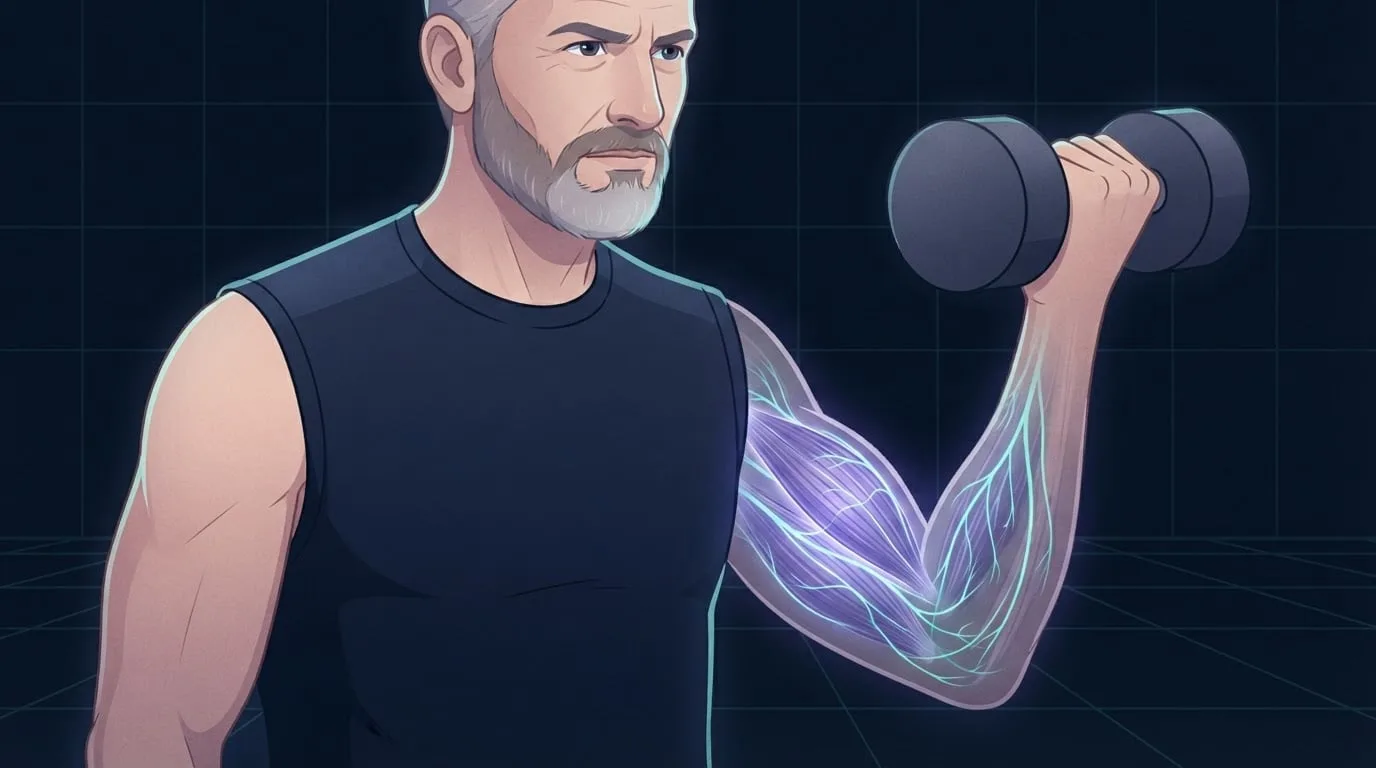
Here's how that plays out for a typical beginner. The later stages are coaching estimates rather than study results:
| Time training | What's changing | What you notice |
|---|---|---|
| Weeks 1 to 4 | Motor units switch on sooner and fire faster; the movement gets more coordinated | Lifts feel steadier and reps jump quickly |
| Weeks 3 to 10 | Muscle fibers start to grow, though early size gains include swelling | Strength keeps climbing at a slightly slower pace |
| Months 3 to 12 | Muscle growth carries more of each strength gain | Visible change and steady but smaller jumps |
| After the first year | Both adaptations continue slowly | A rep or a small weight jump a month is good progress |
The habit that keeps both curves rising is making the work a little harder over time. Our guide to progressive overload for beginners covers how fast to add weight or reps and what to do when progress stalls.
Which Should You Train For?
- Train mainly for strength if you want everyday lifting to feel lighter, you play a sport where force matters, or you're short on time. A few heavy sets of the same lifts two or three times a week go a long way.
- Train mainly for hypertrophy if you want visible muscle, you're rebuilding after a long break, or you plan to chase strength later and want more muscle to work with.
- Train for both if you're not sure. Most beginners belong here, and early on almost any hard training builds both.
Strength vs hypertrophy for women
Women respond to the same training much like men do in relative terms. A meta-analysis by Roberts, Nuckols and Krieger (2020) found similar relative muscle growth and lower-body strength gains between the sexes on matched programs, and larger relative upper-body strength gains in women. Muscle grows slowly for everyone, so a hypertrophy block changes your shape gradually and you decide how far it goes.
How to Train for Strength at Home With Dumbbells and Bodyweight
Dumbbells cap how heavy you can go, so strength training at home is mostly about making each rep harder without a heavier weight. These rules carry most of it:
- Use the hardest version you can do for 3 to 6 clean reps. Think rear-foot-elevated split squats with your heaviest pair, single-leg Romanian deadlifts, heavy one-arm rows, feet-elevated or archer push-ups, and pike push-ups for overhead strength.
- Rest 2 to 3 minutes or more and stop each set a rep or two before failure. Strength sets need to be heavy more than they need to be exhausting.
- Practice the same few lifts two or three times a week. Strength is partly a skill, and frequency is the variable it responds to best.
- Move to a harder version when you pass 6 reps. A one-leg or one-arm variation, a deficit, or a pause at the hardest point keeps the load near your limit.
- Test with a rep max, not a one-rep max. Count your cleanest reps with your heaviest dumbbells every four weeks, and watch that number climb.
Hypertrophy work is easier to do at home, because light and moderate dumbbells build muscle well once sets end close to failure. Our 12-week hypertrophy workout plan sets out the weekly sets, effort targets and progressions in full.
A Week That Builds Both
If you want strength and size at the same time, split the week. Do heavy, low-rep work on one day, higher-rep work near failure on another, and mix the two on a third. Each major muscle gets about 9 to 12 hard sets a week.
| Day | Focus | Exercises (sets x reps) | Rest |
|---|---|---|---|
| Monday | Strength | Rear-foot-elevated split squat 4 x 4-6 per leg; one-arm dumbbell row 4 x 4-6; feet-elevated push-up 4 x 4-6 (hardest version you can do); single-leg Romanian deadlift 3 x 5-6 per leg | 2 to 3 min |
| Wednesday | Hypertrophy | Goblet squat 3 x 10-15; dumbbell Romanian deadlift 3 x 10-15; dumbbell floor press 3 x 8-15; bench-supported row 3 x 10-15; lateral raise 3 x 12-20; curl 2 x 10-15; overhead triceps extension 2 x 10-15 | 1.5 to 2 min |
| Friday | Mixed | Rear-foot-elevated split squat 3 x 4-6 per leg; feet-elevated push-up 3 x 4-6; dumbbell Romanian deadlift 2 x 10-15; one-arm row 3 x 10-15; pike push-up 2 x 8-12 | 2 to 3 min heavy, 1.5 min light |

On the heavy days, stop a rep or two short of failure. On the hypertrophy day, finish most sets with 0 to 2 reps left. When the top of a rep range gets easy on every set, move to a heavier dumbbell or a harder version.
If you'd rather not juggle two rep ranges yourself, FitCraft's dumbbell workout app lays out dumbbell and bodyweight programs that adjust as you progress. Your AI coach, a 3D character, demonstrates each exercise and calls you by name while you train.
The Bottom Line
Strength vs hypertrophy is a question of emphasis, and most people need some of both. Hard sets close to failure build muscle across a wide range of loads. Heavy, frequent practice in a lift builds maximal strength, and the muscle you add makes that strength easier to grow.
Practical rule: if you want size, count hard sets per muscle. If you want strength, practice a few heavy lifts often. If you want both, give each its own day.
Whichever you pick, the deciding factor is still training long enough to see it. As Mike, 23, who got visibly stronger in four months, put it: "The streak system got me hooked. I didn't want to break my chain." You don't need the perfect split. You need one you'll still be doing in six months.
Frequently Asked Questions
How long does it take to get stronger?
Most beginners get measurably stronger within two to four weeks, mainly because the nervous system learns to recruit and fire muscle fibers harder. Muscle growth adds to that from roughly the third week, although early scans partly reflect swelling. After the first six to twelve months, progress slows to small steps each month.
Does hypertrophy build strength?
Over months and years, yes: a bigger muscle has more tissue to produce force, and in long-trained lifters muscle size explains most of the strength gap with untrained people. In the short term the link is loose. In one 8-week study, people who only practiced a one-rep max test gained as much strength as a high-volume group that grew more muscle.
Is it better to lift heavy or light weights?
For muscle size, light and heavy loads work about equally well when sets end close to failure. For maximal strength, heavier loads win, because lifting near your limit is a skill you build by practicing it. Most people do best with some of each.
How many sets to build muscle?
Around 10 to 20 hard sets per muscle per week works for most people, and beginners grow on fewer. Extra sets keep adding growth with shrinking returns. For strength the returns from extra sets flatten even sooner, so a few heavy sets done often matter more.
What exercises are best for hypertrophy?
The best ones let you load a muscle through a full range of motion and push close to failure safely. With dumbbells and bodyweight that means split squats, goblet squats, Romanian deadlifts, rows, presses, push-ups, lateral raises, curls and overhead triceps extensions. Pair one multi-joint exercise with one isolation exercise for each muscle you care most about.
What is the difference between hypertrophy and hypotrophy?
Hypertrophy means a muscle getting bigger, and hypotrophy means it getting smaller, a word often used interchangeably with atrophy. Resistance training drives hypertrophy. Long breaks, immobilization, illness and aging push muscle the other way.