You've done the push-ups and the flat presses. Your chest is stronger than it was, your shirts fit a little tighter across the middle, and yet the area just under your collarbones still looks flat. That gap is what most people mean when they search for upper chest exercises.
It's frustrating to put in the work and see it land everywhere except the spot you care about. It's easy to decide your genetics are the problem. Usually the training is. Most home chest training happens on the floor or a flat bench, and both of those angles favor the middle and lower fibers of the pec. The upper chest responds to a different direction of push, and once you change the angle the work goes where you want it.
Below are the 8 best upper chest exercises you can do at home, the anatomy and the studies behind them, how to program them, and a 20-minute workout in two versions: one with a bench and dumbbells, and one with nothing but the floor, a couch cushion and your body weight.
The 8 Best Upper Chest Exercises
The list runs from the exercise that loads the upper chest hardest to the ones that work best as finishers. The first five should make up most of your sets. Numbers 6 to 8 fill gaps: a band when you have no dumbbells, and two shoulder-heavy moves that bring the upper chest along with them.
| # | Exercise | Equipment | What sets the angle | Typical dose |
|---|---|---|---|---|
| 1 | Incline dumbbell press | Dumbbells, adjustable bench | Bench at 30 to 45 degrees | 3 to 4 sets of 6 to 12 |
| 2 | Feet-elevated push-up | A step, chair or bench | Feet raised above your hands | 3 sets, 1 to 3 reps short of failure |
| 3 | Cushion incline floor press | Dumbbells, two firm couch cushions | Cushions under your upper back | 3 sets of 8 to 15 |
| 4 | Reverse-grip incline press | Dumbbells, bench or cushions | Incline plus palms facing you | 2 to 3 sets of 8 to 12 |
| 5 | Low-incline dumbbell fly | Light dumbbells, bench or cushions | Bench at 15 to 30 degrees | 2 to 3 sets of 10 to 15 |
| 6 | Low-to-high band fly | A resistance band | Band anchored low, arms sweep up | 2 to 3 sets of 12 to 20 |
| 7 | Dumbbell pec raise | One light dumbbell | Arm lifts up and across the body | 2 sets of 10 to 12 per arm |
| 8 | Pike push-up | Body weight | Hips high, body close to vertical | 2 sets of 6 to 10 |
1. Incline dumbbell press
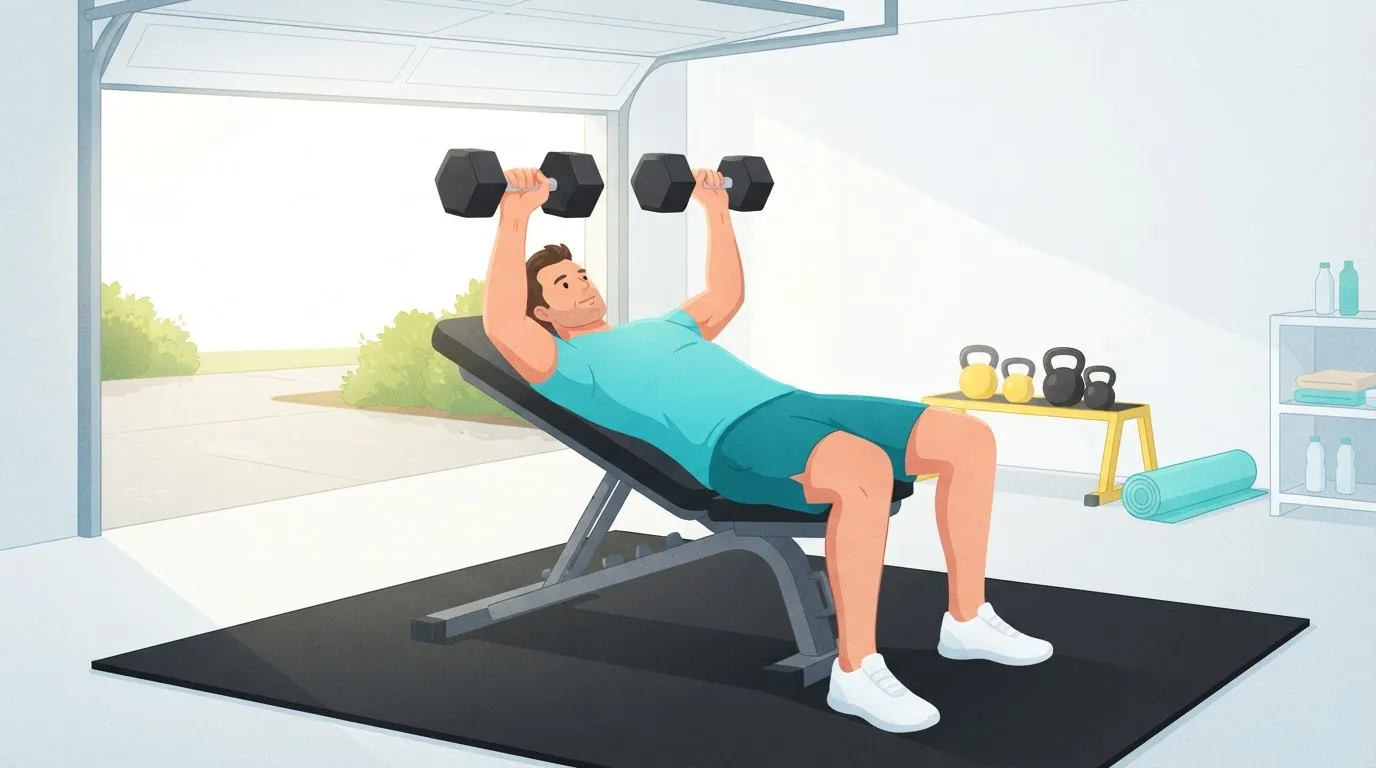
Set an adjustable bench to about 30 degrees, or 45 if you're tall and feel little in your upper chest at 30. Plant your feet, pull your shoulder blades back and down, and lower the dumbbells to the sides of your upper chest with your elbows about 45 degrees from your torso. Press up and slightly in until the dumbbells nearly touch over your collarbones. This is the heaviest load you can put on the upper chest at home, so it goes first in the session. If you feel it mostly in the front of your shoulders, drop the bench one notch.
2. Feet-elevated push-up (decline push-up)
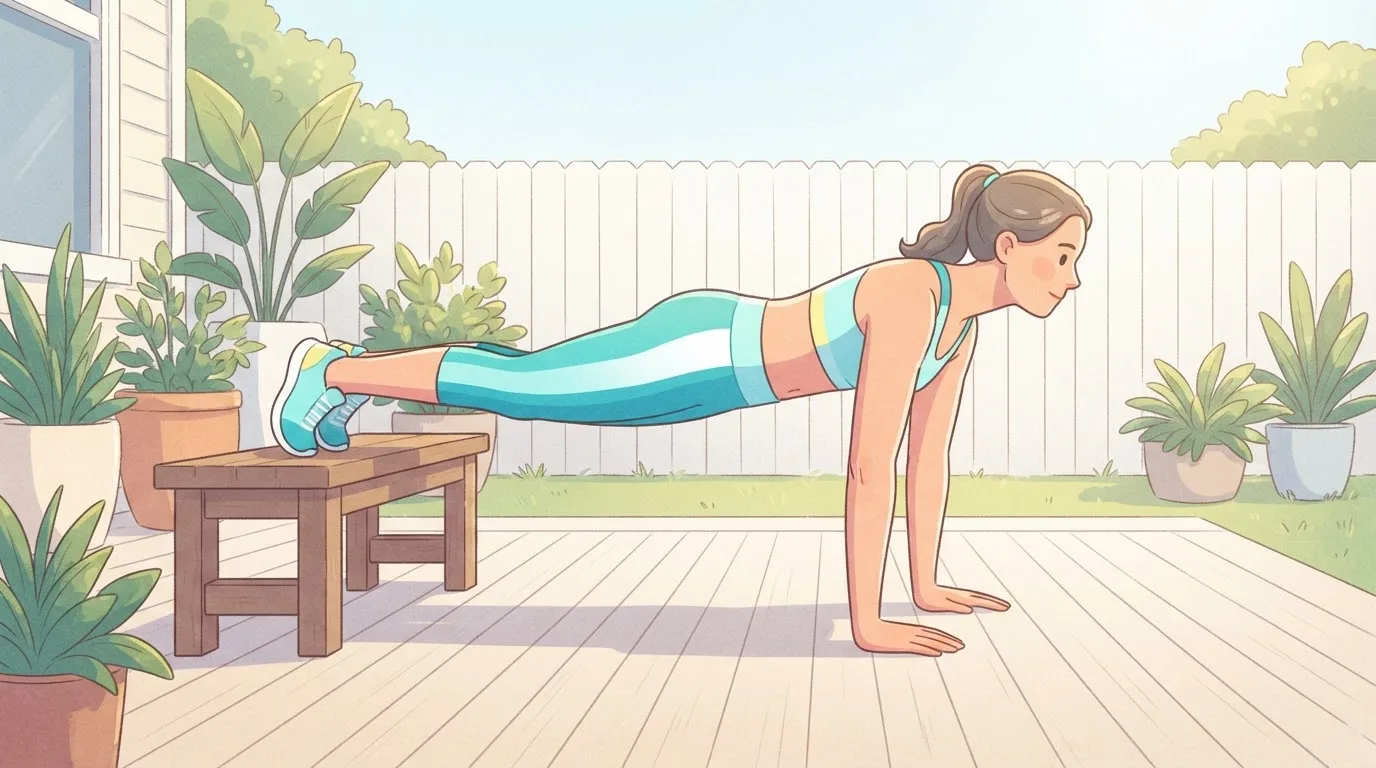
Put your feet on a step, a sturdy chair or a bench and your hands on the floor slightly wider than your shoulders. Keep a straight line from heels to head and lower the top of your chest, not your chin, toward the floor between your hands. Raising your feet flattens the head-up slope of a floor push-up, and once your feet sit higher than your shoulders your body tilts head-down, toward the angle of a low-incline press. It also makes the push-up heavier, as the section on decline push-ups below explains. Start with a low step and work up to about knee height. Our decline push-up exercise guide covers the setup and the neck position.
3. Cushion incline floor press (no bench)
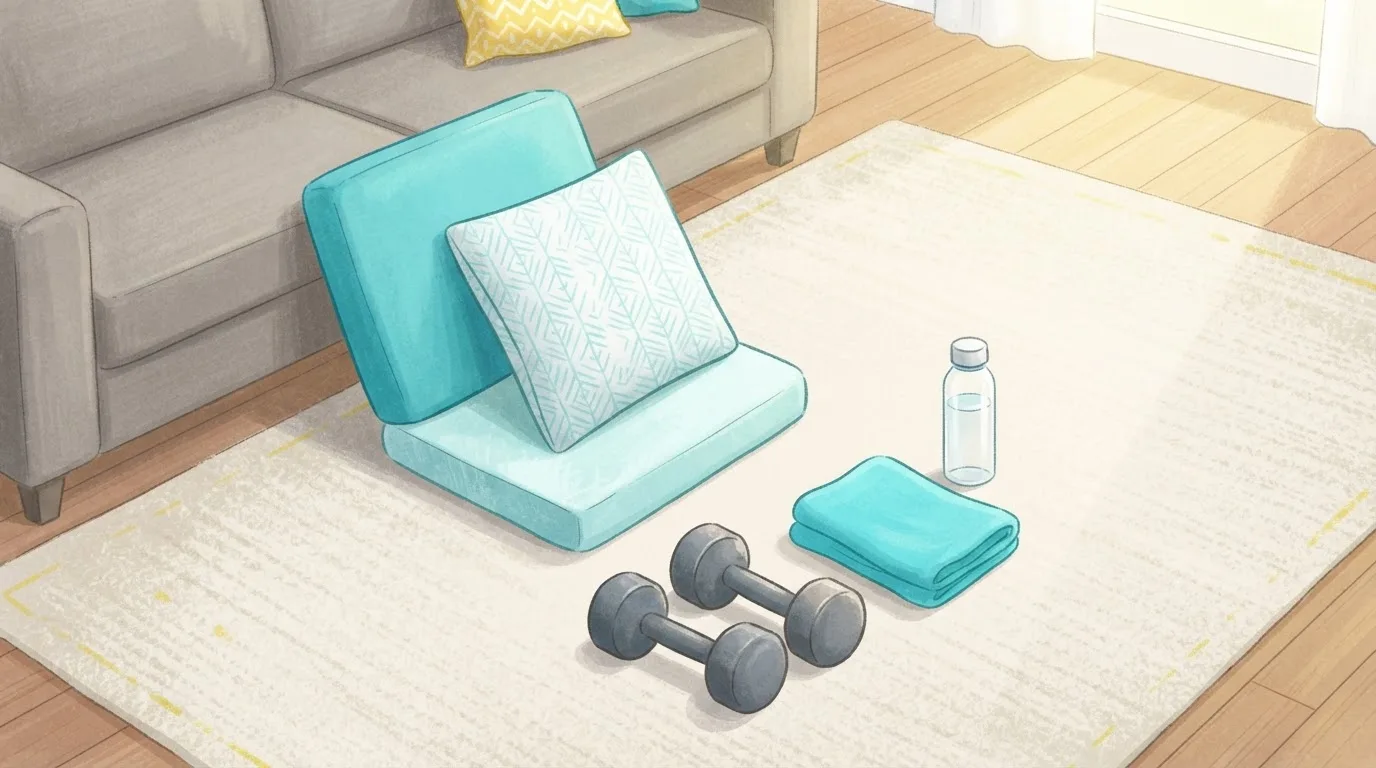
Stack two firm couch cushions or a few pillows against the front of a sofa so they make a slope. Sit on the floor, lean back so your upper back rests on the slope, bend your knees and press the dumbbells up. You want your shoulders roughly a forearm's length off the floor, which puts your torso near 30 degrees for most adults. The floor stops your elbows a little early, so the range is shorter than on a bench, but the angle is right. Check that the dumbbells travel over your upper chest and not over your face.
4. Reverse-grip incline press
Use the same incline as exercise 1 or 3, but hold the dumbbells with your palms turned toward your face. In a study of 12 men by Lehman (2005), a supinated grip held on a flat bench raised activity in the clavicular part of the pec, along with the biceps. Go about 20 to 30 percent lighter than your normal incline weight, keep your wrists straight, and stop if the position bothers your elbows.
5. Low-incline dumbbell fly
Set the bench, or your cushion stack, to a gentle 15 to 30 degrees. Hold light dumbbells over your upper chest with a soft bend in your elbows. Open your arms in a wide arc until you feel a stretch across the top of your chest, then bring the dumbbells back together along the same arc. The fly trains the up-and-across sweep the clavicular head does best, without the triceps helping. Keep the elbow bend fixed and the weight modest, and treat it as a light stretch-and-squeeze move.
6. Low-to-high band fly
Anchor a resistance band low, under your foot or in a door anchor near the floor. Start with your arms down by your hips, palms forward, and sweep them up and in until your hands meet at about chin height. This is the home version of the low-to-high cable fly. The band pulls hardest at the top, where your upper chest is most shortened, which makes it a good finisher after the presses.
7. Dumbbell pec raise
Stand tall holding one light dumbbell at your opposite thigh. Raise it up and across your body to shoulder height with a soft elbow, then lower it slowly. The front of your shoulder does most of this lift and the upper chest helps, so treat it as an accessory for the end of a session, never a replacement for the presses.
8. Pike push-up
From a push-up position, walk your feet in and lift your hips high so your body makes an upside-down V. Bend your elbows and lower the top of your head toward the floor between your hands. This is the steep end of the angle range, so your shoulders take most of the load and the upper chest assists. It earns a place for people with no dumbbells who've outgrown feet-elevated push-ups. Our pike push-up guide has the form cues.
What the Upper Chest Is: The Clavicular Head
Your pectoralis major is a fan-shaped muscle with two heads that share one tendon on the upper arm. The sternocostal head starts on your breastbone and upper ribs and makes up most of the muscle. The clavicular head starts on the inner half of your collarbone. That second head is the "upper chest."
Because its fibers run from the collarbone down and out to the arm, the clavicular head pulls your arm forward and up, and across your body. Paton and Brown (1994) placed six pairs of electrodes along the pec in eight men and had them push in different directions. Lifting the arm forward and up used the top segments. Bringing the arm down from in front of the body used the lowest segments. When the men pressed their arm into their side, activity spread from the bottom of the muscle upward but left the clavicular head out. That's the logic behind every exercise on the list: the arm moves up and in.
The clavicular head is also built differently. Fung and colleagues (2009) dissected 11 cadaver specimens and built 3D models of five of them. They found the clavicular head was uniform in structure, while the sternal head was split into six or seven segments, and the clavicular fibers sat at a steeper angle to the tendon, about 29 degrees against 21.
Shape varies from person to person too. In 80 pecs from 40 cadavers, Haładaj and colleagues (2019) found the textbook layout in about 64 percent, and the most common variation was a clavicular portion separated from the rest of the muscle. In one cadaver the clavicular portion was underdeveloped. The lateral pectoral nerve supplied most of the muscle. So the upper chest isn't built the same way in everyone, and training changes how much muscle you carry there, not the layout you were born with.
What the Bench-Angle Studies Show
These five studies measured the two heads of the pec at different bench angles. They tested bench presses, but the direction of the push is the same with dumbbells or your own body weight.
| Study | People | Angles tested | Upper chest finding |
|---|---|---|---|
| Rodriguez-Ridao 2020 | 30 trained adults | 0, 15, 30, 45, 60 degrees | Peak at 30 degrees; front shoulder peaked at 60 |
| Trebs 2010 | 15 men | 0, 28, 44, 56 degrees | Higher at 44 and 56 than flat, and at 44 than 28 |
| Lauver 2016 | 14 trained men | -15, 0, 30, 45 degrees | No difference over the whole press; higher at 30 and 45 in the second quarter of the lift |
| Cabral 2022 | 8 adults | 0 and 45 degrees | Center of activity moved up toward the collarbone at 45 |
| Albarello 2022 | 13 men | 0 and 45 degrees | Incline: clavicular head more active and more swollen than the sternocostal head. Flat: the reverse |
Rodriguez-Ridao and colleagues (2020) is the largest of the five, and our chest workout at home guide already walks through it. The short version: the upper portion peaked at 30 degrees, the middle and lower portions were highest flat, and above 45 degrees the front deltoid took over while the pec's output dropped.
Trebs, Brandenburg and Pitney (2010) had 15 men press 70 percent of their one-rep max at four angles. Clavicular activity was higher at 44 and 56 degrees than flat, and higher at 44 than at 28. The sternocostal head did the opposite and was most active on the flat bench. Front deltoid activity was higher at every incline than flat, and the authors concluded that both flat and incline pressing are needed to train the whole muscle.
The third study adds a useful caution. Lauver, Cayot and Scheuermann (2016) tested 14 trained men at 65 percent of their max. Averaged over the whole upward push, upper chest activity didn't differ between angles. Split into quarters, the 30 and 45 degree presses produced about 123 percent of a maximal contraction in the second quarter of the lift, against about 98 percent flat. The lower chest was least active at 45 degrees. So a flat bench doesn't ignore your upper chest. An incline just loads it harder through part of every rep.
Two newer studies looked at where in the muscle the activity sits. Cabral and colleagues (2022) recorded 15 small regions from the top of the pec to the bottom in eight adults. On the flat bench the activity was concentrated in the sternocostal head. At 45 degrees its center moved up toward the collarbone. Albarello and colleagues (2022) then had 13 men do four sets of each press and scanned the pec with ultrasound before and after. During the incline sets the clavicular head was more active than the sternocostal head, and right afterward its cross-sectional area had increased more. The flat sets showed the reverse. The swelling is short-lived, so it says nothing about growth, but it does show the work landing where the EMG says it does.
Find out what's really holding you back
FitCraft, our mobile fitness app, pairs you with an AI coach who builds you a personalized plan around your goals, schedule, and fitness level. Every FitCraft program is designed by Domenic Angelino, MPH (Brown University) and NSCA-CSCS, with research published in the Journal of Strength and Conditioning Research and Medicine & Science in Sports & Exercise.
Take the Free Assessment Free • 2 minutes • No credit cardDoes Incline Pressing Grow the Upper Chest More?
Activity during a set isn't the same thing as growth over months, so the real test is a training study. The clearest one compared flat and incline pressing with measurements at several heights of the muscle. Chaves and colleagues (2020) split untrained young men into three groups: flat bench, 44-degree incline bench, or half of each. Forty-seven finished the eight weeks. Everyone trained once a week with 8 to 12 rep sets on a Smith machine, starting at four sets and rising to six.
The researchers measured pec thickness by ultrasound at three heights in 10 men per group. At the highest site, just below the collarbone, the incline group grew more than both the flat group and the mixed group. At the middle and lower sites the groups didn't differ significantly. Strength gains on both the flat and the incline test were similar across all three groups.
Read it with its limits in mind. The men were beginners, they trained the chest only once a week, they used a machine, and only 30 of them had their muscle measured. Still, it agrees with all five activation studies, and it suggests something practical. If your chest is already growing from flat presses and push-ups, adding incline work is the most direct way to bring the top of it along. The mixed group, which did half its sets at each angle, didn't match the incline group at the top site, so a token incline set or two may not be enough.
Decline Push-Ups: Why Raising Your Feet Shifts Work to the Upper Chest
Push-up names are confusing here. A decline push-up has your feet raised, and it's the one that matches an incline press. Think about the direction your arms push relative to your body. On an incline bench your torso is tilted head-up and you press straight up toward the ceiling, so your arms finish above your head relative to your chest. In a push-up with your feet raised higher than your shoulders, your body tilts head-down and you push straight down into the floor. Relative to your trunk, that's the same direction.
On the flat floor it works the other way. In a regular push-up your shoulders sit higher than your feet, so your body slopes head-up and the push behaves more like a flat or slightly declined press. Raise your feet to about the height of your shoulders in the push-up position and your body levels out. Raise them higher and you're in incline territory. Push them very high, with your hips piked, and you've arrived at the pike push-up, where the shoulders take over, just as they did above 45 degrees on the bench.
Raising your feet also makes the push-up heavier. Ebben and colleagues (2011) put 23 adults on a force plate for six push-up variations, and the two feet-elevated versions produced more force than any of the others. The same team first reported the study at a 2010 biomechanics conference, and that paper gives the numbers. At its peak, a regular push-up loaded the hands with about 64 percent of body weight. Feet on a 12-inch box raised that to about 70 percent, and a 24-inch box to about 74 percent. Hands on a 24-inch box dropped it to about 41 percent. For a 180-pound person, that's roughly 115 pounds per rep on the floor and about 133 pounds with feet on a 24-inch box.
| Push-up | Load on the hands (share of body weight) | Pressing angle it resembles |
|---|---|---|
| Hands on a 24-inch box | About 41% | A light, steeply declined press |
| Regular push-up | About 64% | A flat to slightly declined press |
| Feet on a 12-inch box | About 70% | Close to a flat press |
| Feet on a 24-inch box | About 74% | A low-incline press |
| Pike push-up | Not measured in that study | A steep press that favors the shoulders |
Be clear about what's measured and what isn't. Ebben's group measured force through the hands, not muscle activity. No study we could find has recorded the clavicular head during a feet-elevated push-up. The upper chest bias is an inference from the bench studies plus the geometry above, and it's a sound one, but it hasn't been tested directly. The angle column in the table is our estimate for an average adult, not a measured value.
Two setup details protect the angle. Brace your stomach so your hips don't sag, because sagging flattens the slope you just created. And the hands-raised "incline push-up" is the opposite tool: it makes the push-up easier and tips the angle away from the upper chest, so use it only to build up to the floor version.
Grip, Elbow and Range Tweaks for the Upper Chest
Angle does most of the work, but four small details shift a little more of each rep toward the upper chest:
- Turn your palms toward you. In Lehman's study, turning the palms toward you was the grip change that raised clavicular activity. A reverse-grip incline press with dumbbells is the easiest way to use it.
- Lower to the top of your chest. On any press, the dumbbells or your chest should meet at the upper chest, a few inches below the collarbone, not at the bottom of your ribs. A low touch point flattens the push.
- Keep the elbows about 45 degrees from your sides. Flaring them out to 90 degrees puts more strain on the front of the shoulder without adding anything for the upper chest. Tucking them tight to your sides shifts work to the triceps.
- Use the full range. Dumbbells let your hands travel lower than a bar. Lower until you feel a stretch across the top of your chest, as long as your shoulder stays comfortable there.
How to Program Upper Chest Training
Exercise choice decides where the work lands. Programming decides whether it adds up. Four research findings shape a good plan.
Count your weekly sets
Muscle growth rises with the number of hard sets you do per week. Schoenfeld, Ogborn and Krieger (2017) pooled 15 studies and found each extra weekly set was linked to a little more growth, and studies using 10 or more sets per muscle a week trended toward the most. For the chest, a practical target is 10 or more hard sets a week. While the upper chest is your priority, make 8 to 12 of them upper-chest sets: incline presses, feet-elevated push-ups and low-incline flies. Flat presses and regular push-ups still count toward the whole muscle.
Train it twice a week
In a meta-analysis by the same group in 2016, training a muscle twice a week grew it more than once a week when the total sets were equal. Split your upper chest sets over two sessions rather than piling them into one chest day. That also sidesteps the once-a-week limit of the Chaves study.
Put it first
The exercise you do first gets your best reps. A review of exercise order by Simão and colleagues (2012) found that whichever exercise opens a session gets more total reps and, in beginners, bigger strength gains, and the authors advised ordering exercises by priority. If the upper chest is your priority, start with the incline press or feet-elevated push-ups, not the flat press.
Stop a rep or two short of failure
You don't have to grind every set to failure. A meta-analysis of 15 studies by Refalo and colleagues (2023) found no clear advantage for training to momentary muscular failure over stopping short of it. Ending most sets with 1 to 3 good reps left keeps your form clean and your shoulders happy, especially on push-ups, where the last ugly reps usually come from sagging hips.
Progress without heavier dumbbells
Home training runs out of weight before it runs out of muscle. When you hit the top of the rep range, make the same weight harder before you buy new dumbbells: slow the lowering to three seconds, pause for a second at the bottom, add a half rep at the bottom of each rep, or raise your feet a few inches higher on push-ups. Change one thing at a time and hold it for a week or two.
A 20-Minute Upper Chest Workout at Home
Do this twice a week with at least two days between sessions. Warm up for about three minutes first: arm circles, 10 band pull-aparts or wall slides, and an easy set of regular push-ups. Rest 60 to 90 seconds between sets of the presses and about 45 seconds on the rest.
Version A: dumbbells and an adjustable bench
| Order | Exercise | Sets | Reps |
|---|---|---|---|
| 1 | Incline dumbbell press, 30 degrees | 3 | 8 to 12 |
| 2 | Feet-elevated push-up | 2 | 1 to 3 short of failure |
| 3 | Low-incline dumbbell fly | 1 | 12 to 15 |
| 4 | Dumbbell pec raise (optional finisher) | 1 | 10 to 12 per arm |
Version B: no bench
| Order | Exercise | Sets | Reps |
|---|---|---|---|
| 1 | Feet-elevated push-up | 3 | 1 to 3 short of failure |
| 2 | Cushion incline floor press, or reverse-grip if you have light dumbbells only | 2 | 10 to 15 |
| 3 | Low-to-high band fly, or a cushion fly with dumbbells | 1 | 12 to 20 |
| 4 | Pike push-up (optional) | 2 | 6 to 10 |
Each version gives you 6 upper-chest sets per session, not counting the optional finisher. Done twice a week, that's 12 a week, the top of the 8-to-12 range. If you also train your whole chest with flat presses or regular push-ups, drop the first exercise to 2 sets so you land at 10 a week and the total stays manageable.
Where Upper Chest Work Fits in Your Chest Training
Upper chest work is one slice of chest training. The rest of the pec still grows best from heavy flat pressing, regular and deficit push-ups and flyes, and those fundamentals carry most of your progress. For the whole muscle at home, our chest workout at home guide ranks the bodyweight options and builds a full session. If you own dumbbells and a bench, the dumbbell chest workout lays out a two-day split with sets, reps and progression. Use this page to choose the upper chest sets within those plans.
The Bottom Line
The upper chest is the clavicular head of the pec, and it works hardest when your arm moves up and across your body. Press at 30 to 45 degrees, raise your feet on push-ups, finish with a low-incline fly or a low-to-high band fly, and give it 8 to 12 hard sets a week over two sessions, done first. Steeper than about 45 degrees trains your shoulders more than your chest.
Knowing the angles is the easy part. Showing up twice a week for the next three months is the hard part, and it's where most chest programs stall. If you'd like the sets planned for you, a dumbbell workout app can carry that load. FitCraft's strength workouts use dumbbells and body weight, an AI coach demonstrates each exercise on an interactive 3D model and says your name while you train, and your workouts adjust as you progress. As Tim, a FitCraft user, put it, "I didn't think an app could replace my trainer. My AI coach proved me wrong."
Frequently Asked Questions
What's the most effective upper chest workout?
The most effective upper chest workout starts with a heavy incline press at 30 to 45 degrees, adds a feet-elevated push-up or a second incline press, and finishes with a low-incline fly. Three exercises for about 6 hard sets per session, done twice a week, covers it. Put the upper chest work first in the session, while you're fresh.
Are dips good for upper chest?
Dips aren't a good upper chest exercise. They push your hands down toward your hips, the direction of a steep decline press, and that's the job of the lower, sternocostal fibers. An EMG study of the pec found the lowest segments did most of the work when the arm pushed down from in front of the body, while lifting the arm forward and up used the top segments. Keep dips for the lower chest and triceps.
Are 4 exercises enough for chest day?
Four exercises are plenty for chest day. What builds muscle is the number of hard sets per week, not the number of exercises. A flat press, an incline press, a feet-elevated push-up and a fly cover every angle the pec trains through, and 10 or more hard chest sets a week spread over two days is a solid target for most people.
Can you build your upper chest with push-ups only?
You can build your upper chest with push-ups only if you raise your feet. A floor push-up slopes your body head-up, which favors the middle and lower chest, while raising your feet to knee height or higher brings you toward the incline-press angle. Feet-elevated push-ups also load about 70 to 74 percent of your body weight, more than any other push-up a force-plate study measured.
What incline angle is best for the upper chest?
An incline of about 30 to 45 degrees is best for the upper chest. EMG studies found upper chest activity peaked at 30 degrees in one study of 30 trained adults and was higher at 44 degrees than at 28 or 0 in another. Above about 45 degrees the front shoulder takes over, so if you feel the press mostly in your shoulders, lower the bench.
Why is my upper chest not growing?
The most common reason is that all your pressing is flat: floor push-ups and flat presses favor the middle and lower chest. Make 8 to 12 of your weekly chest sets incline presses at 30 to 45 degrees or feet-elevated push-ups, do them first in the session, and add reps or slow the lowering when sets get easy. Anatomy plays a part too, since the clavicular head isn't shaped the same in everyone.