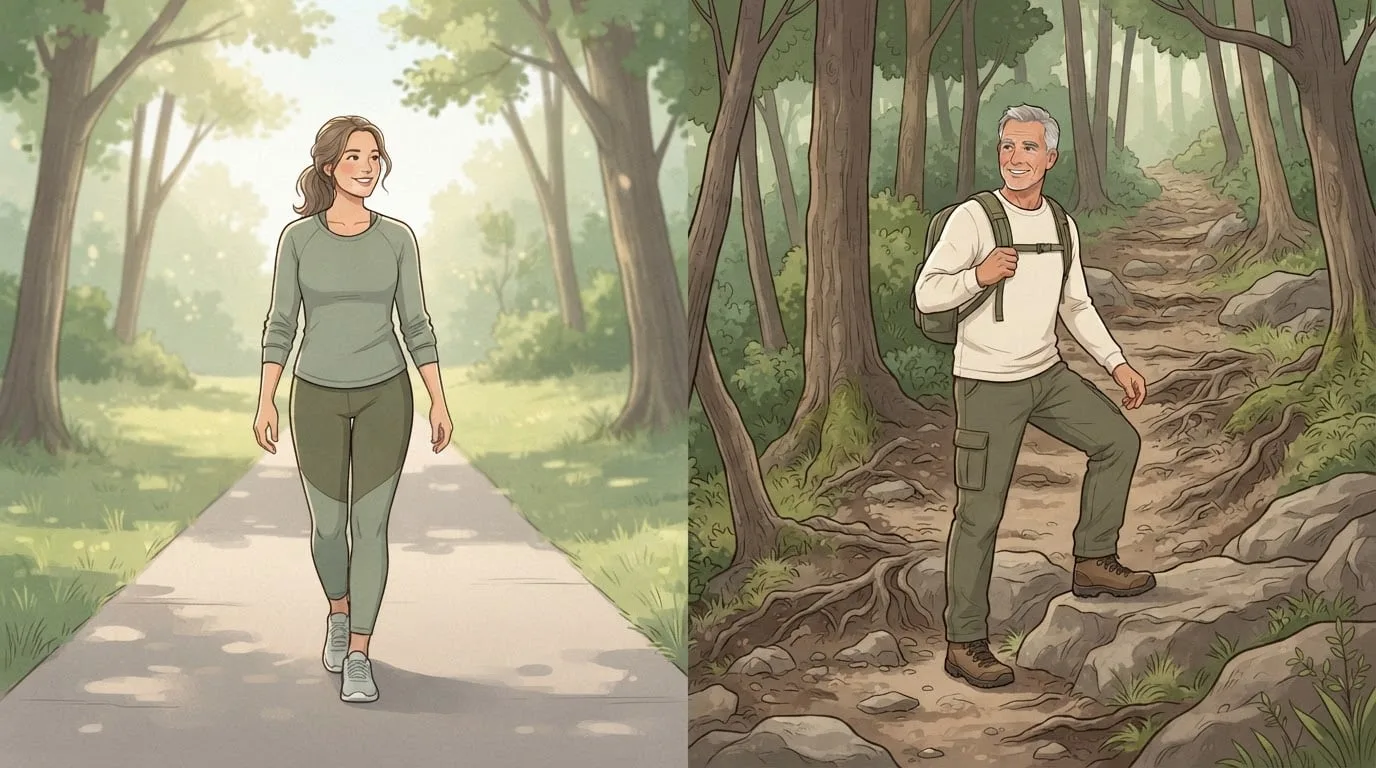
If you already walk most days, a hike can look like the same activity with better scenery. It isn't quite. The difference between walking and hiking is the ground under your feet. Roots, rock, loose gravel and long climbs and descents change how hard you work, which muscles do the work and what you need on your feet.
Maybe you hiked once, felt fine on the way up and then struggled down the stairs for three days. That's common, and it doesn't mean you're out of shape. It means hiking asks for things a sidewalk never does. This guide compares hiking vs walking on effort, calories, knees, stress and footwear, and then shows how to get from one to the other.
Walking vs Hiking at a Glance
| Walking | Hiking | |
|---|---|---|
| Surface | Paved, groomed and even | Dirt, rock, roots and loose gravel |
| Elevation | Little or none | Climbs and descents, often hundreds of feet |
| Energy cost (2024 Compendium) | 3.8 METs moderate, 4.8 brisk | 5.3 to 6.0 METs, 7.8 with a daypack |
| Pace | Steady, about 3 mph | Slower and uneven, set by the terrain |
| Main muscle demand | Calves, quads and glutes in a repeating pattern | More hip and thigh work, plus braking quads on descents |
| Balance demand | Low | High, because every step lands differently |
| Knee load | Low and even | Peaks on steep descents |
| Gear | Walking shoes | Lugged shoes or boots, water, food, layers, often poles |
| Typical session | 20 to 60 minutes, from your door | One to several hours, usually with travel |
Every row on the hiking side adds work. So the useful questions are how much more work, and what it costs your body.
What Is the Difference Between Walking and Hiking?
There's no official line, and the forum threads on this question argue about it endlessly. Here's the practical test I use. A walk becomes a hike when three things are true. The surface is unpaved and uneven, so you have to watch where you put your feet. The route climbs and descends enough that you feel it in your breathing and your thighs. And you're far enough from food, water and help that you carry your own.
A paved greenway with one long hill is still a walk. A flat, rooty forest path for three hours is a hike, even without a summit. Most people draw the line somewhere in between, and the energy data below follow the ground rather than the label.
What is trekking?
Trekking is hiking stretched across several days, usually on long routes through remote or mountain country, with nights in huts, tents or villages. A single trekking day can feel like a hard day hike. What makes trekking harder is the repetition: you climb again on tired legs, often with a heavier pack and sometimes at altitude. Mountaineering starts where you need technical skills such as ropes, an ice axe or scrambling on steep rock.
Is Hiking Harder Than Walking?
Yes, and the ground explains a surprising share of it before any hill appears. Voloshina and colleagues (2013) built a treadmill surface from blocks of three heights, varying by up to about 2.5 cm, and had 11 adults walk on it at 1.0 m/s, a slow stroll. Net metabolic rate rose 28 percent over a smooth belt at the same speed. Positive work at the hip rose 62 percent. Muscle activity in the three quadriceps heads they measured climbed by 49 to 60 percent, and step width varied about a third more as people searched for footing.
Real trails show the same thing outdoors. Kowalsky and colleagues (2021) had 10 adults walk at 1.25 m/s, about 2.8 mph, over five outdoor surfaces while measuring their oxygen use. Energy cost rose in order from sidewalk to dirt, gravel, grass and woodchips, and woodchips cost about 27 percent more than the sidewalk. The US Army measured the same effect for soldiers carrying loads in the 1970s. Its terrain coefficients, starting with Soule and Goldman (1972) and built into the Pandolf load-carriage equation (1977), put a dirt road at 1.1 times the cost of blacktop, light brush at 1.2, heavy brush at 1.5 and loose sand at 2.1.
Then add the hills. Grade is the biggest single lever on walking effort, and the Compendium rates climbing a 6 to 10 percent grade at a moderate-to-brisk pace at 7.0 METs, nearly double a moderate walk on the flat. Our review of incline walking research covers the full energy-cost curve and what grade does to the glutes and knees. A trail stacks both effects: rough footing on every step, and climbs that come in long blocks rather than at a treadmill setting you choose.
Hiking vs Walking Calories per Hour
The cleanest comparison uses METs from the 2024 Adult Compendium of Physical Activities by Herrmann and colleagues, the standard reference for the energy cost of everyday and sporting activities. One MET is roughly one calorie per kilogram of body weight per hour. So a 70 kg (154 lb) adult burns about 70 calories an hour for each MET.
| Activity (2024 Compendium) | METs | Approx. calories per hour at 70 kg |
|---|---|---|
| Walking, 2.5 mph, firm level surface | 3.0 | 210 |
| Walking, 2.8 to 3.4 mph, moderate pace | 3.8 | 266 |
| Hiking slowly through fields and hillsides, no load | 3.8 | 266 |
| Walking, 3.5 to 3.9 mph, brisk | 4.8 | 336 |
| Hiking at a normal pace through fields and hillsides | 5.3 | 371 |
| Hiking, cross country | 6.0 | 420 |
| Climbing hills, no load, 6 to 10% grade | 7.0 | 490 |
| Hiking with a daypack | 7.8 | 546 |
| Climbing hills, no load, 11 to 20% grade | 8.8 | 616 |
Read it in pairs. A moderate walk and a slow amble through fields cost the same 3.8 METs, so a gentle hike isn't a calorie bonus. A normal hiking pace over hilly ground runs about 40 percent above a moderate walk. Cross-country hiking runs about 60 percent above it, and hiking with a daypack about double. Steep climbing sits higher still, though nobody climbs for a full hour without a break.
Per mile the gap shrinks, because you move slower on a trail. Hikers plan time with Naismith's rule, which allows an hour for every 3 miles plus extra time for the climbing, and our guide to how long it takes to walk a mile works through it. What hiking adds is minutes. A three-hour hike at 6.0 METs comes to about 1,260 calories for a 70 kg adult, about the same as five 45-minute moderate walks combined.
Is hiking or walking better for weight loss? Per hour, hiking. Per week, walking usually wins, because you can do it every day from your front door, while most people hike once a week at most. The two work well together: daily walks for steady volume, plus a weekend hike as a big block on top. If you're setting a target for the other days, our guide to how many miles to walk a day breaks it down by goal.
Find out what's really holding you back
FitCraft, our mobile fitness app, pairs you with an AI coach who builds you a personalized plan around your goals, schedule, and fitness level. Every FitCraft program is designed by Domenic Angelino, MPH (Brown University) and NSCA-CSCS, with research published in the Journal of Strength and Conditioning Research and Medicine & Science in Sports & Exercise.
Take the Free Assessment Free • 2 minutes • No credit cardWhy the Downhill Is the Hard Part
Most first-time hikers worry about the climb. The descent is what leaves them sore. Walking down a slope makes your quadriceps work as brakes, lengthening under load on every step, and that kind of muscle work is what causes soreness a day or two later.
Kuster and colleagues (1995) compared 12 adults walking on the flat and down a 19 percent grade. Peak moments and muscle power at the knee were much higher going downhill, while the ankle did less. The authors said this load explains why people with kneecap problems or ACL injuries struggle on descents, and why mountain trekkers get sore.
Trekking poles move some of that load to your arms. In Howatson and colleagues (2011), 37 active adults climbed and descended Mount Snowdon with a 5.6 kg day pack, half with poles and half without. The pole group rated the climb as easier and lost less leg strength right after the hike and over the next two days. They also had less soreness at 24 and 48 hours, and lower creatine kinase, a blood marker of muscle damage. In the lab, Schwameder and colleagues (1999) found that poles on a steep descent cut ground reaction force, knee moment and the compressive and shear forces in the knee by 12 to 25 percent.
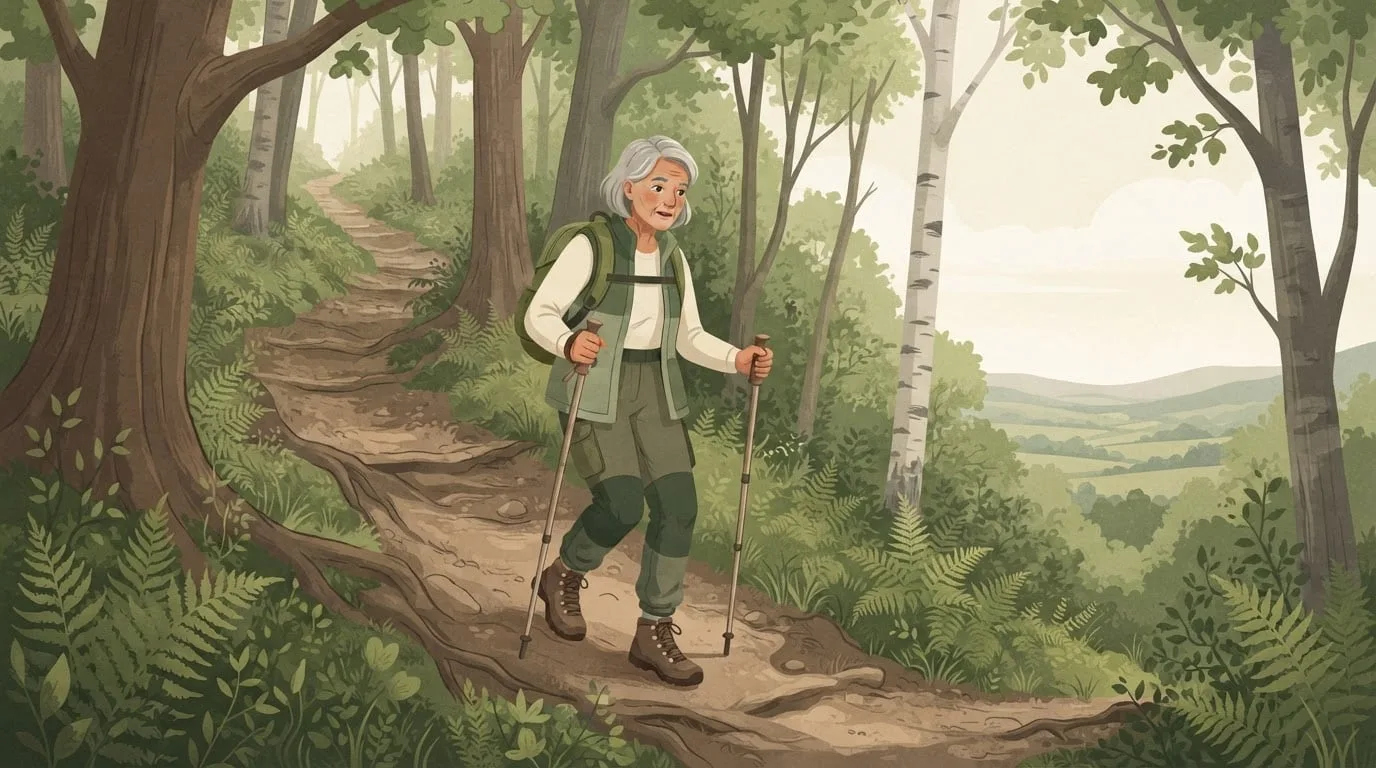
A few habits make descents easier. Shorten your stride and keep a slight bend in your knees. Set your poles a little longer than you had them on the climb, and slow down. Soreness after your first big descent is normal, and it's usually much milder on the next hike of the same size, because muscle adapts quickly to this kind of work.
What Happens to Your Body When You Start Hiking?
In the first week, expect sore thighs and calves from the descents and a deeper tiredness than the same hours of walking would leave. Uneven ground also works the muscles that steady your hips, knees and ankles, as the muscle activity numbers above show. Over the next few weeks the soreness fades, and familiar climbs feel easier on your breathing.
One of the best controlled looks at a block of hiking comes from the Austrian Moderate Altitude Study. Neumayr and colleagues (2014) randomized 71 men with metabolic syndrome to a three-week hiking holiday at either 1,700 m or 200 m. Each group did 12 guided hikes of about 2.5 hours at 55 to 65 percent of maximum heart rate. Both groups lost an average of 3.13 kg and lowered their 24-hour blood pressure and heart rate, with no difference between the two altitudes. The authors credited the regular exercise rather than the mountain air, and nobody had an adverse event.
Does Hiking Lower Cortisol?
Time in nature lowers cortisol, while hard uphill effort raises it for a while. Hunter and colleagues (2019) followed 36 city dwellers for eight weeks as they took at least three nature breaks of 10 minutes or more each week. Each nature break lowered salivary cortisol by 21.3 percent per hour beyond its normal daily decline. The best return per minute came between 20 and 30 minutes, and whether people sat or walked made no difference to the cortisol drop.
Hard exercise pushes cortisol up during the effort. In Hill and colleagues (2008), 30 minutes at 60 percent of VO2 max raised circulating cortisol by about 40 percent, and 80 percent raised it by about 83 percent. An easy 40 percent effort didn't raise it significantly, and after the authors corrected for fluid shifts it actually fell. So a steep climb lifts cortisol while you're working, and the green setting around you pulls it the other way.
The mood data point the same direction. Niedermeier and colleagues (2017) put 42 adults through three sessions of about three hours each: a mountain hike with about 600 m of climbing, treadmill walking at matched speeds and a 10 percent incline, and sitting. The hike produced more positive feelings and less fatigue than the treadmill, even though heart rate ran slightly higher outdoors (59 versus 57 percent of maximum).
How you get the time matters less than getting it. In a survey of 19,806 adults, White and colleagues (2019) found that people who spent at least 120 minutes a week in nature were more likely to report good health and wellbeing, whether they got it in one long visit or several short ones. One weekend hike covers that in a morning, and a green walk in a city park counts too.
Hiking Shoes vs Boots vs Walking Shoes
Footwear is the question most people search next, and it has a clearer answer than the gear aisle suggests.
What is the difference between walking shoes and hiking boots?
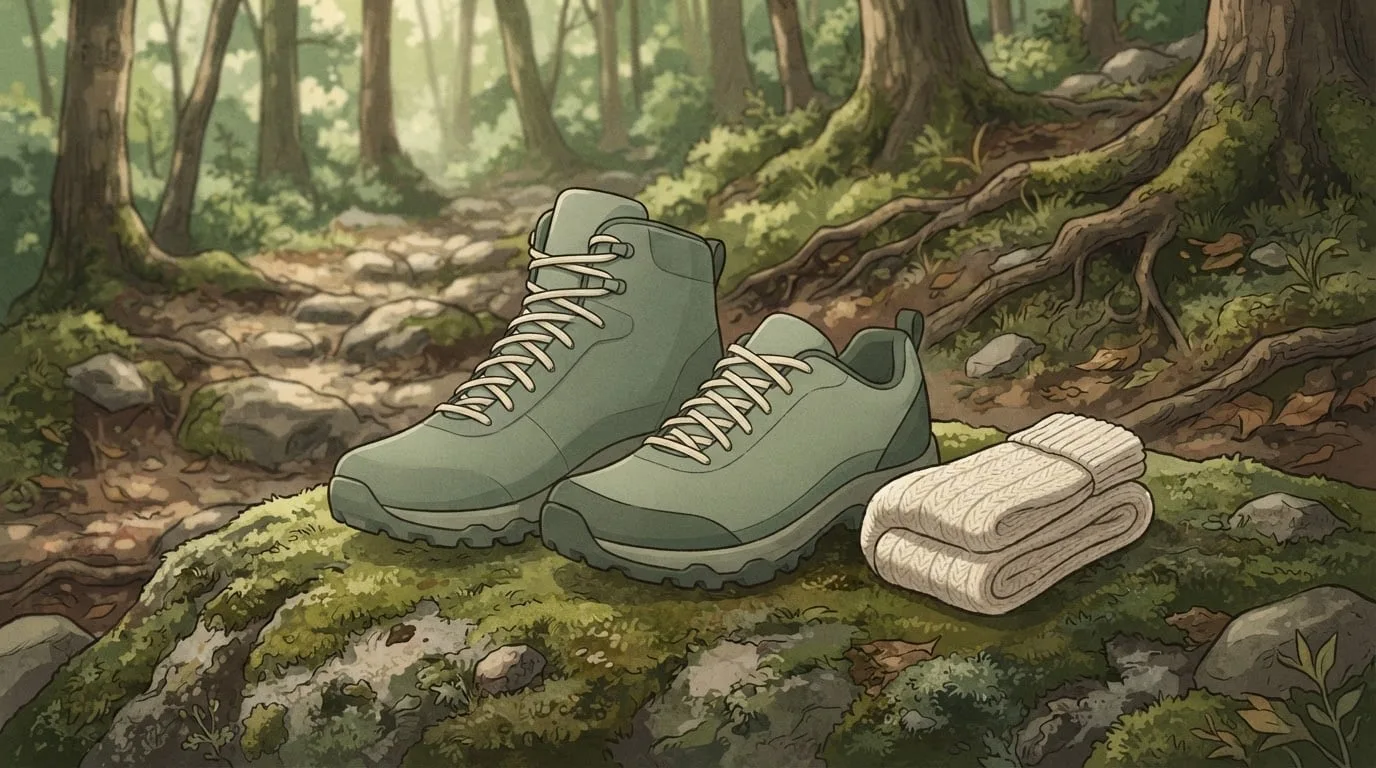
Walking shoes are light, flexible and cushioned for smooth, repeated strides on pavement. Hiking boots cover the ankle, use stiffer soles with deep lugs for grip on loose ground, and are usually built to keep water out. Hiking shoes sit between the two, with boot-style tread and a firmer sole in a low-cut shoe. Trail running shoes are the lightest of the trail options.
Hiking shoes vs boots: what the research shows
Heavier and stiffer isn't the same as safer. Böhm and Hösl (2010) had 15 young adults walk over coarse gravel in two hiking boots whose ankle shafts differed by 50 percent in stiffness. Stability was no different between them. The stiffer boot cut the ankle's range of motion and shifted work to the knee, which showed more muscle co-contraction and absorbed more braking energy. The authors concluded that blocking ankle motion shouldn't be mistaken for safety.
Weight on the feet is also expensive. Legg and Mahanty (1986) had young men walk carrying a pack of 35 percent of body weight. Each 100 grams added to the boots raised energy cost by about 1 percent, which made weight on the feet roughly six times as costly as the same weight in the pack.
Which to wear
- Paved paths, rail trails and groomed park trails: walking shoes are fine.
- Most day hikes on dirt and rock: hiking shoes or trail shoes with real lugs and a snug heel.
- Boots: a heavy pack, scree, snow, deep mud or cold, wet days, or ankles that feel steadier with more support.
- Fit beats category: leave a thumb's width in front of your toes so they don't jam on descents, and break new footwear in on short walks first.
How to Go From Walking to Hiking
- Pick your first trail by distance and climb, not by photos. Three to five miles with a few hundred feet of climbing is a good first outing for a regular walker.
- Make one weekday walk hilly. Hills, stairs or a steep street once a week get your lungs and calves used to sustained climbing.
- Train the descent twice a week. The table below targets the braking and balance work a sidewalk never asks for.
- Carry water and food. For outings of one to two and a half hours, the American College of Sports Medicine nutrition position stand (Thomas et al. 2016) suggests 30 to 60 grams of carbohydrate an hour.
- Bring poles for the way down, and turn around early the first few times. Finishing with legs to spare is how you want to remember your first hikes.
| Exercise | Sets and reps | Why it helps on a trail |
|---|---|---|
| Step-ups onto a stair or sturdy box, 3-second lowering | 3 x 8 to 10 per leg | Builds the climbing push and the slow braking you need going down |
| Reverse lunges holding dumbbells | 3 x 8 to 12 per leg | Hip and thigh strength for big steps over rocks and roots |
| Single-leg Romanian deadlift with one dumbbell | 3 x 8 per leg | Hamstrings, glutes and balance on one foot |
| Calf raises with a slow lowering | 3 x 12 to 15 | Push-off on climbs and control of the ankle on uneven ground |
| Side plank | 3 x 20 to 30 seconds per side | Keeps the hips and trunk steady under a pack |
The hard part is the weekday work, not the weekend hike. Two short leg sessions are easy to plan and easy to skip. If that's been your pattern, a workout app built to keep you motivated can carry the habit for you. In FitCraft, a 3D AI coach demonstrates each bodyweight and dumbbell exercise, and streaks and leaderboards give you a reason to open it on a Tuesday.
Which Should You Choose?
| If this is you | Start with | Why |
|---|---|---|
| You want daily movement with no planning | Walking | It starts at your door and needs no recovery days |
| You want more work per hour | Hiking | About 40 percent more energy per hour, up to double with a daypack |
| You're training for a mountain trip or a trek | Hiking, plus leg strength | Descending is a skill, and only descending trains it fully |
| Your knees ache on stairs or slopes | Walking, then gentle trails with poles | Descents load the knee hardest |
| You want to lower stress | Either, somewhere green | Nature time lowered cortisol whether people sat or walked |
| You're new to exercise or coming back after a break | Walking | A few weeks of regular walks make the first hike far kinder |
If you want more intensity without leaving the pavement, there's another route. Our comparison of whether running is better than walking covers the other way to raise the effort per minute, and what it costs your joints.
The Bottom Line
Walking vs hiking comes down to the ground. A hike is a walk on uneven, hilly terrain, and that terrain raises the energy cost by about 40 percent to double, makes the hips and thighs work harder, and loads the knees most on the way down.
Practical rule: walk most days for volume, hike whenever you can for the hills and the time outdoors, and add two short leg sessions a week so the descents stop wrecking you.
The habit that decides your results is the weekday one. Hikes are the reward, and they feel better every time your legs are ready for them. As Katie put it after years of false starts: "I've tried everything. This is the first time I've stuck with something past two weeks."
Frequently Asked Questions
Is hiking better exercise than walking?
Per hour, yes. The 2024 Adult Compendium of Physical Activities rates hiking at 5.3 to 7.8 METs depending on the terrain and the pack, against 3.8 for a moderate walk, and rough ground works the hips and thighs harder. Walking wins on how often you can do it, so most people get the most from daily walks plus a regular hike.
Is hiking or walking better for weight loss?
Hiking burns more per hour, from about 40 percent more than a moderate walk to roughly double with a daypack, and a long hike piles up a lot of calories in one outing. Walking usually burns more per week because you can do it every day. Weight loss follows your weekly total and your diet, so use both.
Are hiking shoes good for walking on pavement?
Yes, they're comfortable enough for everyday walking, but their stiffer soles feel clunkier than walking shoes and the soft lugs wear down faster on concrete. If most of your miles are on pavement, keep walking shoes for those and save the hiking shoes for trails.
Do I need hiking boots?
For most day hikes on dirt and rock, no. Low hiking shoes or trail shoes with deep lugs work well, and a study of stiff boot shafts found they didn't make people more stable on gravel. Boots earn their place with a heavy pack, on scree, snow or deep mud, or if your ankles feel steadier in them.
Which is harder, trekking or hiking?
Trekking is usually harder because it strings several hiking days together. You climb again on tired legs, often with a heavier pack, and sometimes sleep at altitude. A single hard day hike can still be tougher than an easy trekking day, so compare the distance, the climb and the load rather than the label.
What to eat while hiking?
For a short hike, water and one snack are enough. For hikes longer than about an hour, sports nutrition guidelines suggest 30 to 60 grams of carbohydrate an hour, which is roughly a banana plus a small handful of dried fruit. Eat and drink a little at every stop instead of waiting until you're hungry.