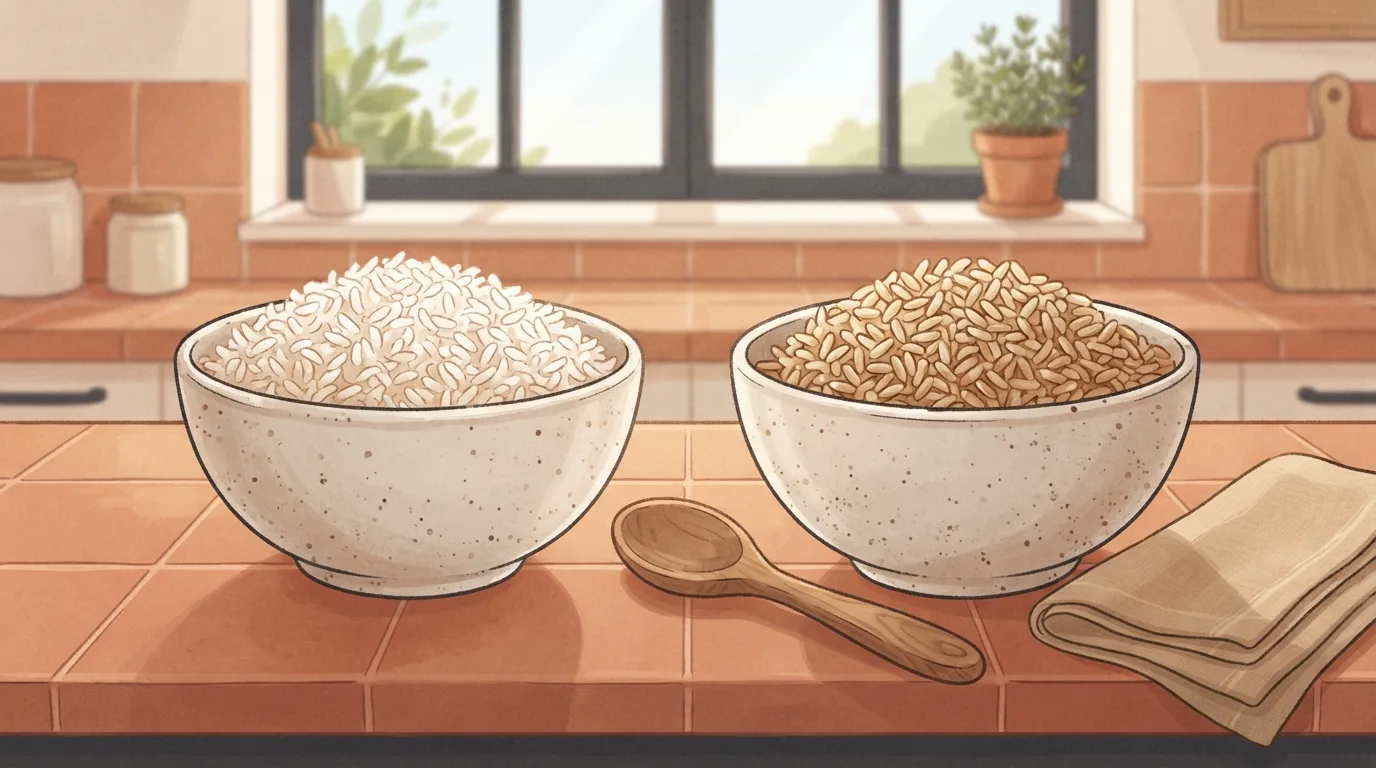
You've probably been told that brown rice is the healthy one and white rice is a guilty pleasure. Then you watch lifters eat white rice by the pot, and you read that whole cultures with long life expectancies eat it every day. It's hard to know whether swapping your rice is worth it or just one more rule to feel bad about.
The confusion is understandable, because both camps are partly right. Brown rice does keep more nutrients, and large studies do link it to a lower risk of type 2 diabetes. But when researchers actually switched people from white to brown rice for months, most of the measured health markers barely moved, and brown rice turned out to carry more arsenic.
Below you'll find the USDA nutrition numbers per 100 grams and per cup, what the glycemic index really shows, the cohort and trial evidence on diabetes and weight loss, the arsenic data, and which rice fits best around your workouts.
White Rice vs Brown Rice Nutrition: USDA Values per 100 g and per Cup
Every grain of white rice starts out as whole-grain rice. The edible kernel has three parts: the bran (the tan outer layers), the germ (the small embryo) and the endosperm (the starchy middle). Milling strips off the bran and germ and leaves the endosperm, which is white rice. In the US, most white rice is then enriched with iron, thiamin, niacin and folic acid to replace some of what milling removed.
The table compares the two standard long-grain entries in USDA FoodData Central: enriched white rice, cooked (FDC 168878), and brown rice, cooked (FDC 169704). A cup of cooked white rice weighs 158 grams and a cup of cooked brown rice weighs 202 grams, which is why the per-cup columns differ more than the per-100-gram ones.
| Nutrient (cooked, long-grain) | White, per 100 g | Brown, per 100 g | White, 1 cup (158 g) | Brown, 1 cup (202 g) |
|---|---|---|---|---|
| Calories | 130 | 123 | 205 | 248 |
| Protein | 2.7 g | 2.7 g | 4.3 g | 5.5 g |
| Carbohydrate | 28.2 g | 25.6 g | 44.5 g | 51.7 g |
| Fiber | 0.4 g | 1.6 g | 0.6 g | 3.2 g |
| Fat | 0.3 g | 1.0 g | 0.4 g | 2.0 g |
| Magnesium | 12 mg | 39 mg | 19 mg | 79 mg |
| Manganese | 0.47 mg | 0.97 mg | 0.75 mg | 1.97 mg |
| Potassium | 35 mg | 86 mg | 55 mg | 174 mg |
| Niacin (B3) | 1.5 mg | 2.6 mg | 2.3 mg | 5.2 mg |
| Iron | 1.2 mg (enriched) | 0.56 mg | 1.9 mg | 1.1 mg |
| Folate | 97 µg DFE (enriched) | 9 µg DFE | 153 µg DFE | 18 µg DFE |
| Glycemic index (boiled) | White 73, brown 68 (Atkinson and colleagues, 2008) | Same grain, so same index per cup | ||
Source: USDA FoodData Central, SR Legacy. Unenriched white rice has the same calories and fiber but only about 0.2 mg of iron and 3 µg of folate per 100 g, so check the label for the word "enriched".
Which rice is higher in protein?
Neither, gram for gram. Per 100 grams cooked, white rice has 2.69 grams of protein and brown rice has 2.74 grams. A cup of brown rice does give you about 5.5 grams against 4.3 grams for white, but only because a cup of brown rice packs in more grain by weight. Either way, rice is a carbohydrate food. You'll get your protein from what you put next to it.
How many calories are in 1 cup of cooked rice?
A cup of cooked long-grain white rice has about 205 calories and a cup of cooked long-grain brown rice about 248, based on the USDA cup weights above. Half a cup comes to roughly 103 calories for white and 124 for brown. Per 100 grams the order flips (130 for white, 123 for brown), so if you weigh your food, brown rice is very slightly lighter. Measuring cups and rice cookers vary, so treat these as estimates.
Is Brown Rice Healthier Than White Rice?
On nutrient density, yes, modestly. The bran is where rice keeps its fiber, magnesium, manganese, potassium and most of its B vitamins, plus plant compounds such as gamma-oryzanol and phenolic acids. Keeping it gives brown rice four times the fiber of white rice per 100 grams, more than three times the magnesium and about twice the manganese and potassium.
Enrichment changes the picture for a few nutrients. Per 100 grams, enriched white rice has roughly twice the iron and ten times the folate of brown rice, because folic acid and iron are added back after milling and brown rice isn't usually enriched. That matters for anyone who could become pregnant, since folic acid in the weeks around conception helps prevent neural tube defects, and for people who run low on iron.
Put together, brown rice wins on fiber and minerals and enriched white rice wins on folate and iron. For most people eating a varied diet, brown rice is the better everyday default. The gap is real but small, and a cup of either is a minor part of a whole day's nutrition. If fiber is the reason you're switching, our list of the best sources of fiber shows how far beans, lentils, oats and vegetables outrun any rice.
Brown Rice vs White Rice: Glycemic Index and Blood Sugar
The glycemic index (GI) ranks how much a carbohydrate food raises blood sugar compared with pure glucose, which scores 100. In the 2008 international GI tables by Atkinson and colleagues in Diabetes Care, boiled white rice averaged 73 and boiled brown rice averaged 68. That's a smaller gap than most people expect. Both sit in the medium-to-high range, and the 2021 update of the same tables found rice in high, medium and low GI versions depending on the variety and how it's processed.
In practice, three things change your blood sugar response more than the colour of the rice:
- The variety. Sticky, short-grain rice tends to test high. Some long-grain and parboiled rices test lower.
- What you eat with it. Protein, fat, vegetables and vinegar-based dressings slow how quickly the starch reaches your blood.
- Whether it's been cooled. Chilling cooked rice turns part of its starch into resistant starch, which your small intestine can't fully digest.
The cooling effect has been measured. Sonia and colleagues (2015) found that freshly cooked white rice had 0.64 grams of resistant starch per 100 grams, and rice chilled for 24 hours at 4°C and then reheated had 1.65 grams. In 15 healthy adults, the chilled and reheated rice produced a lower blood sugar response (125 vs 152 mmol·min/L). If you batch-cook rice, cool it quickly and refrigerate it within a couple of hours, because cooked rice left out at room temperature can grow bacteria. A short walk after the meal helps too: our review of walking after meals and blood glucose covers the trials.
White Rice, Brown Rice and Type 2 Diabetes Risk
The biggest reason brown rice has a health halo is one study. Sun and colleagues (2010), writing in Archives of Internal Medicine, followed 39,765 men and 157,463 women in the Health Professionals Follow-up Study and the Nurses' Health Studies. After adjusting for age and other lifestyle and diet factors, they found:
- Eating white rice five or more times a week, compared with less than once a month, was linked to a 17% higher risk of type 2 diabetes.
- Eating brown rice twice a week or more, compared with less than once a month, was linked to an 11% lower risk.
- Replacing 50 grams of cooked white rice a day (about a third of a serving) with brown rice was linked to a 16% lower risk. Replacing it with whole grains as a group was linked to a 36% lower risk.
The dose matters. Hu and colleagues (2012) pooled seven cohorts with 352,384 people in the BMJ. In Chinese and Japanese cohorts, where people ate three or four servings of white rice a day, the highest intake carried a 55% higher diabetes risk than the lowest. In Western cohorts eating one or two servings a week, the link was small and not statistically clear. Across everyone, each extra daily serving was linked to an 11% higher risk.
The most recent review, Yu and colleagues (2022) in BMJ Open, pooled eight cohort studies and found the same pattern: higher white rice intake was linked to a 16% higher risk, mainly above about 300 grams a day, and higher brown rice intake to an 11% lower risk.
Keep in mind what this kind of study can and can't show. People who choose brown rice in the US also tend to exercise more, smoke less and eat more vegetables. The researchers adjusted for those habits, but no adjustment is perfect. That's why the trials below matter.
What Happened When People Swapped White Rice for Brown
When researchers randomly assigned people to eat brown or white rice, the differences shrank.
- Shanghai, 16 weeks. Zhang and colleagues (2011) gave 202 middle-aged adults with diabetes or a high risk of it unlimited white or brown rice. Weight, waist, blood pressure, HbA1c, blood sugar, insulin and cholesterol didn't differ between the groups overall. Among the 47 people who already had diabetes, LDL cholesterol fell more on white rice and diastolic blood pressure fell more on brown rice.
- Chennai, 3 months each way. Malik and colleagues (2019) ran a crossover trial in 166 overweight adults who ate parboiled brown rice or white rice at two meals a day, six days a week. Across everyone there was no difference in blood sugar, insulin, HbA1c or blood lipids. People with metabolic syndrome saw a small HbA1c drop on brown rice (0.18 percentage points), and an inflammation marker rose less on brown rice than on white.
- All the trials together. Yu and colleagues (2022) pooled 11 trials with 1,034 people. The only significant difference was a small rise in HDL (good) cholesterol on brown rice, about 0.06 mmol/L.
Read the cohort and trial evidence together and a fair conclusion emerges. Choosing brown rice over white is a small, sensible step that probably adds up over years, especially if you eat rice every day. It isn't a treatment, and three months of brown rice won't change your blood work much by itself.
Find out what's really holding you back
FitCraft, our mobile fitness app, pairs you with an AI coach who builds you a personalized plan around your goals, schedule, and fitness level. Every FitCraft program is designed by Domenic Angelino, MPH (Brown University) and NSCA-CSCS, with research published in the Journal of Strength and Conditioning Research and Medicine & Science in Sports & Exercise.
Take the Free Assessment Free • 2 minutes • No credit cardBrown Rice or White Rice: Which Is Better for Weight Loss?
Brown rice has a small edge in the research, with low certainty. In Kazemzadeh and colleagues (2014), 40 women with overweight or obesity ate 150 grams of cooked brown or white rice a day for six weeks each, in random order. On brown rice they lost more weight and waist size, and their diastolic blood pressure and C-reactive protein, an inflammation marker, fell more. Only 35 women finished, though, and the trial was short.
A 2022 meta-analysis of 13 trials by Golzarand and colleagues found brown rice led to about 1.6 kilograms more weight loss and 2.6 centimetres more off the waist than white rice. The trials disagreed sharply with each other, and the authors rated the certainty of the evidence low to very low. Pre-germinated brown rice, which is soaked until it starts to sprout, did better than ordinary brown rice in the same analysis.
The likely mechanism is the fiber, which slows eating and may help you feel full sooner. But a cup of brown rice has about 40 more calories than a cup of white, so the swap won't help if the portion grows. For weight loss, the size of the scoop and what fills the rest of the plate beat the colour of the rice. Beans, vegetables and a palm or two of protein next to a measured serving will do more than any rice swap.
The bigger obstacle is usually staying with a plan once the first few weeks are over. Our roundup of the best workout apps for weight loss compares apps built to keep you training past that point. FitCraft is one of them. Your AI coach is a 3D character who demonstrates every exercise, calls you by name and adapts your workouts as you progress, and streaks and leaderboards give you a reason to come back tomorrow.

Arsenic in Rice: Why Brown Rice Has More
Rice takes up more arsenic from soil and water than most crops, because it grows in flooded fields. The inorganic form is the one linked to cancer and other harm with long-term exposure, and it builds up in the bran. Milling the bran off lowers the level, which is why arsenic is where white rice wins most clearly.
The FDA's 2016 risk assessment measured an average of 92 parts per billion of inorganic arsenic in white rice and 154 in brown rice. By type, regular brown rice averaged 160 ppb, white long-grain 103, white jasmine 78 and white basmati 62. The FDA estimated that lifetime rice eating accounts for about 39 extra lung and bladder cancer cases per million people, mostly from white rice because Americans eat far more of it. Eating a serving every day would raise that to between 74 and 184 per million, depending on the rice.
Consumer Reports' 2014 analysis of 697 samples found the same pattern. Brown rice had 80% more inorganic arsenic on average than white rice of the same type. White basmati from California, India and Pakistan, and US sushi rice, had about half the arsenic of most other rice, and brown basmati from those three places had about a third less than other brown rice. Rice labelled as from Arkansas, Louisiana, Texas or simply the US had the highest levels.
Cooking makes a real difference. In an FDA study by Gray and colleagues (2016), boiling rice in excess water and draining it cut inorganic arsenic by about 40% in polished long-grain rice, 50% in brown rice and 60% in parboiled rice. Rinsing before cooking barely changed arsenic. Cooking in excess water also washed out 50 to 70% of the added iron, folate, thiamin and niacin in enriched white rice, and rinsing removed some of them too. Brown rice, which isn't enriched, lost much less.
What that means for your plate:
- If you eat rice once or twice a week, the arsenic difference between white and brown is small in absolute terms. Pick on taste and nutrition.
- If you eat rice every day, rotate in other grains such as oats, quinoa, barley and bulgur, choose basmati more often, and consider the cook-and-drain method for brown rice.
- Infants and young children are more sensitive. The FDA set an action level for inorganic arsenic in infant rice cereal in 2020, and pediatric advice is to vary a baby's grains rather than rely on rice cereal.
White Rice vs Brown Rice Around Training
For the meal before a workout, white rice is usually the better choice. It's low in fiber and digests quickly, so it fuels the session without sitting heavy in your stomach. A review of gut problems during exercise by de Oliveira, Burini and Jeukendrup (2014) lists fiber, fat and protein among the nutritional factors linked to stomach complaints during exercise, and advises athletes to avoid high-fiber foods before competition.
After a hard session, a high-GI carb like white rice refills muscle glycogen a little faster. Burke and colleagues (1993) depleted the glycogen of five trained cyclists and fed them the same amount of carbohydrate from high-GI or low-GI foods for 24 hours. Glycogen rose by 106 mmol/kg on the high-GI diet and by 71.5 on the low-GI diet. That speed matters for people who train twice a day or compete again the next morning. If you lift three or four times a week, your total daily carbohydrate matters more than the type, and our guide to carbs for muscle gain sets out how many grams you need for your training load.
A simple split works for most people who train at home:
- Two to three hours before training: white rice with a lean protein and a small amount of vegetables.
- Right after training: either rice. Choose white if your appetite is low or you train again within a day.
- Every other meal: brown rice, or another whole grain, for the fiber and minerals.
Why Did People Stop Eating Brown Rice?
Brown rice is the older food. Hand-pounding removed some of the bran for centuries, but mechanical mills in the 19th century made fully polished white rice cheap and common. People preferred it for practical reasons. White rice keeps for years, while the oils in brown rice's bran can turn rancid within months. It cooks in about 15 to 20 minutes instead of 40 to 45. Its soft texture and mild flavour carry the taste of whatever it's served with, and polished rice had long been the prestige grain.
The switch had a cost. Diets built on polished rice caused widespread beriberi, a thiamin deficiency, across Asia in the late 1800s, and research into that disease helped lead to the discovery of vitamins. Enrichment is the modern fix, and it's why most white rice sold in the US has thiamin, niacin, iron and folic acid added back.
What's the Healthiest Rice to Eat?
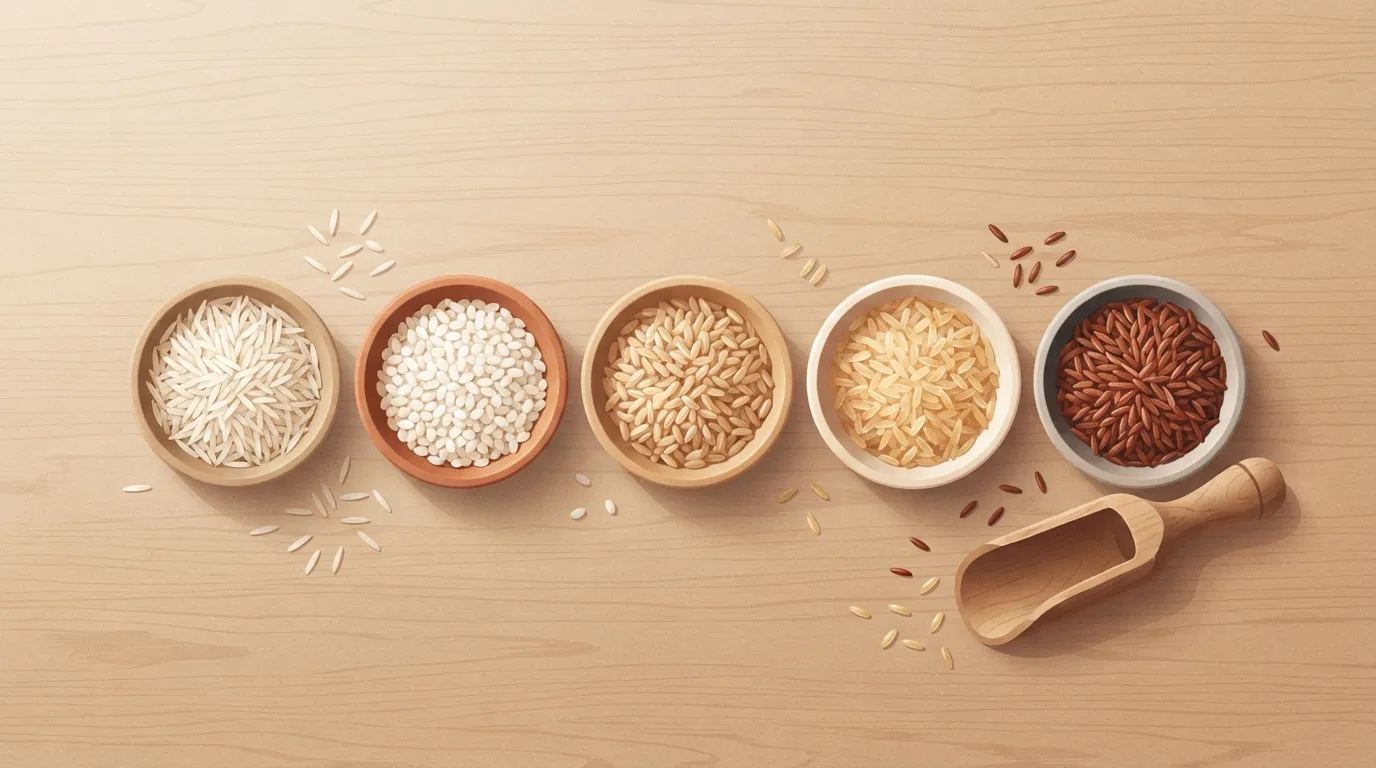
Any whole-grain rice beats refined rice on fiber and minerals. Brown, red, black and wild rice all keep their bran. Red and black rice get their colour from pigments in the bran, including anthocyanins. Wild rice is technically the seed of a water grass, and per 100 grams cooked it has about 4 grams of protein and 101 calories, against roughly 2.7 grams and 123 to 130 calories for ordinary rice.
Basmati rice vs brown rice
Brown rice has more fiber and minerals. White basmati has some of the lowest arsenic of any rice in FDA testing (62 ppb on average), about 40% less than ordinary long-grain white rice. Brown basmati gives you both: the bran's nutrients, with less arsenic than other brown rice. If you want one bag in the pantry, brown basmati is a strong pick.
A practical ranking for most people: brown or brown basmati rice as the everyday default, white basmati or parboiled rice when you want a lighter grain, and plain enriched white rice before workouts and whenever it's simply what you enjoy. Parboiled rice keeps more vitamins in the kernel than ordinary white rice, though FDA testing found its arsenic sits closer to regular long-grain rice than to basmati.
The Bottom Line
Brown rice is the better everyday default, with four times the fiber and three times the magnesium of white rice and a lower diabetes risk in large cohort studies. The difference is modest, the swap trials found few short-term changes, and brown rice carries more arsenic. Enriched white rice gives you more iron and folate and is the better fuel right before a workout.
Choose brown rice most of the time, use white rice where it helps your training or your taste, vary your grains if you eat rice daily, and stop feeling guilty about the white rice in your takeout. A sustainable plan beats a perfect one.
Frequently Asked Questions
Is brown rice even healthier than white rice?
Yes, but only modestly. Per 100 grams cooked, brown rice has about four times the fiber and three times the magnesium of white rice, and cohort studies link it to a lower risk of type 2 diabetes. Enriched white rice has more iron and folate and less arsenic, and trials that swapped one for the other for three or four months found few measurable differences.
Is white rice bad for you?
No. White rice is a refined grain, so it's low in fiber and digests quickly, but in normal portions alongside vegetables and protein it fits a healthy diet. The diabetes risk in the research shows up mainly at high intakes, such as three or four servings a day in Chinese and Japanese cohorts.
Is brown rice better for weight loss?
Slightly, at most. A 2022 meta-analysis of randomized trials found about 1.6 kilograms more weight loss with brown rice than with white, but the trials disagreed with each other and the certainty was rated low. A cup of brown rice also has more calories than a cup of white, so your total intake matters far more than the colour of the grain.
Does rinsing rice remove arsenic?
Barely. An FDA study (Gray and colleagues, 2016) found rinsing had a minimal effect on arsenic but washed away the added iron, folate, thiamin and niacin in enriched rice. Cooking rice in a large pot of water and draining it like pasta cut inorganic arsenic by 40 to 60 percent depending on the type.
Is white rice or brown rice better before a workout?
White rice is usually the better choice in the two or three hours before training, because it's low in fiber and easy on the stomach. Fiber is one of the nutritional triggers of gut complaints during exercise. Brown rice works well at meals further away from your session.
Why do the Chinese eat white rice instead of brown rice?
Mostly for practical reasons and taste. White rice cooks in about half the time, stays soft, carries the flavour of the dishes served with it and keeps for years, while the oils in brown rice's bran can turn rancid within months. Polished rice also had long-standing status as the more refined food across much of Asia.