You probably already work out with music. Most people do. But here's what you might not know: researchers have spent decades studying exactly why it works, how much it helps, and how to use it better. And the answers are more specific than "it just motivates me."
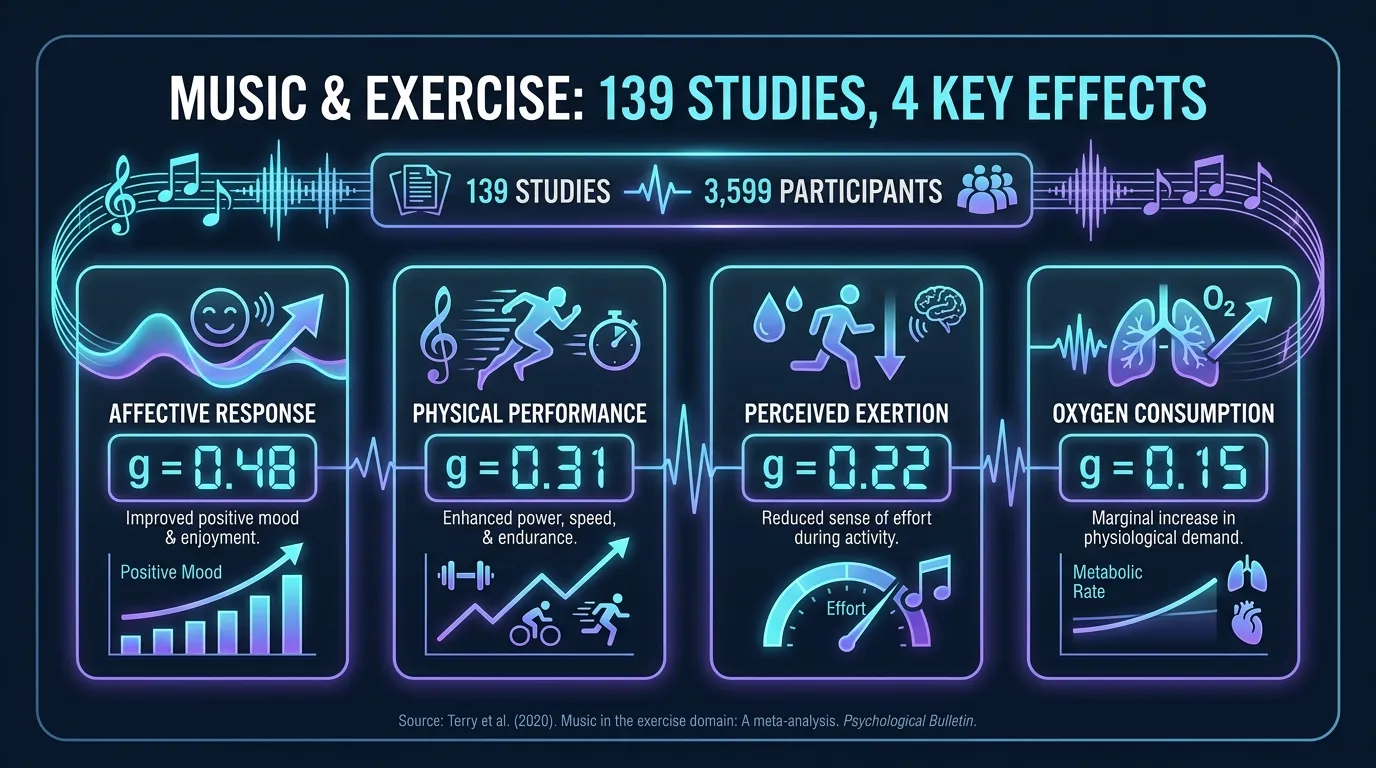
In 2020, Peter Terry, Costas Karageorghis, and colleagues published the largest meta-analysis ever conducted on music and exercise in Psychological Bulletin , one of psychology's most prestigious journals. They analyzed 139 studies. 598 effect sizes. 3,599 participants. The result is the most comprehensive picture we have of what music actually does to your body and brain during a workout.
Here's what they found, and how you can use it.
The Research: What 139 Studies Actually Show
The Terry et al. (2020) meta-analysis didn't just ask "does music help?" It broke the question into four categories: psychological responses (how you feel), physiological responses (what your body does), psychophysical responses (how hard it feels), and performance outcomes (how much you can do). Each one told a different story.
Music Makes Exercise Feel Better , A Lot Better
The strongest finding was emotional. Music produced a Hedges' g of 0.48 on affective valence , basically, how positive or negative the exercise experience felt. That's a medium effect size, which in exercise science is substantial. For context, many pharmaceutical interventions for mood produce smaller effects.
This matters more than it sounds. Here's why: the single best predictor of whether someone sticks with an exercise program isn't the program's design or the person's goals. It's whether they enjoy it. If exercise feels terrible every time, you'll quit. If it feels good, or even just less bad , you're dramatically more likely to come back tomorrow. This is the same principle behind the research on engagement decay: enjoyment is the main variable that separates people who build lasting habits from people who quit after a few weeks.
Music shifts that equation. Not a little. Meaningfully.
It Boosts Physical Performance by 2-3%
Across 139 studies, music improved physical performance with an effect size of g = 0.31. That translates to roughly a 2-3% improvement in endurance capacity. Two to three percent might sound small until you realize that's the difference between finishing your last set and bailing early. It's an extra minute on the treadmill. An extra rep. Over weeks and months, those margins compound.
Two important moderators stood out. First, exercise vs. sport: music helped more during exercise (running, cycling, lifting) than during competitive sport. That makes sense , sport demands tactical focus that music can disrupt. But for your Tuesday evening workout? The boost is real. Second, tempo mattered: fast music (above ~120 BPM) produced stronger performance effects than slow-to-medium tempo tracks.
It Lowers Perceived Exertion
Perceived exertion , how hard exercise feels , dropped significantly with music (g = 0.22). The mechanism is a concept called dissociation: music occupies attentional bandwidth that would otherwise be filled by fatigue signals. Your legs still burn. Your lungs still work. But your brain pays less attention to those signals because it's processing rhythm, melody, and lyrics instead.
There's a ceiling, though. At very high intensities , think all-out sprints or max-effort lifts , internal body signals become too loud for music to override. The dissociative effect works best during low-to-moderate intensity exercise, which is exactly where most people spend most of their workout time.
It Modestly Reduces Oxygen Consumption
A smaller but intriguing finding: music was associated with slightly lower oxygen consumption during exercise (g = 0.15). The likely explanation is that music promotes more efficient movement patterns. When you sync your stride or pedal cadence to a beat, you waste less energy on irregular movement patterns. Your body finds a rhythm , literally, and efficiency improves.
Why Music Works: The Science Behind the Feeling
Knowing that music helps is useful. Understanding why is how you start being strategic about it.
Entrainment: Your Body Wants to Match the Beat
Entrainment is a biomusicological phenomenon where external rhythmic stimuli (like a beat) synchronize with internal biological rhythms (like your heart rate, breathing, or movement cadence). Karageorghis and Priest (2012), in their landmark two-part review in the International Review of Sport and Exercise Psychology, identified entrainment as a core mechanism explaining music's effects on exercise.
Your body wants to match the beat. It's not something you have to force. Put on a 140 BPM track during a run, and your cadence will drift toward 140 steps per minute without you thinking about it. This synchronization , what researchers call "synchronous" music use , produces even stronger ergogenic effects than simply having music on in the background ("asynchronous" use).
The Attentional Gateway: Blocking Fatigue Signals
Bigliassi and colleagues used neuroimaging (fNIRS and EEG) to examine what music does to the brain during exercise. Their work showed that music redirects cortical activity , specifically, it increases activation in the left frontal cortex while reducing communication among somatosensory regions responsible for processing physical discomfort. In plain language: music shifts your brain's spotlight away from "this hurts" and toward "this sounds good."
This is the neuroscience behind the dissociation effect described in the Terry meta-analysis. It's not just a subjective feeling. There are measurable changes in brain activity when you exercise with music versus without it.
Emotional Regulation and Memory Association
Music also triggers emotional memories and associations. That song from your first road trip. The track you played during your best race. These associations don't just make you feel nostalgic. They activate reward circuitry and prime motivational states. This is why self-selected music consistently outperforms researcher-assigned tracks in studies. Your personal connection to the music matters as much as its tempo or genre.
How to Build a Better Workout Playlist
The research points to some surprisingly specific recommendations. This isn't guesswork , these are evidence-based guidelines from decades of tempo, preference, and performance studies.
Match BPM to Your Activity
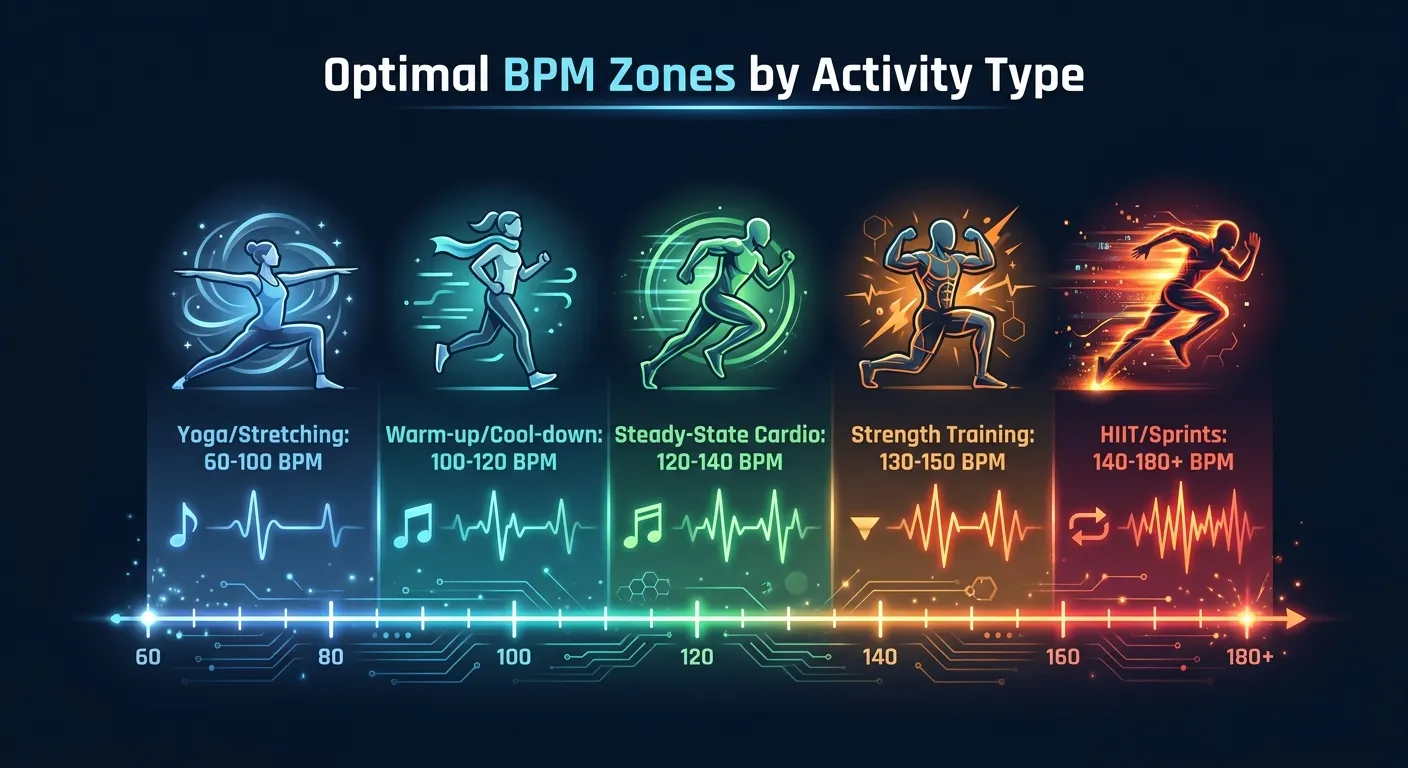
Karageorghis's research established that the preferred tempo range across most exercise modalities is 120-140 BPM. But "preferred" and "optimal" aren't always the same thing. Here's what the data suggests by activity type:
- Warm-ups and cool-downs: 100-120 BPM , enough rhythm to keep you moving without spiking intensity prematurely
- Steady-state cardio (jogging, cycling): 120-140 BPM. The sweet spot where most people find their natural cadence
- Strength training: 130-150 BPM , slightly faster to maintain energy between sets and during lifts
- HIIT and sprints: 140-180+ BPM , fast enough to match high-intensity effort, though the RPE-lowering effect diminishes at maximal effort
- Yoga and stretching: 60-100 BPM , slower tempos promote relaxation and controlled breathing
Preference Trumps Prescription
Here's something researchers consistently find: music you personally enjoy produces better results than "objectively" motivational music you don't connect with. Stork et al. (2015), in a study published in Medicine & Science in Sports & Exercise, found that self-selected music during sprint interval training improved both peak power output and perceived enjoyment compared to no music. Pressing play before you have even decided whether to train is one of ten tactics in our guide on how to motivate yourself to workout on the days you don't feel like it.
So if your guilty pleasure is 90s pop, don't force yourself to listen to aggressive EDM because it "sounds more like workout music." The song that makes you feel something will outperform the song that's theoretically optimal every time.
Synchronize When Possible
For repetitive endurance activities , running, cycling, rowing , try deliberately matching your movement tempo to the beat. Karageorghis's research shows that synchronous music use produces stronger performance benefits than asynchronous use. If you're running at 170 steps per minute, a playlist of 170 BPM tracks (or 85 BPM at half-time) will feel effortless to sync with.
For strength training, synchronization matters less. The rest periods, varied rep speeds, and different exercises make strict tempo-matching impractical. Here, the mood and arousal benefits of music matter more than the rhythmic synchronization.
Enjoying the article?
Start a new fitness routine today, written by me and coached by the AI I designed.
Take the Free Assessment Free • 2 minutes • No credit card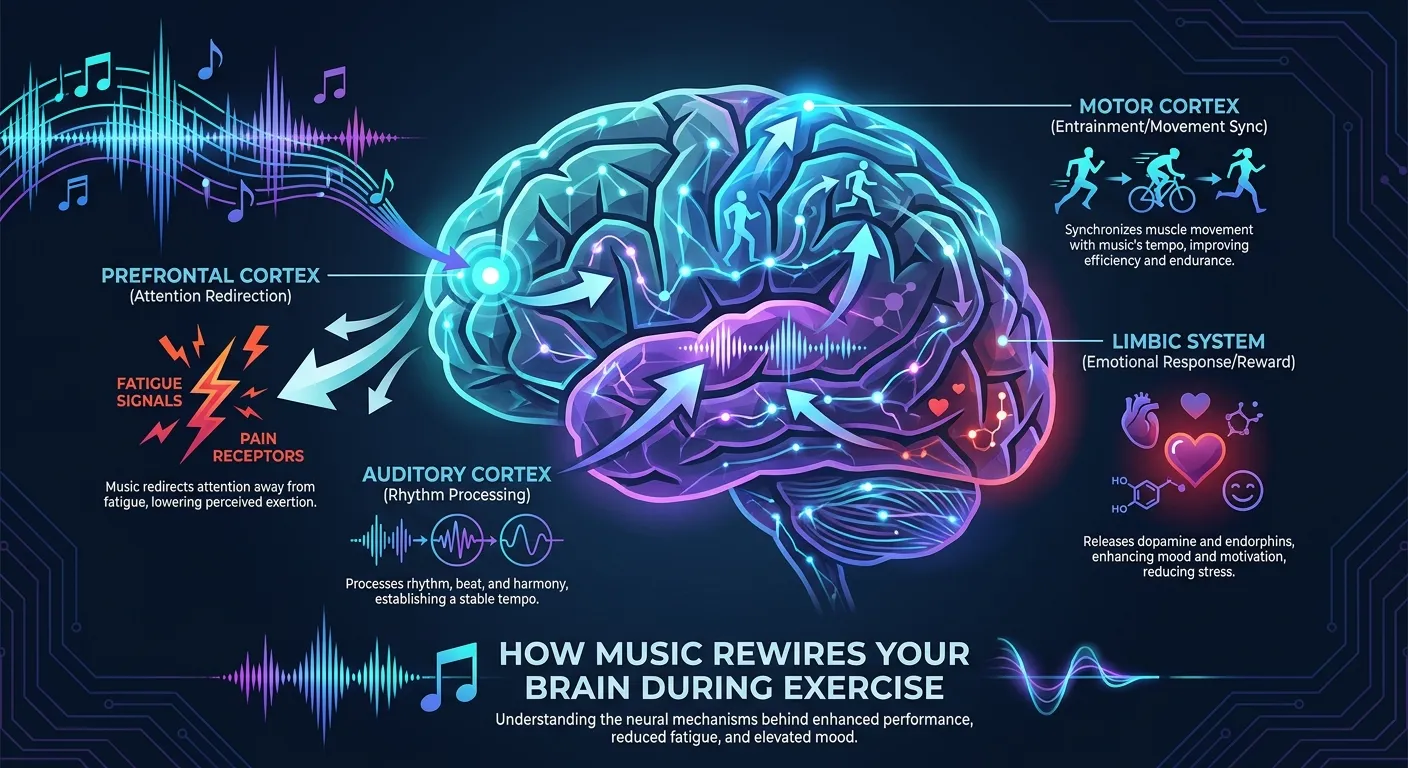
Common Misconceptions About Music and Exercise
Misconception: "Music is just a distraction. It doesn't actually help"
It is a distraction, and that's precisely why it helps. Distraction, or dissociation, in the research literature , is a legitimate performance-enhancing mechanism. When your brain allocates attention to processing music, fewer cognitive resources are available to process fatigue signals. This isn't a trick or a placebo. It's a measurable neurological effect confirmed across 139 studies and 3,599 participants (Terry et al., 2020). The performance gains, while modest (2-3%), are statistically significant and practically meaningful over the course of a training program.
Misconception: "Any music works, just put something on"
Not all music is equally effective. The Terry meta-analysis found that fast-tempo music (above 120 BPM) produced significantly stronger performance effects than slow-to-medium tempo tracks. Karageorghis's work with the Brunel Music Rating Inventory identified specific musical qualities that predict motivational impact: strong rhythm, fast tempo, cultural association, and extra-musical associations (personal memories linked to the song). A slow acoustic ballad and a 140 BPM dance track are not interchangeable during a HIIT session.
Misconception: "Music helps just as much at max effort"
Music's fatigue-masking benefits are strongest during low-to-moderate intensity exercise. As intensity approaches maximal effort, internal physiological signals (screaming muscles, pounding heart, gasping lungs) become too powerful for external stimuli to override. This is sometimes called the "ceiling effect". At very high intensities, your body's distress signals take priority regardless of what's playing. Music still helps with mood and arousal at high intensity, but don't expect it to make a true all-out effort feel easy.
How FitCraft Uses This Research
FitCraft doesn't build playlists for you. You bring your own music. But the science of music and exercise informed several design decisions in the app.
Ty, FitCraft's 3D AI personal trainer, guides workouts with visual cues and adaptive coaching that work alongside whatever you're listening to. The voice coaching is designed to complement, not compete with, your playlist. When Ty cues your next exercise or counts down a rest period, those prompts layer over your music rather than interrupting it.
The broader principle from the music research , that enjoyment predicts adherence , is baked into FitCraft's entire approach. The Terry meta-analysis's strongest finding wasn't about performance. It was about affect. Music makes exercise feel better, and feeling better is the strongest predictor of coming back. FitCraft applies the same logic through gamification: XP, levels, collectible cards, and streak rewards that make each workout feel like more than just reps and sets.
If you've ever quit a fitness app because it felt like a chore, that's not a discipline problem , it's a design problem. Music solves part of it. Gamification and adaptive programming solve the rest. FitCraft's free version gives you access to AI-coached workouts with Ty right out of the box , play your music, follow Ty, and experience what research-backed fitness design actually feels like.
What the Research Suggests Going Forward
The Terry et al. meta-analysis is the most comprehensive study on this topic, but it has limitations worth acknowledging.
Most of the 139 studies measured acute effects , single-session benefits during one workout. Fewer studies have examined whether music's benefits compound over weeks or months of training. Logically, if music increases enjoyment and enjoyment increases adherence, the long-term effects should be substantial. But that specific longitudinal question hasn't been answered with the rigor it deserves.
There's also a self-selection issue. Most studies let participants choose their own music or used music rated as "motivational." We know less about the effects of music that participants dislike or find neutral. The practical implication is clear (pick music you like), but the theoretical picture is incomplete.
Finally, the vast majority of studies focused on cardiovascular exercise , running, cycling, walking. Strength training received less attention, and activities like yoga, Pilates, and mobility work are barely represented. The principles likely transfer, but the specific effect sizes for non-cardio modalities are still being established.
None of these limitations change the practical recommendation. The evidence is clear: music makes exercise feel better, helps you perform better, and costs nothing. That's about as good as it gets in exercise science. If you're interested in other free tools that improve workout quality, the morning vs evening exercise research shows that simply picking a consistent time has a similarly outsized impact on long-term adherence.
References
- Terry, P. C., Karageorghis, C. I., Curran, M. L., Martin, O. V., & Parsons-Smith, R. L. "Effects of music in exercise and sport: A meta-analytic review." Psychological Bulletin 146.2 (2020): 91-117. doi:10.1037/bul0000216
- Karageorghis, C. I., & Priest, D. L. "Music in the exercise domain: A review and synthesis (Part I)." International Review of Sport and Exercise Psychology 5.1 (2012): 44-66. doi:10.1080/1750984X.2011.631026
- Karageorghis, C. I., & Priest, D. L. "Music in the exercise domain: A review and synthesis (Part II)." International Review of Sport and Exercise Psychology 5.1 (2012): 67-84. doi:10.1080/1750984X.2011.631027
- Stork, M. J., Kwan, M. Y., Gibala, M. J., & Martin Ginis, K. A. "Music enhances performance and perceived enjoyment of sprint interval exercise." Medicine & Science in Sports & Exercise 47.5 (2015): 1052-1060. doi:10.1249/MSS.0000000000000494
- Bigliassi, M., Karageorghis, C. I., Hoy, G. K., & Layne, G. S. "Brain mechanisms that underlie music interventions in the exercise domain." Progress in Brain Research 240 (2018): 109-125. doi:10.1016/bs.pbr.2018.09.004
Frequently Asked Questions
Does music actually improve exercise performance?
Yes. A 2020 meta-analysis in Psychological Bulletin covering 139 studies and 3,599 participants found that music produced a significant positive effect on physical performance (Hedges' g = 0.31). The benefits were strongest during endurance exercise and when using fast-tempo music above 120 BPM. Music improved performance more in exercise settings than competitive sport contexts.
What BPM is best for workout music?
Research consistently points to 120-140 BPM as the sweet spot for most exercise modalities. Karageorghis and Priest (2012) found this range preferred across activities from running to cycling. For high-intensity intervals, 140-180 BPM may be more effective. For yoga or cool-downs, 60-100 BPM is more appropriate. Importantly, self-selected music that you personally enjoy tends to outperform researcher-assigned tracks regardless of tempo.
Does listening to music reduce how hard exercise feels?
Music lowers perceived exertion during low-to-moderate intensity exercise by acting as a dissociative stimulus that redirects attention away from fatigue-related sensations. The Terry et al. (2020) meta-analysis found a significant effect on perceived exertion (Hedges' g = 0.22). However, at very high intensities near maximal effort, internal body signals become too strong for music to fully override.
Should I match my music tempo to my workout pace?
Synchronizing movement to music tempo can improve performance. Karageorghis's research on entrainment shows that the body naturally wants to match rhythmic patterns in music, and synchronous music use , where you deliberately match your movement tempo to the beat , produces stronger ergogenic effects than asynchronous use. Try matching your running cadence or cycling RPM to the BPM of your playlist.
Does FitCraft let you work out with your own music?
Yes. FitCraft is designed to work alongside your own music. You can play your Spotify, Apple Music, or any playlist in the background while Ty, FitCraft's 3D AI personal trainer, guides your workout with visual cues and voice coaching. This lets you combine the motivational benefits of your favorite tracks with structured, adaptive programming. The best of both worlds.