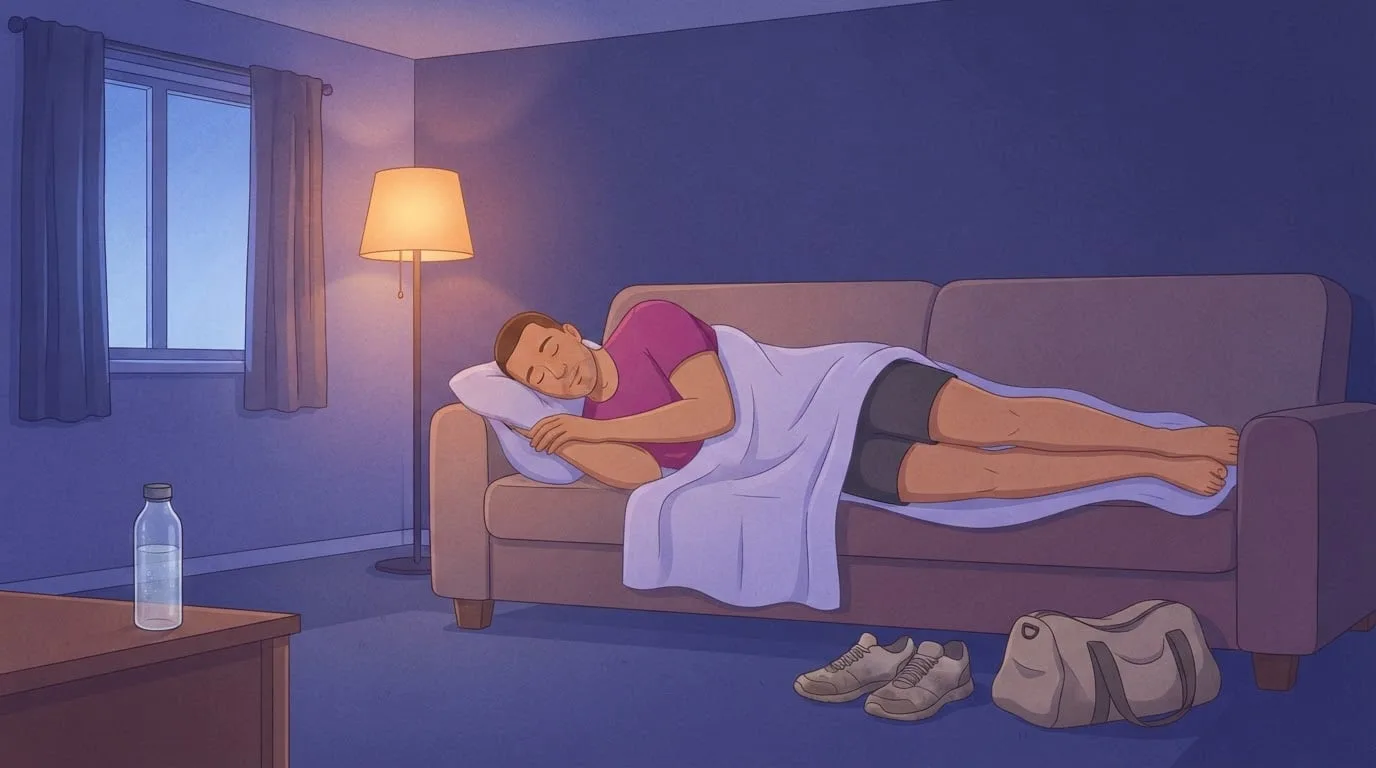
You finish a hard morning session, shower, eat, and the couch starts calling. Plenty of people feel guilty about giving in, as if napping after a workout undoes the work. The research points the other way. Sleeping after exercise is one of the cheapest recovery tools you have, as long as you get the length and the timing right.
Elite teams already plan for it. In a systematic review of 37 studies on napping in athletes, Lastella and colleagues (2021) concluded that naps may help physical and cognitive performance, mood and perceived fatigue, and can add to night sleep without hurting its quality. They suggested naps of 20 to 90 minutes between 1 p.m. and 4 p.m., with 30 minutes to shake off grogginess before training.
This review covers what the trials found on a post-workout nap, how long it should be, how long to wait before sleeping after exercise, why some workouts leave you sleepy and others leave you wired, and two myths about growth hormone and weight gain. Night sleep is still the main event, and our review of sleep and muscle growth covers why.
Is It Good to Sleep After a Workout?
Yes, for most healthy people a nap after a workout is good, and the evidence leans clearly positive. In a systematic review in Sports Medicine, Souabni and colleagues (2021) found 18 studies of daytime naps in physically active people and athletes, 14 of them rated strong quality. Fifteen reported benefits: ten for short bursts of physical performance, three for endurance and two for sport skills. Only one found a drop in sprint performance after a nap.
How much you gain depends mostly on how well you slept the night before, and on what you measure afterward. The trials below show both.
The Research: What Studies Show
A nap between two training sessions
The most direct test of a nap after a workout comes from professional rugby. Teece and colleagues (2023) had 15 professional rugby union players complete two 45-minute training sessions in the morning, then either nap or stay awake at noon. Each player did both conditions a week apart, in random order. After the nap, peak power in a 6-second cycling sprint was 157.6 watts higher than without it, a large effect. Players also rated fatigue and muscle soreness lower, and they rated a fixed 30-minute interval ride that afternoon 1.2 points easier.
Naps help most when your night was short
Blanchfield and colleagues (2018) had 11 trained male runners do a 30-minute morning run at 75 percent of VO2 max, then return in the evening and run to exhaustion at 90 percent. On one day they napped in the afternoon, about 20 minutes on average. Across the group the nap made no difference, 596 against 589 seconds. The runners who had slept less the night before, 6.4 hours against 7.5, were the ones who improved, and night sleep strongly predicted the change. In short, the nap helped the runners who had slept under 7 hours.
A deliberate sleep cut shows the same pattern. In Waterhouse and colleagues (2007), 10 young men slept only from 11 p.m. to 3 a.m., then either napped or sat quietly from 1:00 to 1:30 p.m. Thirty minutes after the nap, their 20-meter sprint time dropped from 3.97 to 3.88 seconds, and alertness and short-term memory improved. Grip strength and average reaction time didn't change. The Souabni review reached the same conclusion across studies: naps taken after lost sleep improved both physical and mental performance, whatever the type of exercise.
What the pooled evidence says after a normal night
Two meta-analyses by Boukhris and colleagues looked at naps taken after a normal night of sleep. In the first, pooling 18 studies in Sports Medicine (2024), napping improved performance in a repeated 5-meter shuttle run test, with large gains in best distance (effect size 1.03) and a lower fatigue index. It had no significant effect on muscle force, and there were too few studies to judge sprints, jumps or endurance.
The second, in Biology of Sport (2026), pooled 35 studies and 489 athletes and active people. After a normal night, napping lowered fatigue, improved mood and perceived recovery, and lowered perceived exertion both during and after exercise. It had no significant effect on muscle soreness, sleepiness or exercise heart rate. The authors rated the certainty of evidence as moderate for perceived exertion and low to very low for everything else.
Not every trial finds a benefit
In Petit and colleagues (2014), a 20-minute post-lunch nap didn't improve short, all-out exercise in 16 young male athletes who didn't usually nap. In Daaloul, Souissi and Davenne (2019), a 30-minute nap after a normal night sharpened alertness and mental performance in 13 national-level karate athletes but didn't change their jumps. After an exhausting karate-specific test, though, they jumped higher in the nap condition than without it.
So if you slept well and your next session is a short power test, a nap may not show up on the stopwatch. It shows up more reliably in how tired you feel and how hard the next session seems.
Get an evidence-based plan built for you
FitCraft, our mobile fitness app, pairs you with an AI coach who builds you a personalized plan around your goals, schedule, and fitness level. Every FitCraft program is designed by Domenic Angelino, MPH (Brown University) and NSCA-CSCS, with research published in the Journal of Strength and Conditioning Research and Medicine & Science in Sports & Exercise.
Take the Free Assessment Free • 2 minutes • No credit cardHow Long Should a Post-Workout Nap Be?
A post-workout nap should last 10 to 20 minutes if you need to be sharp soon after, or up to about 90 minutes if you have the afternoon free and an hour to wake up properly. Four studies explain the trade-off.
- Short naps work fastest. Brooks and Lack (2006) tested naps of exactly 5, 10, 20 and 30 minutes of sleep in 24 young adults after a 5-hour night. A 5-minute nap did little. A 10-minute nap improved alertness, fatigue and mental performance right away, with some benefits lasting about two and a half hours. The 20-minute nap's benefits appeared about 35 minutes after waking. The 30-minute nap left people groggy and slower at first, then helped.
- Longer naps helped physical tests more. In Hsouna and colleagues (2019), 20 active men had nap opportunities of 25, 35 or 45 minutes. A jump test improved by 3.5 percent after 35 minutes and 3.7 percent after 45, and attention improved 7.5 percent after 45. Fatigue scores were lower after all three.
- Ninety minutes beat 40. Boukhris and colleagues (2020) gave 14 amateur team-sport players a 40- or 90-minute nap opportunity. Both helped, and the 90-minute nap produced more strength, more shuttle-run distance, better recovery ratings and less soreness.
- Grogginess takes about an hour to clear. In a 2026 trial by Boukhris and colleagues, 17 active adults performed worse in the first 30 minutes after waking from both 25- and 90-minute naps, more so after the longer one. Most measures improved by 60 to 90 minutes after waking, and the 90-minute nap came out ahead by the second hour.
| Nap length | What the studies found | Best for |
|---|---|---|
| 10 to 20 minutes | Alert right away after a 10-minute nap and within about 35 minutes after a 20-minute nap, with little grogginess | Work, driving or another session soon after |
| 25 to 45 minutes | Better jumps and attention than no nap, with grogginess for the first half hour or more | A free afternoon |
| About 90 minutes | Largest gains in strength, sprint distance and recovery ratings, and the most grogginess at first | After a short night, with 1 to 2 hours before anything demanding |
Most of these studies measured the time allowed for napping, not the minutes actually asleep. It usually takes a few minutes to drop off, so set an alarm for about 25 to 30 minutes after you lie down if you're aiming for a 20-minute nap.
How Long Should You Wait to Sleep After a Workout?
You don't need to wait long before a nap. The rugby players in the Teece trial napped at noon, straight after their morning sessions, and still performed better that afternoon. Showering, eating and drinking some water first is sensible, because you'll wake up needing all three anyway.
Night sleep is a slightly different question, and it's also the answer to what time is too late to work out. In a meta-analysis of 23 studies, Stutz, Eiholzer and Spengler (2019) found that evening exercise didn't harm sleep overall and slightly increased deep slow-wave sleep. Vigorous exercise ending within about an hour of bedtime was the exception: it could delay sleep onset and cut total sleep time and efficiency. For high-intensity sessions specifically, Frimpong and colleagues (2021) pooled 15 studies and found that training ending 2 to 4 hours before bed didn't disrupt sleep. Finishing hard sessions at least 1 to 2 hours before bed covers most people. Our review of exercise and sleep research covers how regular training improves sleep over weeks.
Can't sleep after working out?
The Stutz analysis points to two likely culprits. A higher body temperature at bedtime went with lower sleep efficiency and more time awake during the night. A session that was hard relative to what you usually do had the same effect. Both findings came from moderator analyses that disappeared when one study was removed, so treat them as clues rather than rules. In practice, a cooler room, a shower and a little more time between your last hard effort and bed are the easy fixes. If you napped late or long that day, a shorter or earlier nap tomorrow is worth trying too.
Why Do I Feel Sleepy After Exercise?
Feeling drowsy for an hour or two after a hard session is common, and a post-workout nap is a reasonable response to it. How you slept matters here too. In the Blanchfield study, the runners who benefited from napping were the ones who had slept under 7 hours, which suggests post-workout sleepiness can be sleep debt showing itself.
Needing a long nap after every session is a different signal. If workouts regularly wipe out the rest of your day, the cause is usually training load, under-eating or a run of short nights, and our guide to why you're so tired after working out walks through how to tell which one it is.
How a Post-Workout Nap Works in Practice
- Pick the window. Nap between about 1 p.m. and 4 p.m., the range the Lastella review suggests. Later naps are more likely to eat into night sleep.
- Pick the length first. Choose 10 to 20 minutes if anything demanding follows within the hour, or about 90 minutes on a free afternoon or after a short night.
- Set it up like night sleep. Dark, quiet and cool helps, with an eye mask if you need one and an alarm so a short nap stays short.
- Leave time to wake up. Allow at least 30 minutes after a short nap and an hour or more after a long one before training, driving or anything that needs quick reactions.
- Protect the night. If your night sleep gets worse on nap days, shorten the nap or move it earlier. A nap supplements 7 to 9 hours at night; it doesn't replace them.
Training earlier in the day makes an early-afternoon nap easier to fit, which is the pattern the rugby trial used. If you'd like your workouts planned around your day, an AI personal trainer app can carry that structure: FitCraft's AI coaches build a personalized plan around your goals and schedule, demonstrate each exercise in interactive 3D, and adapt your workouts as you progress.
Common Misconceptions
Misconception 1: "A post-workout nap triggers a growth hormone surge that builds muscle"
Growth hormone does rise during sleep, but the biggest release is tied to deep sleep early in the night. In a review of sleep and the growth hormone system, Van Cauter, Plat and Copinschi (1998) report that about 70 percent of men's daily growth hormone output comes during early sleep, in step with the first period of slow-wave sleep. An early study by Sassin and colleagues (1969) showed the release follows sleep itself, not the clock, so a long daytime nap with deep sleep can trigger some. A short nap that stays in light sleep produces little.
More to the point, hormone spikes don't predict muscle growth. West and Phillips (2012) followed 56 young men through 12 weeks of weight training. The rises in growth hormone, free testosterone and IGF-1 after a workout didn't correlate with gains in lean mass or leg press strength. Training, protein and total sleep are what build muscle.
Misconception 2: "Sleeping after exercise makes you gain weight"
Body weight changes with the balance of calories eaten and burned over days and weeks. A nap doesn't cancel the calories the workout burned, and the difference between 20 or 30 minutes asleep and the same time resting on the couch is tiny next to what the workout used. If naps help you train more consistently, they're more likely to help your weight goals than hurt them.
Misconception 3: "The longer the nap, the better"
Longer naps produced bigger gains in some trials, but they also bring more grogginess, as the Brooks and Lack trial and the 2026 sleep-inertia trial showed. There's a health question too. Mantua and Spencer (2017) describe a nap paradox: short naps have clear benefits, yet frequent napping has been linked with cognitive decline, high blood pressure and diabetes, mainly in older adults. Those links come from observational studies and don't prove that napping causes harm, but they argue against using long daily naps as a substitute for a good night.
What the Research Suggests Going Forward
The overall direction is clear. A nap after a workout lowers fatigue and perceived effort, often improves performance later that day, and helps most when the night before was short. Short naps work fast with little grogginess, and long naps do more but need an hour or more to wear off.
The limits matter. Most trials enrolled 10 to 20 young, mostly male athletes, measured performance within a few hours, and recorded the time allowed for napping rather than actual sleep. The newest meta-analysis rated most outcomes as low or very low certainty. No trial has tested whether regular post-workout naps add to long-term gains in muscle or fitness. Older adults, women and people with irregular schedules are underrepresented, and the nap paradox reminds us that daily napping isn't automatically healthy.
The practical answer is simple. Sleep enough at night, and use an early-afternoon nap on hard training days or after short nights. Keep it short when you need to be sharp, and longer only when you have time to wake up.
References
- Lastella M, Halson SL, Vitale JA, Memon AR, Vincent GE. "To nap or not to nap? A systematic review evaluating napping behavior in athletes and the impact on various measures of athletic performance." Nature and Science of Sleep 13 (2021): 841-862. doi:10.2147/NSS.S315556
- Souabni M, Hammouda O, Romdhani M, Trabelsi K, Ammar A, Driss T. "Benefits of daytime napping opportunity on physical and cognitive performances in physically active participants: a systematic review." Sports Medicine 51.10 (2021): 2115-2146. doi:10.1007/s40279-021-01482-1
- Teece AR, Beaven CM, Argus CK, Gill N, Driller MW. "Daytime naps improve afternoon power and perceptual measures in elite rugby union athletes: a randomized cross-over trial." Sleep 46.12 (2023): zsad133. doi:10.1093/sleep/zsad133
- Blanchfield AW, Lewis-Jones TM, Wignall JR, Roberts JB, Oliver SJ. "The influence of an afternoon nap on the endurance performance of trained runners." European Journal of Sport Science 18.9 (2018): 1177-1184. doi:10.1080/17461391.2018.1477180
- Waterhouse J, Atkinson G, Edwards B, Reilly T. "The role of a short post-lunch nap in improving cognitive, motor, and sprint performance in participants with partial sleep deprivation." Journal of Sports Sciences 25.14 (2007): 1557-1566. doi:10.1080/02640410701244983
- Boukhris O, Trabelsi K, Suppiah H, Ammar A, Clark CCT, Jahrami H, et al. "The impact of daytime napping following normal night-time sleep on physical performance: a systematic review, meta-analysis and meta-regression." Sports Medicine 54.2 (2024): 323-345. doi:10.1007/s40279-023-01920-2
- Boukhris O, Trabelsi K, Suppiah H, Jahrami H, Driller M. "The effects of daytime napping on psychophysiological measures in physically active individuals and athletes: a systematic review, meta-analysis, and meta-regression, with assessment of the certainty of evidence." Biology of Sport 43 (2026): 149-163. doi:10.5114/biolsport.2026.153310
- Petit E, Mougin F, Bourdin H, Tio G, Haffen E. "A 20-min nap in athletes changes subsequent sleep architecture but does not alter physical performances after normal sleep or 5-h phase-advance conditions." European Journal of Applied Physiology 114.2 (2014): 305-315. doi:10.1007/s00421-013-2776-7
- Daaloul H, Souissi N, Davenne D. "Effects of napping on alertness, cognitive, and physical outcomes of karate athletes." Medicine & Science in Sports & Exercise 51.2 (2019): 338-345. doi:10.1249/MSS.0000000000001786
- Brooks A, Lack L. "A brief afternoon nap following nocturnal sleep restriction: which nap duration is most recuperative?" Sleep 29.6 (2006): 831-840. doi:10.1093/sleep/29.6.831
- Hsouna H, Boukhris O, Abdessalem R, Trabelsi K, Ammar A, Shephard RJ, Chtourou H. "Effect of different nap opportunity durations on short-term maximal performance, attention, feelings, muscle soreness, fatigue, stress and sleep." Physiology & Behavior 211 (2019): 112673. doi:10.1016/j.physbeh.2019.112673
- Boukhris O, Trabelsi K, Ammar A, Abdessalem R, Hsouna H, Glenn JM, et al. "A 90 min daytime nap opportunity is better than 40 min for cognitive and physical performance." International Journal of Environmental Research and Public Health 17.13 (2020): 4650. doi:10.3390/ijerph17134650
- Boukhris O, Suppiah H, Kerkeni M, Trabelsi K, Chtourou H, Driller M. "The effects of sleep inertia following EEG-monitored short and long naps on perceptual, cognitive, and physical performance in recreational athletes." Chronobiology International 43.2 (2026): 241-256. doi:10.1080/07420528.2025.2597953
- Stutz J, Eiholzer R, Spengler CM. "Effects of evening exercise on sleep in healthy participants: a systematic review and meta-analysis." Sports Medicine 49.2 (2019): 269-287. doi:10.1007/s40279-018-1015-0
- Frimpong E, Mograss M, Zvionow T, Dang-Vu TT. "The effects of evening high-intensity exercise on sleep in healthy adults: a systematic review and meta-analysis." Sleep Medicine Reviews 60 (2021): 101535. doi:10.1016/j.smrv.2021.101535
- Van Cauter E, Plat L, Copinschi G. "Interrelations between sleep and the somatotropic axis." Sleep 21.6 (1998): 553-566. PMID: 9779515
- Sassin JF, Parker DC, Mace JW, Gotlin RW, Johnson LC, Rossman LG. "Human growth hormone release: relation to slow-wave sleep and sleep-walking cycles." Science 165.3892 (1969): 513-515. doi:10.1126/science.165.3892.513
- West DW, Phillips SM. "Associations of exercise-induced hormone profiles and gains in strength and hypertrophy in a large cohort after weight training." European Journal of Applied Physiology 112.7 (2012): 2693-2702. doi:10.1007/s00421-011-2246-z
- Mantua J, Spencer RMC. "Exploring the nap paradox: are mid-day sleep bouts a friend or foe?" Sleep Medicine 37 (2017): 88-97. doi:10.1016/j.sleep.2017.01.019
Frequently Asked Questions
Is it good to nap after a workout?
Yes, for most healthy people. In athlete trials, a daytime nap after training lowered fatigue and perceived effort, and in a 2023 rugby study it raised afternoon peak power by about 158 watts. Keep the nap in the early afternoon, and keep it either short, 10 to 20 minutes, or around 90 minutes when you have an hour afterward to wake up fully.
How long should a nap after a workout be?
Nap for 10 to 20 minutes if you need to be alert soon after. In one study, a 10-minute nap improved alertness right away, while a 30-minute nap caused grogginess first. If you have the afternoon free, naps of up to 90 minutes produced bigger gains in strength and recovery ratings, but allow at least an hour for the grogginess to fade.
How long should you wait to sleep after a workout?
You can nap soon after training: in one trial, professional rugby players napped at noon straight after their morning sessions and performed better that afternoon. For night sleep, evening exercise doesn't harm sleep on average, but vigorous exercise ending within about an hour of bedtime can delay sleep. Finish hard sessions at least 1 to 2 hours before bed.
Will I gain weight if I sleep after exercise?
No. Body weight changes with the balance of calories eaten and burned over days and weeks, and a nap doesn't undo the calories your workout burned. A 20- to 30-minute nap changes your energy use for the day by very little compared with spending the same time resting on the couch.
Does napping after a workout help build muscle?
No study has shown that post-workout naps add muscle on their own. In men, about 70 percent of daily growth hormone is released early in night sleep, and in a study of 56 men, the size of hormone spikes after exercise didn't predict gains in lean mass or strength. Training, protein and enough total sleep build muscle, so a nap helps mainly when it makes up for a short night.
Why can't I sleep after working out?
Hard exercise close to bedtime is the usual cause. A meta-analysis of 23 studies found evening exercise didn't hurt sleep overall, but vigorous sessions ending within an hour of bedtime could delay sleep and shorten it, and a higher body temperature at bedtime went with worse sleep efficiency. A long or late nap can also leave you less sleepy at bedtime.