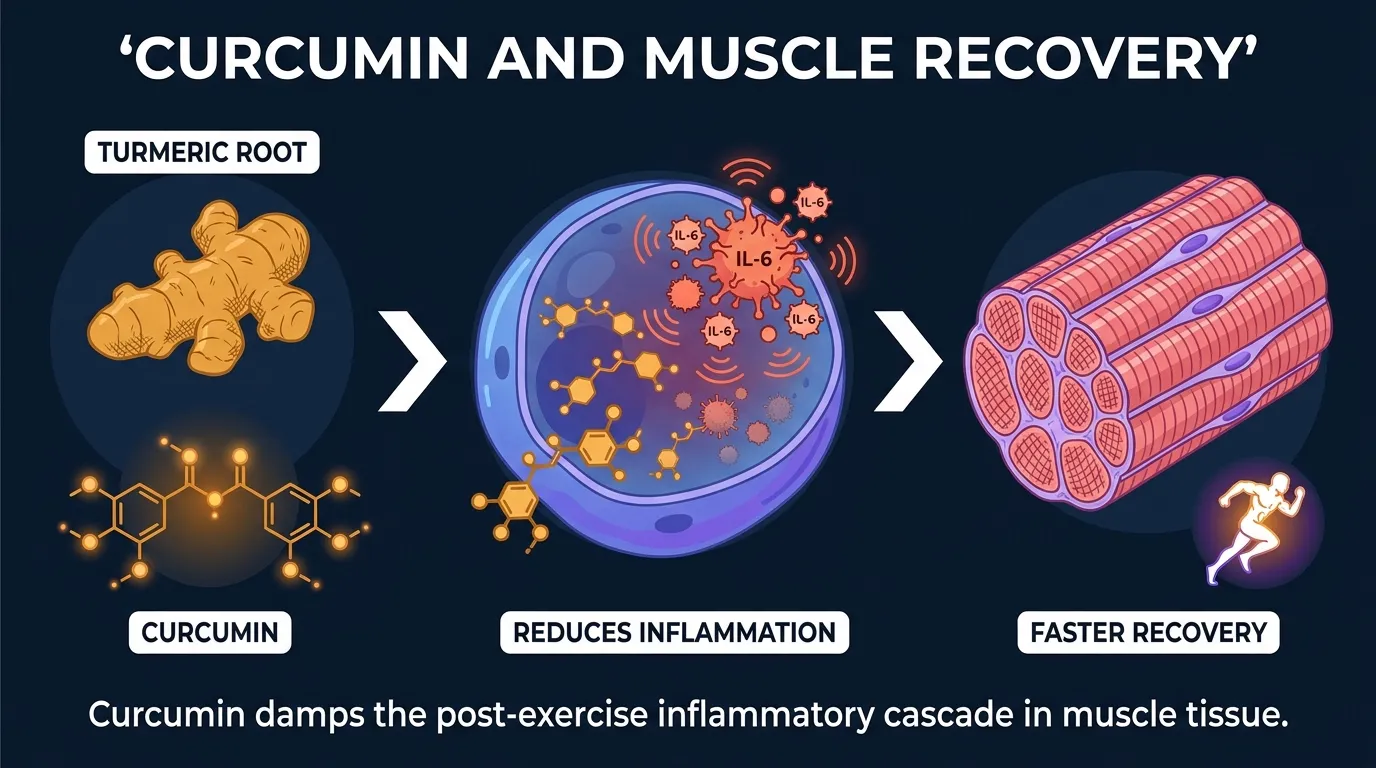
If you've ever stumbled downstairs the morning after a hard leg day and wondered whether a supplement could actually help, curcumin is one of the few candidates with a real body of trials behind it. Turmeric has been a culinary and medicinal staple across South Asia for centuries. What changed in the last decade is that sports scientists started running proper randomized trials on the specific compound inside turmeric that does the anti-inflammatory work. That compound is curcumin, and there is now enough pooled data to say something honest about what it actually does for a person who lifts, runs, or trains hard.
The short version. A 2024 meta-analysis in PLOS ONE looked at 14 randomized trials covering 349 participants and found curcumin significantly reduced blood markers of muscle damage, subjective soreness, and one of the key inflammatory cytokines, and improved joint range of motion after damaging exercise. An earlier 2021 meta-analysis in Phytotherapy Research reached similar conclusions across 10 trials. So the effect is not a supplement-industry myth. But there are important caveats about dose, absorption, and when using it may quietly cost you gains.
This article walks through the primary trials, why the formulation you buy matters more than the label dose, how to use curcumin around hard sessions, and where the marketing overstates what the research actually shows.
The Research: What Studies Show
Liu 2024: The Largest Pooled Analysis
The most complete look at the curcumin recovery literature is a 2024 meta-analysis by Liu, Lin, and Hu in PLOS ONE. They pooled 14 randomized controlled trials totalling 349 subjects and looked at four muscle-damage outcomes: creatine kinase, subjective muscle soreness, interleukin-6, and range of motion.
All four outcomes moved in curcumin's favor. Creatine kinase, a blood marker that spikes after damaging exercise, dropped by a mean difference of 137 U/L versus placebo (95% CI -239 to -36). Subjective soreness on a 10-point scale fell by 0.61 points (95% CI -0.81 to -0.41). Interleukin-6, one of the primary post-exercise inflammatory cytokines, dropped by 0.33 pg/mL (95% CI -0.56 to -0.09). Range of motion recovered better by about 4 degrees (95% CI 1.45 to 6.75). The doses across included trials ranged from 150 mg to 4 g of curcumin per day, and the effect held across both bioavailability-enhanced and standard formulations.
What Liu 2024 did not find was a huge effect. A 0.61-point drop on a 10-point soreness scale is real but modest. A 4-degree ROM benefit is measurable but not dramatic. This is the honest current picture: curcumin nudges recovery in the right direction across multiple outcomes simultaneously. It does not eliminate soreness.
Fang and Nasir 2021: The First Rigorous Meta-Analysis
Three years earlier, Fang and Nasir (2021) in Phytotherapy Research pooled 10 randomized controlled trials looking at curcumin supplementation for exercise-induced muscle damage and delayed-onset muscle soreness. They tracked creatine kinase, visual analog scale pain scores, maximal voluntary contraction, range of motion, and inflammatory markers including IL-6 and TNF-alpha.
Their meta-analysis showed curcumin significantly reduced DOMS after eccentric exercise, and reduced both IL-6 and TNF-alpha inflammatory response. The strength recovery effect (maximal voluntary contraction) trended in curcumin's favor but did not consistently reach statistical significance across trials. That soreness-and-inflammation-but-less-strength pattern shows up again in Liu 2024 and in most individual trials. Curcumin appears to work more on how your muscles feel and less on how much force they produce.
Drobnic 2014: The Meriva Trial
The best-designed early study came from Drobnic and colleagues (2014) in the Journal of the International Society of Sports Nutrition. They gave 20 subjects either 1 gram twice daily of Meriva (a phospholipid-bound curcumin formulation delivering 200 mg of curcumin per dose, so 400 mg/day total) or placebo for 48 hours before through 24 hours after a 45-minute downhill run at anaerobic threshold. Downhill running produces severe eccentric muscle damage. It is one of the harder recovery challenges a research protocol can throw at a subject.
Results. MRI evidence of muscle injury in the posterior and medial thigh compartments was significantly less frequent in the curcumin group (44% vs. 90%, p=0.03). Pain intensity in the anterior thighs was significantly lower on curcumin. IL-8 was significantly lower two hours post-exercise. Creatine kinase and other inflammatory markers trended in curcumin's favor but did not all reach statistical significance in a study of this size. The takeaway. Even at a modest 400 mg/day of a well-absorbed formulation, MRI-confirmed muscle injury dropped by about half.
Tanabe 2015 and the Individual EIMD Trials
Individual eccentric-exercise trials have consistently found curcumin attenuates markers of muscle damage. Tanabe and colleagues (2015) in the European Journal of Applied Physiology gave subjects 150 mg of a highly bioavailable curcumin formulation before and after eccentric elbow-flexor exercise. The curcumin group showed peak creatine kinase roughly half the placebo level (3,398 vs 7,684 IU/L, p<0.05) and preserved maximal voluntary contraction 13 to 16 percent better than placebo over the 48 to 96 hour post-exercise window. Arm circumference (a proxy for muscle swelling) rose similarly in both groups, so the effect showed up in force and blood markers rather than visible swelling.
Two things about Tanabe are worth noting. First, the dose was only 150 mg/day, which lines up with the Fernandez-Lazaro (2020) review's finding that 150 to 1,500 mg of a well-absorbed formulation is the effective window. Second, the timing was pre-exercise plus post-exercise for several days, not a single acute dose. The protocol looks a lot like the Meriva trial: load before, extend through the peak-damage window, don't rely on one pill after the workout.
How Curcumin Actually Works
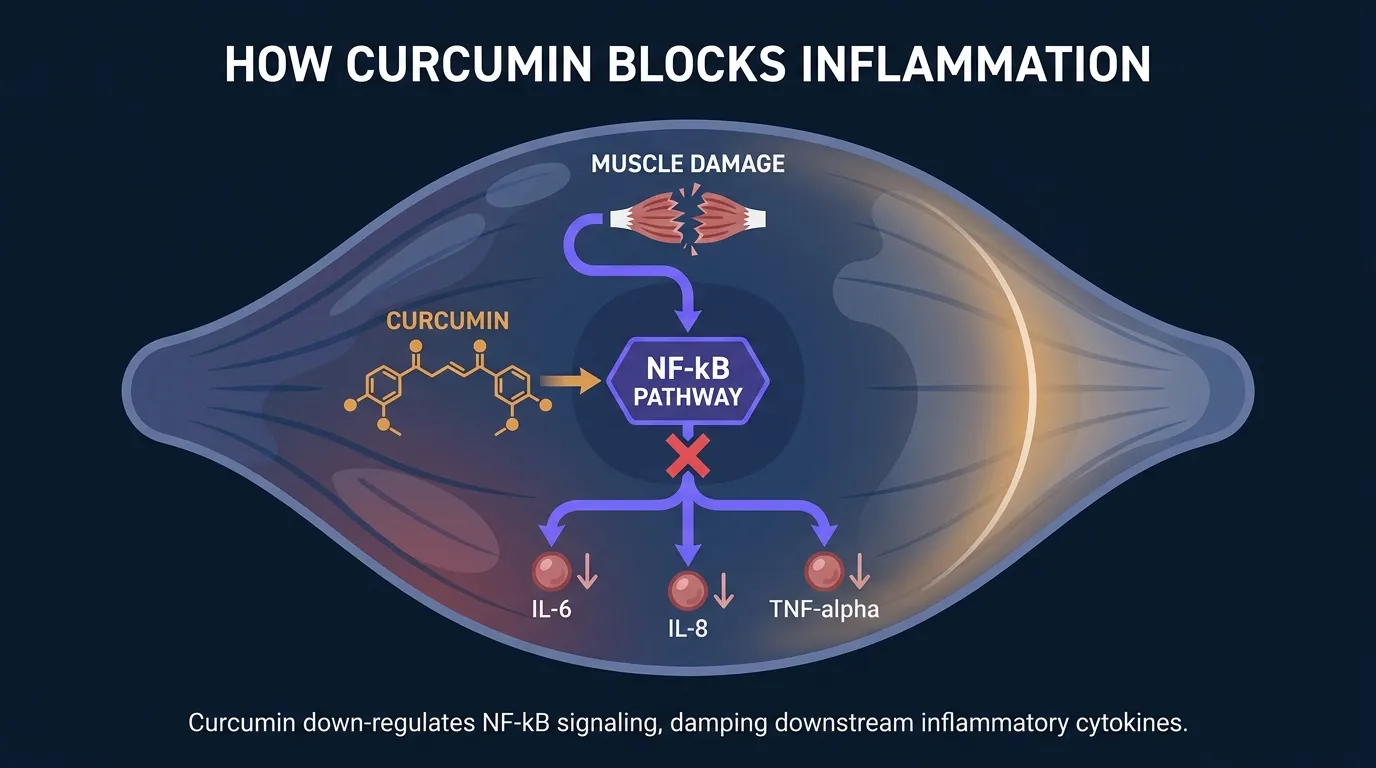
Turmeric root contains a family of compounds called curcuminoids, of which curcumin is by far the most studied and the most biologically active. Curcumin's main mechanism in the context of exercise recovery is inhibition of NF-κB signaling. NF-κB is the master transcriptional regulator of the inflammatory response after tissue damage. When muscle fibers get torn during hard eccentric exercise, NF-κB activation triggers the release of downstream cytokines including IL-6, IL-8, and TNF-alpha. Those cytokines amplify the inflammatory response, and part of that amplification produces secondary damage to muscle tissue beyond what the exercise itself caused.
Curcumin blunts that cascade. It does not stop the initial damage from occurring, but it reduces the size of the secondary inflammatory wave, which is why the studies that show the biggest effects use protocols that get curcumin into the bloodstream before the damaging exercise happens. If you take curcumin only after the workout, you've missed the window in which it does most of its work. That's why every successful trial uses a loading protocol rather than a single post-exercise dose.
Curcumin also appears to modulate the COX-2 pathway, which is the same target as NSAIDs like ibuprofen. That similarity is why Fernandez-Lazaro and colleagues describe curcumin's action as NSAID-like, and it's part of why the effect on subjective pain is one of the more reliable findings. But unlike ibuprofen, curcumin at typical doses does not appear to significantly interfere with the training adaptation process for occasional use. The concern about blunting adaptations applies more to daily year-round supplementation than to targeted use around events.
Bioavailability Is the Whole Ballgame
Here is the single most important thing to understand about curcumin supplementation, and the reason a lot of turmeric supplements on shelves produce disappointing results. Hewlings and Kalman (2017) in Foods put it plainly. Plain curcumin has poor bioavailability. It absorbs poorly from the gut, gets metabolized fast by the liver, and clears the bloodstream quickly. The result is that most of the curcumin in an unenhanced capsule passes through your system without producing meaningful systemic levels.
The successful trials work around this in one of a few ways:
- Piperine (black pepper extract). Piperine inhibits the liver enzymes that metabolize curcumin. Combining curcumin with a small amount of piperine (typically 5 to 20 mg) raises curcumin absorption several-fold. This is the cheapest and most common enhancement.
- Phospholipid or phytosome formulations (Meriva, BCM-95). These bind curcumin to phospholipid carriers (Meriva) or reunite curcumin with turmeric's own essential oils (BCM-95), producing 5 to 30 times higher plasma curcumin than an equivalent dose of standard extract. The Meriva trial (Drobnic 2014) used one of these formulations.
- Nanoparticle and micellar forms. Newer formulations use nanoemulsion or micellar delivery to further improve absorption. These tend to be more expensive.
- Take it with fat. Curcumin is fat-soluble. Taking any curcumin supplement with a meal containing olive oil, avocado, eggs, nuts, or fatty fish supports absorption compared to taking it on an empty stomach.
The practical implication. A cheap 500 mg curcumin capsule with no absorption enhancer, taken on an empty stomach, may deliver only a fraction of the bioavailable dose that a 200 mg Meriva capsule delivers. If the supplement label does not mention piperine, phytosome, phospholipid, BCM-95, Meriva, or a similar enhancement, you're likely paying for capsules that mostly pass through you.
Why This Matters for Your Fitness
The honest translation for a recreational lifter, runner, or hybrid athlete: curcumin is a targeted recovery tool with real evidence, not a daily supplement. If you're training for a marathon, a hyrox event, a hard week of block periodization, or a competition weekend where you need to recover between efforts, loading a well-absorbed curcumin formulation around those bouts is probably worth trying. The effect is modest but consistent across multiple recovery outcomes: less soreness, less inflammation, better range of motion, less MRI-visible muscle injury.
If you're doing 3 to 4 moderate strength sessions a week and some easy cardio, and you're not experiencing prolonged post-workout soreness that limits your next session, curcumin probably will not change your outcomes much. The mechanical damage of that kind of training is not big enough for an anti-inflammatory to move the needle noticeably.
If you're a lifter chasing hypertrophy, the calculation flips. You want some post-exercise inflammation because that inflammatory signal is part of what tells muscle to rebuild bigger. Blunting it every session may reduce the total adaptation you get from the same training input. This concern is the same one that applies to ice baths taken immediately after every strength session. Anti-inflammatory strategies used around hard events help; used every day, they can quietly cost you gains.
None of this replaces the boring truth that consistency beats optimization. A 0.61-point soreness improvement on a workout you skipped is still zero. The biggest predictor of fitness outcomes remains whether you keep stringing workouts together week after week. Pair the supplement with a program that gets you to show up, or the supplement does not matter.
Get an evidence-based plan built for you
FitCraft, our mobile fitness app, pairs you with an AI coach who builds you a personalized plan around your goals, schedule, and fitness level. Every FitCraft program is designed by Domenic Angelino, MPH (Brown University) and NSCA-CSCS, with research published in the Journal of Strength and Conditioning Research and Medicine & Science in Sports & Exercise.
Take the Free Assessment Free • 2 minutes • No credit cardHow to Use Curcumin in Practice
Translating the trial protocols into a workable strategy:
- Pick a bioavailability-enhanced formulation. Look for Meriva, BCM-95, curcumin plus piperine, phytosome curcumin, or a nanoparticle/micellar delivery. The label should mention one of these. If it just says "turmeric extract 500 mg", skip it. You're not going to reach the plasma levels the trials used.
- Target 400 to 1,000 mg of curcumin per day for an enhanced formulation. This matches the trial range once you account for the absorption boost. Standard unenhanced curcumin needs closer to 1,500 mg to 4 g to reach similar plasma levels, and the pill count gets impractical.
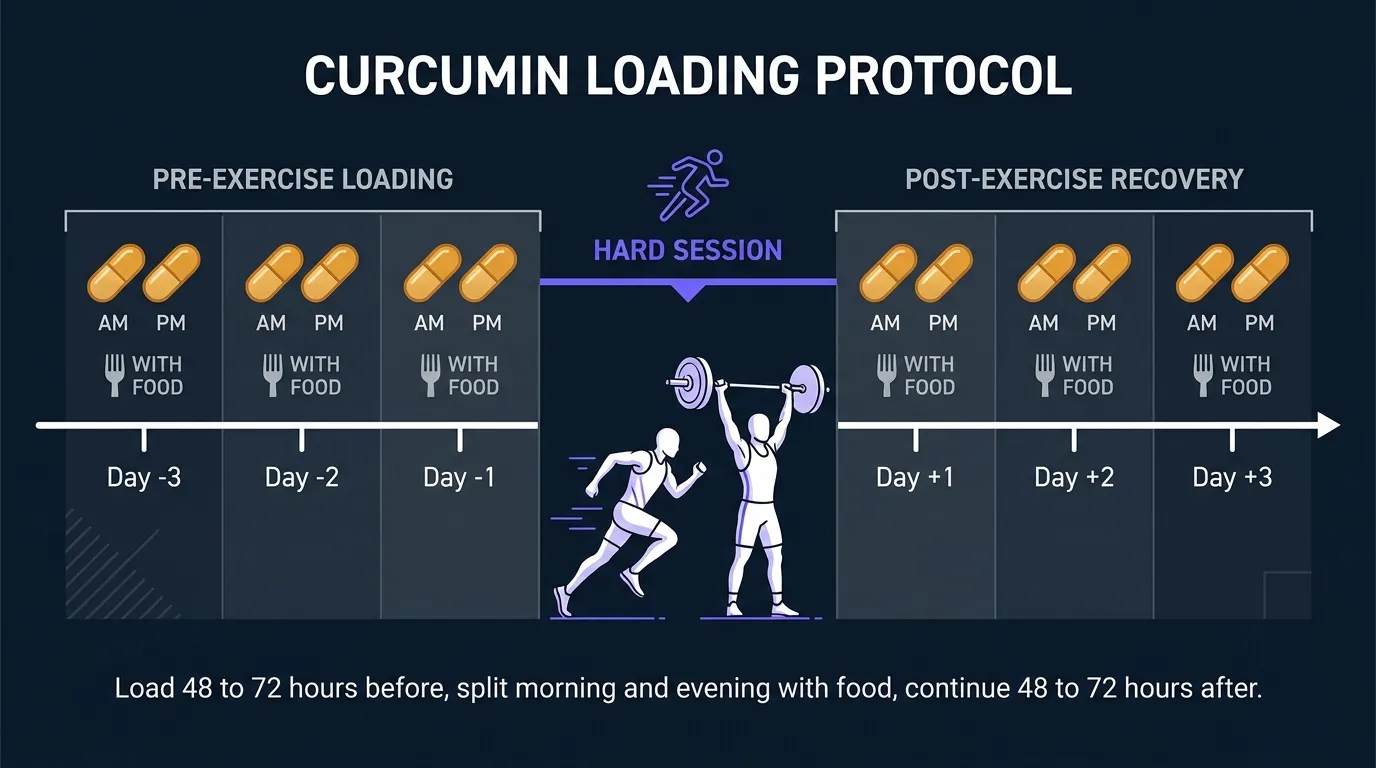
- Split the dose morning and evening with a meal that contains fat. Curcumin is fat-soluble. All successful protocols used twice-daily dosing rather than one large morning dose. Taking it with olive oil, eggs, nuts, or fatty fish supports absorption.
- Start 48 to 72 hours before your hardest session. Loading in advance is what the Meriva, Tanabe, and downhill-running trials did. A single dose the morning of does not match the published effect.
- Continue 48 to 72 hours after. Post-exercise inflammation peaks 24 to 48 hours after damaging exercise. Extending the load through that peak is what the successful trials did.
- Cycle it around events, don't take it year-round. Use it during race weeks, block-periodization peaks, or dense training phases where recovery matters more than adaptation. During accumulation blocks where you're trying to build muscle or drive fitness, daily anti-inflammatory dosing may cost you response.
- Don't rely on culinary turmeric. Whole turmeric powder is only 2 to 5 percent curcumin. Reaching 400 mg of curcumin from culinary turmeric would take roughly 10 to 20 grams of turmeric per day, which is far more than food volume tolerates.
Individual Variation: Who Responds Most
Type of Exercise
Curcumin's biggest published effects come from eccentric-heavy exercise. Downhill running, drop-set resistance training, long marathon efforts, prolonged intermittent sport (soccer, rugby, tennis tournaments), and high-volume eccentric-loaded lifting all produce large inflammatory responses that curcumin has room to blunt. Steady-state zone-2 cardio and short concentric-only sessions produce less mechanical damage, so the intervention has less to do.
Training Status
Recreationally trained subjects tend to show clearer benefits than the untrained or the elite. Untrained subjects experience so much damage from any hard bout that a nutritional intervention gets partly swamped. Elite athletes have highly adapted inflammatory-response systems that produce less baseline damage from equivalent relative work. Middle-of-the-bell-curve recreational athletes have the most room for a supplement like curcumin to move the needle.
Formulation Choice
This is the biggest source of variation in the literature. Trials using bioavailability-enhanced formulations (Meriva, BCM-95, phospholipid delivery) consistently show effects at lower doses than trials using standard extract. If you tried plain turmeric capsules once and felt nothing, that is not evidence curcumin does not work. It is evidence the specific product you used had poor absorption. Switching to an enhanced formulation is often the difference between a supplement that produces a measurable effect and one that does not.
Common Misconceptions
Misconception 1: "Turmeric is the same as curcumin."
Whole turmeric is only 2 to 5 percent curcumin by weight. To reach the 400 to 1,500 mg of curcumin used in the trials, you'd need roughly 10 to 30 grams of turmeric per day, which no one eats. That's why the culinary turmeric craze (golden milk, turmeric lattes) rarely produces the effects the supplement trials do. Fantastic anti-inflammatory spice for cooking. Not a substitute for a standardized extract if you want the studied recovery effect.
Misconception 2: "More curcumin is always better."
The trial doses that showed benefit cluster in the 150 to 1,500 mg range for enhanced formulations, and up to 4 g/day for standard extract. Fernandez-Lazaro (2020) noted the effective window sits at 150 to 1,500 mg/day and there is no clear evidence that pushing much higher produces proportionally larger effects. Very high doses (5 g/day and up) have been associated with gastrointestinal side effects in some subjects. Staying near the trial-tested dose captures most of the benefit without pushing into diminishing or negative territory.
Misconception 3: "Curcumin knocks out muscle soreness."
The evidence on soreness is real but modest. Liu 2024 found a 0.61-point drop on a 10-point scale versus placebo. That is meaningful, but it's not "you won't feel sore." If the marketing sold you on soreness elimination, expect a smaller effect than the ads promised. The most reliable finding is that the biological markers of muscle damage and inflammation drop meaningfully. The subjective experience of soreness drops less.
Misconception 4: "Curcumin is a natural NSAID, so it must be safer."
Curcumin does share some anti-inflammatory pathways with NSAIDs like ibuprofen, and it does have a better long-term GI safety profile than chronic NSAID use. But "natural" does not mean "no interactions." Curcumin can potentiate blood-thinning medications, interact with diabetes and blood-pressure drugs, and may affect iron absorption at high doses. It is not a free lunch. If you're on prescription medications, talk to a pharmacist or physician before adding chronic curcumin supplementation.
What the Research Suggests Going Forward
The curcumin recovery literature is now mature enough to say the basic effect is real. What's still being actively worked out:
- Whether chronic year-round curcumin use meaningfully blunts hypertrophy and endurance adaptations. The concern is mechanistically plausible and shows up in the NSAID and high-dose antioxidant literature, but direct long-term data on curcumin specifically is thin.
- Whether different bioavailability-enhanced formulations (Meriva vs. BCM-95 vs. piperine-enhanced vs. nanoparticle) produce meaningfully different effects at matched plasma curcumin. Head-to-head trials are still sparse.
- Whether curcumin stacks additively with other recovery interventions (tart cherry, protein timing, sleep, compression) or whether the anti-inflammatory pathways overlap and compete.
- How curcumin behaves in populations under-represented in the current literature, including women across menstrual cycle phases, adults over 60 training seriously, and clinical populations with elevated baseline inflammation.
The takeaway for someone training today. Curcumin is a legitimate targeted recovery tool with a real evidence base. Buy a bioavailability-enhanced formulation, take it with food that contains fat, load it 2 to 3 days before your hardest sessions and events, and don't use it as a daily supplement during accumulation blocks. And treat culinary turmeric as a delicious spice, not as a substitute for a standardized extract.
References
- Liu X, Lin L, Hu G. "Meta-analysis of the effect of curcumin supplementation on skeletal muscle damage status." PLoS ONE. 2024;19(7):e0299135. doi:10.1371/journal.pone.0299135
- Fang W, Nasir Y. "The effect of curcumin supplementation on recovery following exercise-induced muscle damage and delayed-onset muscle soreness: A systematic review and meta-analysis of randomized controlled trials." Phytother Res. 2021;35(4):1768-1781. doi:10.1002/ptr.6912
- Fernández-Lázaro D, Mielgo-Ayuso J, Seco Calvo J, et al. "Modulation of Exercise-Induced Muscle Damage, Inflammation, and Oxidative Markers by Curcumin Supplementation in a Physically Active Population: A Systematic Review." Nutrients. 2020;12(2):501. doi:10.3390/nu12020501
- Suhett LG, de Miranda Monteiro Santos R, Silveira BKS, et al. "Effects of curcumin supplementation on sport and physical exercise: a systematic review." Crit Rev Food Sci Nutr. 2021;61(6):946-958. doi:10.1080/10408398.2020.1749025
- Drobnic F, Riera J, Appendino G, et al. "Reduction of delayed onset muscle soreness by a novel curcumin delivery system (Meriva): a randomised, placebo-controlled trial." J Int Soc Sports Nutr. 2014;11:31. doi:10.1186/1550-2783-11-31
- Hewlings SJ, Kalman DS. "Curcumin: A Review of Its Effects on Human Health." Foods. 2017;6(10):92. doi:10.3390/foods6100092
- Tanabe Y, Maeda S, Akazawa N, et al. "Attenuation of indirect markers of eccentric exercise-induced muscle damage by curcumin." Eur J Appl Physiol. 2015;115(9):1949-1957. doi:10.1007/s00421-015-3170-4
Frequently Asked Questions
How much curcumin should I take for muscle recovery?
The dose across most successful trials falls between 150 mg and 1,500 mg of curcumin per day, with bioavailability-enhanced formulations (Meriva, BCM-95, curcumin plus piperine, phytosome forms) at the lower end and standard curcumin at the higher end. Fernandez-Lazaro and colleagues (2020) identified 150 to 1,500 mg/day as the effective window, and Drobnic (2014) used 400 mg/day of the Meriva phytosome formulation. Split the daily dose across two servings with a meal that contains fat, since curcumin is fat-soluble. Start 48 to 72 hours before your hardest session and continue for 48 to 72 hours after.
Does turmeric or curcumin actually help muscle recovery?
The muscle-damage and inflammation effects are real. A 2024 meta-analysis in PLOS ONE pooled 14 randomized controlled trials (349 participants) and found curcumin supplementation significantly reduced creatine kinase, subjective muscle soreness, and IL-6 while improving range of motion after damaging exercise. The effect on peak strength recovery is smaller and less consistent than the effect on soreness and blood biomarkers. So the benefit shows up most clearly in how sore and how inflamed you feel, and less clearly in how much force you can produce the next day.
What is the difference between turmeric and curcumin?
Turmeric is the root spice you buy at the grocery store. Curcumin is the specific polyphenol inside turmeric that produces most of its anti-inflammatory effects. Whole turmeric is only about 2 to 5 percent curcumin by weight, which is why culinary use alone will not reach the doses used in recovery studies. Every published trial uses standardized curcumin extract, not raw turmeric powder. If you want the studied effect, buy a standardized curcumin supplement (ideally a bioavailability-enhanced formulation) rather than trying to eat enough turmeric to match the trial dose.
Why does curcumin need piperine or a special formulation?
Plain curcumin has famously poor oral bioavailability. It absorbs poorly, gets metabolized fast, and clears the bloodstream quickly, which is why Hewlings and Kalman (2017) emphasize that ingesting curcumin alone produces limited systemic effects. Piperine (a black pepper extract) raises curcumin absorption several-fold by inhibiting the liver enzymes that metabolize it. Phytosome and phospholipid formulations (Meriva, BCM-95) bind curcumin to lipid carriers that push absorption 5 to 30 times higher than standard curcumin. If a supplement is unformulated curcumin with no absorption enhancer, most of the dose passes through unused.
Should I take curcumin every day, even on rest days?
Probably not, and probably not year-round. Post-exercise inflammation is part of how muscle adapts and grows. A blanket anti-inflammatory strategy applied every day can blunt training adaptations over long training blocks. Cycle curcumin around events, competition weeks, or dense training phases where recovery matters more than adaptation. During accumulation blocks where you're trying to build muscle or drive fitness gains, daily anti-inflammatory dosing may quietly cost you response.