
Potatoes have spent years on the wrong side of diet advice. Low-carb plans cut them, Harvard's Healthy Eating Plate doesn't count them as a vegetable, and fries have given the whole food a bad name. Yet a bag of potatoes is still one of the cheapest, most filling things in the grocery store, and plenty of people eat them most days.
So are potatoes healthy for you, or just cheap starch? Are potatoes good for you at all? For most people, yes. The research splits sharply by how they're cooked, and that split is the part worth understanding. This page covers the nutrition in one potato, the fried vs boiled research, weight loss, cooled potatoes and blood sugar, the healthiest varieties, training fuel and who should be careful.
If you've gone back and forth on potatoes, you're not alone. Advice that flips every few years makes it hard to settle on simple meals you can repeat. If you're choosing between white and orange, our page on whether sweet potato is healthy compares the two side by side. Here the subject is the everyday white potato: russet, red, yellow and the rest.
Potato Nutrition per Medium Potato
USDA counts a medium potato as one 2.25 to 3.25 inches across, about 173 grams once baked. Here's what one gives you with the skin on, from USDA FoodData Central:
| One medium baked potato with skin (173 g) | Amount | % Daily Value |
|---|---|---|
| Calories | 161 | n/a |
| Carbohydrate | 36.7 g | 13% |
| Fiber | 3.8 g | 14% |
| Protein | 4.3 g | 9% |
| Fat | 0.2 g | 0% |
| Potassium | 926 mg | 20% |
| Vitamin B6 | 0.54 mg | 32% |
| Copper | 0.20 mg | 23% |
| Vitamin C | 16.6 mg | 18% |
| Manganese | 0.38 mg | 16% |
| Niacin | 2.4 mg | 15% |
| Magnesium | 48 mg | 12% |
| Folate | 48 mcg | 12% |
| Iron | 1.9 mg | 10% |
| Sodium | 17 mg | 1% |
Source: USDA SR Legacy entry 170093 (potatoes, baked, flesh and skin, without salt), multiplied out to USDA's 173-gram medium potato. Percentages use the FDA's adult Daily Values.
Most of the calories come from starch, about 30 grams of it, which is why a potato behaves like rice or bread on your plate. The rest of the label is the surprise: almost no fat or sodium, and useful amounts of several vitamins and minerals. What a potato doesn't bring is much protein. Four grams won't carry a meal, so give it a partner such as eggs, fish, chicken, beans or Greek yogurt.
What Vitamins Are Potatoes a Good Source Of?
Potatoes are a good source of vitamin B6 and vitamin C, and one of the richest everyday sources of potassium. A medium potato covers about a third of the day's vitamin B6, which your body uses to process protein and make red blood cells, and close to a fifth of its vitamin C. It also brings about a fifth of the day's copper and smaller amounts of niacin, folate and magnesium.
Potassium is the standout. A medium baked potato holds about 926 milligrams, while a medium banana, the food most people think of first, holds about 422 (USDA entry 173944). Gram for gram, baked potato carries about half again as much potassium as banana.
Keep the skin if you can. Per 100 grams, USDA lists 7.9 grams of fiber in baked potato skin against 1.5 grams in the flesh (entries 170034 and 170033). The cooking method matters too. Potatoes boiled whole in their skins keep about 13 milligrams of vitamin C per 100 grams of flesh, while peeled potatoes boiled the same way keep about 7.4, and they lose some potassium as well (entries 170438 and 170440).
Is a Potato a Vegetable or a Carb?
A potato is both. Botanically it's a vegetable, the swollen underground stem of a plant in the nightshade family. Nutritionally it's a starchy carbohydrate food, and that's why the answer changes depending on whose plate you look at.
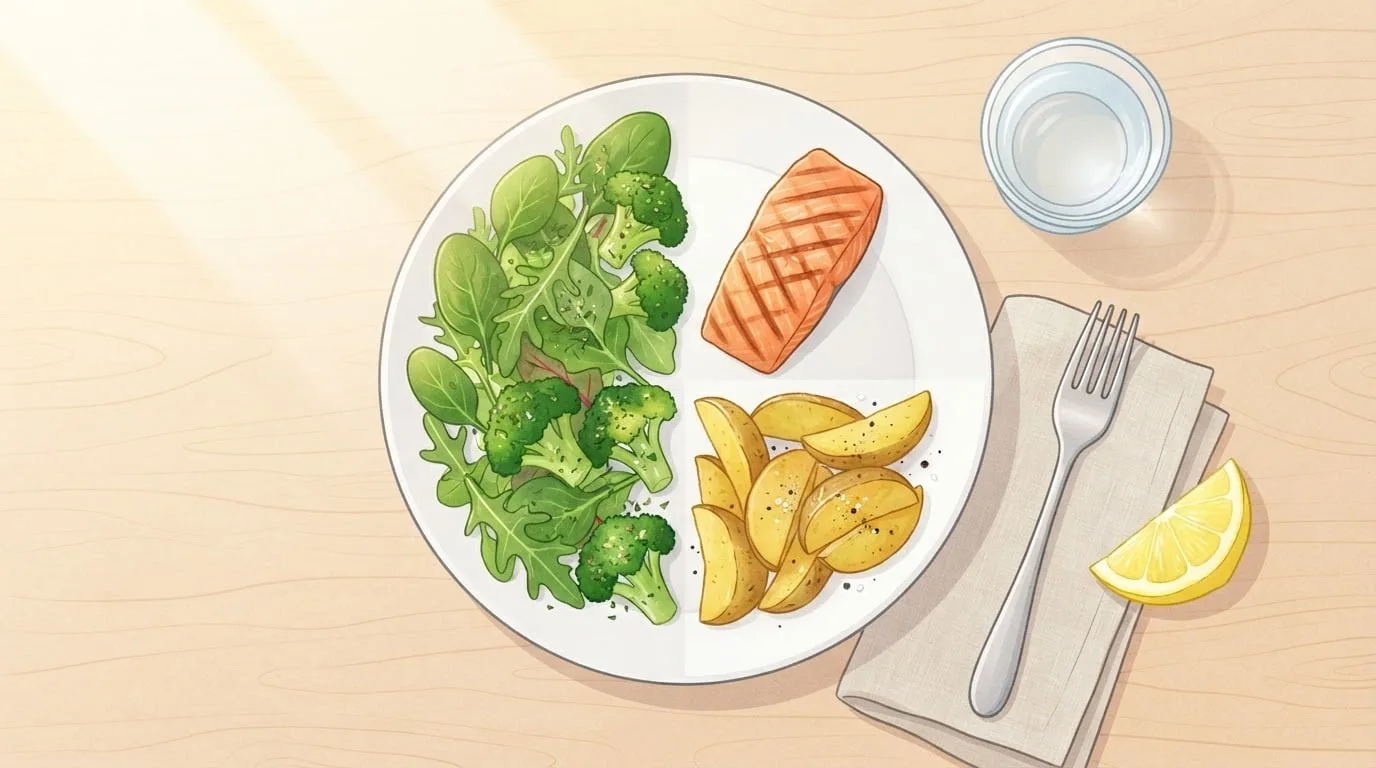
The Dietary Guidelines for Americans, 2025-2030, show potatoes in their vegetables and fruits group and recommend three servings of vegetables a day. Harvard's Nutrition Source takes the opposite view: potatoes don't count as vegetables on its Healthy Eating Plate at all. The American Diabetes Association's plate method sits in between. It puts potatoes in the carbohydrate quarter of a nine-inch plate, next to whole grains and fruit, and keeps the other half for non-starchy vegetables.
Is a potato a vegetable or a grain? It isn't a grain, since grains are the seeds of cereal grasses such as wheat, rice and oats. The practical answer is simple. Count a potato as the starch on your plate, not as one of your vegetable servings, and put a non-starchy vegetable beside it.
Fried vs Boiled Potatoes: What the Long-Term Studies Show
Long-term studies of potatoes and disease keep finding the same split. Fried potatoes carry the risk. Baked, boiled and mashed potatoes carry little or none.
The largest study is also the newest. Mousavi and colleagues (2025) followed 205,107 US nurses and health professionals for up to 36 years, and 22,299 of them developed type 2 diabetes. Every three weekly servings of French fries went with a 20 percent higher risk. Baked, boiled or mashed potatoes showed no meaningful link, with a hazard ratio of 1.01. What replaced the potatoes mattered as well. Swapping three weekly servings of fries for whole grains was linked to a 19 percent lower risk, while swapping baked, boiled or mashed potatoes for white rice was linked to a higher one. Pooling 13 cohorts with 587,081 people, the authors found a 16 percent higher risk per three weekly servings of fried potatoes.
An earlier 2019 meta-analysis by Schwingshackl and colleagues found no link between total potato intake and death, heart disease, stroke or colorectal cancer. Per daily 150-gram serving, French fries went with a 66 percent higher risk of type 2 diabetes and a 37 percent higher risk of high blood pressure, while boiled, baked or mashed potatoes showed a small 9 percent link with diabetes. The authors rated most of this evidence as low certainty.
Frying shows up in mortality data too. In an eight-year study by Veronese and colleagues (2017) of about 4,400 adults aged 45 to 79, people who ate fried potatoes two to three times a week had about twice the risk of dying during follow-up (a hazard ratio of 1.95), and those who ate them three or more times a week had 2.26 times the risk. Unfried potatoes weren't linked to higher risk. Only 236 people died, so those estimates are rough.
Blood pressure is the one area where plain potatoes don't come out entirely clean. In three US cohorts of 187,453 adults, Borgi and colleagues (2016) found that eating French fries four or more times a week went with a 17 percent higher risk of developing high blood pressure. Baked, boiled or mashed potatoes at that frequency showed an 11 percent higher risk that fell short of statistical significance, and swapping one daily serving of them for a non-starchy vegetable was linked to a 7 percent lower risk.
A controlled feeding trial points the other way for plain potatoes. In a crossover study by Stone, Martin and Weaver (2021), 30 adults with raised blood pressure ate a diet in which potatoes added about 1,000 milligrams of potassium a day for roughly two weeks. Their systolic pressure fell 6.0 mm Hg, against 2.6 on the control diet. The Alliance for Potato Research and Education, a potato-industry research group, funded that trial.
Why would frying matter so much? Frying more than triples the calories per gram, adds salt and forms acrylamide, a compound that builds up when starchy foods brown at high heat. Fries also tend to arrive with burgers and soda, and cohort studies can only partly separate a food from the habits around it. None of these studies can prove cause, but they all point the same way.

Knowing what to do is the easy part.
FitCraft, our mobile fitness app, pairs you with an AI coach who builds you a personalized plan around your goals, schedule, and fitness level. Every FitCraft program is designed by Domenic Angelino, MPH (Brown University) and NSCA-CSCS, with research published in the Journal of Strength and Conditioning Research and Medicine & Science in Sports & Exercise.
Take the Free Assessment Free • 2 minutes • No credit cardAre Potatoes Healthy for Weight Loss?
Yes, plain potatoes can help with weight loss, because they fill you up for relatively few calories. Fried potatoes work against you for the opposite reason.
The best-known evidence is a satiety index built by Holt and colleagues (1995). Volunteers ate 240-calorie portions of 38 everyday foods and rated how full they felt over the next two hours. Plain boiled potatoes beat every other food, scoring more than three times as filling as white bread for the same calories.
Newer meal tests mostly agree. In a trial by Akilen and colleagues (2016), children aged 11 to 13 ate a fixed portion of lean beef with as much of a side dish as they liked. They ate 30 to 40 percent fewer calories at meals with boiled or mashed potatoes than at meals with rice, pasta or French fries, in a trial funded by the Alliance for Potato Research and Education. Adults are less clear-cut: in a test by Geliebter and colleagues (2013), 12 adults felt less desire to eat after potato side dishes than after pasta, but ate about the same amount at lunch.
Weight-loss trials show that potatoes don't stand in the way. Randolph and colleagues (2014) asked 90 overweight adults to eat five to seven servings of potatoes a week for 12 weeks, with or without diet advice. All three groups lost a modest amount of weight, and the authors tied the loss to eating fewer calories. In an eight-week feeding study by Rebello and colleagues (2022), 36 adults with insulin resistance ate low-calorie-density meals built around either potatoes or beans. The potato group lost 5.6 percent of their body weight and the bean group 4.1 percent, and insulin resistance improved on both. The same potato research group funded that study in part.
Long-term data show where the trouble starts. In a study of 120,877 US adults by Mozaffarian and colleagues (2011), each extra daily serving of French fries went with 3.35 pounds of weight gain every four years, and potato chips with 1.69 pounds. Boiled, baked or mashed potatoes went with 0.57 pounds. Calorie density explains much of the gap:
| Per 100 g | Calories | Fat |
|---|---|---|
| Potato, boiled in its skin | 87 | 0.1 g |
| Potato, baked with skin | 93 | 0.1 g |
| French fries, fast food | 312 | 14.7 g |
| Potato chips, salted | 532 | 34.0 g |
USDA FoodData Central SR Legacy entries 170438, 170093, 170698 and 169677, rounded.
A medium order of fast-food fries (117 grams) comes to about 365 calories, more than two medium baked potatoes. Toppings can do the same to a baked potato. Butter, sour cream, cheese and bacon add calories quickly, while salsa, chives or Greek yogurt add flavor for far fewer.
Cooled Potatoes and Resistant Starch
When cooked potatoes cool, some of their starch re-forms into a tighter structure that your small intestine can't fully digest. This resistant starch travels on to the large intestine, where gut bacteria ferment it much as they ferment fiber, and less of the potato's starch turns into blood sugar.
A Swedish trial measured how much difference cooling makes. Leeman, Östman and Björck (2005) fed 13 healthy adults potatoes that were either freshly boiled or boiled and then kept in the fridge at 8°C for 24 hours. Chilling raised the resistant starch from 3.3 to 5.2 percent of the starch and cut the insulin response by 28 percent. Served cold with a vinaigrette of olive oil and white vinegar, the potatoes produced a 43 percent smaller blood sugar response and a 31 percent smaller insulin response than freshly boiled ones.
A Canadian study found a big swing in glycemic index from temperature alone. Fernandes, Velangi and Wolever (2005) tested red potatoes boiled and eaten hot, which scored 89, a high glycemic index, and boiled and eaten cold, which scored 56, an intermediate one. Baked russets landed at 77 and instant mashed potatoes at 88. In a second test, russets that were cooked ahead, refrigerated and reheated raised blood sugar less than russets cooked the same day.
An analysis of three popular varieties by Raatz and colleagues (2016) found more resistant starch in baked potatoes than boiled ones, and more in chilled potatoes than in hot or reheated ones. The variety made no difference. In people with blood sugar problems the effect is real but modest. In a crossover trial by Patterson and colleagues (2019), 30 women with raised fasting glucose and insulin ate 250 grams of boiled russets on one day and baked-then-chilled russets on another. After the chilled potatoes, blood sugar was 5 to 9 percent lower at 15 and 30 minutes and the overall insulin response was smaller. Total blood sugar over the whole test wasn't significantly different.
In your kitchen, this means potato salad with a vinegar dressing, or potatoes you cook ahead and eat cold or reheated during the week. One storage detail keeps these two ideas apart: chill potatoes after cooking, not before. The FDA advises keeping raw potatoes in a cool, dark place outside the fridge, because refrigerated raw potatoes form more acrylamide when they're later fried or roasted.
Are Potatoes OK for Prediabetes and Diabetes?
Yes, potatoes can fit a diet for prediabetes or type 2 diabetes. The form and the portion matter more than the food itself.
The cohort data above found no link between baked, boiled or mashed potatoes and developing type 2 diabetes, only for fries. A trial in healthy adults points the same way. Johnston, Petersen and Kris-Etherton (2020) had 50 adults eat one medium unpeeled potato, baked or steamed, every day for four weeks, and a refined-grain side dish every day for another four. Fasting blood sugar didn't differ between the two periods, and the potato weeks brought higher diet quality and more potassium and fiber. The Alliance for Potato Research and Education funded the study.
A low blood sugar response isn't the same thing as healthy, though. In the children's trial above, French fries produced the lowest blood sugar and insulin of any side dish, probably because the fat slowed digestion. Those are the same fries most linked to diabetes in the long-term studies.
If you have prediabetes, these habits keep potatoes on the menu:
- Keep the portion to a quarter plate. One medium potato fits the carbohydrate quarter of the diabetes plate, with non-starchy vegetables filling half.
- Eat it cooled, or with vinegar. Potato salad with a vinaigrette, or potatoes cooked the day before, raise blood sugar less than freshly boiled ones.
- Pair it with protein and skip the fryer. Fish, chicken, eggs or beans beside a baked, boiled or steamed potato make a steadier meal than fries.
Your doctor or dietitian can tell you how many grams of carbohydrate fit your plan. A medium baked potato has about 37.
Which Potatoes Are Healthiest? Russet, Red, Yellow and Purple
The differences between everyday varieties are small, and how you cook a potato matters more than which one you buy. Here's how three common types compare when baked with the skin, per 100 grams, in USDA FoodData Central:
| Per 100 g, baked with skin | Calories | Fiber | Potassium | Vitamin C | Vitamin B6 |
|---|---|---|---|---|---|
| Russet | 95 | 2.3 g | 550 mg | 8.3 mg | 0.35 mg |
| Red | 87 | 1.8 g | 545 mg | 12.6 mg | 0.21 mg |
| White | 92 | 2.1 g | 544 mg | 12.6 mg | 0.21 mg |
USDA SR Legacy entries 170030, 170435 and 170434.
Russets bring a little more fiber, protein and vitamin B6, while red and white potatoes bring more vitamin C. Potassium is about the same in all three.
Color adds plant compounds. Ramdath and colleagues (2014) measured polyphenols in four varieties and found the most in Purple Majesty, almost three times the amount in a white potato, followed by a red variety and then Yukon Gold. In nine volunteers the glycemic index ran from 77 for the purple potato to 93 for the white one, a gap that wasn't statistically significant in such a small group.
Which potatoes are healthiest for diabetics? The method matters more than the variety. Raatz's team found no difference in resistant starch between Yukon Gold, red and russet potatoes, and the lowest glycemic index in the Canadian tests came from red potatoes boiled and eaten cold. Red and yellow potatoes also hold their shape when boiled, which makes them the easy choice for potato salad.
Potatoes as Carbs for Training
If you train, potatoes are an easy way to cover carbohydrate. A medium potato gives about 37 grams of carbohydrate and almost no fat, so it sits well in a meal two to three hours before a workout and helps refill muscle glycogen in the meal after one.
Potatoes even work during long endurance sessions. In a 2019 cycling trial by Salvador and colleagues, potato puree supported a two-hour ride and time trial as well as a commercial carbohydrate gel. Potato protein is also better than its small amount suggests. In a 2022 trial by Pinckaers and colleagues with 24 young men, 30 grams of potato protein concentrate raised muscle protein synthesis after resistance exercise as much as 30 grams of milk protein. A whole potato is a different food, though. You'd need about seven medium potatoes to reach 30 grams of protein, so treat potatoes as the carbohydrate in a meal and get your protein from another food.
A 30- to 45-minute bodyweight or dumbbell session at home needs no special fueling, and a potato with eggs, chicken or Greek yogurt afterward covers carbohydrate and protein together. Our guide to carbs for muscle gain shows how many grams a day suit your training and body size.
Who Should Be Careful With Potatoes?
Potatoes are safe for almost everyone. A few groups, and a few kitchen habits, deserve care:
- People with chronic kidney disease. The National Kidney Foundation lists white and sweet potatoes among high-potassium vegetables, which it defines as 200 milligrams or more per serving. A medium potato has more than four times that. Soaking and boiling removes some of the potassium but not all of it, so ask your renal dietitian how potatoes fit your limit.
- People with diabetes or prediabetes. Count a potato as your meal's carbohydrate serving, as covered above, and check portions with your care team.
- Anyone with green or sprouted potatoes. Potatoes make natural toxins called glycoalkaloids, solanine among them, and light raises the levels. The European Food Safety Authority (2020) found them at 3 to 10 times higher levels in the peel than in the flesh, and at far higher levels in sprouts. Large doses cause nausea, vomiting and diarrhea, with effects reported from about 1 milligram per kilogram of body weight in a day. The same review found no evidence of harm from eating ordinary potatoes regularly, so the skin of a firm potato is fine. Cut away green patches and sprouts, and throw out potatoes that have turned green all over.
- Anyone who fries or roasts often. According to the FDA, frying forms the most acrylamide, roasting less and baking whole potatoes less again, while boiling and microwaving whole potatoes in their skins form none. Soaking raw slices in water for 15 to 30 minutes before frying or roasting, and cooking them to golden yellow rather than brown, both lower it.
How to Eat Potatoes the Healthy Way
- Cook them plainly. Boil, steam, bake or microwave them whole, and keep fries and chips for occasional meals.
- Leave the skin on. Scrub firm, unblemished potatoes and eat the skin for its fiber.
- Cook a batch ahead. Chilled potatoes, eaten cold with a vinaigrette or reheated, raise blood sugar less than freshly cooked ones.
- Top them lightly. Salsa, herbs, Greek yogurt or a little olive oil do the job of butter, cheese and bacon for far fewer calories.
- Store them in the dark. Keep raw potatoes somewhere cool and dark, out of the fridge, and use them before they sprout.
Are Potatoes Healthy to Eat Every Day?
Yes, for most people, as long as they aren't fried. A daily baked or steamed potato did no harm to blood sugar in the four-week trial above, and it raised diet quality compared with refined grains. Variety still helps. Harvard's Nutrition Source suggests potatoes a few times a week with whole grains as the main starch, and in the 2025 cohort analysis, swapping potatoes for whole grains went with a lower diabetes risk. Rotating potatoes with oats, brown rice, beans and whole-grain bread covers more nutrients than any single starch. If bread is the other staple on your table, our look at whether bread is bad for you explains how to pick a better loaf.
What This Means for You
Potatoes earn their place on your plate. A plain baked or boiled potato is filling, almost fat-free and one of the best food sources of potassium, and the long-term studies that worry people are mostly about fries and chips. Keep the skin, cook them simply, chill a batch for potato salad, and build each plate with a medium potato, a portion of protein and half a plate of vegetables.
Eating well gets easier once the training side of your week is steady too, and that's the part most people lose first. Sarah, 27, lost 18 pounds in three months and called FitCraft the "first app that made exercise feel like something I chose, not forced." If you keep starting and stopping, our comparison of the best workout apps for weight loss looks at which apps help people keep going. In FitCraft, a 3D AI coach demonstrates each bodyweight and dumbbell exercise and says your name while you train, and streaks and leaderboards give you a reason to come back tomorrow.
Frequently Asked Questions
Do potatoes have vitamin K?
Very little. A medium baked potato has about 3.5 micrograms of vitamin K, roughly 3 percent of the 120-microgram Daily Value, according to USDA data. Leafy greens such as kale, spinach and collards are the big sources, which is why the foods MedlinePlus lists for people on warfarin are greens and certain oils, not potatoes.
Which is better for a diabetic, potatoes or pasta?
Pasta usually raises blood sugar less. In the 2008 international glycemic index tables, white spaghetti averaged 49, against 78 for boiled potato and 87 for instant mashed potato. A cooled potato salad with a vinegar dressing narrows that gap, and either food works in a quarter-plate portion next to protein and vegetables. Our page on whether pasta is bad for you covers pasta and diabetes in more detail.
What are russet potatoes good for?
Russets are starchy and fluffy, so they're best for baking, mashing and oven fries. Baked with the skin, they have slightly more fiber, protein and vitamin B6 per 100 grams than red or white potatoes in USDA's data, and a little less vitamin C. Waxy red and yellow potatoes hold their shape better in boiled dishes and potato salad.
Is it healthier to eat potatoes with the skin?
Yes. Per 100 grams, USDA lists 7.9 grams of fiber in baked potato skin against 1.5 grams in the flesh, and potatoes boiled in their skins keep more vitamin C and potassium than peeled ones. Scrub the skin well, and cut away any green patches or sprouts before cooking.
Are mashed potatoes healthy?
Homemade mashed potatoes can be. The calories depend mostly on how much butter, cream and cheese go in, so milk, a little olive oil or Greek yogurt keeps them lighter. Mashing does make the starch quick to digest: instant mashed potatoes tested at a glycemic index of 87 to 88, among the highest of any potato dish.
Is potato salad healthy?
It can be one of the better ways to eat potatoes. Chilling cooked potatoes raises their resistant starch, and in a Swedish trial cold potatoes with a vinaigrette produced a 43 percent smaller blood sugar response than freshly boiled ones. A heavy mayonnaise dressing adds a lot of calories, so an oil-and-vinegar or yogurt dressing keeps it lighter.