Is pasta healthy, or is it the refined carb every low-carb diet told you to drop? Is spaghetti healthy enough to eat on a weeknight without guilt? If you've ever pushed a bowl of pasta away because you thought it would undo your workout, you're not alone. Pasta sits on most "foods to avoid" lists next to white bread, and many nutrition studies file it under refined grains without a second look.
Here's my view as an exercise scientist: pasta deserves a better reputation than it has, and the reason is physical rather than nutritional. A plate of spaghetti and a slice of white bread can start from similar wheat, yet your blood sugar treats them very differently. This page covers pasta nutrition per cup, why pasta digests more slowly than bread, what the weight, diabetes and heart studies of pasta found and who paid for them, which pasta is healthiest, rice vs pasta, eating it every day, and how to make a bowl of pasta healthier.
Pasta Nutrition: What's in a Cup of Spaghetti
Dried pasta is mostly durum wheat semolina and water, pressed through a die and dried. In the US, regular pasta is enriched, which means iron and B vitamins, including folic acid, are added to the flour. Here's one cup of each common type, cooked, from USDA FoodData Central:
| Per cup, cooked | Enriched spaghetti (124 g) | Whole-wheat spaghetti (117 g) | Egg noodles (160 g) |
|---|---|---|---|
| Calories | 196 | 174 | 221 |
| Carbohydrate | 38.3 g | 35.2 g | 40.3 g |
| Fiber | 2.2 g | 4.6 g | 1.9 g |
| Sugars | 0.7 g | 0.9 g | 0.6 g |
| Protein | 7.2 g | 7.0 g | 7.3 g |
| Fat | 1.2 g | 2.0 g | 3.3 g |
| Saturated fat | 0.2 g | 0.3 g | 0.7 g |
| Cholesterol | 0 mg | 0 mg | 46 mg |
| Selenium | 33 mcg (60% DV) | 42 mcg (77% DV) | 38 mcg (69% DV) |
| Folate | 148 mcg DFE (37% DV) | 25 mcg DFE (6% DV) | 221 mcg DFE (55% DV) |
| Iron | 1.6 mg | 2.0 mg | 2.4 mg |
| Magnesium | 22 mg | 63 mg | 34 mg |
| Potassium | 55 mg | 112 mg | 61 mg |
| Sodium (no salt in the water) | 1 mg | 5 mg | 8 mg |
USDA entries 169737, 168910 and 169732, scaled to USDA's own cup weights (spaghetti not packed). Daily values are the FDA's adult figures.
Two things stand out. Pasta is almost fat-free and sodium-free until you add sauce and salt, and it's a surprisingly good source of selenium, a trace mineral your body uses in antioxidant enzymes. The folate gap is the enrichment at work: USDA's whole-wheat entry isn't fortified, so it carries about a sixth of the folate of regular pasta.
Is pasta a carb?
Yes. Pasta is a starchy carbohydrate food, and nearly 80 percent of its calories come from carbohydrate. It's almost all starch: a cup of cooked spaghetti has about 38 grams of carbohydrate and under 1 gram of sugar. That's why pasta shows up in endurance athletes' meals and on the list of foods to measure when you're managing blood sugar.
Does pasta have protein?
More than most people expect. A cup of cooked spaghetti has about 7 grams, roughly 15 percent of its calories, which is more protein per calorie than white rice or potatoes. Wheat protein is low in lysine, one of the essential amino acids, so pasta works best with a protein partner: beans, lentils, cheese, eggs, fish, chicken or lean meat.
Does pasta have fiber?
Some. Regular spaghetti has about 2 grams per cup and whole-wheat spaghetti about 4.6 grams, a sixth of the 28-gram daily value. Pastas made from beans or lentils usually carry more.
How many calories is pasta?
About 196 calories per cooked cup of regular spaghetti. Most pasta labels count 2 ounces of dry pasta as a serving, and USDA lists 57 grams of dry enriched pasta at about 211 calories, which cooks to a little more than a loose cup. A cup of egg noodles comes out higher, about 221 calories, only because a cup of noodles weighs more. Per 100 grams cooked, egg noodles actually have fewer calories than spaghetti.
Why Pasta Raises Blood Sugar Less Than Bread
The glycemic index (GI) ranks how much a carbohydrate food raises blood sugar compared with pure glucose. In the 2008 international GI tables by Atkinson and colleagues, white spaghetti averaged 49 and whole-meal spaghetti 48. White wheat bread averaged 75, boiled white rice 73 and boiled potato 78. Foods at 55 or below count as low GI, so pasta lands in the low group while most other everyday starches don't.
Researchers have seen the gap in head-to-head tests for decades. Jenkins and colleagues (1983) fed nine people with diabetes 50-gram carbohydrate portions of white bread, wholemeal bread and white spaghetti. The two breads raised blood sugar almost identically. The spaghetti raised it markedly less, and the authors concluded that the form of the food mattered more than its fiber.
Granfeldt, Björck and Hagander (1991) took it a step further. They made dried spaghetti and fresh linguine from durum wheat, then baked bread from the same ingredients. Every pasta produced lower blood sugar and insulin responses than the bread, and its starch broke down more slowly in a test tube too.
The difference is structure. Pasta dough is pressed through a die under pressure and dried, which packs the starch granules inside a tight network of gluten protein. Digestive enzymes have to work in from the surface, so glucose trickles into your blood instead of arriving all at once. Yeast and baking do the opposite to bread, puffing the flour into an airy sponge that enzymes can attack from every side. Couscous shows the same rule: it's made from durum semolina too, but it isn't pressed into dense strands, and it averaged a GI of 65 in the tables.
Shape matters more than cooking time
You've probably read that cooking pasta al dente keeps its GI low. The best direct test found something more specific. Wolever and colleagues (1986) gave 13 people with diabetes several kinds of pasta. Spaghetti boiled for 5 minutes scored a GI of 45, and spaghetti boiled for 15 minutes scored 46, so cooking time made no real difference. Macaroni scored 68, small star-shaped pastina scored 54, and protein-enriched spaghetti scored lowest at 38.
So within normal cooking times, the shape and density of the pasta mattered more than the minutes on the stove. Pasta boiled until it's mushy hasn't been tested as carefully, so cooking it until it's still firm is a sensible habit, and it tastes better.
Does cooling and reheating pasta help?
A little. When cooked starch cools, some of it changes into resistant starch, a form your small intestine can't fully digest. Hodges and colleagues (2019) tested this on 45 adults aged 20 to 24. Each ate the same meal of white fusilli and tomato sauce three ways: freshly cooked, chilled for 24 hours and eaten cold, or chilled and then microwaved.
Reheated pasta produced about 4 percent less blood sugar over two hours than fresh pasta, with an area under the curve of 703 against 735, and it returned to baseline sooner. Cold pasta didn't differ significantly from fresh, and the researchers didn't measure resistant starch itself. It's a real effect, but a small one. Leftovers are a fine habit. They won't turn pasta into a different food.
Is Pasta Healthy? What Studies of Pasta Found
Most large nutrition studies never look at pasta on its own. They lump it into refined grains with white bread, crackers and breakfast cereal. When researchers do study pasta by itself, the results are reassuring.
Weight
The strongest trial evidence is a meta-analysis by Chiavaroli and colleagues (2018) in BMJ Open. It pooled 32 trial comparisons with 2,448 adults who ate pasta, a median of 3.3 servings a week, as part of a low-GI diet for a median of 12 weeks. Compared with higher-GI diets, they lost 0.63 kilograms more, and their BMI fell by 0.26 more. No trial tested pasta on its own, so the result shows that pasta doesn't sabotage a low-GI diet. It doesn't show that pasta makes you lose weight.
Population data point the same way. Pounis and colleagues (2016) analyzed two Italian surveys: 14,402 adults from the Moli-sani study and 8,964 from the INHES study. Once the researchers adjusted pasta intake for body weight, more pasta went with a lower BMI in both surveys, and with a smaller waist and a lower waist-to-hip ratio in the Moli-sani group. These surveys were a snapshot rather than a follow-up, so they can't show cause and effect, and the link only appeared after adjustment.
Diabetes, heart disease and stroke
The largest long-term study comes from the Women's Health Initiative. Huang and colleagues (2021) followed 84,555 postmenopausal women from the mid-1990s to 2010. Women who ate the most pasta meals had no higher risk of type 2 diabetes than women who ate the fewest (a hazard ratio of 1.02). They had a lower risk of stroke (0.84), and of heart disease and stroke combined (0.89). Swapping a serving of white bread or fried potatoes for a pasta meal was linked to lower stroke risk too. The "pasta meals" included macaroni and cheese, lasagna, and spaghetti with meat or tomato sauce, so this was pasta the way Americans actually eat it.
Who paid for the research
You should know where this evidence comes from. Several authors of the 2018 meta-analysis reported research support or honoraria from Barilla, the pasta maker, though Canada's national health research agency funded the review itself. Barilla also helped fund the INHES survey, and two authors of the Women's Health Initiative analysis were partly supported by a fund Barilla donated to Brown University. A 2023 review of 38 studies by Sanders and Slavin, which concluded that pasta doesn't contribute to weight gain within a healthy diet, was funded by the National Pasta Association.
None of that makes the findings wrong. The designs are standard and the trials agree with the cohorts. But it's a reason to read "pasta isn't bad for you" as well supported and "pasta is good for you" with more caution.
The worrying refined-grain numbers you may have seen come from studies such as PURE, where very high combined intakes of white bread, pasta, cereals and crackers went with more heart attacks and strokes. Our look at whether bread is bad for you walks through that research and the whole-grain evidence, and the lesson carries over: the amount and the rest of the plate decide the outcome. The 2025-2030 Dietary Guidelines for Americans don't single out pasta, but they set a target of 2 to 4 servings of whole grains a day and say refined grain products "should be limited."
Is Pasta Good for Weight Loss?
Pasta can fit a weight-loss diet, and the trials above show it doesn't stall one. The usual problem is the size of the plate. A label serving is 2 ounces of dry pasta, about 211 calories, and it's easy to serve yourself two or three times that before the sauce goes on. The Sanders and Slavin review identified one trial that compared a reduced-calorie diet high in pasta with one low in pasta, and weight loss was the same in both.
Here's how to make pasta work while you're losing weight:
- Weigh the dry pasta a few times. 57 grams per person looks smaller than you'd guess. After a week of weighing, you'll be able to eyeball it.
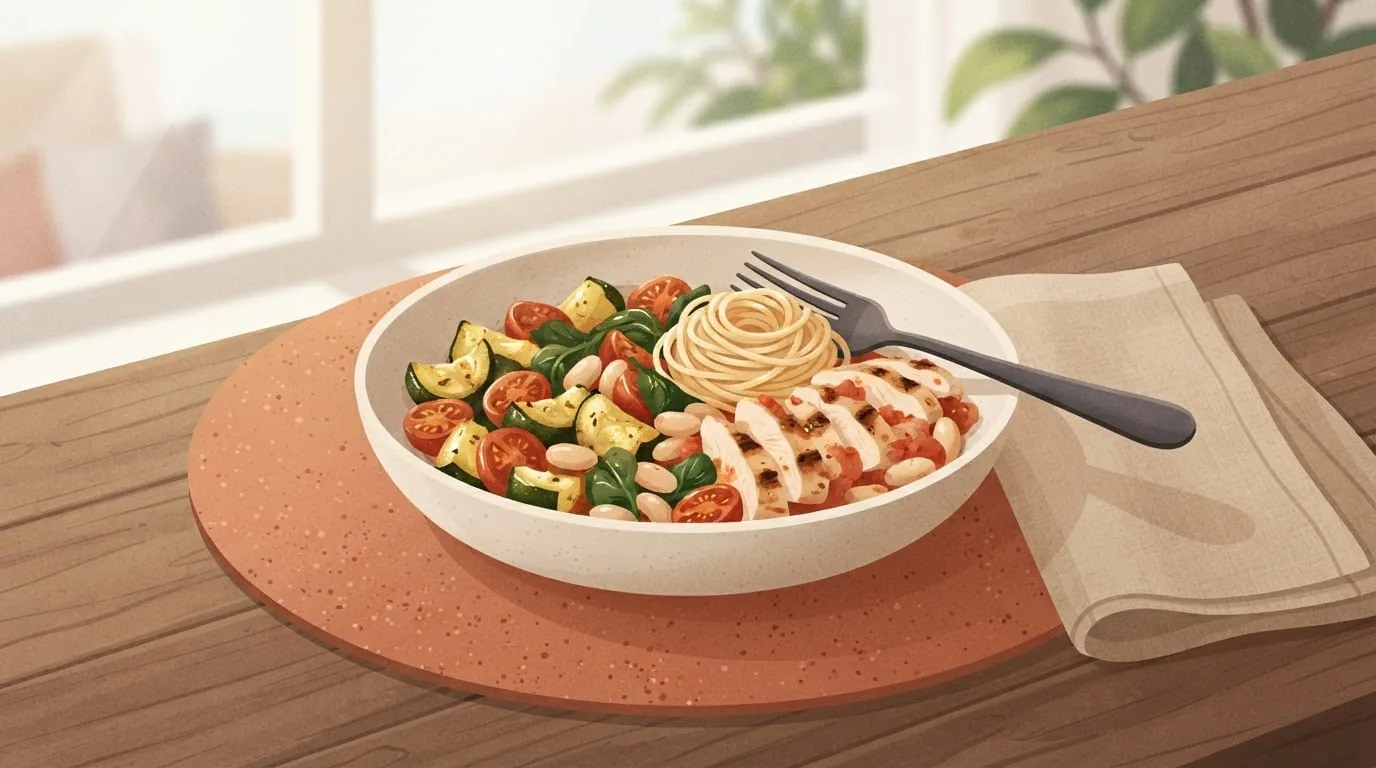
- Make vegetables half the bowl. Spinach, zucchini, peppers, mushrooms and tomatoes add volume and fiber for very few calories.
- Add a real portion of protein. Chicken, fish, lean beef, eggs, tofu, beans or lentils make the meal more filling and protect muscle while you eat less.
- Watch the sauce. Tomato sauces are light. Cream, butter and a mountain of cheese can double the calories of the bowl.
Food is half of the plan. The other half is training you keep doing, and that's where most weight-loss plans quietly fall apart. Our roundup of the best workout apps for weight loss compares the apps built to keep you moving. FitCraft is one of the apps it covers. Its workouts use your bodyweight and dumbbells at home, a 3D AI coach demonstrates each move and calls you by name, and your streak gives you a reason not to skip tomorrow.
Knowing what to do is the easy part.
FitCraft, our mobile fitness app, pairs you with an AI coach who builds you a personalized plan around your goals, schedule, and fitness level. Every FitCraft program is designed by Domenic Angelino, MPH (Brown University) and NSCA-CSCS, with research published in the Journal of Strength and Conditioning Research and Medicine & Science in Sports & Exercise.
Take the Free Assessment Free • 2 minutes • No credit cardIs Pasta Good for Diabetes?
Pasta is one of the more diabetes-friendly starches, as long as the portion stays sensible. Its low GI comes from studies in people with diabetes, including the Jenkins and Wolever trials above. Diets built on low-GI foods also help blood sugar control over time. A meta-analysis by Chiavaroli and colleagues (2021) pooled 29 trial comparisons in 1,617 adults with type 1 or type 2 diabetes. Low-GI diets lowered HbA1c, the three-month blood sugar marker, by 0.31 percentage points more than higher-GI diets.
A low GI doesn't change the total, though. A cup of spaghetti still carries about 38 grams of carbohydrate, and two cups carry twice that. If you have diabetes or prediabetes:
- Start with a measured cup and check how your glucose meter or monitor responds. Responses differ from person to person.
- Eat the pasta with protein, vegetables and a little olive oil, which slow digestion further.
- Prefer spaghetti and other dense strands. Whole-wheat pasta adds fiber, even though its GI is about the same.
- Talk to your care team before changing your carbohydrate intake if you take insulin or medicine that lowers blood sugar.
Is Pasta Bad for Your Heart?
Not by itself. Plain pasta has about 0.2 grams of saturated fat per cup, no cholesterol and almost no sodium before the salt goes in the water. In the Women's Health Initiative data above, the women who ate the most pasta meals had a lower risk of stroke, not a higher one.
What goes on top decides the rest. A cream sauce, a pile of cheese, butter or sausage adds saturated fat and often a lot of sodium. A tomato sauce with olive oil, vegetables, beans or fish doesn't. If you're watching your cholesterol or blood pressure, change the sauce before you give up the pasta.
Which Pasta Is Healthiest?
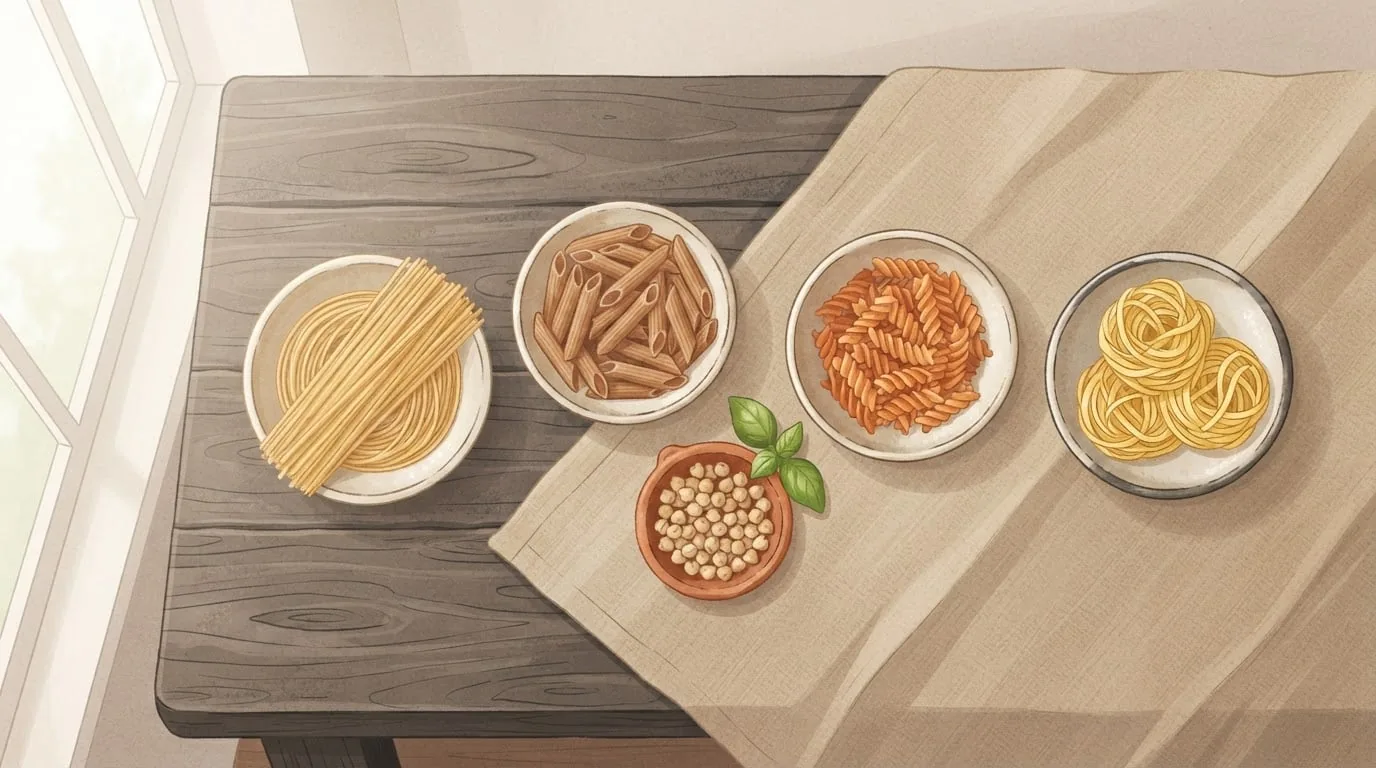
What is healthy pasta? Any common type can be part of a healthy diet, but they differ in useful ways.
Whole-wheat pasta
Whole-wheat spaghetti has about twice the fiber of regular spaghetti (4.6 against 2.2 grams a cup), nearly three times the magnesium and twice the potassium, for slightly fewer calories. Its GI is the same, 48 against 49, so the advantage is fiber and minerals rather than blood sugar. If you eat pasta several times a week, whole-wheat or a half-and-half mix is the easiest upgrade.
Bean and lentil pasta
Pastas made from chickpea, lentil or bean flour usually carry more protein and fiber than wheat pasta, and most are gluten-free. USDA has no generic entry for them and recipes vary a lot, with some blending legume flour with rice or wheat, so compare the protein and fiber on the label.
Are egg noodles healthy?
Yes, and they're closer to regular pasta than most people think. Per 100 grams cooked, egg noodles have 138 calories, 4.5 grams of protein and 2.1 grams of fat, against 158 calories, 5.8 grams of protein and 0.9 grams of fat for regular pasta. The egg adds about 29 mg of cholesterol per 100 grams. Pick egg noodles for the dish they suit, not for a health reason in either direction.
Gluten-free pasta
Rice and corn pastas are the standard choice with celiac disease. They usually carry less protein and fiber than wheat or legume pasta, so lean on the toppings. Rice noodles averaged a GI of 53 in the 2008 tables, still in the low range.
Which Is Better, Rice or Pasta?
For most goals, pasta has a slight edge. Here's a cooked cup of each, using USDA's entries for enriched pasta and for enriched long-grain white rice:
| Per cup, cooked | Enriched spaghetti (124 g) | White rice (158 g) |
|---|---|---|
| Calories | 196 | 205 |
| Carbohydrate | 38.3 g | 44.6 g |
| Protein | 7.2 g | 4.3 g |
| Fiber | 2.2 g | 0.6 g |
| Selenium | 33 mcg | 12 mcg |
| Glycemic index (boiled) | 49 | 73 |
USDA entries 169737 and 168878. Glycemic index values from Atkinson and colleagues (2008).
Pasta gives you about two-thirds more protein, more fiber and a much lower GI for about the same calories per cup. Rice has two advantages: it's naturally gluten-free, and it's lighter per gram, at 130 calories per 100 grams against 158 for pasta. If you mainly eat rice, our guide to white rice vs brown rice covers which rice to choose and how to cook it.
Is It Okay to Eat Pasta Every Day?
Yes, for most people, in a normal portion. In the Italian surveys above, pasta was an everyday food, and higher intake went with a lower BMI after adjustment. In the Women's Health Initiative, the women who ate the most pasta meals had no higher diabetes risk and a lower stroke risk.
Daily pasta works the same way as any daily staple. Keep the portion around a cup or two of cooked pasta, depending on how active you are. Use whole-wheat or legume pasta for some of those meals, put vegetables and protein in the bowl, and keep other carbohydrates in your week too, such as oats, potatoes, rice, beans and fruit.
Pasta for Runners and Lifters
Pasta's reputation as athlete food is earned. A cup of cooked spaghetti carries 38 to 47 grams of carbohydrate, depending on how tightly you pack it, and that pasta energy refills the glycogen your muscles burn in long or hard sessions. It's also cheap, easy to digest for most people and simple to cook in bulk.
How you use it depends on your training. For endurance, our guide to what to eat before a long run covers how long before a run to eat pasta and how much carbohydrate a pre-run meal needs. For strength, our guide to carbs for muscle gain sets daily carbohydrate targets by training load. In both cases, pasta is one good option among several.
Is Pasta Bad for Your Stomach?
For most people, no. Wheat pasta contains gluten, so it's off the menu if you have celiac disease or a wheat allergy. Wheat also carries fructans, fermentable carbohydrates that can cause bloating in people with irritable bowel syndrome. Our bread page covers the trials on gluten sensitivity and fructans, and they apply to pasta as well.
If regular pasta bothers you, try a smaller portion, a legume pasta, or a gluten-free rice or corn pasta. If you suspect celiac disease, see a doctor before dropping gluten, since the blood test only works while gluten is still in your diet.
How to Make Pasta Healthier
These steps keep pasta on the menu while improving what it does for you:
- Measure the pasta. About 57 grams dry per person for a light meal, more if you train hard or have high calorie needs.
- Cook it until it's still firm. Dense strands like spaghetti scored far lower than macaroni in the Wolever trial, and firm pasta is more satisfying to eat.
- Make vegetables half the bowl. Roast or sauté them and toss them through, or stir a few handfuls of spinach into the sauce.
- Add protein. Beans, lentils, chicken, fish, eggs, tofu or lean meat round out wheat protein and keep you full longer.
- Choose tomato, olive oil or vegetable sauces most nights. Save cream and heavy cheese sauces for when you'll really enjoy them.
- Swap in whole-wheat or legume pasta. Half regular and half whole-wheat is a painless start.
- Cook extra. Chilled and reheated leftovers raised blood sugar slightly less than fresh pasta in the Hodges trial.
What This Means for You
Pasta isn't the problem food it's made out to be. It digests more slowly than bread or white rice, the studies that look at pasta itself don't tie it to weight gain or diabetes, and a cup of cooked spaghetti has about 200 calories. Keep the portion honest, build the bowl around vegetables and protein, and reach for whole-wheat or legume pasta when you eat it often.
What changes your weight and health is what you repeat week after week. Stacy, 41, lost 22 pounds in four months and put it simply: "After my second kid, I needed something stupidly simple." A measured bowl of pasta with vegetables and a short workout you'll actually do again tomorrow are both about that simple.
Frequently Asked Questions
Is spaghetti healthy?
Yes, in a normal portion. A cup of cooked spaghetti has about 196 calories, 7 grams of protein and 2 grams of fiber, and white spaghetti averaged a glycemic index of 49 in the international tables, far below white bread at 75. A tomato or vegetable sauce keeps it light, while cream and cheese sauces add most of the calories.
Is pasta a healthy food?
Pasta can be a healthy food. It's low in fat and sodium, enriched pasta is a good source of selenium and folate, and studies of people who eat pasta don't link it to weight gain or type 2 diabetes. Whole-wheat or legume pasta adds fiber, and the portion and the sauce decide most of the rest.
Is pasta good for diabetes?
Pasta is one of the better starches for diabetes because of its low glycemic index, and low-GI diets lowered HbA1c by 0.31 percentage points in a meta-analysis of trials in people with diabetes. A cup still has about 38 grams of carbohydrate, so measure the portion, add protein and vegetables, and check how your own glucose responds.
Is pasta bad for you if you have high cholesterol?
No. Plain pasta has no cholesterol and only about 0.2 grams of saturated fat per cup, so it doesn't push LDL up on its own. Egg noodles add about 46 mg of cholesterol per cup. Cream sauces, cheese, butter and processed meats matter far more, so lean on tomato or olive-oil sauces with vegetables, beans or fish.
Are egg noodles healthier than pasta?
They're about the same. Per 100 grams cooked, egg noodles have 138 calories and 4.5 grams of protein against 158 calories and 5.8 grams for regular pasta, plus a little more fat and about 29 mg of cholesterol from the egg. Whole-wheat pasta beats both on fiber.
Does pasta have protein?
Yes. A cup of cooked spaghetti has about 7 grams of protein, roughly 15 percent of its calories. Wheat protein is low in the amino acid lysine, so pair pasta with beans, lentils, dairy, eggs, fish or meat to round out the meal. Bean and lentil pastas usually carry more protein than wheat pasta.
How many calories is pasta?
A cup of cooked enriched spaghetti has about 196 calories, according to USDA FoodData Central, and a 2-ounce (57-gram) dry serving has about 211. Whole-wheat spaghetti has about 174 calories per cup and egg noodles about 221, mainly because a cup of egg noodles weighs more.