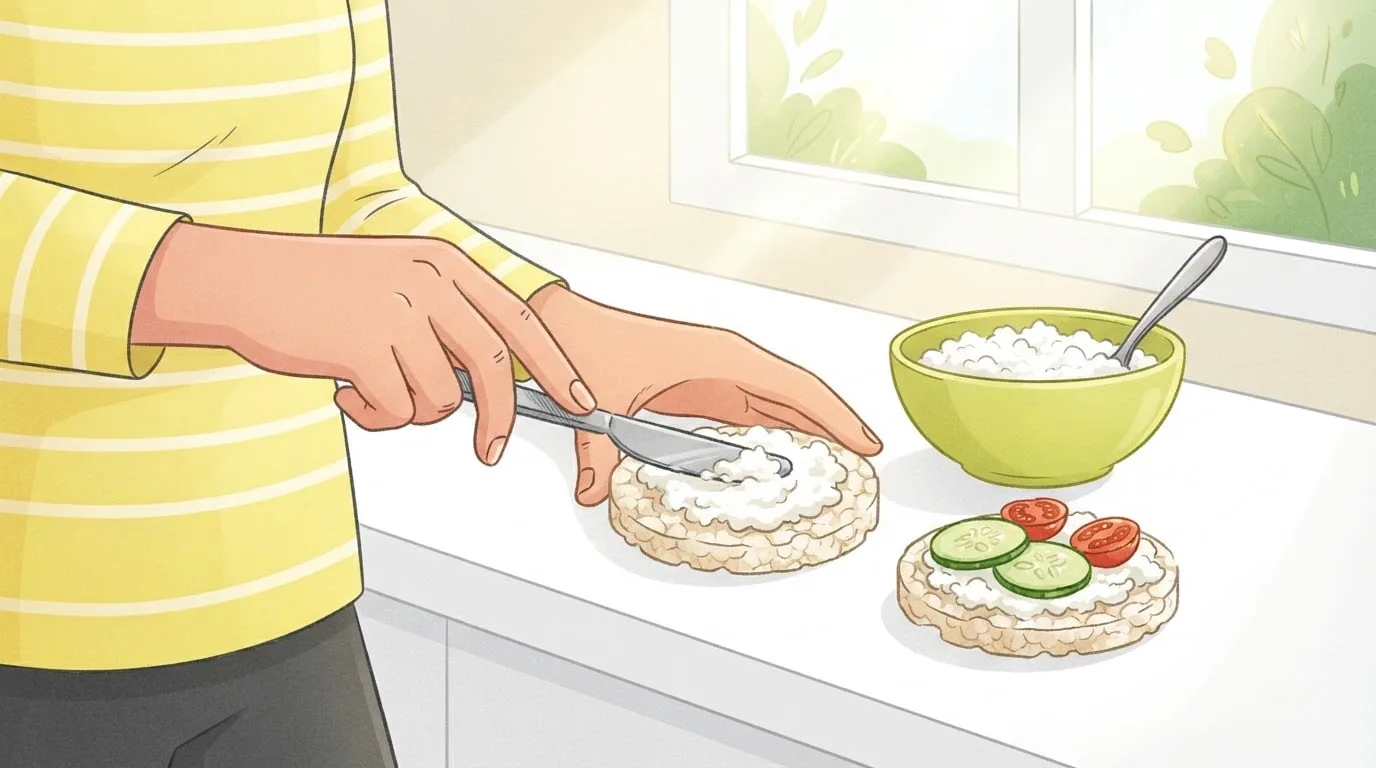
Rice cakes have been a diet-aisle staple for decades. They're crunchy, cheap, gluten free and so light that it's hard to imagine them doing any harm. Plenty of people eat them precisely because they seem to contain almost nothing.
That's the catch, and it's why the question keeps coming up. Are rice cakes healthy, are rice cakes good for you, and are rice cakes fattening if you eat a stack of them? This page goes through rice cake nutrition and calories, how puffing changes the way your body handles the rice, what they do to blood sugar, whether they help or hurt weight loss, how they compare with popcorn and chips, the arsenic question, and the toppings that turn a rice cake into a real snack.
Rice Cake Nutrition: How Many Calories Are in a Rice Cake?
A standard plain rice cake weighs about 9 grams and has about 35 calories. Here's the full picture for one plain brown rice cake, according to USDA FoodData Central:
| One plain brown rice cake (9 g) | Amount | % Daily Value |
|---|---|---|
| Calories | 35 | n/a |
| Carbohydrate | 7.3 g | 3% |
| Fiber | 0.4 g | 1% |
| Protein | 0.7 g | 1% |
| Fat | 0.3 g | 0% |
| Sodium (unsalted) | 2 mg | 0% |
| Manganese | 0.34 mg | 15% |
| Niacin | 0.7 mg | 4% |
| Selenium | 2.2 mcg | 4% |
| Magnesium | 12 mg | 3% |
| Phosphorus | 32 mg | 3% |
Values from USDA FoodData Central entry 170250 (rice cakes, brown rice, plain, unsalted), scaled to one 9-gram cake and rounded. Daily values are the FDA's adult figures. Salted versions carry more sodium, so check the label.
Two cakes, a typical snack, come to about 70 calories and 15 grams of carbohydrate. About 84 percent of a rice cake's calories come from carbohydrate. There's a little manganese and some B vitamins, but at 0.7 grams of protein and 0.4 grams of fiber per cake, a rice cake brings almost nothing that keeps you full.
Most plain rice cakes are made from whole-grain brown rice, which is why they show up when people search for whole grain rice cakes. That label is true, but it doesn't buy you much fiber here. Gram for gram, a rice cake has 387 calories per 100 grams, exactly the same as air-popped popcorn, yet popcorn has more than three times the fiber. Our look at whether popcorn is healthy covers that snack in detail.
Flavored, mini and salted rice cakes
The plain cake is the baseline. Caramel, chocolate, apple cinnamon and cheddar versions add sugar, fat or salt to a snack that already has very little protein or fiber, and the sweet ones sit closer to a cookie than a cracker. Mini rice cakes and rice crisps have about the same calories per gram as the big ones, but they come in bags, which makes it easy to eat a lot without noticing. Read the serving size on the back before you trust the calories on the front.
What Is a Rice Cake, and How Does Puffing Change the Rice?
A rice cake is rice that's been puffed under heat and pressure until the grains expand and fuse into a disk. Moistened rice goes into a hot mold, the mold closes, and when the pressure is released the water inside each grain flashes to steam and the grain puffs. In lab studies with a rice cake machine, Xie and colleagues (2008) puffed grain blends at 221 to 243°C for just 4 to 6 seconds. Earlier work by Huff and colleagues (1992) showed that the moisture of the rice, the heat and the heating time all change how far a brown rice cake expands.
That process explains rice cake nutrition. Nothing much is added, so a plain cake is just rice and sometimes salt. But the puffing cooks the starch fully and leaves it in a thin, porous structure that digestive enzymes reach quickly, and most of the cake's volume is air. You get a big, crunchy bite that weighs very little and digests fast.
Korean rice cakes are a different food
Korean rice cakes, or tteok, share the name and little else. They're steamed, pounded rice dough, dense and chewy rather than puffed. They're mostly refined starch too, so the same advice about pairing applies, but a bowl of tteokbokki carries far more calories than a couple of puffed cakes, much of it from the sweet, spicy sauce.
Rice Cakes and Blood Sugar: The Glycemic Index
Rice cakes raise blood sugar quickly. The 2008 international GI tables by Atkinson and colleagues don't list plain rice cakes on their own, but the closest entry, rice crackers and crisps, averages 87. That's higher than boiled white rice at 73, brown rice at 68 and popcorn at 65. A GI of 70 or more counts as high.
The glycemic load gives a fairer picture of one snack, because it accounts for the portion. One rice cake has about 7 grams of digestible carbohydrate, so its glycemic load is about 6, which is low. Two cakes come to about 12, which is medium. The problem isn't one cake. It's a stack of plain cakes eaten alone, which gives you a quick rise in blood sugar and very little to slow it.
What toppings do to the blood sugar spike
What you eat with the rice changes the curve a lot. In a trial by Sun and colleagues (2014), 12 healthy adults ate white rice alone or with chicken breast, peanut oil, a leafy vegetable or all three. Plain white rice had a GI of 96. Adding oil brought it to 67, chicken to 73 and the vegetable to 82, and all three together brought it down to 50. That study used cooked rice rather than rice cakes, but the principle carries over: protein, fat and vegetables on top of a rice cake slow down how fast its starch hits your blood.
Are rice cakes healthy for diabetics?
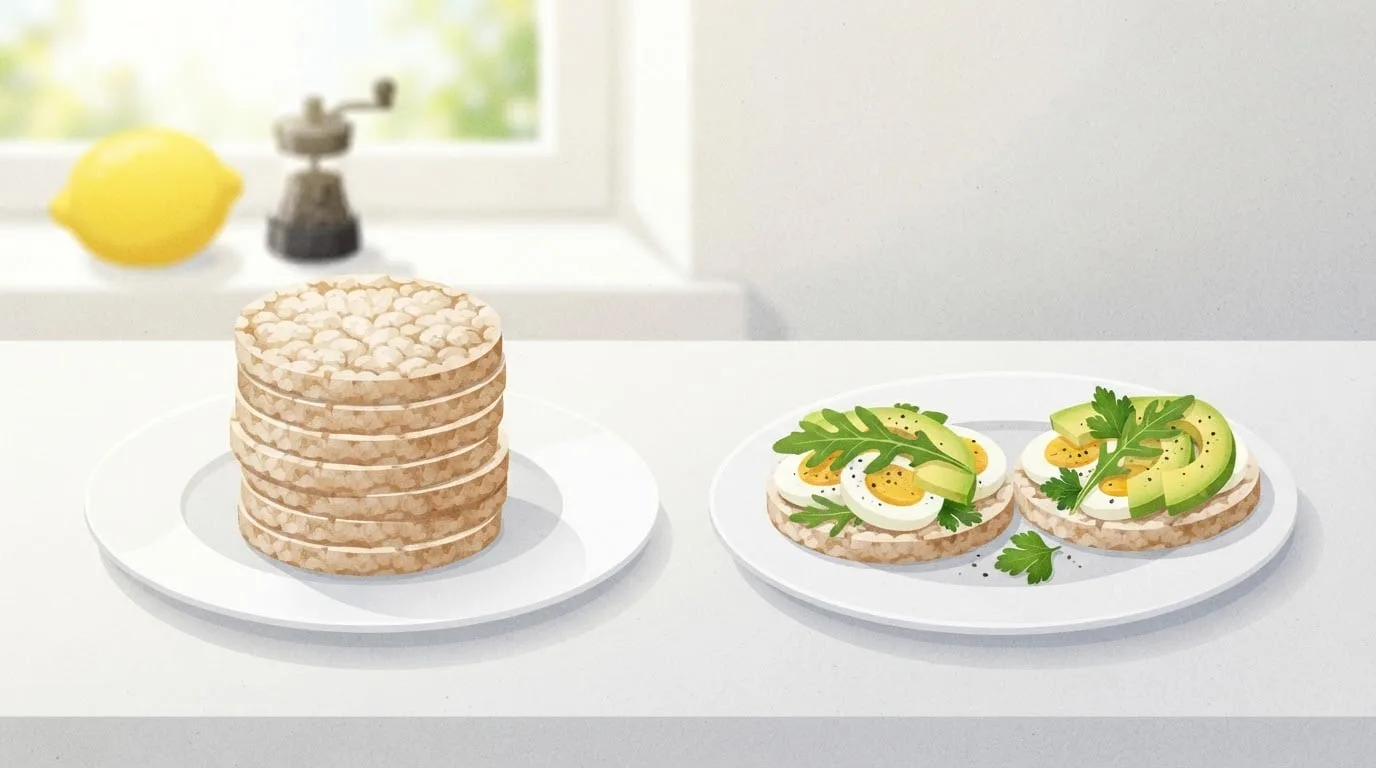
They can fit, as a measured carb serving with a topping. Two plain cakes add up to about 15 grams of carbohydrate, roughly one carb serving. Eaten with eggs, cottage cheese, nut butter or avocado, they're a reasonable snack. A stack of plain cakes on an empty stomach is the version most likely to push your glucose up fast. If you use a glucose meter or a sensor, test your own response, because it varies from person to person.
Knowing what to do is the easy part.
FitCraft, our mobile fitness app, pairs you with an AI coach who builds you a personalized plan around your goals, schedule, and fitness level. Every FitCraft program is designed by Domenic Angelino, MPH (Brown University) and NSCA-CSCS, with research published in the Journal of Strength and Conditioning Research and Medicine & Science in Sports & Exercise.
Take the Free Assessment Free • 2 minutes • No credit cardAre Rice Cakes Fattening? Rice Cakes and Weight Loss
No, rice cakes aren't fattening. At about 35 calories each, they're one of the lowest-calorie crunchy snacks you can buy, and weight gain comes from total calories over time, not from any single food. The real question is whether they help you eat less, and there the answer is mixed.
The air helps
Puffed snacks look like more food than they are. In a study by Osterholt and colleagues (2007), 28 adults ate as much as they wanted of two versions of the same cheese puff, identical in calories per gram but one far more aerated. With the airier snack they ate 21 percent fewer calories, about 70 fewer, even though they ate 73 percent more of it by volume. Rice cakes work the same way: a crunchy cake that fills your hand is only 35 calories.
The lack of protein hurts
Fullness is where plain rice cakes fall short. In a study by Marmonier and colleagues (2000), 11 young men ate an afternoon snack of equal calories that was high in protein, fat or carbohydrate, then asked for dinner whenever they felt hungry. After the high-protein snack they waited 60 minutes longer than usual for dinner. After the high-carbohydrate snack, 84 percent carbs, which is about the same share as a plain rice cake, they waited only 34 minutes longer. A snack that's almost all fast carbohydrate tends to leave you hungry again soon.
Are rice cakes good for dieting?
They're a useful base, not a complete snack. Two plain cakes for 70 calories won't hold most people for long, and it's easy to keep reaching for another. Ten cakes come to about 350 calories with only 7 grams of protein. Put a protein food on top and the same two cakes become a snack that lasts. The rule that works for every snack applies here too: protein, fiber or both for about 100 to 200 calories, which is how our guide to the best snacks for weight loss ranks its 15 picks.
Are Rice Cakes Healthier Than Chips?
Yes, plain rice cakes are healthier than potato chips for most people, mainly because they have a fraction of the fat. But popcorn beats both. Here's what 100 calories of each gets you, from USDA FoodData Central:
| Per 100 calories | Amount | Protein | Fiber | Fat | Sodium |
|---|---|---|---|---|---|
| Plain rice cakes (unsalted) | About 3 cakes (26 g) | 2.1 g | 1.1 g | 0.7 g | 7 mg |
| Air-popped popcorn | About 3 cups (26 g) | 3.3 g | 3.7 g | 1.2 g | 2 mg |
| Potato chips, salted | About 2/3 ounce (19 g) | 1.2 g | 0.6 g | 6.4 g | 99 mg |
USDA entries 170250, 167959 and 169677, scaled to 100 calories.
For 100 calories you get about three rice cakes, three cups of popcorn or a small handful of chips. The rice cakes and the popcorn give you far more food than the chips do, with almost no fat. Popcorn gives you more than three times the fiber of rice cakes and a bit more protein, so if you're choosing a plain crunchy snack on its own, popcorn is the better pick. Rice cakes win when you want a flat base to put something on.
Arsenic in Rice Cakes: How Much Is There?
Because rice grows in flooded fields, it absorbs more arsenic than most grains do, and the inorganic form is the kind linked to health problems after years of exposure. Rice cakes carry it too. In the FDA's 2013 testing of 59 rice cake samples, inorganic arsenic averaged 4.3 micrograms per serving, ranging from 0.7 to 8.2. Brown rice grains averaged 7.2 micrograms per serving and long-grain white rice 4.6 in the same program. One serving isn't the issue. The concern with inorganic arsenic is regular exposure over years, which is why regulators set limits for rice products.
The European Union treats rice cakes as a category worth regulating on their own. EU Regulation 2023/465 caps inorganic arsenic at 0.30 milligrams per kilogram in rice waffles, rice wafers, rice crackers and rice cakes, higher than the limit for white rice and three times the 0.10 limit for rice used in baby food. Because arsenic builds up in the bran, whole-grain brown rice cakes tend to carry more than white ones. Our guide to white rice vs brown rice explains why the bran holds it and how cooking rice in extra water lowers it.
Are rice cakes healthy for toddlers?
An occasional rice cake is fine for most toddlers who can manage the texture, but they shouldn't be the everyday snack. In a New Hampshire study of 759 infants by Karagas and colleagues (2016), 12-month-olds who ate rice snacks and no fish had a geometric mean urinary arsenic of 4.97 micrograms per liter, against 2.85 for babies who ate no rice products. Babies who ate rice cereal were higher still, at 9.53. Those families drew water from private wells, so their exposure may differ from yours, but the authors concluded that rice snacks add to infants' arsenic exposure. Small bodies eat more food per kilogram than adults do, so rotating rice cakes with oat, wheat or corn-based snacks, fruit and yogurt makes sense.
What Are the Downsides of Rice Cakes?
- Very little protein or fiber. Under a gram of each per cake means a plain rice cake won't keep you full for long.
- Fast-digesting carbs. The puffed starch raises blood sugar quickly when you eat the cakes plain.
- Inorganic arsenic. Small amounts in every rice product, which matters most for young children and people who eat rice at most meals.
- Easy to overeat. Each cake is light, so a whole sleeve can disappear before you register it.
- Flavored versions. Sweet and cheese coatings add sugar, fat and salt.
- Gluten in some blends. Plain rice cakes are gluten free, but multigrain ones can include rye, barley or wheat.
How Many Rice Cakes Can You Eat a Day?
There's no official limit. For most adults, two to four rice cakes a day as a snack base is a reasonable amount, as long as they carry a protein topping and aren't your only grain. If you eat a lot of rice already, at meals as well as in snacks, swap some of your rice cakes for popcorn, oats or whole-wheat crackers to spread your arsenic exposure across different grains. For young children, keep rice snacks to a few times a week.
Rice Cakes Before a Workout
The low fiber and fat that make rice cakes a weak snack make them a good pre-workout one. Before training you want carbohydrate that leaves your stomach quickly. In a survey of 55 triathletes by Rehrer and colleagues (1992), every athlete who got intestinal cramps during the race had eaten fiber-rich food in the pre-race meal, against 10 percent of those without cramps. The athletes who vomited or felt like vomiting had also eaten more fat and protein beforehand.
One rice cake with a teaspoon of honey gives you about 13 grams of quick carbohydrate for 56 calories. Two cakes with honey and a few banana slices make a bigger top-up before a long or hard session. Our guide to what to eat before a workout covers timing from five hours out down to 30 minutes.
How to Make Rice Cakes a Healthier Snack
Treat the rice cake as a plate, not the whole snack. These pairings use two plain cakes and USDA values:
| Two rice cakes plus | Calories | Protein | Best for |
|---|---|---|---|
| 1/2 cup 1% cottage cheese, cucumber and tomato | About 155 | 15 g | Most protein for the calories |
| 2 large eggs, sliced or scrambled | About 215 | 14 g | A snack that works as a light meal |
| 1 tablespoon peanut butter | About 165 | 5 g | A sweet-leaning snack with fat to slow it down |
| 2 tablespoons hummus and vegetables | About 145 | 4 g | A savory snack with extra fiber |
| 1 teaspoon honey (one cake) | About 56 | 1 g | Quick fuel 30 to 60 minutes before training |
Rice cakes from USDA entry 170250, toppings from USDA entries 173417, 171287, 172470, 174289 and 169640. Vegetable calories are small and left out.
A few more habits help. Put your topping on before you sit down, so you're eating a planned snack rather than working through a sleeve. Watch the salt in cottage cheese, which runs about 460 milligrams in half a cup, and pick a no-salt-added tub if that matters to you. And keep the honey and jam versions for the hour before a workout, when fast carbs are useful.
What This Means for You
Rice cakes are neither a health food nor a junk food. Plain, they're a light, low-fat, gluten-free carbohydrate with almost no protein or fiber, which makes them a good base and a poor snack on their own. Top them with protein, keep a couple of them in your rotation rather than all of it, and save the plain-with-honey version for before training.
No single snack decides your results, though. The pattern you repeat does: meals that mostly hold you until the next one, and workouts you keep showing up for. If the training side is what keeps slipping, our ranking of the best strength training apps compares the apps that coach you through strength workouts at home. FitCraft is one of them: a 3D AI coach demonstrates each exercise and says your name during the session, and streaks and leaderboards give you a reason to show up again tomorrow. Stacy, 41, lost 22 lb in four months: "After my second kid, I needed something stupidly simple."

Frequently Asked Questions
Are rice cakes good for you?
Plain rice cakes are fine for most people, but they aren't very nutritious on their own. One cake has about 35 calories and 7 grams of carbohydrate with less than a gram of protein or fiber. They become a good snack when you add protein, fat or vegetables on top.
Are rice cakes gluten free?
Plain rice cakes are naturally gluten free, because rice has no gluten. Multigrain versions can include rye, barley or wheat, and some are made on shared lines, so check the ingredient list and look for a certified gluten-free label if you have celiac disease.
Are rice cakes healthy to eat every day?
A couple of rice cakes a day is fine for most adults. Top them with a protein food so they keep you full, and rotate them with other snacks such as popcorn, fruit, yogurt or nuts, because rice products carry small amounts of inorganic arsenic. That variety matters most for young children.
Are flavored rice cakes healthy?
Less so than plain ones. Caramel, chocolate and cheese-flavored rice cakes add sugar, fat or salt to a snack that already has little protein or fiber, so read the label and treat the sweet versions like a cookie. Plain cakes with your own topping give you more control.
What is the healthiest snack to snack on?
The healthiest snacks bring protein, fiber or both for about 100 to 200 calories: Greek yogurt, cottage cheese, eggs, edamame, fruit, vegetables with hummus, air-popped popcorn or a measured handful of nuts. A plain rice cake becomes one of them once you add a protein topping.
What to eat when you crave junk food?
Match the craving's texture with a better food. If you want crunch, try two rice cakes with peanut butter or a bowl of air-popped popcorn; if you want sweet, try fruit with yogurt. Eating something with protein first often takes the edge off the craving.