- Women gain similar relative strength and similar percentage muscle growth as men. Roberts, Nuckols, and Krieger (2020) in the Journal of Strength and Conditioning Research meta-analyzed studies on both sexes and found nearly identical adaptations on a relative basis. The "I'll get bulky" fear has no basis in physiology.
- Strength training lowers all-cause mortality. Momma et al. (2022) pooled 16 cohort studies in the British Journal of Sports Medicine and found 30 to 60 minutes of weekly muscle-strengthening activity was associated with a 10 to 20 percent lower risk of dying from any cause.
- Lifting builds bone, even in women with osteopenia. The LIFTMOR trial (Watson et al., 2018) randomized 101 postmenopausal women with low bone mass and found supervised resistance and impact training increased spine and hip bone mineral density over 8 months, while a low-intensity control group lost ground.
- The biggest wins compound after 40. Lean mass falls 3 to 8 percent per decade and bone density falls 0.5 to 1 percent per year without intervention. Strength training reverses both, with the largest gains in women who haven't trained before.
- You don't need a barbell. Hagstrom et al. (2020) found women gained significant strength and hypertrophy across a range of training modalities, including dumbbells, bands, and bodyweight, when the protocol provided enough load and progression.
A while back a thread popped up on r/xxfitness. A woman who had built visible muscle through years of training asked others like her what it actually felt like to carry that strength around. The replies were striking. People talked about confidence, about not flinching when a partner asked them to lift something heavy, about the moment they realized they could carry both kids and all the groceries from car to kitchen in one trip. The emotional answers came easily. The physiological ones got less attention.
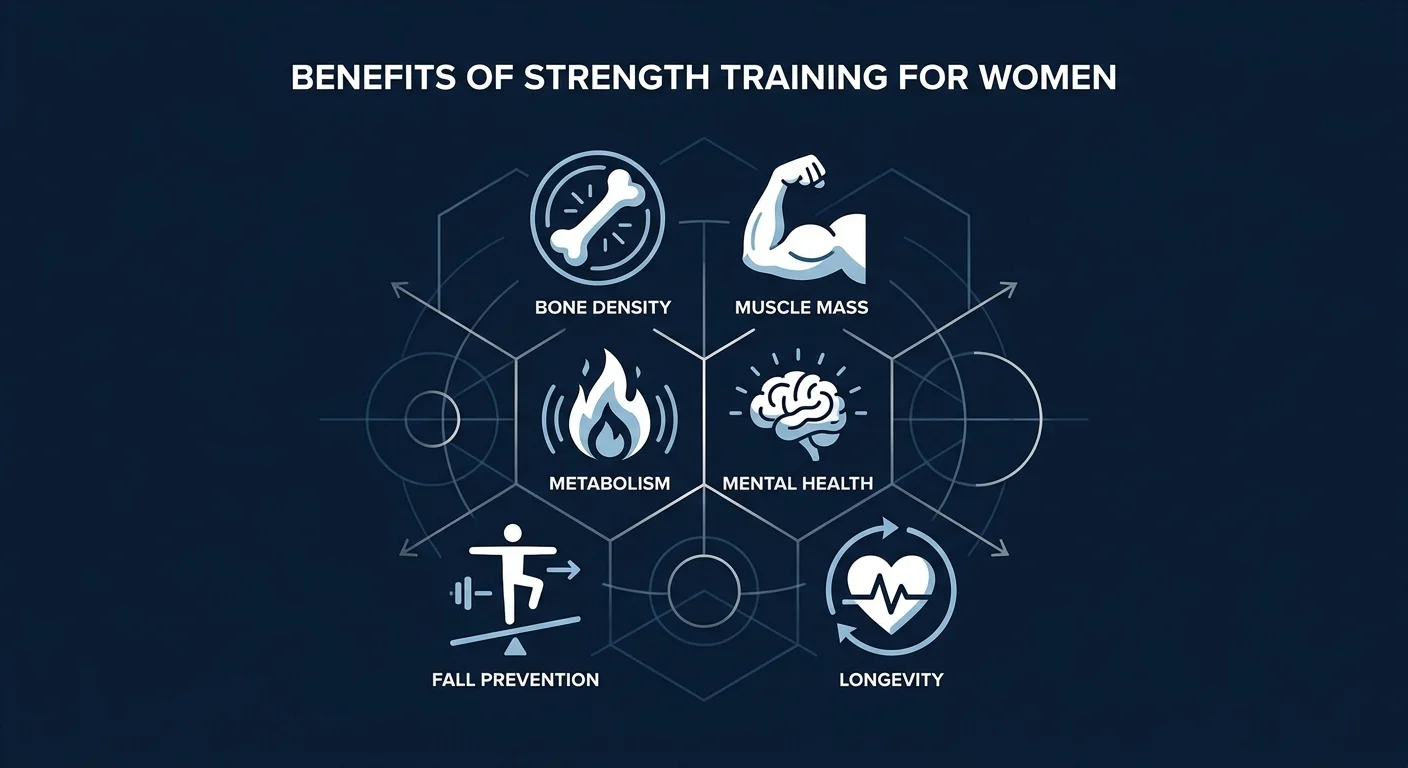
So here's the other half. Strength training does a long list of measurable things to women's bodies, most of which have nothing to do with how arms look in a sleeveless dress. The research on this is enormous, decades old, and largely settled. The summary: lifting is one of the highest-yield things a woman can do for her present-day function and her long-term health. The benefits compound across the decades, and they get larger as the baseline gets worse.
This article walks through what changes, broken down by goal and by decade, with the studies that document each claim.
Strength Training and the "I'll Get Bulky" Myth
Let's clear this one out of the way first, because it stops more women from lifting than any other single belief.
Women and men have roughly the same skeletal muscle structure, but women circulate about 5 to 10 percent of the testosterone that men do. Testosterone is the single biggest driver of absolute muscle growth, and the gap matters. When researchers compare relative changes (percentage gains in strength and muscle size, normalized to starting point), women and men adapt similarly. Roberts, Nuckols, and Krieger (2020) ran a systematic review and meta-analysis comparing the two sexes in the Journal of Strength and Conditioning Research. Relative strength gains and relative hypertrophy were nearly identical between sexes. The absolute size increase is smaller in women, because the same percentage applied to a smaller starting muscle produces a smaller absolute bump.
The practical implication is the opposite of what the bulky myth says. The visible "bodybuilder" physique requires years of deliberate, high-volume, high-load training combined with a calorie surplus. It does not occur as a side effect of two or three sensible lifting sessions a week. Women who train for general health, fitness, or strength typically end up looking more athletic and well-shaped, not larger. The bulkiness fear is solving for an outcome that takes years of intent to produce.
What Lifting Does to a Woman's Bones
This is the benefit most worth understanding deeply, because it is also the benefit that becomes impossible to recapture if you wait too long.
Bone is living tissue. It responds to load by depositing more material in the lines of stress, and to disuse by giving back material it doesn't need. Female bone mineral density (BMD) tends to peak in the late 20s, plateau through the 30s, and then decline gradually until perimenopause, when the loss accelerates. Estrogen helps regulate bone turnover; when estrogen drops, the rate of resorption outpaces the rate of formation, and BMD can fall 1 to 2 percent per year in the years immediately around menopause.
Resistance training pushes back against this. The clearest evidence in recent years is the LIFTMOR trial by Watson and colleagues (2018) in the Journal of Bone and Mineral Research. They randomized 101 postmenopausal women with low bone mass (osteopenia or osteoporosis) to either 8 months of supervised high-intensity resistance and impact training, twice a week, or a low-intensity home-based exercise program. The lifting group gained bone density at the lumbar spine (about 2.9 percent) and the femoral neck (about 0.3 percent), while the control group lost ground at most measured sites. The lifting group also improved on the timed up-and-go test, back extensor strength, and several other functional measures.
This finding mattered because previous concerns about high-intensity training in osteopenic populations had pushed older women toward gentle, low-load exercise. LIFTMOR demonstrated that supervised loading was safe in this group and produced changes that low-intensity exercise could not. The implication: for postmenopausal women with bone density concerns, "be careful and do light exercise" is the worse advice. Carefully supervised loading is what builds bone.
Lower-intensity strength work also helps, particularly in younger women still building toward peak BMD, but the dose-response curve is real. Bones respond to the magnitude of load, not the duration of activity. This is one place where harder work pays off.
Resting Metabolism, Body Composition, and Fat Loss
The other benefit women search for first is body composition. Strength training plays an unusual role here that cardio cannot replicate.
Muscle is metabolically active tissue. A pound of muscle burns roughly 6 to 10 calories per day at rest, which sounds modest until you compound it across decades and across the lean mass changes that lifting produces. Westcott (2012), in a widely cited Current Sports Medicine Reports overview titled "Resistance training is medicine," summarized intervention data from multiple studies showing that resistance training increased resting metabolic rate by about 5 to 9 percent in untrained adults over 6 months. For a woman with a baseline RMR of 1,400 kcal/day, that's a 70 to 125 kcal/day shift in the unconscious calorie burn floor, every day, forever, as long as the muscle is maintained.
Body composition shifts independent of weight matter even more. Many women who start lifting see the number on the scale move down slowly, or not at all, while clothes start fitting differently. That's because they are replacing fat with muscle. Body weight is a poor proxy for body composition; tape measurements, photographs, and how clothes fit are better signals. If the scale isn't moving but your jeans are looser, you're winning.
This pattern also explains a frustrating fact for women specifically: the scale moves slowly when strength training is the primary intervention. Hagstrom et al. (2020), in a women-specific systematic review and meta-analysis published in Sports Medicine, found that 8 to 24 weeks of structured resistance training produced significant gains in dynamic strength and muscle hypertrophy across multiple training modalities, but smaller and more variable effects on body weight. The training was working. The scale was just a noisy reporter on it.
If your priority is fat loss, the lifting still belongs in the plan. It's just paired with nutrition and (often) some cardio. Our piece on healthy habits sabotaging weight loss covers why people who lift and feel like they aren't losing are often also under-recovering or under-fueling.
Benefits Across the Decades
In Your 20s and 30s
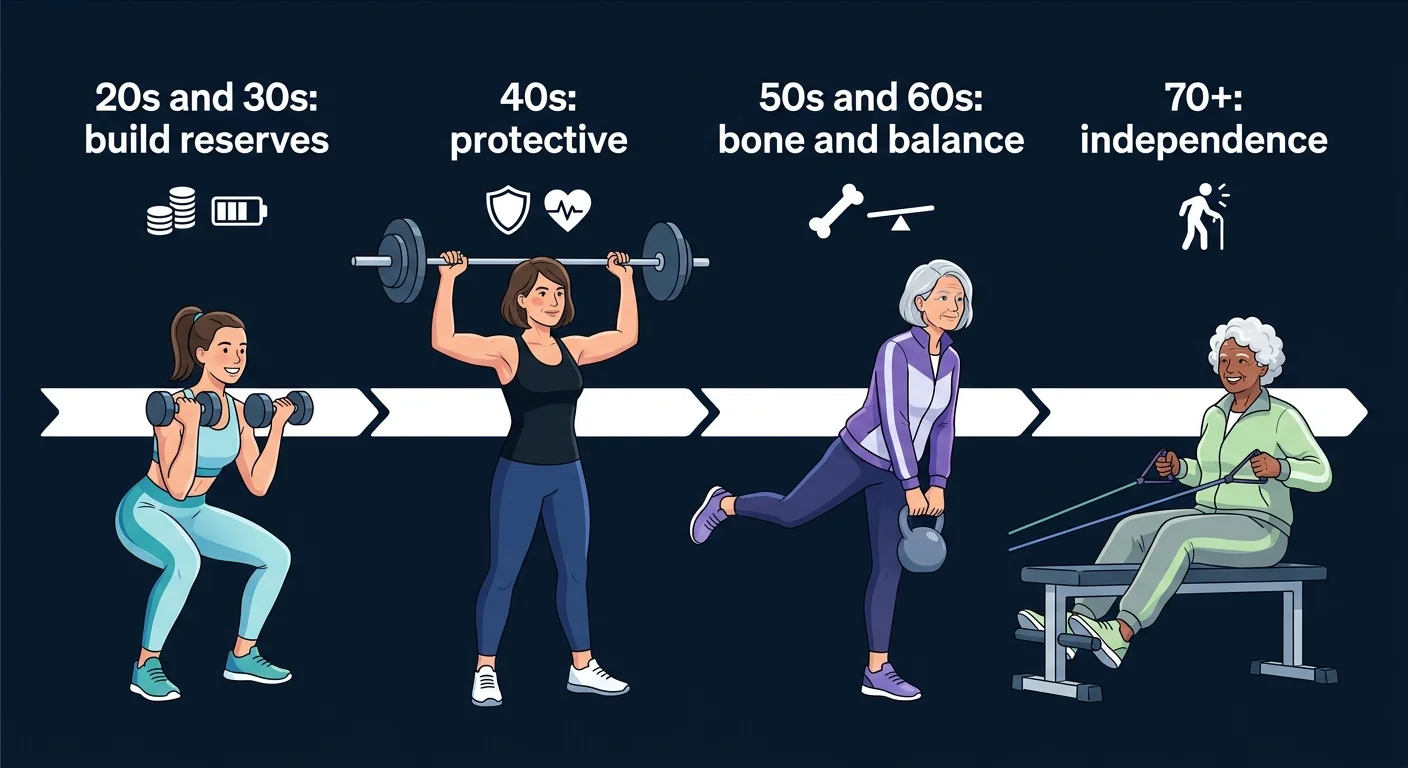
This is when bone is still building toward its lifetime peak and when you have the highest hormonal capacity for muscle growth. The benefits are real but mostly forward-looking. Every pound of lean mass and every percentage point of bone density you bank in this window is material you don't have to fight to rebuild later. It's also when you build the movement competence (squat, hinge, press, pull, carry) that makes lifting in later decades safer and more productive.
If you're in this window and feel like the urgency is low, the data disagrees. The biggest predictor of bone density at age 65 isn't training at age 65. It's bone density at age 30.
Benefits of Strength Training for Women Over 40
This is where the protective layer starts mattering. By the early 40s, lean mass loss has begun, hormonal shifts are arriving (perimenopause for many), and the metabolic ease of the 20s and 30s is fading. Strength training is the single most effective intervention against this drift. Resistance training reverses sarcopenia, raises resting metabolic rate, improves insulin sensitivity, and preserves the strength reserves that make life functional. Westcott (2012) framed it bluntly: resistance training is medicine. For women in their 40s, this is when that framing becomes most relevant.
Benefits of Strength Training for Women Over 50
The dominant benefits shift again. Bone protection moves to the top, followed by fall prevention and functional capacity. The LIFTMOR trial result is the headline study here. Postmenopausal women with low bone mass who trained twice a week with proper supervision improved bone density and physical function over 8 months. Their controls, who did home-based low-intensity exercise, did not. The lifting was not just better; it was the difference between net gain and net loss in a population that's typically told to be careful.
Fall prevention deserves its own mention. The leading cause of injury-related death in adults over 65 is a fall. The cleanest predictor of fall risk is lower body strength (rising from a chair, climbing stairs, balancing on one leg). All of these are trainable with structured resistance work. This connects to the research summarized in our sit-to-stand test and longevity piece: the easier you can stand up from the floor and from a chair, the longer you live independent.
Benefits in Later Decades
Independence becomes the goal. Can you carry groceries up the stairs, lift a grandchild, get yourself off the floor after gardening, recover from a stumble without falling? Strength training preserves the capacity to do all of these. The dose required to maintain function is smaller than the dose required to build it, but it's not zero. Two short sessions a week, with progressive load through a manageable range of motion, is enough to slow most of the decline.
The Mortality Data
This is the strongest argument for lifting that no one talks about at the gym. Strength training appears to lower the risk of dying from any cause, by a substantial amount, at a small weekly dose.
Momma, Kawakami, Honda, and Sawada (2022), in the British Journal of Sports Medicine, pulled together a systematic review and meta-analysis of cohort studies on muscle-strengthening activity and mortality. Their pooled findings: 30 to 60 minutes of muscle-strengthening activity per week was associated with a 10 to 20 percent lower risk of all-cause mortality, cardiovascular disease, and cancer compared with no strength training. The benefit appeared even after adjusting for aerobic activity. The dose-response curve plateaued above about 140 minutes per week, suggesting more was not better past a moderate threshold.
The size of this effect is striking. 30 to 60 minutes a week is two sessions of 15 to 30 minutes. That dose, performed for years, was associated with the same kind of mortality reduction that you see from substantial cardiovascular interventions. Strength training is not a marginal lifestyle choice. It is one of the most powerful upstream health behaviors available.
Knowing what to do is the easy part.
FitCraft, our mobile fitness app, pairs you with an AI coach who builds you a personalized plan around your goals, schedule, and fitness level. Every FitCraft program is designed by Domenic Angelino, MPH (Brown University) and NSCA-CSCS, with research published in the Journal of Strength and Conditioning Research and Medicine & Science in Sports & Exercise.
Take the Free Assessment Free • 2 minutes • No credit cardHow Strength Training Changes a Woman's Body
The full list of measurable changes, with the timeline you can roughly expect:
- Weeks 1 to 4, neural adaptation. You get visibly stronger before you build any meaningful new muscle. The nervous system learns to recruit more motor units, time them better, and inhibit antagonist muscles. The lifts feel easier; the mirror barely changes.
- Weeks 4 to 12, visible composition shifts. Muscle starts to grow. Body fat tends to redistribute as overall composition improves. Clothes fit differently. The scale moves slowly or not at all.
- Weeks 12 to 24, strength and capacity stabilize. The numbers on each lift settle into a pattern of slow, steady progress. Resting metabolic rate adjusts modestly upward. Bone responds to repeated loading, though density changes take longer to show up on a scan.
- Months 6 to 12, bone density gains. Bone is slow tissue. The Watson 2018 LIFTMOR trial reported its primary bone density changes after 8 months of supervised training. This is on a different clock than muscle.
- Years 1 to 5, system-level shifts. Insulin sensitivity, lipid panels, blood pressure, sleep quality, mood, and resilience to stress all tend to improve. The longer the training continues, the more these layers compound.
What About the Mental Side?
This is where the Reddit thread that seeded this article gets it right. The physiological list is impressive, but the felt experience of building strength is what keeps women training. Lifting reliably reduces symptoms of anxiety and depression in women across the studied populations. It improves self-efficacy. It changes posture. It changes what you say yes to and what you say no to.
The most common comment on threads like the r/xxfitness one is some version of "I stopped flinching." Stopped flinching when someone asked her to lift something heavy. Stopped flinching when a man assumed she couldn't. Stopped flinching at her own reflection. These are not muscle changes; they are identity changes downstream of muscle changes. The science of why this happens, and how to keep it going, is covered in our strength training after 60 piece and our perimenopause fitness guide.
What This Means for You
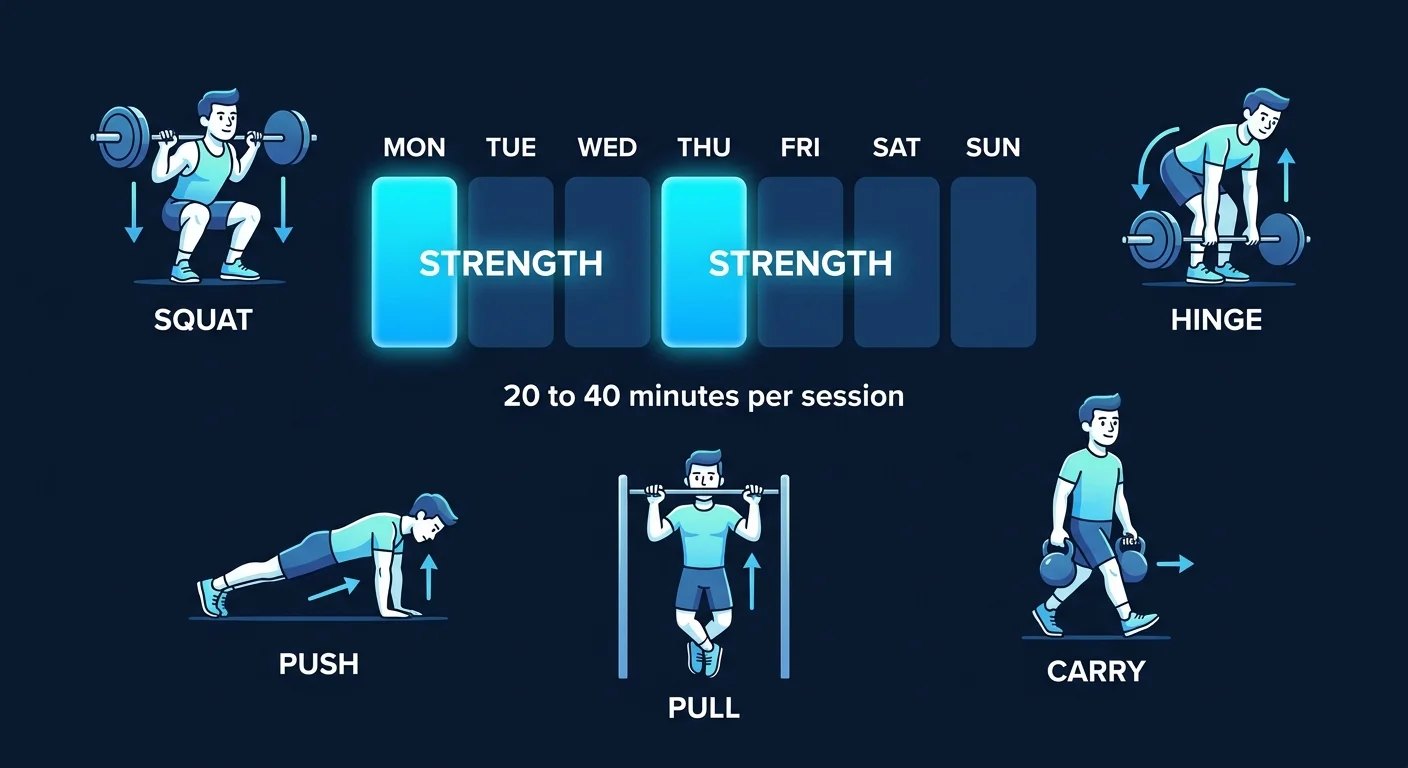
If you've been wondering whether to start, or whether what you're doing is enough, the research gives you a clean floor and a clean ceiling. Two sessions per week of 20 to 40 minutes, focused on compound movements (squat or sit-to-stand, hinge or row, push, pull, carry), is the dose that captures most of the documented benefit. You can do this with dumbbells at home, with bands, with bodyweight, or with a gym setup. The modality matters less than the consistency. If you'd rather have an app structure those sessions, our roundup of the best fitness apps for women looks at which ones handle strength programming well.
If you're under 40, the goal is building reserves. Train for strength, build the movement competence, bank the bone density. If you're 40 to 60, the goal is protection. Train to maintain lean mass, slow the bone loss, and keep functional capacity ahead of the decline curve. If you're over 60, the goal is independence. Train for the strength you need to live the life you want for as long as you want.
The two failure modes are both common. The first is never starting because of the bulky-or-injury fear. The data is clear that this fear isn't warranted. The second is starting too aggressively and burning out before adaptation has time to land. Two sessions a week, done for years, beats five sessions a week done for three months.
How FitCraft Fits In
The hardest part of strength training is not the lifting. It's the decisions. What to do today. Which exercise next. Whether to push the weight up or stay where you are. Whether to skip the session because life happened or to do a shorter version. Most women who stall out at strength training stall because the decision load is too high, not because the workouts are too hard.
FitCraft pairs you with an AI coach who builds a personalized plan around your goals, schedule, and fitness level. Programs are structured multi-week plans that progress automatically as you complete sessions, so you don't have to decide what comes next. Workouts cover yoga, mobility, strength (dumbbells, bands, bodyweight, and barbell options), and cardio, so you can find a path that fits your equipment and your preferences. Every program is designed by Domenic Angelino, our chief exercise scientist, with the same principles drawn from the research on this page.
The free assessment takes about two minutes and gives you a personalized starting point. You don't need to commit to anything else to see what FitCraft would build for you.
Frequently Asked Questions
What are the benefits of strength training for women?
Strength training builds muscle, raises resting metabolism, increases bone density, improves balance and fall resistance, helps glucose regulation, and lowers all-cause mortality. A 2022 meta-analysis in the British Journal of Sports Medicine by Momma et al. pooled 16 cohort studies and found muscle-strengthening activities of 30 to 60 minutes per week were associated with a 10 to 20 percent lower risk of all-cause mortality, cardiovascular disease, and cancer. For women specifically, Hagstrom et al. (2020) confirmed substantial gains in dynamic strength and muscle size when training is structured. The benefits compound across the decades.
Will strength training make a woman look bulky?
No, not under normal training conditions. Women have roughly 5 to 10 percent of the testosterone that men have, which is the single biggest reason men gain more absolute muscle mass. Roberts, Nuckols, and Krieger's 2020 meta-analysis in the Journal of Strength and Conditioning Research found women gained similar relative strength and similar percentage muscle growth to men, but the absolute size increase is smaller. Building visibly bulky muscle as a woman takes years of deliberate high-volume training combined with a calorie surplus. It does not happen by accident.
What are the benefits of strength training for women over 40?
After 40, the benefits shift from aesthetic to protective. Bone mineral density declines roughly 0.5 to 1 percent per year, accelerating after menopause. Lean muscle mass declines about 3 to 8 percent per decade. Resistance training reverses both. Westcott (2012) in Current Sports Medicine Reports summarized the evidence and concluded resistance training is one of the few interventions that simultaneously builds bone, preserves muscle, raises resting metabolic rate, improves glucose regulation, and reduces fall risk. For women over 40, lifting is preventive medicine.
What are the benefits of strength training for women over 50?
Bone and fall prevention become primary. The LIFTMOR trial by Watson et al. (2018) in the Journal of Bone and Mineral Research randomized 101 postmenopausal women with low bone mass to 8 months of supervised high-intensity resistance training versus a low-intensity home program. The lifting group gained bone density at the lumbar spine and femoral neck and improved functional measures like the timed up-and-go and back extensor strength. The control group lost ground on most measures. Done with proper supervision, lifting in your 50s and beyond is one of the highest-yield things you can do.
How often should a woman strength train per week?
Two to three sessions per week is the evidence-supported floor. The Momma 2022 meta-analysis in the British Journal of Sports Medicine found benefits started at 30 to 60 minutes of total weekly muscle-strengthening activity, with diminishing returns above 140 minutes per week. Hagstrom et al. (2020) found women gained measurable strength and hypertrophy with 2 to 3 weekly sessions across 8 to 24 weeks. Pick a frequency you can hold for months, not the maximum tolerable.