The r/Fitness thread that kicked this question off ("Does anyone else feel really crappy and or mildly depressed if they haven't worked out") has 910 comments and 5,957 upvotes. That alone tells you something: it is a near-universal experience among people who train regularly, and almost nobody talks about it as if it were a real biological thing. So they Google it, find vague answers about "endorphins," and decide they must be addicted to exercise. Most of them are not addicted. They are experiencing a documented withdrawal effect that has been studied in controlled trials.
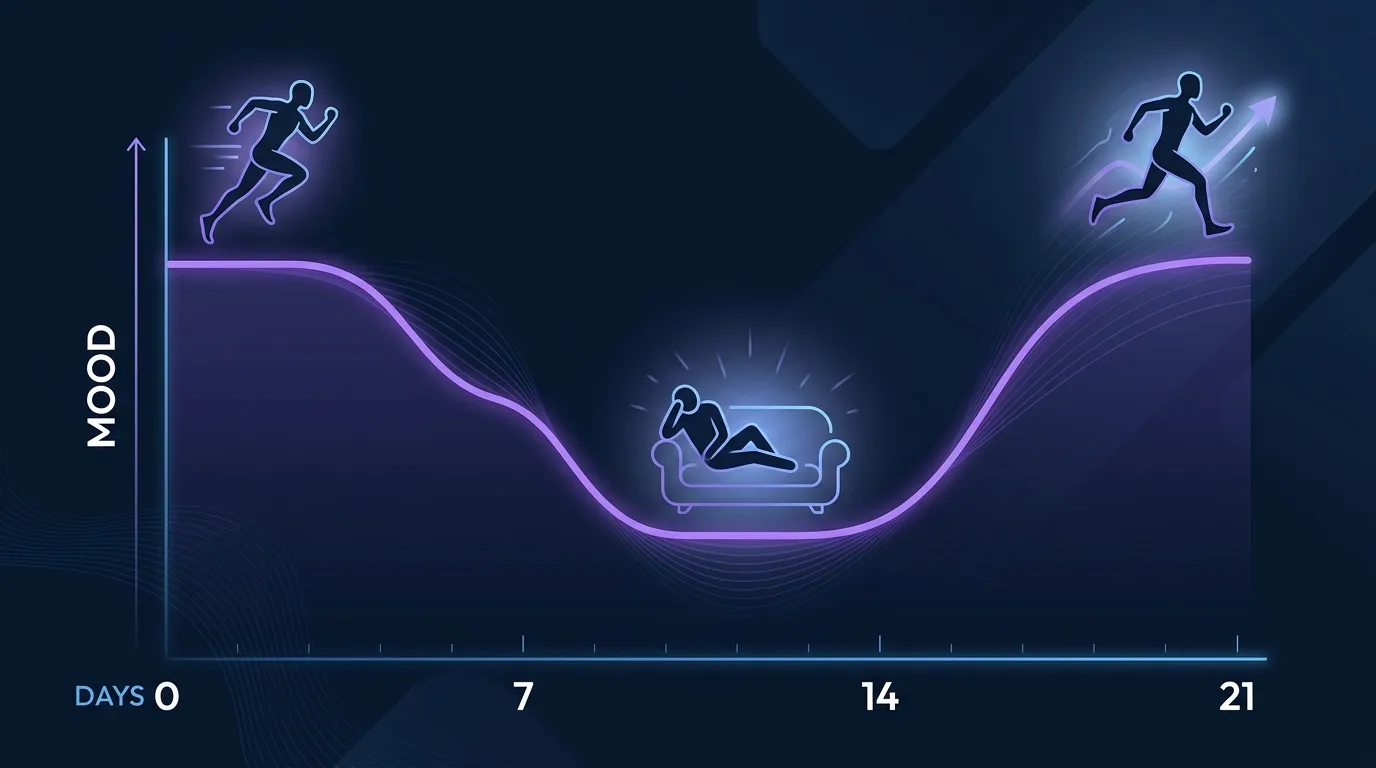
The short version. If you train consistently for several months or years, your brain rewires around that input. BDNF (brain-derived neurotrophic factor) rises chronically. Dopamine and serotonin signaling stabilize. The HPA-axis stress response normalizes. Inflammation drops. When you take the input away, all of those systems wobble for 1 to 3 weeks before they re-stabilize at a lower setpoint. That wobble feels like a mood dip. It is real, it is biology, and it is mostly self-correcting once exercise resumes.
Below is what five of the better studies actually found, why the effect is bigger in some people than others, and the practical part. What to do when you genuinely cannot train (injury, travel, sickness, schedule blow-up) and the mood is starting to slide.
The Research: What Studies Show
Berlin, Kop, and Deuster (2006): The Best Controlled Trial
This is the most carefully designed study on exercise withdrawal in healthy adults. Berlin and colleagues recruited 40 habitual exercisers (averaging 45 or more minutes of vigorous exercise 6 days per week) and randomized them to two groups for 2 weeks. One group continued training as usual. The other stopped completely.
The stopped group showed measurable increases in depressive mood symptoms (POMS depression subscale rose significantly) and fatigue starting around day 3 and reaching their largest gap from controls at day 7. Vigor dropped. The effect was correlated with markers of reduced fitness, meaning the brain was responding to the underlying physiological change, not just the absence of the workout itself. Importantly, the mood changes were transient. Within days of resuming training, the stopped group returned to baseline.
The authors framed the finding pretty cleanly: "Depressive symptoms and fatigue increased significantly during the exercise withdrawal period in regular exercisers, paralleling measurable losses in fitness." Translation: when you stop, your brain notices a real change in your physiology and treats it accordingly.
Antunes and Colleagues (2016): Inflammation and Mood Together
Antunes and colleagues, publishing in Physiology and Behavior, recruited exercise-addicted athletes and a control group of habitual but non-addicted exercisers. Both groups stopped training for 14 days under controlled conditions. The researchers tracked mood (POMS scale), inflammatory cytokines, and neurotransmitter markers across the 2-week withdrawal period.
Both groups showed mood deterioration. The exercise-addicted subgroup showed a bigger drop, with significant increases in depression, fatigue, confusion, and anger scores compared with the non-addicted group. Inflammatory markers (IL-6, TNF-alpha) shifted in parallel, and the authors interpreted this as evidence that exercise withdrawal is a multi-system phenomenon, not just a psychological reaction to missing a workout.
The practical implication. The size of your withdrawal dip scales with how much you typically train. A 2-day rest in someone who exercises 3 times a week is unlikely to produce a noticeable mood change. A 2-week forced rest in someone who trains 6 times a week with high intensity often produces measurable depression, irritability, and fatigue. If you have ever wondered why your worst weeks are the ones after a sprained ankle or a flu, this is part of the answer.
Weinstein, Maayan, and Weinstein (2015): The Compulsion Question
The bigger question lurking behind "I feel depressed when I do not work out" is "am I addicted to exercise?" Weinstein and colleagues in the Journal of Behavioral Addictions looked at the relationship between compulsive exercise, depression, and anxiety in a large sample of habitual exercisers using validated questionnaires.
Their finding. Compulsive-exercise scores correlated with depression and anxiety scores, but the direction is messy. Some people exercise compulsively because they are anxious or depressed and the exercise feels stabilizing. Some develop compulsion through repeated reinforcement and only later show mood disturbance when forced to stop. The two patterns coexist in the population, and the screening tools cannot always separate them. The authors emphasized that diagnosable exercise addiction is rare (under 3 percent in most population estimates), while mild withdrawal-like mood effects on missing a workout are extremely common among regular exercisers.
If you read enough of this literature, the take-home is clear. Feeling worse when you miss workouts is the rule, not a clinical red flag. Training through injury, missing important obligations, sacrificing food or sleep to maintain training, or continuing to train when a clinician told you to stop are the red flags. The mood dip itself is not.
The Mechanism: BDNF, Dopamine, and Inflammation
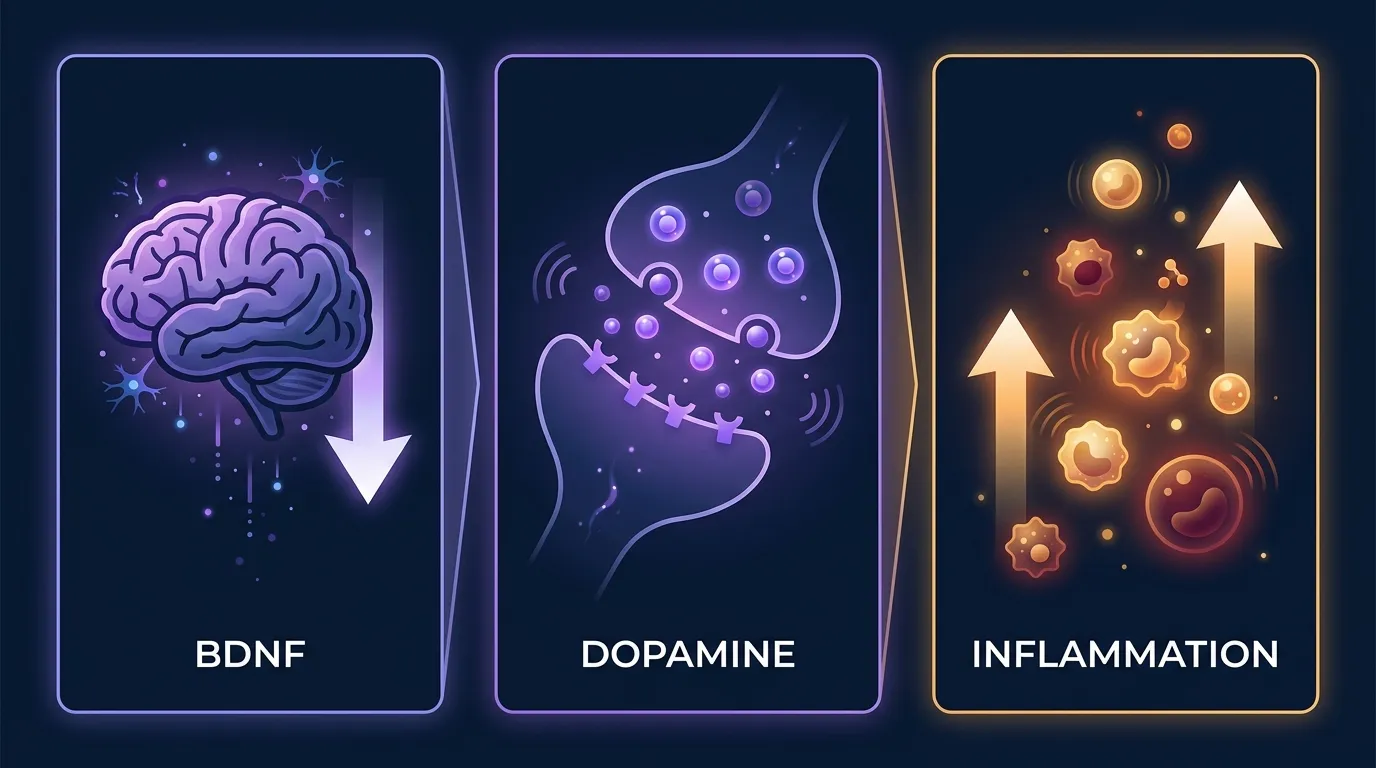
Why does the brain react this way? Three mechanisms keep showing up in the research.
First, BDNF (brain-derived neurotrophic factor) rises chronically with regular exercise and supports neurogenesis, synaptic plasticity, and mood stability. Schuch and colleagues (2016) in their meta-analysis on exercise as a depression treatment documented BDNF as one of the central mediators. Stop exercising, and BDNF drops within 1 to 2 weeks, which removes part of the active antidepressant input the brain had adapted to.
Second, dopamine signaling stabilizes with regular exercise. The acute hit of dopamine from a workout is part of what makes training feel rewarding. But chronic exercise also upregulates dopamine receptor density and tonic dopamine availability. Removing the input causes a temporary downshift in baseline dopamine signaling, which feels exactly like the low-vigor, anhedonia-adjacent mood that people describe. We covered some of this pathway from a different angle in our dopamine and exercise piece.
Third, exercise downregulates chronic inflammation, and inflammation is a known driver of depressive symptoms (the inflammation-depression link is one of the more robust findings in psychiatry in the last decade). When you stop exercising, inflammatory markers slowly rise again, and the mood follows. Antunes (2016) directly measured this in the 2-week withdrawal study and found IL-6 and TNF-alpha shifts that paralleled the depression score increases.
Stack these together and you have a clear biological reason the brain protests when you stop. It is not a moral or willpower issue. It is your nervous system responding to a real physiological change in the inputs it had adapted to.
Knowing what to do is the easy part.
Take the free FitCraft assessment and get a personalized plan based on behavioral science, not willpower.
Take the Free Assessment Free • 2 minutes • No credit cardWhy This Matters Practically
The first practical lesson is mental. If you have ever beaten yourself up for "needing" workouts to feel okay, the research says you are not weak or dependent in any clinical sense. Your brain adapted to a real, healthy input. When the input goes away, the system temporarily destabilizes. That is normal physiology, the same as feeling bad when you suddenly start sleeping 4 hours a night.
The second practical lesson is structural. The size of your withdrawal dip scales with the volume and frequency of your usual training, which means how you manage forced rest matters more for people who train hard. The classic mistake is to swing all the way to zero (no movement, no light cardio, no walks) the moment you cannot do your normal workout. The smarter pattern, supported by every exercise-withdrawal study that included an active comparison condition, is to replace some of the lost stimulus with low-impact, low-time-cost substitutes.
And the third lesson is timing. The withdrawal mood curve is real, but it is also predictable: rising for 1 to 2 weeks, plateauing, and resolving fast once exercise resumes. Knowing the shape helps you wait it out without panicking and making bigger life decisions (quitting things, starting medications, changing jobs) on the basis of a mood that will mostly fix itself in 14 days.
What To Do When You Cannot Train
Five rules drawn from the research and from coaching people through forced rest periods.
1. Walk every day, even if briefly. Walking is the cheapest insurance against the worst of the mood dip. Schuch and colleagues' meta-analysis showed even moderate-intensity activity produces a meaningful antidepressant effect. Twenty minutes of brisk walking is rarely contraindicated by anything that took your usual training off the table. It will not fully replace your normal workouts, but it stops the BDNF drop from being as steep. Our walking after meals piece covers the related benefits.
2. Keep one input that drove your usual mood lift. If your normal training has a social component (a class, training partners, a group chat), keep the social part going even when the workout part is gone. The mood support from regular exercise comes partly from the activity itself and partly from the social structure around it, and the social structure is usually still available. Our social accountability research piece goes deeper on the mechanism.
3. Sleep and protein. Both directly support BDNF and the neurotransmitter systems hit by withdrawal. Sleep restriction amplifies inflammatory markers (the same ones rising during exercise withdrawal), so getting 7 to 9 hours during forced rest is more important than usual. Protein at 1.6 to 2.2 grams per kilogram supports the same systems. This is not the moment to also start a calorie deficit. We covered the broader pattern in our healthy habits sabotaging weight loss piece.
4. Mobility, stretching, or yoga. Low-load movement counts. Stretching sessions produce smaller BDNF and mood effects than vigorous training, but they are not zero, and they keep the daily structure of "I move my body" intact. That structure matters for what comes next: returning to training cleanly without a sense of having broken the habit.
5. If the dip lasts beyond 2 to 3 weeks after resuming training, talk to someone. Exercise withdrawal is short-lived by design. If you are back to your normal routine and the mood has not recovered, the original mood drop may have been masking something the exercise was keeping in check. That is a useful diagnostic, not a failure. Persistent low mood, sleep changes, appetite changes, or anhedonia lasting 2 weeks or more meets the threshold for clinical evaluation. Your normal training was an active treatment. Removing it can reveal an underlying condition that deserves real care.
Common Misconceptions
"I am addicted to exercise"
Almost certainly not in any clinical sense. Diagnosable exercise addiction (sometimes called exercise dependence) is rare. It requires a constellation of features: training through serious injury, sacrificing other major life domains for training, distress at any interruption, escalating intensity over time, and continuing despite negative consequences. Mild mood disturbance when you miss workouts is the much more common pattern of exercise withdrawal, which is biological adaptation to a beneficial habit, not a disorder.
"This means I need to work out every day"
The research does not support that conclusion. Recovery is real and necessary. People who train 3 to 5 times per week (with rest days in between) get most of the brain-and-mood benefits of regular exercise without the larger withdrawal drops that come with very high-volume training. If you find your withdrawal mood dips are unmanageable, the answer is usually to reduce training volume slightly so the system depends less on it, not to train through every fatigue signal to avoid the dip.
"This is just endorphins"
Endorphins are real and contribute, but they are not the main story. The research has moved well past the 1980s "runner's high = endorphins" framing. Modern reviews emphasize BDNF, endocannabinoid signaling, dopamine, serotonin, HPA-axis adaptation, and inflammation reduction as the primary mechanisms behind exercise's mood effects. Endorphins are one input among several, and probably not the dominant one for chronic mood stabilization. The takeaway is that the system is multi-channel, which is why exercise produces such a robust antidepressant effect across populations.
"If I stop training, all the mental health benefits go away"
Some, not all. The withdrawal-driven mood dip is the immediate cost. But the underlying capacity changes (cardiovascular fitness, muscle mass, sleep quality, hormonal balance, insulin sensitivity) decay much more slowly than mood. Our detraining science piece goes through the timeline. The longer-term mental health benefits of having trained at all (improved depression history outcomes, lower dementia risk, better stress tolerance) persist for months to years. So missing 2 weeks does not "undo" your fitness in any meaningful sense, even though it can feel like it does in the moment.
The Bigger Picture
The pattern this article describes (your brain adapting to exercise, then protesting when you stop) is one of the strongest pieces of evidence that regular exercise is doing something real and pharmacologically active, not just providing a distraction or a temporary endorphin hit. The withdrawal effect is uncomfortable, but it is also a marker that the practice is working at a deep biological level.
The pragmatic relationship to have with this is the same one most people develop over years. Train consistently because the cumulative benefits are large. Take rest days because recovery is part of training. When forced rest happens, manage the predictable mood dip with the substitutes above. Resume training when you can. Watch the dip resolve.
And if you have not yet built the consistent training practice that produces these benefits, our guide to building an exercise habit without willpower covers the behavioral science of getting there in a way that does not depend on motivation.
Frequently Asked Questions
Is it normal to feel depressed when not working out?
Yes, and it is a documented phenomenon called exercise withdrawal. Weinstein and colleagues (2015) and a controlled study by Berlin and colleagues (2006) in Psychosomatic Medicine both found that habitual exercisers who stopped training experienced significant increases in depressive mood, fatigue, anxiety, and irritability within 1 to 2 weeks of cessation. The effect is more pronounced in people who exercise frequently and intensely, and it tends to resolve once exercise resumes. The mechanisms involve reduced BDNF (brain-derived neurotrophic factor), shifts in dopamine and serotonin signaling, and inflammatory marker changes.
How quickly do exercise withdrawal symptoms start?
Within days. Berlin and colleagues (2006) measured mood in 40 habitual exercisers (averaging 45+ minutes 6x per week) randomized to either continue training or stop. The exercise-withdrawal group showed measurable increases in depressive symptoms and fatigue by day 3 and significant differences from controls by day 7. Antunes and colleagues (2016) saw a similar timeline in exercise-addicted athletes after 14 days of forced rest. The faster onset in people who train more frequently suggests the brain rapidly adapts to expect regular exercise as a baseline mood input.
Am I addicted to exercise if I feel bad when I miss a workout?
Probably not. Exercise addiction is a clinical syndrome involving compulsive training that causes harm to relationships, work, health, or finances, and continues despite injury or medical advice to stop. Feeling slightly off or low-energy when you skip a workout is the much more common pattern of exercise withdrawal, which the research distinguishes from clinical addiction. Weinstein, Maayan, and Weinstein (2015) found that mild withdrawal-like mood effects happen in a large fraction of regular exercisers, while diagnosable exercise addiction is rare (under 3 percent in most population studies). The signal you should worry about is not the mood dip itself but whether you train through injury, miss work, or sacrifice sleep and food to keep training.
What can I do to feel less depressed when I cannot work out?
First, accept the mood dip as biology, not personal failure. Berlin's 2006 study showed the effect was strongly tied to reduced fitness markers, meaning your brain is responding to a real physiological change, not making it up. Second, replace some of the exercise function with substitute behaviors: light walking, stretching, mobility work, and social activity all blunt the mood drop in the research without re-triggering an injury or schedule conflict. Third, prioritize sleep and protein, which support BDNF and neurotransmitter regulation. Fourth, if the dip lasts more than 2 to 3 weeks after exercise resumes, or it crosses into clinical depressive symptoms (persistent low mood, anhedonia, sleep or appetite disruption), talk to a healthcare provider. Exercise withdrawal is real but short-lived, and persistent depression deserves clinical evaluation.
Does exercise actually treat depression, or does it just mask it?
Treats, not masks. Schuch and colleagues (2016) published a meta-analysis in the Journal of Psychiatric Research adjusting for publication bias and found exercise produced a large antidepressant effect (SMD -1.11) in clinical depression, comparable to or larger than first-line pharmacological treatment in some comparisons. The mechanism is well-mapped: regular exercise increases BDNF, normalizes HPA-axis stress response, reduces inflammation, and increases dopamine and serotonin signaling. So the mood dip when you stop exercising is not just losing a distraction. It is losing an active treatment your brain had adapted to.