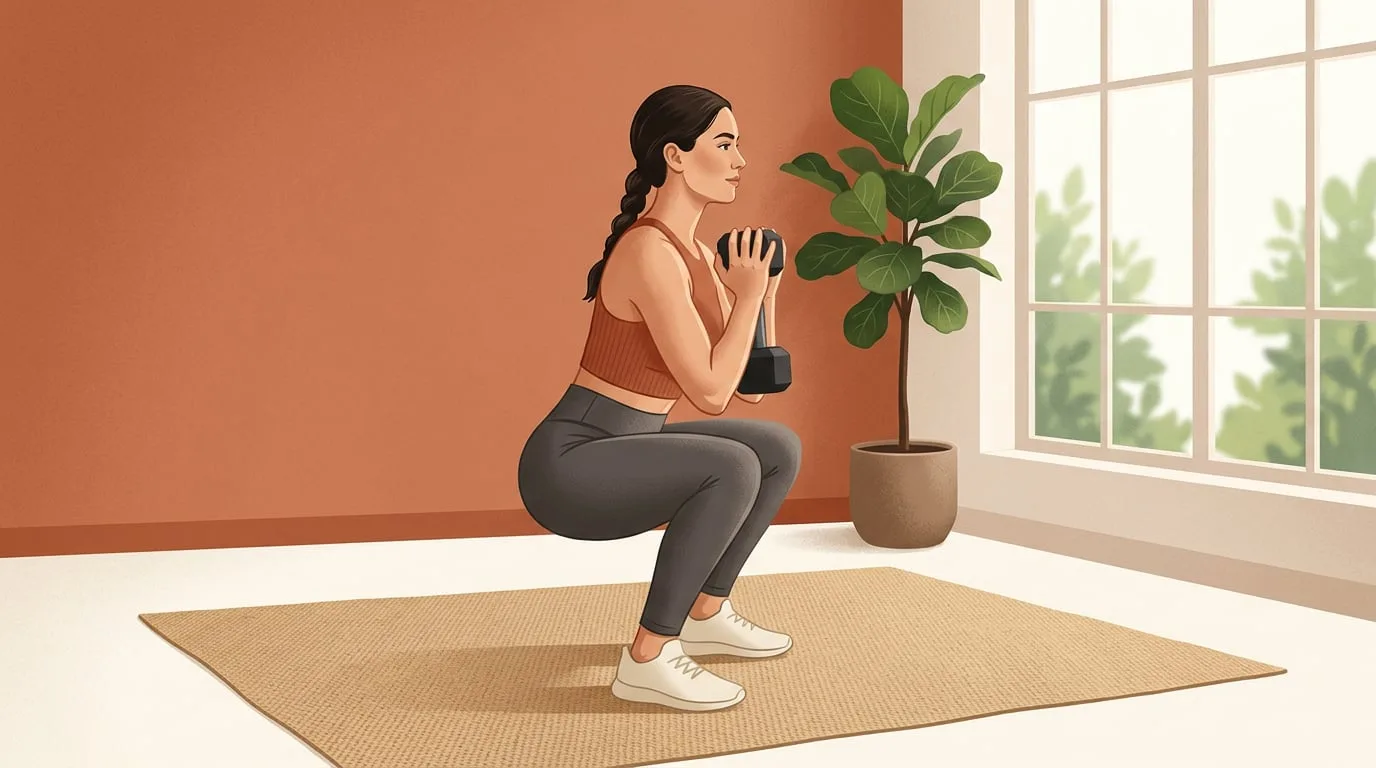
You've been squatting for weeks. Your thighs burn, your jeans feel tighter around the quads, and your butt looks about the same. So you start to wonder whether squats work glutes at all, or whether the internet was wrong again.
It's a fair question, and the answer isn't a plain yes or no. Squats can build a bigger butt, and an MRI trial has measured exactly how much. But the half squats and easy daily sets most people do build far less glute. The difference comes down to three settings you control: how deep you go, how wide you stand and how hard each set is.
Below you'll find what squats work, which squats make your butt bigger, what the depth, stance and load studies found, whether squats make your bum bigger or smaller, and a squat progression you can run at home with dumbbells.
Do Squats Work Glutes?
Yes, squats work the glutes, but they aren't a glute-only exercise. The best evidence comes from Kubo, Ikebukuro and Yata (2019) in the European Journal of Applied Physiology. They trained 17 men twice a week for 10 weeks and measured every major thigh and hip muscle by MRI. Here's what the full-depth squat group grew:
- Gluteus maximus: +6.7%. The main muscle of your butt and the one that gives it shape.
- Adductors (inner thigh): +6.2%. These help drive you out of the bottom of a deep squat.
- Knee extensors (quads): +4.9%. The front of the thigh grew about the same whether the squats were full or half depth.
- Hamstrings and rectus femoris: no change. Squats don't build the back of the thigh, whatever their reputation.
So a squat is a glute, quad and inner-thigh exercise. If you want a bigger butt without much bigger thighs, keep squats in your program but pair them with a hip-hinge or bridge movement. Our guide to growing your glutes covers how squats compare with hip thrusts and how many weekly sets you need.
Which Squats Make Your Butt Bigger?
These are the squats for a bigger butt that you can do with a pair of dumbbells or your body weight, ranked by how much glute work they deliver. The reasons come from the depth, stance and load studies in the next three sections.
- Deep goblet squat. Hold one dumbbell at your chest and sit your hips below your knees. The weight in front acts as a counterbalance, which makes full depth easier to reach. Our goblet squat guide covers setup and the common mistakes.
- Sumo goblet squat. Stand with your feet about one and a half to two times shoulder width, toes turned out, holding a dumbbell between your legs. The wide stance raises glute and inner-thigh activity.
- Bulgarian split squat. Rear foot on a bench or sofa, a dumbbell in each hand. One leg handles most of your body weight, so a light pair of dumbbells becomes a heavy set. Lean your torso slightly forward to bias the glute.
- Dumbbell split squat or reverse lunge. The same idea with both feet on the floor. It's easier to balance and a good step before the Bulgarian version.
- Paused bodyweight squat to a low box. For beginners. Sit to a box or step just below knee height, pause for 2 seconds and stand. The pause removes the bounce, so the glutes do the lifting.
Which squats won't make your butt bigger? Half squats and quarter squats, narrow-stance squats with the heels raised, which tend to shift the work toward the quads, and any squat you can do 40 times in a row. Those either stop short of the range where the glutes work hardest or are too easy to build muscle.
Why Squat Depth Matters Most for Glute Growth
Depth decides how much of each squat your glutes actually do. The gluteus maximus extends the hip, and it's stretched and under the most load when your hips are deepest. Stop halfway and you skip that part of the rep.
Muscle activity shows the shift. Caterisano, Moss, Pellinger and colleagues (2002) recorded four hip and thigh muscles in 10 experienced lifters squatting to three depths in the Journal of Strength and Conditioning Research. The gluteus maximus share of the total activity during the lift rose from 16.9% in partial squats to 28.0% at parallel and 35.4% at full depth. The relative shares of the quads and hamstring didn't change significantly. Going deeper mainly brought in more glute.
The training studies confirm that the extra activity turns into muscle. In the Kubo trial, the full squat group grew three times as much glute (6.7% vs 2.2%) and more than twice as much adductor (6.2% vs 2.7%) as the half squat group, while quad growth was similar in both. Bloomquist and colleagues (2013) found the same pattern for the front of the thigh: 12 weeks of deep squats to 120 degrees of knee bend produced larger gains in front-thigh muscle size than shallow squats to 60 degrees.
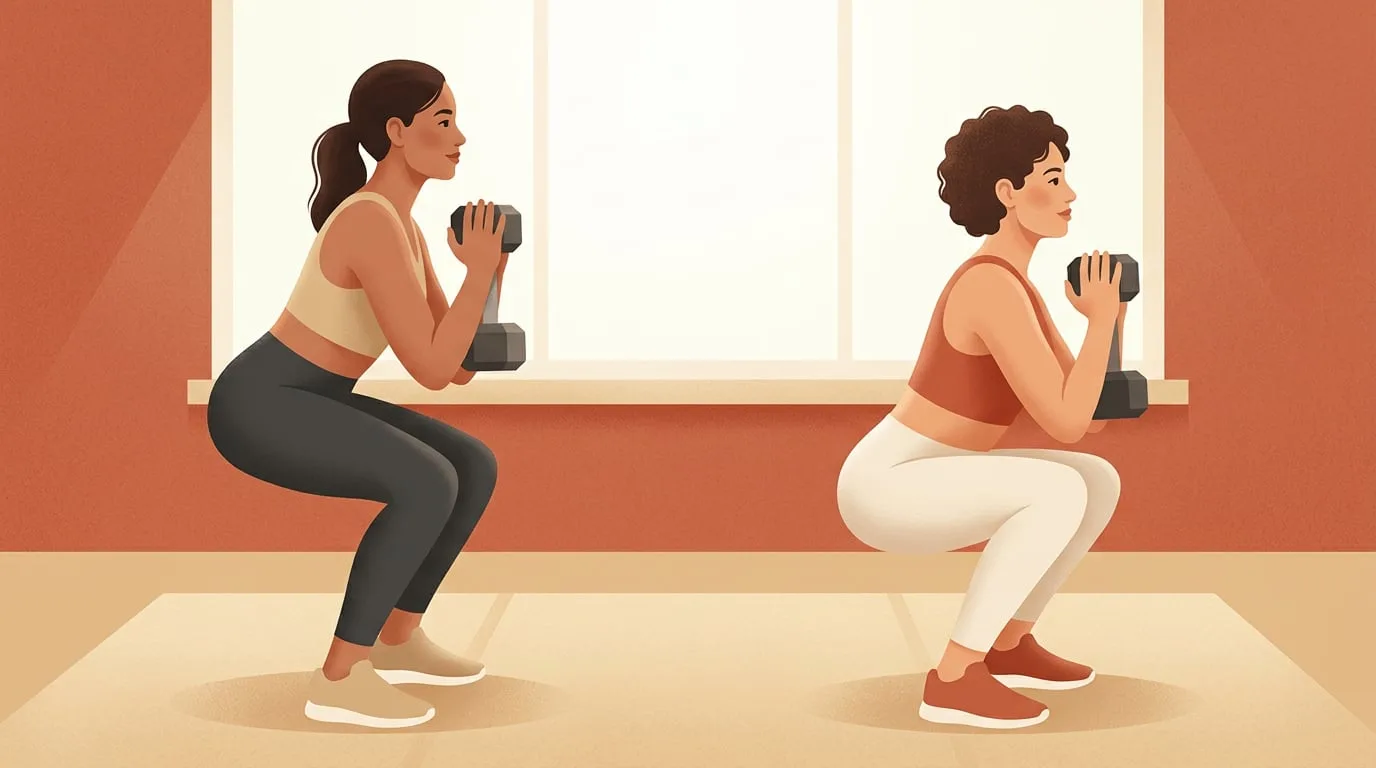
How deep is deep enough? Aim for your hip crease below the top of your knee, with your heels down and your lower back neutral. If you can't get there yet, a goblet hold, a slightly wider stance and a box set at your current depth will help. Lower the box an inch every week or two. A little rounding of the lower back at the very bottom is common, so stop just above the point where it happens.
Does a Wider Stance Grow Your Glutes More?
A wider stance does put more of the squat on your glutes, and it's the reason sumo squats are a glute favorite. McCaw and Melrose (1999) recorded six muscles in nine lifters squatting with narrow, shoulder-width and wide stances (140% of shoulder width) in Medicine and Science in Sports and Exercise. Stance width didn't change quad activity at all. It did change activity in the gluteus maximus, where the effect depended on the load, and in the adductor longus of the inner thigh.
Paoli, Marcolin and Petrone (2009) found the same with eight thigh muscles. Only the gluteus maximus responded to stance, and it was most active at the widest stance, both with no weight and with a heavy load. Seven other muscles, including the gluteus medius, stayed the same.
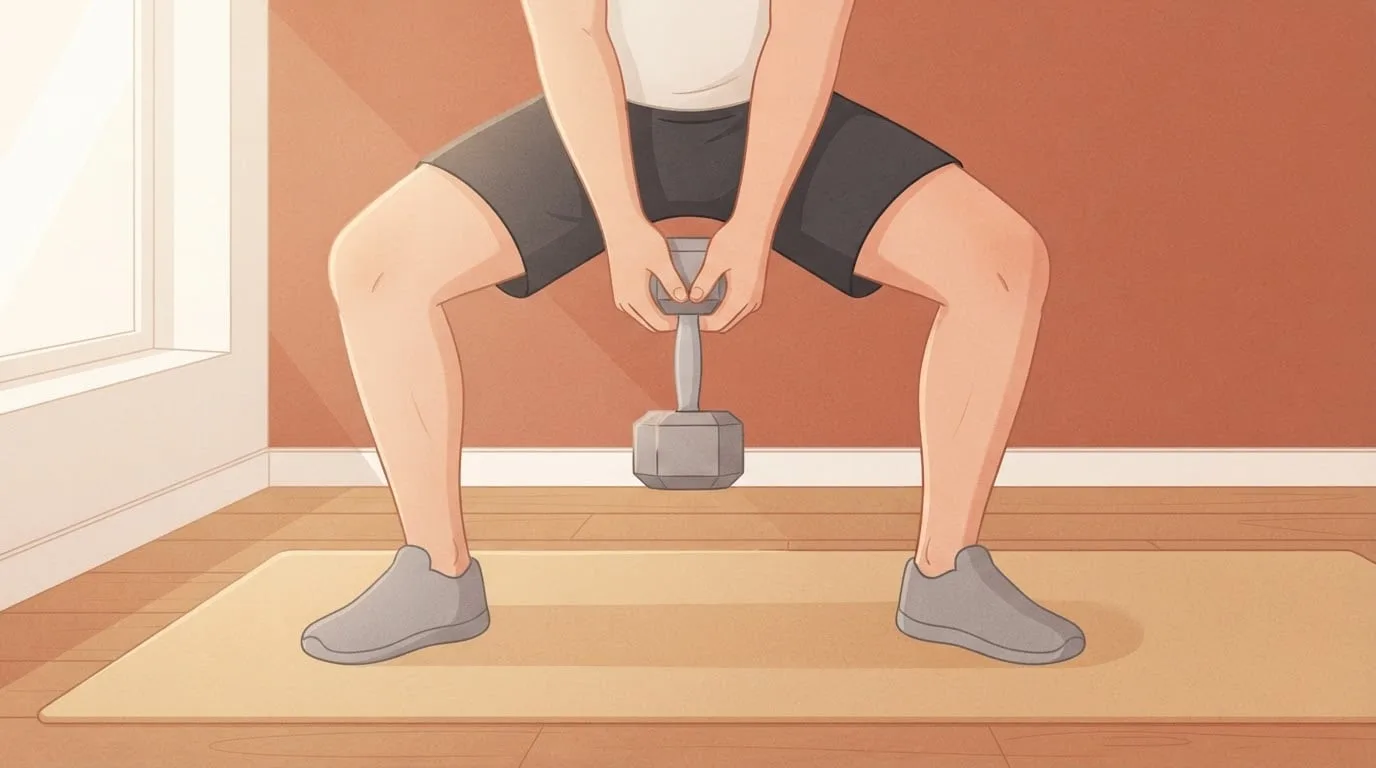
Two cautions. These were EMG studies, which measure how hard a muscle is working, not how much it grows, so treat stance as a fine-tuning tool after depth and effort. And a wide stance only helps if you still reach full depth. Turn your toes out about 30 to 45 degrees so your knees can track over them, and keep the weight across your whole foot. Our best glute exercises at home list shows where sumo squats fit among the other bodyweight glute moves.
Knowing what to do is the easy part.
FitCraft, our mobile fitness app, pairs you with an AI coach who builds you a personalized plan around your goals, schedule, and fitness level. Every FitCraft program is designed by Domenic Angelino, MPH (Brown University) and NSCA-CSCS, with research published in the Journal of Strength and Conditioning Research and Medicine & Science in Sports & Exercise.
Take the Free Assessment Free • 2 minutes • No credit cardHow Heavy Do Squats Need to Be to Grow Your Glutes?
Heavy enough that the last few reps of each set are a real fight. You don't need a barbell, but you do need more than easy body weight once you've been training a few weeks.
Lasevicius, Ugrinowitsch, Schoenfeld and colleagues (2018) trained 30 men for 12 weeks in the European Journal of Sport Science, with one leg on very light loads and the other on heavier ones, matched for total work. Even with every light set taken to failure, loads at 20% of a one-rep max grew the thigh by 8.9%, while 40%, 60% and 80% loads grew it by about 20%. Light work builds muscle, but below a certain load it builds far less.
That's the problem with bodyweight squats. Once your legs adapt, a bodyweight squat is a light load for most people, so the set either takes 40 or more reps to get hard or never gets hard at all. Here are the ways to make each squat heavier at home:
- Hold a dumbbell. A goblet hold first, then a dumbbell in each hand at your sides or on your shoulders.
- Go to one leg. A split squat puts most of your body weight on the front leg, which roughly doubles the load on that side without any new equipment.
- Slow the lowering. Take 3 seconds on the way down and pause for a second at the bottom.
- Use 1.5 reps. Squat to the bottom, rise halfway, sink back down, then stand. The glutes spend twice as long in the deep range.
Aim for sets of about 8 to 15 reps that end with 1 to 3 good reps left, and add a rep or a few pounds whenever the top of the range feels easy. That's progressive overload, and without it your glutes have no reason to keep growing. If you'd like that progression planned for you, FitCraft is a dumbbell workout app whose strength workouts use dumbbells and body weight. An AI coach demonstrates each exercise on an interactive 3D model, workouts adjust as you progress, and streaks help you keep showing up.
Do Squats Make Your Bum Bigger or Smaller?
Squats make your bum bigger in muscle. Whether your bum gets bigger or smaller overall depends mostly on what happens to your body fat, and squats don't choose where you lose fat.
Ramirez-Campillo and colleagues (2013) tested spot reduction directly in the Journal of Strength and Conditioning Research. Eleven young adults trained one leg only, three times a week for 12 weeks, with about 1,000 light leg press reps per session. Total fat mass fell by 5.1%, but the fat came off the arms and trunk. The trained leg lost no more fat than the untrained one.
So if you squat while eating in a calorie deficit, your butt can get smaller even as the glute muscle grows, because you're losing fat from everywhere. If you squat while eating about what you burn, the muscle gain shows as a rounder, fuller shape. And if you've heard squats make your butt flat, that usually means half squats with no progression: lots of quad work and little glute work.
Do squats make your hips wider? They can't change the width of your hip bones. They can add some width and curve through the outer hips and upper inner thighs, because full squats grow both the glutes and the adductors.
Will Doing Squats Every Day Make My Bum Bigger?
Probably not, at least not after the first few weeks. Twenty, 50 or 100 bodyweight squats a day turn into endurance work once your legs adapt, and the Lasevicius data shows very light loads build less muscle even when you push them hard. Daily squats also leave no room to make each session harder.
Two harder sessions a week will do more for your glutes than seven easy ones. Keep daily squats if you like them as a movement habit, and see our how many squats a day guide for daily ranges by goal. Just don't count them as your glute training.
How Long Before Squats Make Your Butt Bigger?
Longer than a 30-day challenge. The Kubo trial that measured real glute growth ran for 10 weeks, and 8 to 12 weeks is a fair expectation for a visible change.
The first few weeks can fool you. Damas and colleagues (2016) tracked a thigh muscle in 10 untrained men through 10 weeks of training. Muscle size was up about 2.7% by week 3, but much of that early gain reflected swelling from muscle damage, not new muscle. By week 10, size was up about 10.4%, and that later gain was real growth. So if your butt feels fuller after two weeks and then seems to shrink back, that's normal. Keep going.
A Squat Progression for Bigger Glutes at Home
Train squats twice a week, 2 or 3 days apart, with 3 hard sets of your current stage in each session. Move to the next stage when you reach the target below with good depth. If you also do hinges or bridges, those sets add to your weekly glute work.
| Stage | Squat | Sets and reps | Move on when |
|---|---|---|---|
| 1 | Bodyweight squat to a box just below knee height, 2-second pause | 3 x 12 to 20 | 20 paused reps feel comfortable |
| 2 | Deep goblet squat with a light dumbbell | 3 x 10 to 15 | 15 reps with 2 or more left in the tank |
| 3 | Sumo goblet squat with a heavier dumbbell, 3-second lowering | 3 x 8 to 12 | 12 slow reps at full depth |
| 4 | Bulgarian split squat with a dumbbell in each hand | 3 x 8 to 12 per leg | 12 reps per leg with the heaviest dumbbells you own |
| 5 | 1.5-rep Bulgarian split squat or 1.5-rep goblet squat | 3 x 6 to 10 | Keep adding weight, reps or a longer pause |
Most people spend 2 to 4 weeks on each of the early stages and longer on the later ones. Squats don't train the hamstrings, so add a dumbbell Romanian deadlift or a glute bridge on one of your two days for the back of the leg.
What This Means for You
Your squats aren't the problem. The settings are. Deep reps, a stance that suits your hips and sets that end close to failure turn the same exercise from a thigh burner into a glute builder.
Give it 10 to 12 weeks of two sessions a week, and judge it by your dumbbell weights and how your jeans fit rather than the mirror after week two. As one FitCraft user, Sarah, 27, put it: "First app that made exercise feel like something I chose, not forced." When training feels like your choice, the weeks add up, and that's when the shape changes.
Frequently Asked Questions
Do squats lift your buttocks?
Squats can make your butt look rounder and more lifted by growing the gluteus maximus, the muscle that gives the backside its shape. They don't tighten skin or move fat upward. The visible change comes from more muscle under the skin, plus less body fat if you're also losing weight.
What happens after 30 days of squats?
After 30 days of hard squat sessions, you'll be noticeably stronger and your legs may feel fuller, but much of that early size is swelling rather than new muscle. In one study, muscle size rose about 2.7 percent by week 3, alongside signs of swelling, and about 10 percent by week 10. Plan on 8 to 12 weeks before squats change how your glutes look.
What will 20 squats a day do?
Twenty bodyweight squats a day is a good habit for leg strength, mobility and breaking up sitting, especially if you're new to exercise. It won't do much for glute size once it feels easy, because each set stops far from failure. For a bigger butt, swap the daily set for 2 harder squat sessions a week.
Can squats improve posture?
Squats strengthen the glutes, thighs and the muscles along the spine that hold the torso upright, which helps you stand and lift with good form. No trial shows that squats alone change how you stand all day. If posture is your goal, pair squats with upper-back work such as rows.
Do squats make your hips wider?
Squats can't change the width of your hip bones. They can add a little width and curve through the outer hips and upper thighs by growing the glutes and the inner-thigh adductors: in one 10-week study, full squats grew the adductors by 6.2 percent.
Do squats make your butt bigger if you're a guy?
Yes. The best-known squat depth study trained only men, and full squats grew their gluteus maximus by 6.7 percent in 10 weeks. Men and women grow muscle at similar relative rates, so the same deep, hard squats work for both.
How many squats to get a bigger bum in a week?
Count hard sets, not squats. About 6 to 10 hard sets of deep squat variations a week, split over 2 sessions, is a good target, with each set ending 1 to 3 reps short of failure. You won't see a bigger bum within one week, but you can set up the 8 to 12 weeks that will.