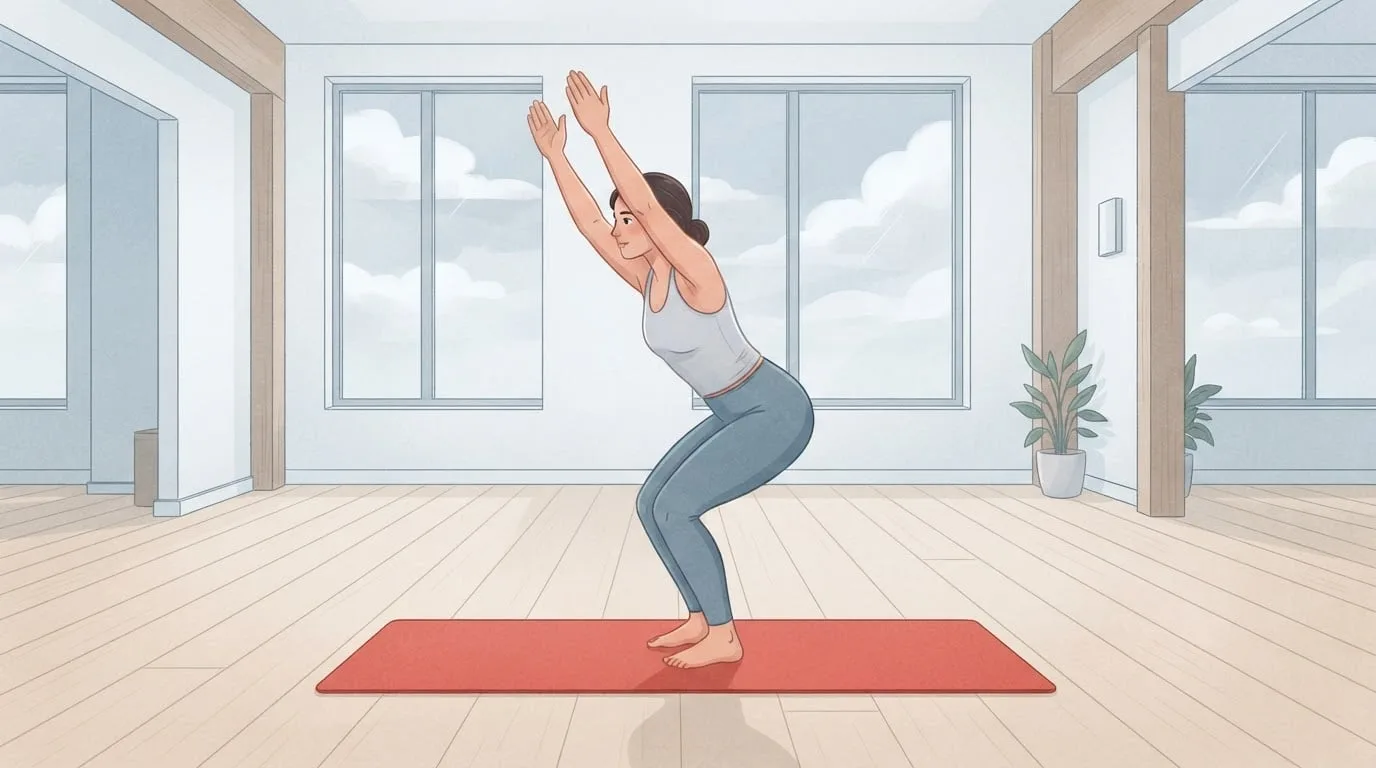
You've held chair pose until your thighs shook, done a dozen chaturangas in one class and felt your shoulders the next morning. So is yoga strength training, or do you still need to pick up weights? People ask it from both directions: lifters wondering if a yoga class can replace a gym day, and yogis wondering if their practice already covers the strength side of exercise.
Time is the real constraint. If yoga is going to be most of your training, you want to know now whether it builds the strength you'll need for carrying a toddler, lifting a suitcase into an overhead bin or getting up off the floor easily at 70, rather than finding out a few years in.
This post covers what the yoga strength studies actually found, which styles and poses load your muscles, where yoga stops being enough, whether it counts as cardio, how to combine yoga and the gym, and how to add weights to yoga once bodyweight gets easy.
Is Yoga Strength Training? What Counts
Exercise counts as strength training when your muscles push or hold against a resistance that's genuinely hard for them, and when that resistance keeps climbing as you adapt, which trainers call progressive overload. The World Health Organization's 2020 guidelines (Bull and colleagues) set the target at two or more days a week of muscle-strengthening activity, at moderate or greater intensity, covering all the major muscle groups. Load decides which kind of strength you get: in a meta-analysis of 21 studies, light and heavy loads built similar muscle when sets went to failure, but heavy loads built more one-rep-max strength (Schoenfeld 2017). We go through those rules in detail in our answer to is Pilates strength training, and they apply to yoga the same way.
By that definition, yoga is bodyweight resistance training. Every standing pose, plank and balance makes some muscle hold or move your body against gravity, and most of it is isometric work, where the muscle holds a position instead of moving through a range. So the real questions are narrower: is a given class hard enough, does it reach every major muscle group, and can it keep getting harder?
What Studies Show About Yoga and Strength
Yoga reliably makes untrained people stronger, mostly in the legs, the trunk and the pushing muscles, and the gains are moderate. These are the trials that measured it.
In people new to exercise
Tran and colleagues (2001) had ten untrained young adults attend at least two Hatha classes a week for eight weeks. Strength measured on an isokinetic machine, which holds the speed of the movement constant, rose 31 percent for elbow extension, 19 percent for elbow flexion and 28 percent for knee extension. It's a tiny study with no control group, so treat those numbers as a direction, not a promise.
A larger controlled trial points the same way. Lau and colleagues (2015) assigned 173 adults with an average age of 52 to 12 weeks of Hatha yoga or a waitlist. By the end, the yoga group did more push-ups and curl-ups than the controls, and their aerobic fitness and hamstring flexibility improved too. The older participants in the yoga group didn't improve their curl-ups compared with controls.
In older adults
Gothe and McAuley (2016) randomized 118 sedentary adults with an average age of 62 to eight weeks of Hatha yoga or a conventional stretching-and-strengthening program, three one-hour sessions a week. Both groups improved on chair stands and arm curls, and yoga did as well as the strengthening program. Across 22 randomized trials in older adults, Sivaramakrishnan and colleagues (2019) found yoga improved lower-limb strength compared with no exercise (effect size 0.45) and compared with other exercise such as walking or chair aerobics (0.49). Both are moderate effects.
Over eight months
The longest trial is the most telling. Kim, Bemben and Bemben (2012) randomized 34 women aged 35 to 50 to Ashtanga yoga twice a week for eight months or a control group, and tested one-rep-max strength on six exercises. Leg press strength rose 11.4 percent with yoga and fell 6.5 percent in the controls. The lat pulldown, shoulder press, biceps curl, knee extension and knee flexion didn't change significantly. That's eight months of a demanding style, and the only clear gain was in the legs.
| Trial | Who | Yoga | Strength result |
|---|---|---|---|
| Tran 2001 | 10 untrained young adults | Hatha, 2+ classes a week for 8 weeks | Elbow and knee strength up 19 to 31 percent (no control group) |
| Lau 2015 | 173 adults, average age 52 | Hatha for 12 weeks vs a waitlist | More push-ups and curl-ups than controls |
| Gothe 2016 | 118 sedentary adults, average age 62 | Hatha, 3 hours a week for 8 weeks | Chair stands and arm curls improved as much as with strengthening exercises |
| Kim 2012 | 34 women aged 35 to 50 | Ashtanga, twice a week for 8 months | Leg press up 11.4 percent; no significant change in pulling, pressing or arm exercises |
| Sivaramakrishnan 2019 | 22 trials in older adults | Various styles | Moderate gains in lower-limb strength |
Put together, yoga improves strength and muscular endurance in people starting from little or no training, and the gains concentrate in the muscles that hold your body up: thighs, hips, trunk, and the pushing muscles of the chest, shoulders and arms. Muscles that pull, like the lats and biceps, get far less.
Does Yoga Build Muscle?
Yoga can add a little muscle in beginners, but it isn't a dependable way to build muscle once you've trained for a while. Few yoga trials have measured muscle size directly, so most of what we know comes from strength tests and from how much load the poses actually put on your muscles.
Biomechanics researchers have measured that load. Wang and colleagues (2013) recorded 20 adults with an average age of 71, after a 32-week Hatha program, as they held seven standing poses. Chair pose and the back leg of a crescent lunge put the most demand on the muscles that straighten the knee, about as much as the peak of a walking stride, while activity in the outer thigh muscle was only 33 to 49 percent of its walking peak. Tree pose worked the hip abductors, the muscles on the side of the hip, about 12 percent harder than walking. For a sedentary 70-year-old, that's useful training. For a 35-year-old who already does squats, it's light.
Light loads only build muscle when the set gets close to fatigue. Holding a pose until your legs shake does that, and holding one you could stay in for five minutes doesn't. Where you hold matters too. In a systematic review of 26 studies on isometric training, Oranchuk and colleagues (2019) found that holds with the muscle in a lengthened position built more muscle than the same amount of holding in a shortened one, and carried over better to strength in moving exercises. In yoga terms, a low chair pose or a long, deep lunge is a better strength stimulus than a shallow one.
Which Yoga Styles Count as Strength Training?
Vinyasa, power and Ashtanga yoga count as strength training for most people, Hatha counts when the holds are long and hard, and yin and restorative classes don't, because they're built around relaxing your muscles rather than working them.
| Style | What a class looks like | Strength demand | Energy cost (2024 Compendium) |
|---|---|---|---|
| Hatha | Held standing, seated and floor poses at a slow pace | Moderate for beginners | 2.3 METs |
| Vinyasa (flow) | Poses linked by movement, with repeated chaturangas | Moderate to high in the shoulders, arms and core | 2.7 METs |
| Power yoga | An athletic vinyasa with longer, harder holds | High for a bodyweight class | 4.0 METs |
| Ashtanga | A set sequence with many sun salutations and vinyasas | High, especially pushing and core | Not listed (sun salutations: 3.5 METs) |
| Hot yoga | Usually a fixed sequence in a heated room | Moderate | 3.0 METs |
| Iyengar | Precise, long holds using blocks, straps and the wall | Moderate, depending on the poses | Not listed |
| Yin and restorative | Long, supported, passive stretches | Low | Not listed |
The strength ratings are my read of how classes are usually taught, not a measured result, and teachers vary a lot. The energy figures come from the 2024 Adult Compendium of Physical Activities by Herrmann and colleagues, where 1 MET is your energy use sitting still and 3.0 METs is where moderate activity starts. METs track how hard your heart and lungs work, not how hard one muscle works, so a slow side plank can exhaust your obliques while barely raising your breathing.
Yoga poses that build the most strength
- Chair pose and crescent lunge: the thighs and glutes. These had the biggest knee demand of the standing poses in Wang's lab study.
- Warrior II: the front thigh and the outer hip. Bend the front knee deeper to make it harder.
- Plank and chaturanga: the chest, shoulders, triceps and core. Chaturanga is the bottom half of a push-up, held.
- Side plank: the obliques and the outer hip of the bottom leg.
- Tree and one-leg balances: the hip abductors and the ankle muscles of the standing leg.
- Boat pose: the abdominals and hip flexors.
- Locust: the back extensors, glutes and the muscles between your shoulder blades.
- Bridge and wheel: the glutes and hamstrings, plus the shoulders and triceps in wheel.
- Crow and other arm balances: the wrists, forearms, shoulders and core.
Knowing what to do is the easy part.
FitCraft, our mobile fitness app, pairs you with an AI coach who builds you a personalized plan around your goals, schedule, and fitness level. Every FitCraft program is designed by Domenic Angelino, MPH (Brown University) and NSCA-CSCS, with research published in the Journal of Strength and Conditioning Research and Medicine & Science in Sports & Exercise.
Take the Free Assessment Free • 2 minutes • No credit cardWhere Yoga Falls Short of Progressive Overload
Yoga's biggest gap is progression. To keep getting stronger, a muscle needs a challenge that keeps rising, and yoga runs out of ways to raise it sooner than lifting does. Three gaps show up again and again.
Almost no pulling
Yoga has plenty of pushing, in chaturanga, plank and downward dog, but almost nothing where you pull a weight toward you. Your upper back holds positions in locust and the warrior poses, but your lats and biceps never pull against a real load. That's why eight months of Ashtanga didn't move the lat pulldown or the biceps curl in Kim's trial.
A ceiling on leg load
Your legs can handle far more than your body weight. Once a low chair pose or a deep lunge stops being hard, yoga's main options are longer holds and one-leg versions, and long holds shift the work toward endurance rather than strength.
Holds at fixed angles
Most yoga strength comes from holding still. That builds strength, but it carries over to moving strength best when the hold is deep, in a lengthened position, as Oranchuk's review found. Shallow holds carry over less, and they're the version most people drift into when a class gets long.
You can push those limits further than most classes do:
- Go deeper before you go longer. Sit lower in chair pose and lengthen your lunge stance.
- Slow down. Take three to five seconds to lower into chaturanga.
- Move to one leg or one arm. Try single-leg chair pose, or side plank with the top leg lifted.
- Hold until it's hard. The last 10 seconds of each hold should take real effort to finish with good form.
Yoga with weights
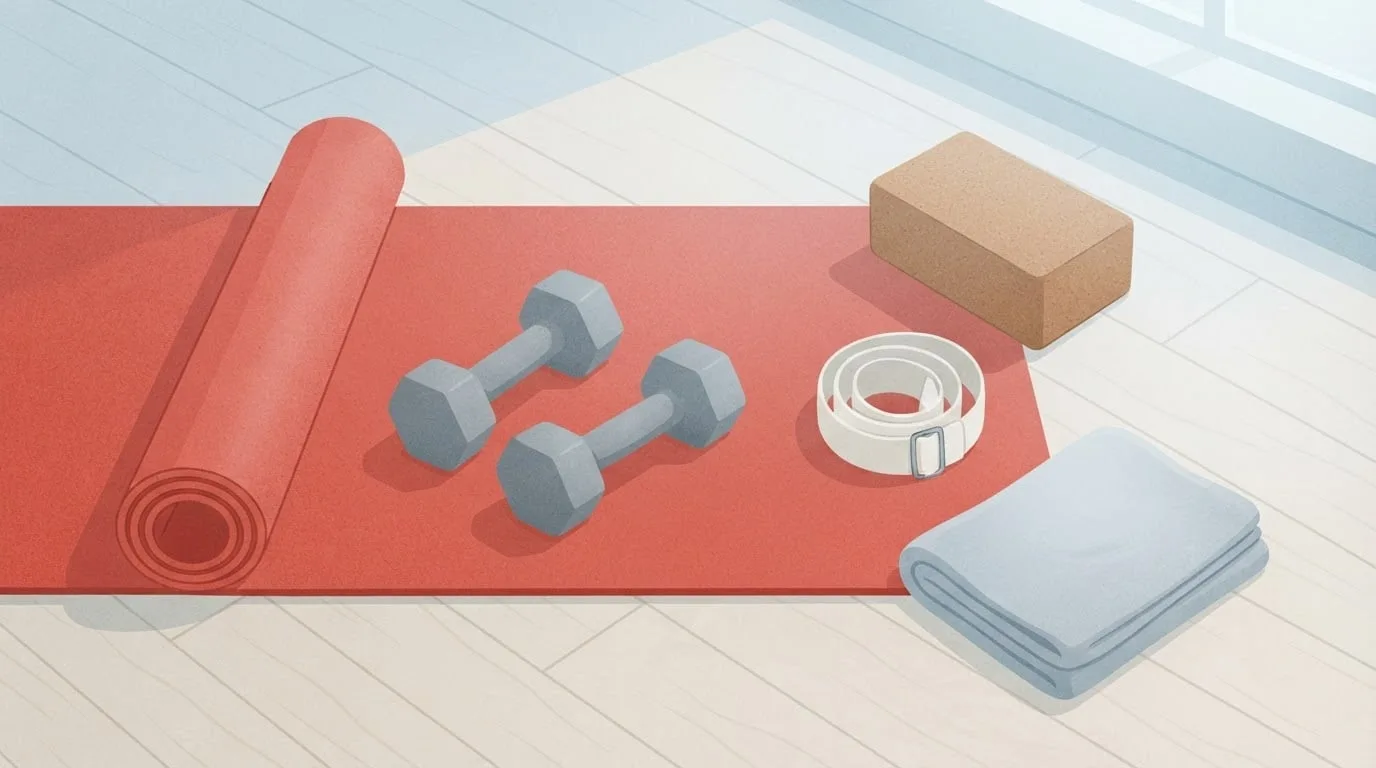
Holding light dumbbells in chair pose, warrior II or a crescent lunge adds load to your legs and shoulders, and some studios teach weighted flow classes. Keep the weights light enough that your form doesn't change, and leave them out of balance poses and anything upside down. Past a certain point, a separate 30-minute dumbbell session of squats, hinges, rows and presses does the job more simply than fitting weights into a flow.
Is Yoga Considered Cardio Exercise?
Most yoga isn't considered cardio exercise, because it rarely raises your heart rate into the moderate-intensity range. Power yoga and long runs of sun salutations are the exceptions.
Hagins and colleagues (2007) put 20 experienced practitioners in a sealed metabolic chamber for a 56-minute beginner Hatha session. Averaged over the session, they worked at 2.5 METs and 49.4 percent of their predicted maximum heart rate, about the same as walking at 3.2 km/h (2 mph). The authors concluded that a typical session doesn't meet the recommendations for cardiovascular fitness, though 10 minutes or more of continuous sun salutations might help unfit people. The 2024 Compendium agrees: Hatha at 2.3 METs and vinyasa at 2.7 sit below the 3.0 line, while sun salutations (3.5) and power yoga (4.0) cross into moderate activity.
So count most yoga as strength and mobility work, and get your 150 minutes a week of moderate cardio from walking, cycling or a power class that keeps you breathing hard. If you're weighing yoga against Pilates for the same slot in your week, our comparison of Pilates vs yoga covers how the two differ for strength, flexibility, back pain and stress.
Yoga vs Strength Training for Bone Density
Strength training has much stronger evidence for bone density than yoga does. The best-known yoga study is Lu and colleagues (2016), who asked 741 volunteers recruited online to do a 12-minute daily yoga routine. Only 227 followed it moderately or fully. In them, spine density rose, and the changes at the hip and thigh bone were smaller and not clearly significant. There was no control group, so the study can't show that the yoga caused the change.
Bone responds best to heavy, fast loading, and heavy, impact-style lifting has the strongest trial evidence, which our Pilates answer covers in detail. If bone density is one of your reasons for training, keep your yoga and add progressively heavier strength work. If you already have osteoporosis or osteopenia, ask a physical therapist which poses to adapt before you start.
Can I Do Yoga and Gym Together?
Yes. Yoga and strength training fit together well, and the order is the only real thing to manage. Long static holds right before lifting can sap a little strength: Simic and colleagues (2013) pooled 104 studies and found that static stretching before exercise cut maximal strength by about 5.4 percent on average, with the smallest losses when each stretch lasted 45 seconds or less.
So if you're asking whether to do yoga before or after a workout, use a short, flowing sequence to warm up before lifting, and save long holds and deep stretches for afterward or another day. Yoga and weightlifting on the same day works fine in that order. For a full sample week that mixes both, our guide to how often you should do yoga lays one out by goal.
How to Make Yoga Count as Strength Training
If yoga is your main strength work, five habits make it count for more:
- Choose active styles at least twice a week. Vinyasa, power, Ashtanga or a strong Hatha class.
- Finish each hold near your limit. The final seconds of a pose, or the final chaturangas of a flow, should take real effort to complete cleanly.
- Change the challenge every few weeks. Go deeper, slower or onto one leg instead of repeating the same class forever.
- Add two short dumbbell sessions. Rows, a hinge such as the dumbbell Romanian deadlift, split squats and a press, two or three sets each.
- Get your cardio elsewhere unless your yoga is power yoga that keeps you breathing hard.
Here's a week that hits every box: yoga on two or three days, a pair of half-hour dumbbell sessions, and a walk most days. To have those dumbbell days programmed for you, see how the apps in our best strength training apps roundup compare.
What This Means for You
If yoga is the workout you actually look forward to, keep it at the center of your week. It already counts as strength training for most of the muscles that hold you up, and the routine you'll still be doing next spring does more for you than an "optimal" one you abandon. What's left is filling the gaps: some pulling, some heavier leg work and a little progression.
Fast-forward six months. Your chaturangas are slow and controlled, your rows have moved up a dumbbell size or two, and getting up off the floor takes no thought at all. FitCraft includes yoga, mobility and dumbbell and bodyweight strength workouts in one app, with an AI coach and interactive 3D demos of the exercises. As Tim, a FitCraft user, put it: "I didn't think an app could replace my trainer. My AI coach proved me wrong."
Frequently Asked Questions
Is 30 minutes of yoga a day enough exercise?
Thirty minutes of yoga a day is enough strength and mobility work for most people, but usually not enough cardio. Done daily, it easily meets the WHO's two or more days a week of muscle-strengthening activity if your sessions work every major muscle group, but most styles sit below the 3.0 METs where moderate activity starts. Add about 150 minutes a week of brisk walking or other moderate cardio, or make some of those sessions power yoga.
Does 20 minutes of yoga count as exercise?
Yes. Twenty minutes of active yoga counts as exercise, and if it works your legs, core and upper body hard it counts toward your muscle-strengthening days. A gentle 20-minute stretch counts as mobility work rather than strength training or cardio. Hagins and colleagues (2007) found that 10 minutes or more of continuous sun salutations may add some useful cardio for people who are unfit.
Why is my weight increasing after doing yoga?
Early weight gain after starting yoga is usually water and food, not fat or a sudden burst of muscle. Unfamiliar exercise can leave your muscles holding a little extra fluid for a few days while they recover, and a new routine can raise your appetite. Yoga burns relatively few calories, 2.3 to 4.0 METs depending on the style in the 2024 Compendium, so weigh yourself weekly and judge the trend over a month.
What happens after 30 days of yoga?
After 30 days of regular yoga, beginners usually find poses getting easier as strength, balance and flexibility improve. The shortest strength trials ran eight weeks: twice-weekly Hatha raised elbow and knee strength by 19 to 31 percent in ten untrained young adults (Tran 2001), so a month gets you partway there. Big changes in muscle size or body weight don't happen in 30 days.
Can yoga replace weight lifting?
Yoga can replace weight lifting for general health if you're new to exercise and your practice works every major muscle group hard on two or more days a week. It falls short for maximal strength, continued muscle growth and pulling strength: in an eight-month Ashtanga trial, leg press strength rose 11.4 percent, but the lat pulldown and biceps curl didn't improve (Kim 2012). Most people do best with both.
Is yoga or strength training better for women?
Neither is better across the board, because they do different jobs. Yoga improves flexibility, balance and bodyweight strength, while progressive strength training builds more maximal strength and has far stronger evidence for bone density, which matters more after menopause. A week with both covers what either one misses.