You finally have a free hour, and you just ate lunch. Do you go now, or do you wait? And if you wait, how long should you wait after eating to workout before your stomach stops complaining? Most of the advice online gives you a number and moves on. The number is useful, but it changes with the meal, the workout and your own gut.
Getting it wrong costs you. A side stitch at minute ten, heartburn halfway through a set, or a heavy, sluggish feeling can turn a planned session into a skipped one. Do that a few times and the problem stops being digestion. It becomes a habit you can't keep.
So here's how long to wait after eating to workout for each kind of meal and activity, then the research behind those numbers: how fast a stomach empties, what hard effort does to it, and which workouts tolerate food best. If your question is what to eat rather than when, our guide to what to eat before a workout covers the foods.
How Long to Wait After Eating to Workout, by Meal and Activity
Two things set the wait: how much energy the meal held and how hard you plan to move. The table puts both together. These are starting points built from the gastric emptying and exercise studies further down, so treat them as a first guess and adjust to your own stomach.
| What you ate | Easy walk or gentle yoga | Strength training or cycling | Running, HIIT or hard swimming |
|---|---|---|---|
| Big or high-fat meal (a large restaurant dinner, a fry-up) | Right away, keep it easy | 2 to 3 hours | 3 to 4 hours |
| Normal full meal (rice, chicken and vegetables) | Right away | About 2 hours | 2 to 3 hours |
| Light meal (eggs on toast, a sandwich, a bowl of oatmeal) | Right away | About 1 hour | 1 to 2 hours |
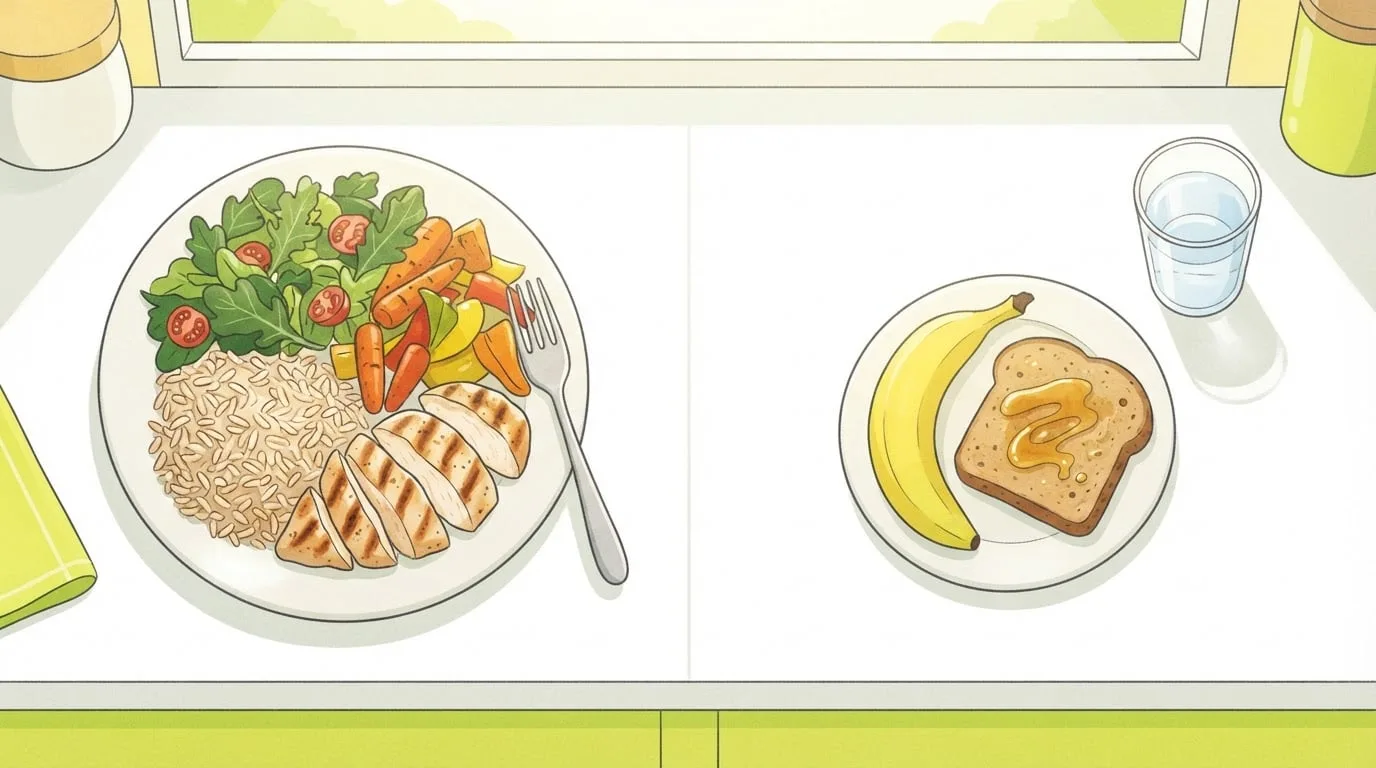
| Small snack (a banana, toast with honey, yogurt) | Right away | 15 to 30 minutes | 30 to 60 minutes |
| Shake, milk or sports drink | Right away | About 15 minutes | 15 to 30 minutes |
Notice the pattern. The harder and bouncier the activity, the longer the wait. Running and intervals sit in the right-hand column because they combine high intensity with constant jostling. Lifting and cycling sit in the middle. Walking sits on the left, because easy movement doesn't fight digestion at all.
Why You Have to Wait: How Fast Your Stomach Empties
Your stomach doesn't dump a meal into the small intestine all at once. It grinds food down and lets it out in small amounts, and the timing has been measured carefully. To set normal values for hospital tests, Tougas and colleagues (2000) fed 123 healthy adults aged 19 to 73 a small, low-fat egg-substitute meal tagged with a tracer, then imaged their stomachs at 11 centers.
- After 1 hour: a median 69% of the meal was still in the stomach.
- After 2 hours: a median 24% was left, and about 1 in 20 healthy volunteers still had 60% or more.
- After 4 hours: almost all of it had gone, with a median of 1.2% left.
That was a light, low-fat meal. A full plate with oil, meat and fiber starts out bigger and empties more slowly. Emptying was a little faster in men in the first hours and in older adults, and body size made no difference. That's why two people who eat the same lunch can feel ready to train at very different times.
What slows a meal down
The stomach mostly meters out energy. Hunt and Stubbs (1975) pooled 33 gastric emptying studies with meals from 50 ml to 1,250 ml. The more calories each milliliter carried, the less of the meal reached the intestine in the first 30 minutes. In their analysis, fat, protein and carbohydrate slowed emptying about equally per calorie. Fat packs 9 calories per gram against 4 for carbohydrate, so gram for gram it slows emptying about twice as much.
Fiber matters too, mostly for comfort. In a survey of 55 men after a half Ironman triathlon, every athlete who reported intestinal cramps had eaten fiber-rich food in the pre-race meal, against only 10% of those without cramps (Rehrer and colleagues, 1992). The athletes who vomited or felt the urge to vomit had eaten more fat and protein before the race.
Why a shake or a banana leaves sooner
Liquids and small, low-fat snacks get through fastest. Calbet and MacLean (1997) gave six adults 600 ml drinks of different strengths. A thin glucose drink was half gone in about 9 minutes. A milk protein drink with seven times the calories per milliliter took about 26 minutes to reach the halfway point. Across the four drinks, the emptying time rose in a straight line with their calorie density.
So a protein shake isn't digested instantly, but it leaves your stomach far sooner than a plate of food with the same protein. That's why the bottom rows of the table allow a 15 to 30 minute gap.
What a Workout Does to the Food in Your Stomach
Exercise intensity changes the picture more than most people expect. In a classic treadmill study, Neufer, Young and Sawka (1989) had 10 men drink 400 ml of water and then walk or run for 15 minutes at a range of efforts. Walking at every pace and running at about 57% and 65% of VO2 max emptied the stomach faster than sitting still. Running at about 75% of VO2 max slowed it below every lower intensity. The authors suggested that at moderate effort, the working abdominal muscles squeeze the stomach and help it empty.
That study used water, so food will behave more slowly. The direction still holds. Moderate movement leaves digestion alone or even helps it. Hard effort works against it.
Blood flow explains much of the rest. When you work hard, your nervous system sends blood away from the gut and toward your muscles. A review by ter Steege and Kolkman (2012) found that blood flow to the gut can drop by 80% or more during long or intense exercise, and that up to 70% of athletes in some studies report stomach or gut symptoms. Their practical advice to prevent symptoms was to lower the intensity, stay hydrated and avoid very concentrated drinks.
Put those two findings together and the table makes sense. A full stomach and an easy pace get along. A full stomach and a hard pace compete for the same blood supply, and your gut loses.
Knowing what to do is the easy part.
FitCraft, our mobile fitness app, pairs you with an AI coach who builds you a personalized plan around your goals, schedule, and fitness level. Every FitCraft program is designed by Domenic Angelino, MPH (Brown University) and NSCA-CSCS, with research published in the Journal of Strength and Conditioning Research and Medicine & Science in Sports & Exercise.
Take the Free Assessment Free • 2 minutes • No credit cardHow Long After Eating Can You Workout? It Depends on the Activity
Different workouts load your stomach in different ways. Here's how the main ones compare.
How long after eating should you walk?
You don't need to wait at all. An easy walk is gentle enough that your gut keeps its blood supply, and a walk soon after a meal blunts the blood sugar rise that follows it. Our post on walking after meals covers the studies behind the 10-minute post-meal walk. Keep the pace conversational if the meal was big.
How long after eating can you lift weights?
Lifting has a problem most people don't expect: reflux. Collings and colleagues (2003) tested 10 runners, 10 cyclists and 10 weightlifters, all with at least three months of heartburn during exercise. Each trained hard fasted and again after eating, while a probe measured how much of the time acid sat in the esophagus.
- Weightlifters: 18.5% of the time fasted and 35.8% after eating, the most heartburn of the three groups.
- Runners: 4.9% fasted and 17.2% after eating.
- Cyclists: 4.0% fasted and 6.5% after eating.
Bracing your trunk for a heavy lift raises the pressure inside your abdomen, and bending over to pick weights up adds to it. If you're prone to heartburn, give a full meal about 2 hours before strength training, or keep the pre-lift food to a small snack. Most people without reflux can lift comfortably about an hour after a light meal. Lying flat for a bench press or a floor exercise is usually the moment a full stomach lets you know.
How long after eating should you run?
Running is the least forgiving activity in the table. Your stomach bounces with every stride, and many runners push into the effort range where emptying slows. In the triathlon survey above, more gut symptoms occurred during the run than at any other time (Rehrer, 1992).
The side stitch is the classic result. About 70% of runners report a stitch in the past year, and the pain gets worse after eating, especially after sugary, concentrated drinks (Morton and Callister, 2015). In one lab test, 10 men drank a large volume of fluid, about 14 ml per kilogram of body weight or roughly a liter for a 70 kg man, then did hard running intervals. Every drink brought on a stitch of similar intensity in the first two bouts. The authors concluded the results fit a fluid-filled gut tugging on the ligaments that hold it in place (Plunkett and Hopkins, 1999).
So before a run, give a full meal 2 to 3 hours, a light meal 1 to 2 hours, and a snack 30 to 60 minutes. Sip fluids rather than gulping a large amount right before you start. If cramps and stitches are already a regular problem, our post on why your stomach hurts when you run works through each type of pain.
How long after eating can you swim?
The old rule of waiting an hour before swimming is about drowning, and that part is a myth. Members of the American Red Cross Scientific Advisory Council reviewed the evidence and found that swimming within an hour of eating doesn't raise the risk of drowning. A relaxed swim after lunch is fine.
Hard swimming is a different matter. In the triathlon survey, every athlete who had eaten within 30 minutes of the start vomited during the swim (Rehrer, 1992). Lying flat and working hard on a full stomach is uncomfortable for the same reasons running is. Treat hard laps like a run.
Cycling, HIIT and yoga
Cycling is the most stomach-friendly hard exercise. Your upper body stays still, and in the Collings study eating before a ride barely changed reflux. Intervals and HIIT belong with running because they push you into the high-intensity range where gut blood flow drops. Yoga is easy on the heart but hard on a full stomach when it includes twists, forward folds and inversions, so give a full meal about 2 hours before a flow class. A gentle stretch session can start sooner.
Is Exercising After Eating Bad?
For most healthy people, exercising after eating isn't harmful. The cost is comfort and performance, and the companion post on whether to eat before or after a workout covers the meal-planning side. These are the side effects of exercise after eating that the studies above describe:
- Side stitches: sharp pain under the ribs, most common when running soon after food or a large drink.
- Heartburn and reflux: acid rising into the chest or throat, worst with lifting and bending.
- Nausea or vomiting: more likely after fat, protein or very sugary drinks close to hard effort.
- Cramps and an urgent need for the bathroom: linked to fiber-rich food before long, hard sessions.
- A heavy, sluggish feeling: the session feels harder than it should, and you cut it short.
Most of these fade within an hour of stopping. Lowering the intensity usually helps during the session.
A rare reaction worth knowing about
A small number of people have food-dependent, exercise-induced anaphylaxis. In this allergy, a specific food and exercise are each fine on their own, but exercising within a few hours of eating that food sets off a serious allergic reaction (Feldweg, 2017). Alcohol and aspirin can make it more likely. Hives, itching, swelling of the lips or throat, or trouble breathing during exercise after a meal is an emergency. Stop, get help and later see an allergist.
Benefits of Exercise After Eating
Moving after a meal has a real upside for blood sugar. A systematic review by Borror and colleagues (2018) pooled 12 crossover trials in 135 adults with type 2 diabetes who exercised within 3 hours of a standard meal. Aerobic exercise after eating cut the short-term blood sugar rise by 3% to 27%, and the two resistance training trials cut it by about 30%. The most consistent benefit came from 45 minutes or more of moderate aerobic exercise.
Strength training after dinner did especially well in one trial. Heden and colleagues (2015) had 13 adults with type 2 diabetes and obesity do resistance exercise either before dinner or starting 45 minutes after it. Lifting after dinner lowered the rise in blood sugar by about 30% and the rise in blood fats by about 92% compared with no exercise. Lifting before dinner lowered blood sugar too, but it didn't change blood fats.
Can I do exercise after dinner for weight loss?
Yes. A workout after dinner burns about the same calories as the same workout at any other time, and weight loss depends on your energy balance across the week. What evening exercise adds is the blood sugar benefit above, plus a slot that many busy people can actually keep. Start a light session 45 minutes to an hour after a normal dinner, and save hard intervals for 2 to 3 hours after. Leave some time between a hard workout and bed if late sessions keep you awake.
How Long After Breakfast to Workout
Breakfast is usually the smallest meal of the day, so the wait is often short. A bowl of oatmeal, a yogurt with fruit or eggs on toast counts as a light meal: about 1 hour before lifting and 1 to 2 hours before a hard run. A big cooked breakfast with bacon, sausages and pastries counts as a full, high-fat meal, so leave 2 to 3 hours or keep the morning session easy.
If you train soon after waking, you have three options:
- Eat a small snack and go 20 to 30 minutes later. Half a banana or a slice of toast is enough for most sessions under an hour.
- Train first and eat breakfast afterward. For an easy or short session, this is a preference for most healthy adults.
- Eat a light breakfast and walk or stretch first. Do the hard part of your plan later in the day.
What This Means for You
Two questions decide the wait: how big was the meal, and how hard is the workout? A light lunch and a dumbbell session an hour later is a good match. A big dinner and a hard run an hour later isn't. When the timing doesn't fit, change one side. Eat a smaller meal, swap the run for a walk, or move the hard work to a different slot.
Then make the slot a habit. The bigger risk to your progress is a plan with no regular place in the day, because every awkward meal then becomes a reason to skip. Picking a time that works with your meals, and repeating it, removes that excuse. A workout app that keeps you motivated can help with the repeating part. FitCraft's 3D AI coaches lead each session, and streaks and calendar tracking make the habit something you can see. As FitCraft user Katie put it: "I've tried everything. This is the first time I've stuck with something past two weeks."
Frequently Asked Questions
Should you exercise before or after eating?
Either works, so pick the order that fits your day and your stomach. Hard sessions usually go better with a light meal 1 to 2 hours earlier or a snack 30 to 60 minutes before, and you'll want a protein-rich meal within a few hours afterward. An easy walk is the one activity that is better right after a meal, because it lowers the blood sugar rise that follows eating.
Can you work out right after eating?
You can walk, stretch or do gentle yoga right after eating. A hard workout straight after a full meal is safe for most healthy people but often uncomfortable, with side stitches, reflux, nausea or a heavy feeling. If you only have a few minutes, a small carbohydrate snack or a drink is the better choice than a full plate.
How long should you wait to exercise after eating a big meal?
Wait about 3 to 4 hours after a big or high-fat meal before running, HIIT or hard laps in the pool, and about 2 to 3 hours before strength training or cycling. Big meals hold more energy, and the stomach releases energy into the intestine at a fairly steady rate, so a meal with twice the calories takes much longer to clear. An easy walk can start right away.
What to eat 30 minutes before a workout in the morning?
Eat something small and mostly carbohydrate, like a banana, a slice of toast with honey or a small cup of yogurt, plus a glass of water. Keep fat, fiber and large amounts of protein for after the session, because they take longer to leave the stomach. A drink such as milk or a smoothie also works if solid food sits badly that early.
Should I gym on an empty stomach in the morning?
You can if you feel fine doing it. A workout under about an hour on an empty stomach is a personal preference for most healthy adults, but long or very hard sessions usually go better with a small snack first. People with diabetes who use insulin, anyone prone to low blood sugar and anyone who feels dizzy should eat something before training.
Is 2 bananas good pre-workout?
Two bananas are a good pre-workout snack for a long or hard session if you eat them about 45 to 60 minutes before you start. A medium banana carries about 27 grams of carbohydrate, so two give you roughly 50 to 55 grams. For a short workout, or if you only have 20 to 30 minutes, one banana is usually enough.
What is the 80% rule in eating?
The 80% rule is the Okinawan habit called hara hachi bu: stop eating when you feel about 80% full rather than stuffed. It isn't a workout rule, but it helps with timing, because a smaller meal holds less energy and leaves your stomach sooner. Stopping at 80% full can shorten the wait before a workout.