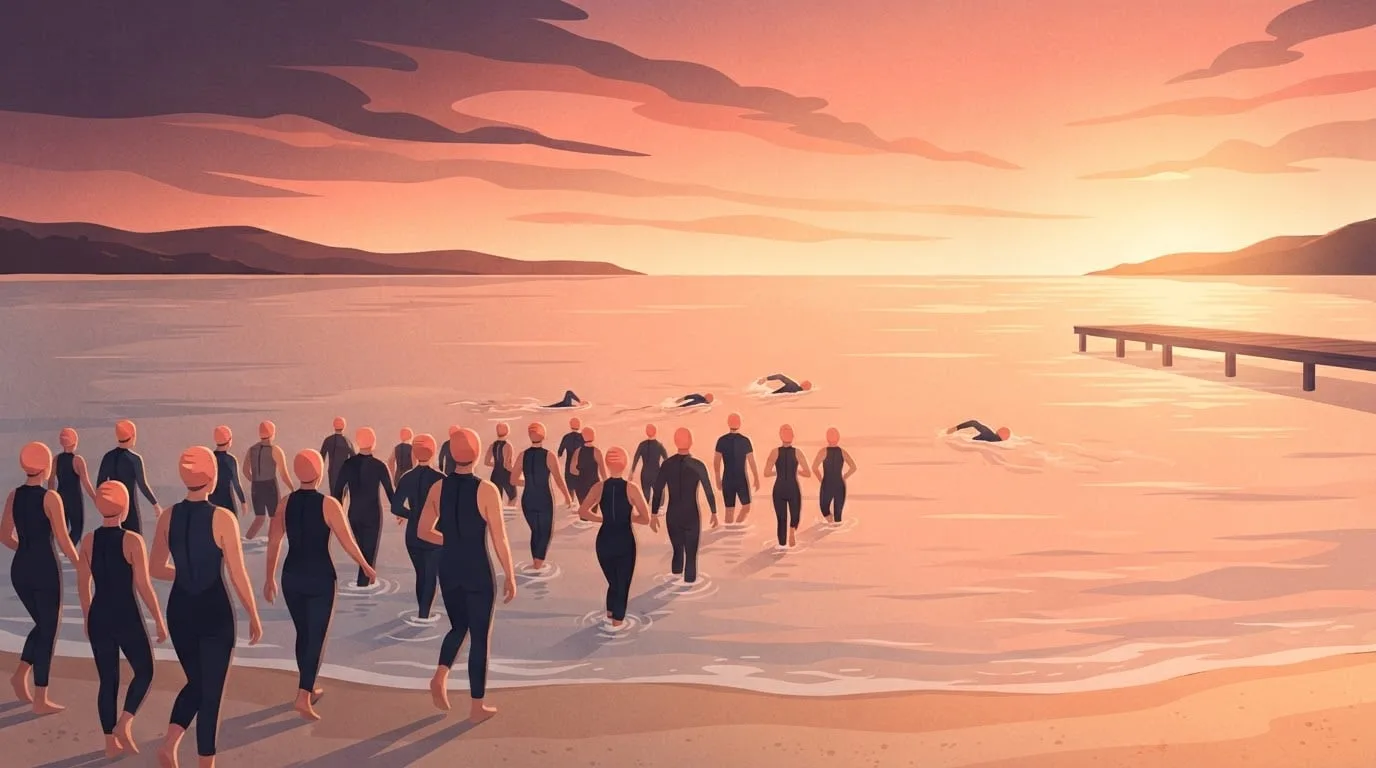
An Ironman is the longest of the standard triathlon formats, and it's long in both senses. The course covers 140.6 miles, and the race clock usually runs from sunrise until well after dark. So if you're asking what is an Ironman, it's a 2.4-mile swim, a 112-mile ride and a full marathon, raced back to back with no breaks beyond the minutes you spend changing gear.
From the outside it can look like something only professional athletes do. The results say otherwise. The dataset on this page holds nearly 700,000 age-group finishes, and men aged 45 to 49 alone outnumbered all the men under 30. For most age-groupers, the hard part is squeezing months of long training days in between a job and a family.
This page covers what an Ironman is and where it came from, the 140.6 miles leg by leg with average splits, the cutoffs, and average finish times by age and sex. It also covers how many hours a week finishers train and what the research says about fueling on race day.
What Is an Ironman?
An Ironman is a full-distance triathlon: a 2.4-mile swim, a 112-mile bike ride and a 26.2-mile run, completed in that order on the same day. The race was the creation of Judy and John Collins and was first held on the Hawaiian island of Oahu on February 18, 1978. Fifteen athletes started and twelve finished, and Gordon Haller won in 11 hours, 46 minutes and 40 seconds, according to USA Triathlon, which inducted all twelve finishers into its Hall of Fame in 2023.
Strictly speaking, IRONMAN is a brand. Races of the same length run by other organizers are usually called iron-distance or full-distance triathlons, and they cover the same 140.6 miles. Either way, the swim, bike and run come in the same order, with two transitions where you change gear while the clock keeps running.
An Ironman is the longest of the five standard formats. The others are the super sprint (about 8 miles), the sprint (16 miles), the Olympic (32 miles) and the half Ironman, or IRONMAN 70.3. Our page on how long a triathlon is covers all of them, with distances, typical finish times and training timelines.
Ironman Breakdown: 140.6 Miles by Leg
Here's how the 140.6 miles break down, with the average time age-groupers spent on each leg in the same 687,696 IRONMAN finishes:
| Leg | Distance | Men, mean | Women, mean | Share of finish time |
|---|---|---|---|---|
| Swim | 2.4 mi (3.86 km) | 1:17:21 | 1:21:41 | about 10% |
| Bike | 112 mi (180.25 km) | 6:14:42 | 6:46:16 | about 49 to 50% |
| Run | 26.2 mi (42.2 km) | 4:50:05 | 5:07:28 | about 38% |
| Two transitions | about 16 min | about 16 min | about 2% | |
| Finish | 140.6 mi (226.3 km) | 12:37:49 | 13:31:40 | 100% |
Mean splits and finish times from Knechtle and colleagues (2024), Table 1. The shares and the transition row are our arithmetic: the transition time is the finish time minus the three splits.
The bike is the big one. It took about half of the average finish time for both men and women, while the swim took about a tenth. Spread over the distance, the averages work out to about 2:00 per 100 meters in the water for men and 2:07 for women. On the bike that's 17.9 and 16.5 mph, and on the run 11:04 and 11:44 per mile.
That run pace tells you something. The median American finished a standalone marathon in about 4 hours 14 minutes (men) and 4 hours 41 minutes (women) in 2024, as our page on how long a marathon is shows. The average Ironman marathon took 4:50 for men and 5:07 for women. The two groups aren't the same people, but the gap gives you a feel for what 114 miles of swimming and riding does to your legs before the run even starts.
How Long Do You Have to Finish an Ironman?
Most IRONMAN races give you 17 hours from start to finish, with earlier cutoffs for the swim and the bike. Before the 2019 IRONMAN World Championship in Hawaii, race director Diana Bertsch summed up the limits for Hawaii Public Radio. Each athlete had 2 hours 20 minutes to complete the swim, 10 hours 30 minutes to complete the bike and 17 hours in total. Athletes started in waves between 6:30 and 7:30 a.m., so the final cutoff moved from midnight, when the race had one mass start, to 12:30 a.m.
Here's what those limits mean in practice:
- Swim: 2 hours 20 minutes for 2.4 miles is about 3:38 per 100 meters, a pace most steady swimmers can hold with room to spare.
- Bike: you need to be off the bike within 10 hours 30 minutes of your start. A swimmer who exits in 1 hour 30 minutes has 9 hours for the transition and the 112 miles, an average of about 12.4 mph.
- Run: the marathon gets whatever is left of the 17 hours, at least 6.5 hours. That's about 4 mph for 26.2 miles, a brisk walk.
Other races set their own limits, and some close sooner than 17 hours, so read the athlete guide for your race before you enter. Missing a cutoff ends your race at that point.
Average Ironman Time by Age and Sex
The largest open dataset on Ironman times is the Knechtle analysis of every age-group finish at official IRONMAN races worldwide from 2002 to 2022. Here is the average Ironman time for each age group:
| Age | Women, mean time | Men, mean time |
|---|---|---|
| 18 to 24 | 13:16:04 | 12:36:07 |
| 25 to 29 | 13:07:35 | 12:19:28 |
| 30 to 34 | 13:11:43 | 12:15:21 |
| 35 to 39 | 13:19:36 | 12:20:21 |
| 40 to 44 | 13:30:14 | 12:31:19 |
| 45 to 49 | 13:43:29 | 12:44:21 |
| 50 to 54 | 14:01:25 | 13:03:32 |
| 55 to 59 | 14:18:42 | 13:27:46 |
| 60 to 64 | 14:46:36 | 13:53:40 |
| 65 to 69 | 15:17:54 | 14:21:44 |
| 70 to 74 | 15:43:20 | 14:59:52 |
| 75 and over | 16:33:16 | 15:43:40 |
Mean finish times for 687,696 age-group finishes at official IRONMAN races, 2002 to 2022 (Knechtle and colleagues, 2024, Table 2). Finishers only: athletes who missed a cutoff or dropped out aren't included.
The fastest groups were men aged 30 to 34, at 12:15:21, and women aged 25 to 29, at 13:07:35. Age costs surprisingly little for a long time. Men in their early 50s averaged 48 minutes slower than the fastest men's group, and women in their early 50s about 54 minutes slower than the fastest women's group. By 60 to 64, both gaps had grown to about 1 hour 38 minutes.
Across all ages, women averaged about 7 percent slower than men, with a gap of roughly 5 to 8 percent inside each age group. Women made up about one finisher in five, and men aged 35 to 49 accounted for 56 percent of all male finishes. The standard deviation was about 1 hour 35 minutes to 1 hour 50 minutes in most groups, so finishing times spread widely around these averages.
Which Leg Decides Your Ironman Time?
For age-groupers, the bike and the run decide most of the finish. Using the same 687,696 finishes, Knechtle and colleagues (2025) found that overall time tracked the bike and run splits more closely than the swim. The correlations were 0.88 (women) and 0.89 (men) for cycling and 0.89 and 0.90 for running. The swim's link to the finish weakened further with age.
Professionals look a little different. In IRONMAN pro races from 2015 to 2020, Sousa and colleagues (2021) found the run was the best predictor of the full-distance finish, and running mattered more the longer the race. The fastest third of professional men averaged 8 hours 13 minutes, and the fastest third of women 9 hours 4 minutes.
Our advice follows from both findings. Swim calmly, ride at an effort you could hold all day, and start the marathon with something left in your legs.
Knowing what to do is the easy part.
FitCraft, our mobile fitness app, pairs you with an AI coach who builds you a personalized plan around your goals, schedule, and fitness level. Every FitCraft program is designed by Domenic Angelino, MPH (Brown University) and NSCA-CSCS, with research published in the Journal of Strength and Conditioning Research and Medicine & Science in Sports & Exercise.
Take the Free Assessment Free • 2 minutes • No credit cardHow Long Does It Take to Train for an Ironman?
In the best available study, amateur Ironman finishers trained about 14 hours a week before the race. At IRONMAN Switzerland in 2009 and 2010, Knechtle and colleagues (2011) studied 184 male finishers who weren't professionals. They trained 13.9 hours a week on average: 2.5 hours of swimming (6.2 km), 7.1 hours of cycling (194 km) and 4.3 hours of running (45 km). They finished in 11 hours 26 minutes on average. Half their training time went to the bike, close to the share it takes on race day.
Most of those hours are easy. In a six-month study of 10 Ironman triathletes, Neal and colleagues (2011) found 69 percent of training time in the lowest heart-rate zone, 25 percent in the middle zone and 6 percent in the highest. In nine triathletes training for the same Ironman, Muñoz and colleagues (2014) found that athletes who spent more time in the easiest zone finished faster, while a lot of moderate-intensity cycling went with slower results. Our review of polarized training research explains why plans built mostly on easy work tend to do well.
How long the whole build takes depends on where you start. For someone who already races shorter triathlons, the Ironman-specific block usually runs six months to a year. Counting the base and the shorter races most people do first, a MedStar Health guide puts the whole journey at one to two years. The timeline for every distance is on our page about how long a triathlon is.
Ironman Race-Day Fueling: What the Research Shows
Over 12 or 13 hours, eating and drinking become a fourth leg of the race. In a survey of endurance races by Pfeiffer and colleagues (2012), triathletes averaged 62 grams of carbohydrate an hour at the Ironman World Championship in Hawaii. At Ironman Germany they averaged 71 grams. At both races, athletes who took in more carbohydrate in total tended to finish faster (correlations of -0.55 and -0.48 with finish time). The cost was the gut. About 31 percent of Ironman athletes reported serious stomach or intestinal symptoms, against 14 percent at the 70.3 in the same survey.
How much should you aim for? In a 2014 review, Jeukendrup recommended up to about 60 grams an hour from a single type of sugar for events of 2 to 3 hours, and about 90 grams an hour for ultra-endurance events. Intakes that high only work with a mix of sugars, such as glucose with fructose, which the gut absorbs through different routes. Practice your race-day intake on long rides, because the gut adapts with training. Our guide on what to eat before a long run covers the pre-race meal and how to train your gut.
Even a good plan can't keep up with what you burn. At a Spanish Ironman-distance race, Barrero and colleagues (2015) estimated that 11 triathletes burned about 11,000 calories while eating and drinking about 3,600. They averaged 84 grams of carbohydrate an hour and still finished with an energy deficit of about two thirds, 4.3 kilograms lighter on average. On race day the goal is to keep carbohydrate coming in steadily, since replacing every calorie isn't possible.
Drinking too much carries its own risk. Noakes and colleagues (2005) weighed 2,135 athletes before and after marathons, a 109-kilometer cycle race and 226-kilometer Ironman triathlons. Eleven percent gained weight during their race, and 30 percent of those finished with low blood sodium, a condition called exercise-associated hyponatremia. The authors concluded that athletes can prevent it by not drinking to excess. A simple check is to weigh yourself before and after long training days: if you finish heavier than you started, you drank more than you needed.

How Long Is an Ironman for Beginners?
For a first Ironman, plan on the slower side of the averages. For many first-timers, 13 to 16 hours is a realistic finish. The averages above include experienced racers, and the spread around them is wide. A first-timer is better off planning around the cutoffs than around a time goal. Reach the swim exit with time in hand, get off the bike with at least six and a half hours left for the marathon, and walk the aid stations if you need to.
Very few people make a full Ironman their first triathlon. The usual route is a sprint or Olympic race, then a half Ironman, then the full distance. If the 2.4-mile swim is the part that worries you, our swimming workouts for beginners are the place to start.
What This Means for You
Here are the core numbers. An Ironman is 140.6 miles, most races allow 17 hours, and the average man finishes in about 12.5 hours and the average woman in about 13.5. The bike takes about half the day, the finishers in the Swiss study trained about 14 hours a week, and race-day carbohydrate deserves practice in training like any other skill.
An Ironman is decided in the months before it, in the long rides and in the weeks when work gets busy and training starts to slide. A 14-hour training week lasts only if the routine is one you want to come back to. As Sarah put it: "First app that made exercise feel like something I chose, not forced."
Ironman plans schedule the swims, rides and runs first, so strength and mobility work is what slips. A workout app that keeps you motivated gives that work a fixed place in the week. In FitCraft, a 3D AI coach shows you every dumbbell and bodyweight move, leads yoga and mobility sessions and says your name as you go, and a streak gives you one more reason not to skip.
Frequently Asked Questions
How long is an Ironman in miles?
An Ironman is 140.6 miles: a 2.4-mile swim, a 112-mile bike ride and a 26.2-mile run. In kilometers that's about 226, made up of a 3.86 km swim, a 180.25 km ride and a 42.2 km marathon.
What does an Ironman consist of?
An Ironman consists of a 2.4-mile swim, a 112-mile bike ride and a 26.2-mile marathon, raced in that order on the same day with two transitions in between. Most races allow 17 hours in total, with earlier cutoffs for the swim and the bike.
How long is a half Ironman?
A half Ironman is 70.3 miles: a 1.2-mile swim, a 56-mile ride and a 13.1-mile run. In 823,459 IRONMAN 70.3 age-group finishes, men under 45 averaged about 5 hours 39 minutes to 5 hours 47 minutes and women about 6 hours 9 minutes to 6 hours 16 minutes.
Can a beginner do a half Ironman?
Yes, a beginner can do a half Ironman, but it's a big first race. A common route is a sprint or Olympic triathlon first, then about 16 to 24 weeks of half Ironman training at roughly 8 to 12 hours a week.
Why can't you wear headphones during a triathlon?
USA Triathlon's rules bar athletes from using communication devices of any type in a distracting way during a race, and playing music counts. Breaking the rule can mean disqualification. IRONMAN races set their own rulebook, so check your athlete guide.
What are the distances of a T100 triathlon?
A T100 triathlon is 100 kilometers: a 2 km swim, an 80 km bike ride and an 18 km run, or about 1.24, 50 and 11.2 miles. It's the format of the professional T100 World Tour and sits between an Olympic distance and a half Ironman.