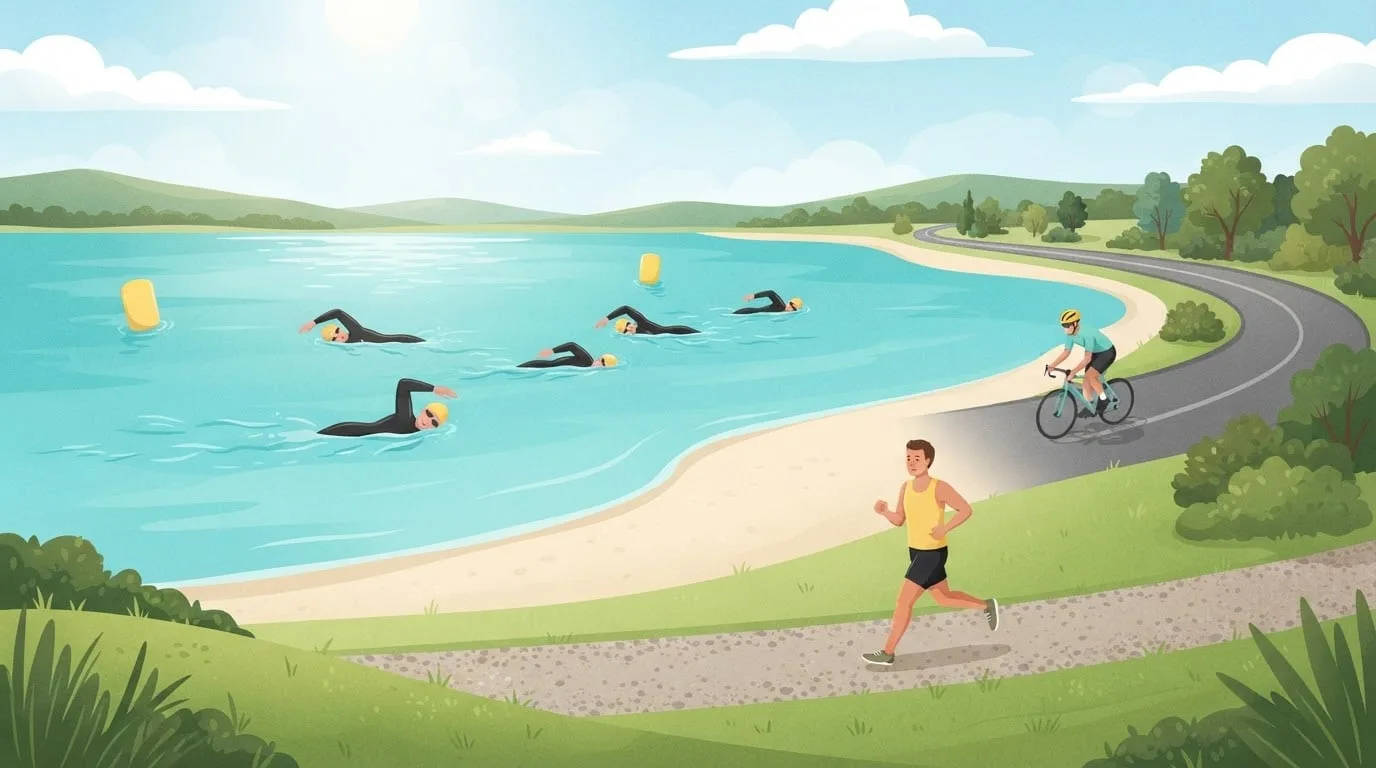
Triathlon distances run from a 12.9-kilometer super sprint that many people finish in under an hour to a 140.6-mile Ironman that takes most of a day. So the first answer to how long is a triathlon is a question back: which one? Most local races offer sprint triathlon distances (a 750-meter swim, a 20-kilometer ride and a 5-kilometer run) or Olympic triathlon distances, which double every leg. Those two are where almost everyone starts.
Three sports can look like three times the work, and the swim puts plenty of people off before they ever sign up. The shorter races are built for newcomers, though. In a typical sprint the swim is over in 15 to 25 minutes, and the bike and the run make up most of your time. What usually derails a first triathlon is a training plan that falls apart after the first busy week.
This page gives every standard triathlon distance in miles and kilometers and how long each format takes, from professionals to first-timers. It also has average 70.3 times by age and sex from more than 800,000 results, and how long to train for each distance. If the full distance is the one on your mind, our page on how long an Ironman is takes the 140.6 miles leg by leg.
Triathlon Distances in Miles and Kilometers
Every triathlon is a swim, then a bike ride, then a run, raced back to back with the clock running the whole time. What changes from race to race is the length of each leg. These are the standard triathlon distances as USA Triathlon, the sport's governing body in the United States, lists them:
| Format | Swim | Bike | Run | Total |
|---|---|---|---|---|
| Super sprint | 400 m (0.25 mi) | 10 km (6.2 mi) | 2.5 km (1.6 mi) | 12.9 km (8 mi) |
| Sprint | 750 m (0.47 mi) | 20 km (12.4 mi) | 5 km (3.1 mi) | 25.75 km (16 mi) |
| Olympic (standard) | 1.5 km (0.93 mi) | 40 km (24.9 mi) | 10 km (6.2 mi) | 51.5 km (32 mi) |
| Half Ironman (70.3) | 1.2 mi (1.9 km) | 56 mi (90 km) | 13.1 mi (21.1 km) | 70.3 mi (113 km) |
| Full Ironman (140.6) | 2.4 mi (3.9 km) | 112 mi (180 km) | 26.2 mi (42.2 km) | 140.6 mi (226 km) |
USA Triathlon gives the first three formats in metric units and the two long ones in miles. The conversions in brackets are our arithmetic. Its list also includes World Triathlon's long course, a 2 km swim, 80 km ride and 20 km run (102 km in all), which sits between the Olympic and the half Ironman.
So how many miles is a triathlon? Anywhere from about 8 to 140.6. The sprint is almost exactly 16 miles, the Olympic is 32, and the two long formats are named after their total mileage. Local races bend these numbers to fit their lake or road loop, which is why USA Triathlon sorts races by their legs. If two of the three legs fall in the same category, that's the race's category, and if all three differ, the bike decides.
What Does a Triathlon Consist Of?
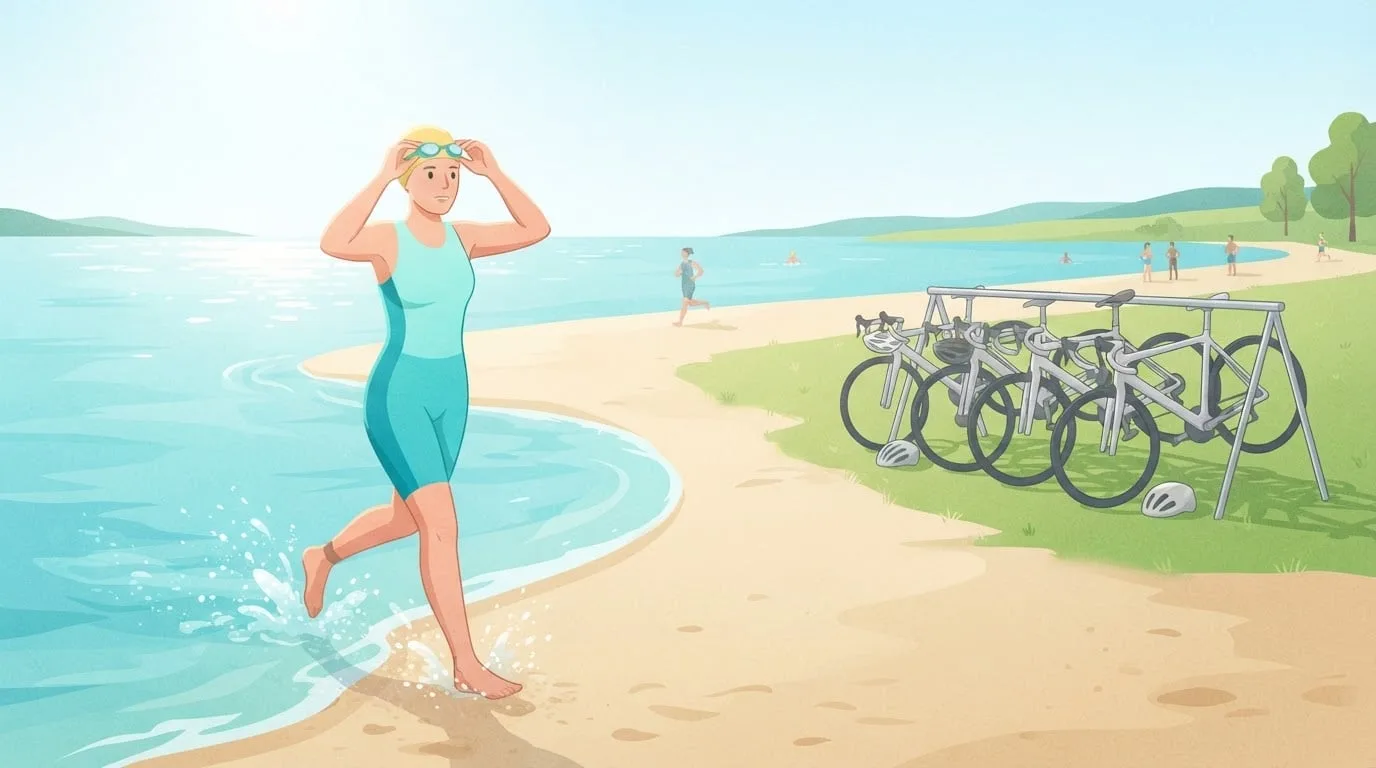
A triathlon consists of five parts: the swim, the first transition (T1), the bike, the second transition (T2) and the run. The order is always swim, bike, run. The transitions happen in a transition area where your bike waits on a rack. In T1 you pull off your goggles and cap, and your wetsuit if you wore one, buckle your helmet and wheel the bike out. In T2 you rack the bike, change shoes and head out on foot. The clock never stops, so transition time counts toward your finish, and a nervous first-timer can easily spend several minutes in each one.
Why is drafting not allowed in triathlon?
In most age-group races you ride on your own. Drafting means tucking in behind another rider to shelter from the wind, and it's banned. Under USA Triathlon's 2023 rules, the draft zone around each rider is 10 meters in sprint and Olympic races and 12 meters in longer ones. You can pass through it, but you can't sit in it. Elite Olympic-distance racing is the big exception: those races are draft-legal, so the professionals ride in packs.
The ban exists because drafting is a large advantage. In a French study, eight international-level triathletes raced the same sprint triathlon twice, once riding alone and once drafting. Hausswirth and colleagues (1999) found that drafting cut oxygen uptake on the bike by 14 percent and heart rate by about 12 beats a minute. Afterward, the athletes ran about 4 percent faster. Over a 5K that's roughly 40 seconds, which is why age-group rules ask everyone to ride in their own air.
How Long Is a Sprint Triathlon?
A sprint triathlon is 25.75 kilometers, or 16 miles: a 750-meter swim (0.47 miles), a 20-kilometer bike ride (12.4 miles) and a 5-kilometer run (3.1 miles). In time, most people finish one in 1 to 2 hours. The fastest professionals need under an hour. Across five seasons of draft-legal World Triathlon sprint races, the fastest third of professional men averaged 52.9 minutes and the fastest third of women 58.2 minutes, according to Sousa and colleagues (2021).
No large study has published finish times for everyday sprint racers, partly because sprint courses vary so much. So here is an estimate built leg by leg from common amateur paces, with the arithmetic shown:
| Leg | Fit regular | Steady first-timer |
|---|---|---|
| Swim, 750 m | 15 min (2:00 per 100 m) | 22.5 min (3:00 per 100 m) |
| Transition 1 | 2 min | 5 min |
| Bike, 20 km | 37.5 min (19.9 mph) | 50 min (14.9 mph) |
| Transition 2 | 1 min | 3 min |
| Run, 5 km | 30 min (9:39 per mile) | 40 min (12:52 per mile) |
| Total | about 1 hour 25 minutes | about 2 hours |
This is our estimate, not measured race data. The faster swim pace matches the 2:00 per 100 meters that amateur men averaged over the Olympic-distance swim in the Brazilian study below. The run times bracket the median standalone 5K times on our 5K page, about 32 minutes for men and 39 for women. A 5K off the bike usually runs a little slower than a standalone one.
For most people a sprint is the right first race. The swim is short, the ride is about the length of a relaxed weekend spin, and the run is a 5K. If you can swim 750 meters without stopping, ride for an hour and jog for 30 minutes, you're most of the way there already.
Super sprint: the shortest triathlon
A super sprint halves the sprint again: a 400-meter swim, a 10-kilometer ride and a 2.5-kilometer run, 12.9 kilometers or about 8 miles in all. At the same paces as the table above, it takes about 45 minutes to an hour. Some super sprints and sprints swim in a pool instead of open water, which many first-timers find far less daunting.
Olympic Triathlon Distances and Times
An Olympic triathlon is 51.5 kilometers, or 32 miles: a 1.5-kilometer swim (0.93 miles), a 40-kilometer ride (24.9 miles) and a 10-kilometer run (6.2 miles). It's also called the standard distance, and it's exactly double the sprint in every leg. So the difference between the Olympic and sprint distances is simple: twice as far, and usually a bit more than twice as long, because you can't hold sprint effort for three hours.
Real amateur data for this distance is thinner than you'd expect. One of the few studies with full splits comes from Brazil, where Barbosa and colleagues (2023) tested 20 women and 20 men who raced the 30th Santos International Olympic Triathlon in 2022. The men averaged 2 hours 27 minutes and the women 2 hours 38 minutes. These were volunteers for a lab study, so they're probably fitter than the average entrant. At the leg paces in the sprint table, an Olympic distance comes out at about 2 hours 50 minutes for a fit regular and close to 4 hours for a steady first-timer. The fastest third of professionals in the Sousa data averaged 1 hour 47 minutes for men and 1 hour 57 minutes for women.
The Santos splits also show where the time goes. The bike took 45 percent of the race for both sexes, the run about a third and the swim about a fifth. That pattern holds at the longer distances too. The swim is the leg people worry about, and it's the shortest one in time.
How hard is an Olympic triathlon?
An Olympic triathlon is hard but very doable for a regular exerciser with about three months of preparation. For most people it means two and a half to four hours of continuous effort, and the 10K comes on tired legs, which is the part first-timers tend to underrate. If you've run a 10K before, the standalone times on our page about how many miles a 10K is give you a baseline. Expect to run several minutes slower off the bike.
Knowing what to do is the easy part.
FitCraft, our mobile fitness app, pairs you with an AI coach who builds you a personalized plan around your goals, schedule, and fitness level. Every FitCraft program is designed by Domenic Angelino, MPH (Brown University) and NSCA-CSCS, with research published in the Journal of Strength and Conditioning Research and Medicine & Science in Sports & Exercise.
Take the Free Assessment Free • 2 minutes • No credit cardHow Long Is a Half Ironman (70.3)?
A half Ironman is 70.3 miles, or 113 kilometers: a 1.2-mile swim (1.9 km), a 56-mile ride (90 km) and a 13.1-mile half marathon (21.1 km). IRONMAN's own races at this distance are branded IRONMAN 70.3, which is where the number comes from. Most age-groupers finish in about 5.5 to 7 hours.
This is also the best-measured triathlon distance. Knechtle and colleagues (2023) analyzed 823,459 age-group finishes at official IRONMAN 70.3 races from 2004 to 2020. Every one of those courses is the same length, so the times compare cleanly, and about one finish in four was by a woman.
What is a good IRONMAN 70.3 time?
A good IRONMAN 70.3 time is one that beats the average for your age and sex. In the Knechtle data that means under about 5 hours 45 minutes for men and 6 hours 15 minutes for women up to their mid-40s:
| Age | Women, mean time | Men, mean time |
|---|---|---|
| 18 to 24 | 6:10:20 | 5:38:38 |
| 25 to 29 | 6:09:29 | 5:40:45 |
| 30 to 34 | 6:10:04 | 5:41:16 |
| 35 to 39 | 6:13:18 | 5:43:27 |
| 40 to 44 | 6:16:18 | 5:46:34 |
| 45 to 49 | 6:20:14 | 5:49:47 |
| 50 to 54 | 6:26:25 | 5:54:25 |
| 55 to 59 | 6:35:04 | 6:01:54 |
| 60 to 64 | 6:49:32 | 6:13:00 |
| 65 to 69 | 7:05:10 | 6:28:14 |
| 70 to 74 | 7:28:41 | 6:52:49 |
| 75 and over | 7:43:26 | 7:18:36 |
Mean finish times from 823,459 age-group finishes at official IRONMAN 70.3 races, 2004 to 2020 (Knechtle and colleagues, 2023, Table 1). These are means for finishers only, not medians.
Two things stand out. First, age costs very little for a long time. The average man aged 50 to 54 was only about 16 minutes slower than the average man aged 18 to 24. Women in their early 50s were about 17 minutes behind the fastest women's group, aged 25 to 29. Second, women's average times stayed about 8 to 10 percent slower than men's through most of the age range. For reference, the fastest third of professional men in the Sousa data averaged 3 hours 50 minutes and the fastest third of women 4 hours 16 minutes.
How Long Is a Full Ironman Triathlon?
A full Ironman is 140.6 miles, or 226 kilometers: a 2.4-mile swim, a 112-mile ride and a full 26.2-mile marathon, all on the same day. Across 687,696 finishes by age-group athletes at IRONMAN events between 2002 and 2022, the average was 12 hours 38 minutes for men and 13 hours 32 minutes for women, according to Knechtle and colleagues (2024). The run alone is a marathon, which our page on how long a marathon is covers as a standalone race. For the splits, the cutoffs, times by age and sex and race-day fueling, see how long an Ironman is.
How Far Are the Swim, Bike and Run in a Triathlon?
If you're sizing up one leg at a time, here's how each one grows across the formats.
How far is a triathlon swim?
A triathlon swim is 400 meters in a super sprint, 750 meters (about 820 yards) in a sprint, 1.5 kilometers in an Olympic, 1.2 miles in a half Ironman and 2.4 miles in a full. Most race swims are in open water, a lake, a river or the sea, with no wall to rest on and no lane line to follow. If you're new to swimming laps, our swimming workouts for beginners build up from single lengths. Before race day, add a few open-water swims with a friend or a coached group so the first one isn't on race morning.
How far is the bike in a triathlon?
The bike leg is 10 kilometers in a super sprint, 20 kilometers (12.4 miles) in a sprint, 40 kilometers (24.9 miles) in an Olympic, 56 miles in a half Ironman and 112 miles in a full. It's the longest leg in distance and in time at every format. For a first sprint, any roadworthy bike and a helmet will do. Riding builds the front of your thighs but not much else, as our look at whether cycling builds muscle explains, which is one reason triathletes add strength work.
How far is the run in a triathlon?
The run is 2.5 kilometers in a super sprint, then a 5K, a 10K, a half marathon and a full marathon as the formats grow. It always comes last, on legs that have just ridden, so expect to run slower than your standalone race times. The first few minutes off the bike feel strange to almost everyone. Practicing short runs straight after rides, known as brick workouts, takes the edge off that feeling.
How Long Does It Take to Train for a Triathlon?
Training time depends on the distance and on where you start. If you can already swim a few lengths, ride for half an hour and jog for 20 minutes, these are realistic timelines:
| Distance | Training time | Hours per week |
|---|---|---|
| Super sprint | 4 to 8 weeks | 2 to 4 |
| Sprint | 8 to 12 weeks | 2 to 5 |
| Olympic | 12 to 16 weeks | 3 to 7 |
| Half Ironman (70.3) | 16 to 24 weeks | 8 to 12 |
| Full Ironman | 6 to 12 months of specific training | 10 to 20 |
Weekly hours for the sprint to full distances come from a MedStar Health beginner's guide written by a physical therapist. The training times and the super sprint row are our coaching estimates, in line with USA Triathlon's note that sprint plans typically run four, eight or twelve weeks.
The MedStar guide also advises finishing a sprint or Olympic race before moving up to a half or full Ironman, and it calls training for an Ironman a 12- to 24-month process. That's sound advice. The jump from 32 miles to 70.3 is bigger than it looks on paper, because race day grows from about three hours to six or more.
How long is a triathlon for beginners?
For beginners, the right first triathlon is a sprint or a super sprint, which takes most first-timers 1 to 2 hours including transitions. Give yourself about 8 to 12 weeks and swim at least twice a week, which is USA Triathlon's guidance for sprint training. If your race is in a lake or the sea, practice in open water first. And if the swim worries you, look for a race with a pool swim.
Make room for strength work
Most triathlon plans are three sports' worth of cardio, and strength work is easy to drop. In a USA Triathlon coaching article, coach Marty Gaal (2022) recommends two or three strength sessions a week. Each one covers six to ten exercises, at two or three sets of 10 to 20 reps with light to moderate resistance. At home, with a pair of dumbbells and your body weight, that can be as simple as:
- Legs: goblet squats, reverse lunges and step-ups onto a sturdy box or stair.
- Hips and back: dumbbell Romanian deadlifts and glute bridges.
- Upper body: one-arm dumbbell rows and push-ups.
- Core: planks, side planks and bird dogs.
- Lower legs: calf raises, slow on the way down.
Twenty-five to thirty minutes covers it, and on a busy week, one session still counts.
What This Means for You
Keep the numbers short. A sprint is 16 miles and 1 to 2 hours, and an Olympic is 32 miles and about 3 to 4 hours for a first-timer. A half Ironman is 70.3 miles and 5.5 to 7 hours, and a full Ironman is 140.6 miles and most of a day. If you've never raced, pick a sprint 8 to 12 weeks out and let the date do some of the motivating.
What ends a lot of first triathlon plans is a busy week five, when one session slips, then another, and the race date starts to feel like a mistake. That's a consistency problem, and willpower is a poor fix for it. A routine that pulls you back works better. As Katie put it: "I've tried everything. This is the first time I've stuck with something past two weeks."
The swims, rides and runs are the visible part of triathlon training. Strength and mobility sessions are the ones that quietly disappear, which is where a workout app that keeps you motivated earns its place. In FitCraft, 3D AI coaches demonstrate every dumbbell and bodyweight exercise, and your coach says your name during the workout. Streaks and leaderboards keep those sessions on the calendar, and the workouts adjust as you progress.
Frequently Asked Questions
How many miles is a triathlon?
A triathlon is about 8 to 140.6 miles, depending on the format. A super sprint is about 8 miles, a sprint 16 miles, an Olympic 32 miles, a half Ironman 70.3 miles and a full Ironman 140.6 miles, always as a swim, a bike ride and a run in that order.
How long is a sprint triathlon in miles?
A sprint triathlon is 16 miles, or 25.75 kilometers: a 0.47-mile (750-meter) swim, a 12.4-mile (20-kilometer) bike ride and a 3.1-mile (5-kilometer) run. Most people finish one in 1 to 2 hours, and the fastest professionals need under an hour.
What is the order of a triathlon?
The order of a triathlon is swim, bike, run. Between the legs come two transitions: T1, where you change from swimming to cycling, and T2, where you rack the bike and set off running. The race clock keeps running through both.
How many miles is a 750m swim?
A 750-meter swim is 0.47 miles, or about 820 yards. That's 30 lengths of a 25-meter pool, and most people swim it in about 15 to 25 minutes in a sprint triathlon.
Why is drafting not allowed in triathlon?
Drafting isn't allowed in age-group triathlons because riding in another cyclist's shelter saves a lot of energy. In a 1999 study, drafting cut oxygen uptake on the bike by 14 percent, and the triathletes then ran about 4 percent faster. USA Triathlon's draft zone is 10 meters in sprint and Olympic races and 12 meters in longer ones.
How long is a triathlon for beginners?
For beginners, a sprint triathlon is the usual first race: 16 miles that most first-timers finish in 1 to 2 hours. A super sprint, about 8 miles and roughly 45 minutes to an hour, is an even gentler start. Allow about 8 to 12 weeks of training for a sprint.