Eggs should be the easiest food to log. Then the carton says 70 calories, your app says 72, a boiled egg shows up as 78, and someone online swears a fried egg is 120. When every number looks a little different, tracking your food starts to feel like guesswork.
The differences are easy to explain. Size sets the starting point, label rounding shaves off a couple of calories, and the fat in your pan does the rest. Below you'll find how many calories in an egg at every size, the numbers for the white and the yolk, how much protein an egg has, and what each way of cooking adds.
How Many Calories in an Egg by Size?
A large egg has about 72 calories, and each step up in size adds about 8 to 10 more. USDA's numbers below describe the egg without its shell.
| Size | Weight | Calories | Protein | Fat | Saturated fat | Carbs | Cholesterol | Sodium |
|---|---|---|---|---|---|---|---|---|
| Small | 38 g | 54 | 4.8 g | 3.6 g | 1.2 g | 0.3 g | 141 mg | 54 mg |
| Medium | 44 g | 63 | 5.5 g | 4.2 g | 1.4 g | 0.3 g | 164 mg | 62 mg |
| Large | 50 g | 72 | 6.3 g | 4.8 g | 1.6 g | 0.4 g | 186 mg | 71 mg |
| Extra large | 56 g | 80 | 7.0 g | 5.3 g | 1.8 g | 0.4 g | 208 mg | 80 mg |
| Jumbo | 63 g | 90 | 7.9 g | 6.0 g | 2.0 g | 0.5 g | 234 mg | 89 mg |
| Per 100 grams | 100 g | 143 | 12.6 g | 9.5 g | 3.1 g | 0.7 g | 372 mg | 142 mg |
Values from USDA FoodData Central SR Legacy entry 171287 (Egg, whole, raw, fresh), scaled to USDA's portion weight for each size and rounded.
For more than one egg, multiply. Two large eggs come to 143 calories and 12.6 grams of protein, three come to 215 calories and 18.8 grams, and four come to 286 calories and 25.1 grams.
Size names also change by country. UK grading rules put a medium egg at 53 to under 63 grams and a large at 63 to under 73 grams, weighed in the shell, so compare by weight if your carton isn't American.
Why Egg Calorie Counts Differ
Most of the small differences come down to rounding. FDA's rounding rules take anything above 50 calories to the nearest 10, so a 72-calorie large egg goes on a carton as 70 and a 63-calorie medium egg as 60.
USDA also has two sets of numbers. The 72 comes from its older Standard Reference data. Its newer Foundation entry, published in 2019 from retail eggs, lists a 50.3-gram Grade A large egg at about 74 calories, 6.2 grams of protein and 5.0 grams of fat, with more cholesterol too, about 207 milligrams against 186. Two calories won't matter in a food log, so use either number and stay with it.
Calories in Egg Whites vs Yolks
The white has about a quarter of an egg's calories and more than half of its protein. The yolk has almost everything else:
| One large egg | Weight | Calories | Protein | Fat | Saturated fat | Cholesterol | Choline | Vitamin D |
|---|---|---|---|---|---|---|---|---|
| White | 33 g | 17 | 3.6 g | 0.1 g | 0 g | 0 mg | 0.4 mg | 0 mcg |
| Yolk | 17 g | 55 | 2.7 g | 4.5 g | 1.6 g | 184 mg | 139 mg | 0.9 mcg |
| Whole egg | 50 g | 72 | 6.3 g | 4.8 g | 1.6 g | 186 mg | 147 mg | 1.0 mcg |
Values from USDA FoodData Central SR Legacy entries 172183, 172184 and 171287, scaled to USDA's large-egg weights and rounded.
Gram for gram, the yolk has more protein, at 15.9 grams per 100 grams against 10.9 in the white. The white wins on calories, because it's mostly water and protein. It gives you about 21 grams of protein per 100 calories, against about 9 for a whole egg. A boiled egg white has the same 17 calories, since boiling adds nothing.

The yolk earns its calories. It holds about 139 of the 147 milligrams of choline in a large egg, and that whole-egg amount is about 27 percent of the Daily Value. If you're cutting calories, adding whites to a whole egg or two makes more sense than throwing every yolk away.
Knowing what to do is the easy part.
FitCraft, our mobile fitness app, pairs you with an AI coach who builds you a personalized plan around your goals, schedule, and fitness level. Every FitCraft program is designed by Domenic Angelino, MPH (Brown University) and NSCA-CSCS, with research published in the Journal of Strength and Conditioning Research and Medicine & Science in Sports & Exercise.
Take the Free Assessment Free • 2 minutes • No credit cardHow Much Protein in an Egg?
A large egg has about 6.3 grams of protein, with about 3.6 grams in the white and 2.7 in the yolk. A medium egg has about 5.5 grams, an extra large 7.0 and a jumbo 7.9. Cooking barely changes those numbers: a large hard-boiled egg has 6.3 grams and a scrambled one 6.1.
Cooking does change how much you absorb. In a small study of five people with ileostomies, Evenepoel and colleagues (1998) found that about 91 percent of cooked egg protein was digested, against about 51 percent of raw.
How many eggs does a meal take?
About three large eggs reach the dose in the best-known study on this question, which happened to use egg protein. Moore and colleagues (2009) gave six young men 0, 5, 10, 20 or 40 grams of whole egg protein after a hard leg workout. Muscle protein synthesis rose with the dose and peaked at 20 grams. More amino acids were burned at the top doses, which suggests the extra wasn't going to muscle. It's one small study in young men, so read 20 grams as a useful marker rather than a limit.
If you want more than that, five large eggs give about 31 grams of protein for 358 calories. Three whole eggs plus three whites give about 30 grams for 266 calories. The yolks are still worth keeping: in a study of 10 trained men, van Vliet and colleagues (2017) found that whole eggs drove more muscle protein synthesis than egg whites with the same 18 grams of protein. To set your daily number, see our guide to how much protein you need per day.
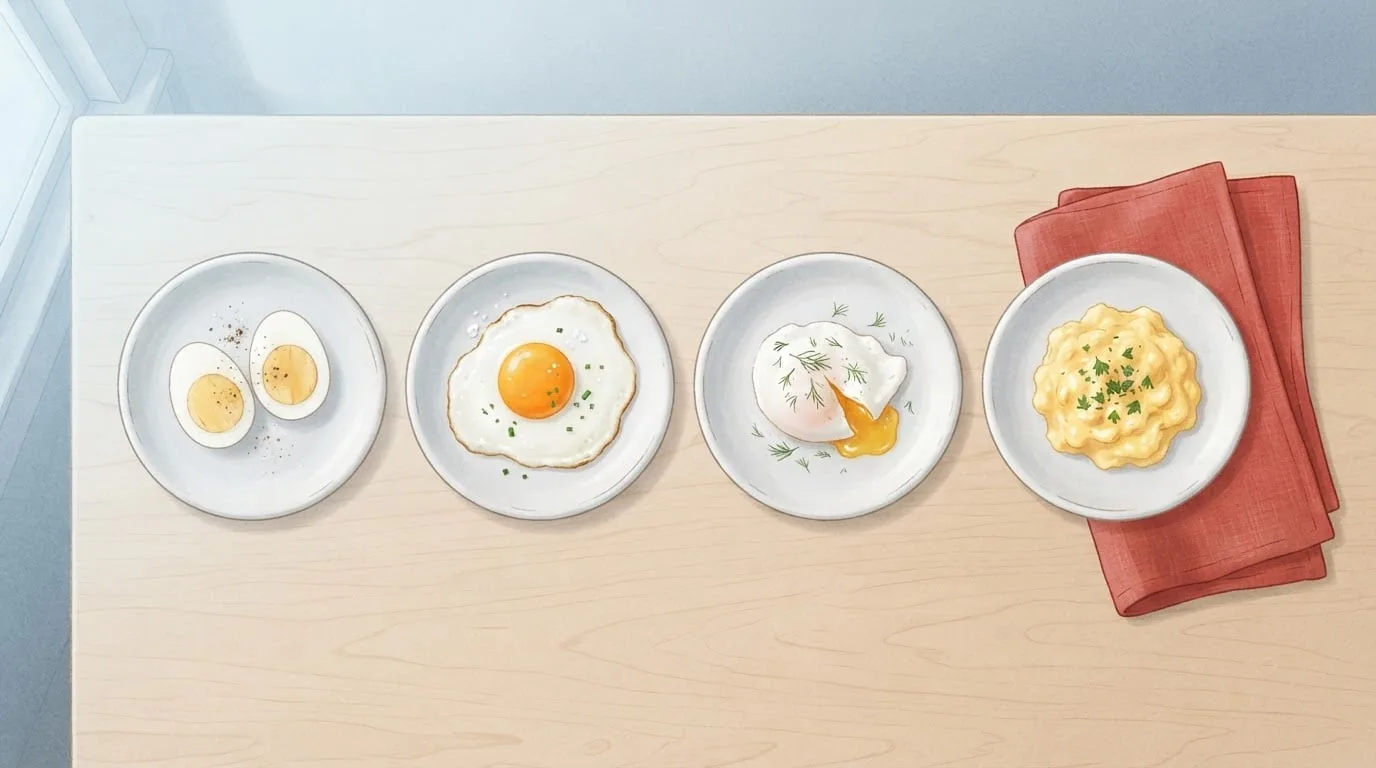
Calories in Boiled, Fried, Scrambled and Poached Eggs
Heat adds almost nothing to an egg. What changes the count is the fat and milk that go in with it. USDA's averages for one large egg look like this:
| One large egg | Weight | Calories | Protein | Fat | Saturated fat | Sodium |
|---|---|---|---|---|---|---|
| Raw | 50 g | 72 | 6.3 g | 4.8 g | 1.6 g | 71 mg |
| Poached | 50 g | 72 | 6.3 g | 4.7 g | 1.6 g | 149 mg |
| Hard-boiled | 50 g | 78 | 6.3 g | 5.3 g | 1.6 g | 62 mg |
| Fried | 46 g | 90 | 6.3 g | 6.8 g | 2.0 g | 95 mg |
| Scrambled | 61 g | 91 | 6.1 g | 6.7 g | 2.0 g | 88 mg |
| Omelet | 61 g | 94 | 6.4 g | 7.1 g | 2.0 g | 95 mg |
Values from USDA FoodData Central SR Legacy entries 171287, 172186, 173424, 173423, 172187 and 172185, at USDA's large-egg weights, rounded.
- Boiled and poached: Nothing goes into the egg, so treat both as about 72 to 78 calories. USDA's hard-boiled entry is higher because it comes from separately analyzed eggs with a little more fat and less water.
- Fried: USDA's fried egg weighs less than a raw one, at 46 grams, and carries about 2 grams more fat, which adds about 19 calories. USDA doesn't name the fat.
- Scrambled and omelets: The 61-gram portion is heavier than the egg alone, which points to added milk and fat. USDA doesn't list the recipe, so your own pan may differ.
What the pan adds
USDA's averages are modest, and home cooking often isn't. If all of it stays on your plate, here's what common additions do to one large egg:
| Added to one large egg | Adds | Total calories |
|---|---|---|
| 1 tablespoon whole milk | 9 | 81 |
| 1 teaspoon butter | 34 | 106 |
| 1 teaspoon olive oil | 40 | 112 |
| 1 tablespoon butter | 102 | 174 |
| 1 ounce cheddar | 116 | 188 |
| 1 tablespoon olive oil | 119 | 191 |
Values from USDA FoodData Central entries 2705385, 173410, 171413 and 328637, rounded, with a teaspoon of butter taken as a third of USDA's tablespoon. Some butter and oil stays in the pan, so those rows are upper limits.
This is why you'll see a fried egg listed anywhere from 90 to 120 calories or more. If you're counting, the fat is the number to measure. Pouring it straight from the bottle can turn a 90-calorie egg into a 190-calorie one.
What This Means for You
Log a large egg as 72 calories, or 78 if you want USDA's hard-boiled figure, and use the size table if your carton says medium or jumbo. Then add whatever went into the pan. For a meal, plan on two or three eggs plus another protein food, because one egg's 6.3 grams won't carry a meal by itself. If you're eating eggs to lose weight, our page on whether eggs are good for weight loss covers the breakfast trials and what eggs do to LDL cholesterol.
Protein only builds muscle if you give it a reason to, and that means training often enough for the work to add up. Tim said it well: "I didn't think an app could replace my trainer. My AI coach proved me wrong." If that's where you get stuck, a personalized training program takes the planning off your plate. In FitCraft, your AI coach demonstrates each bodyweight and dumbbell exercise on a 3D model and calls you by name, your workouts adjust as you progress, and streaks and leaderboards keep you coming back.

Frequently Asked Questions
What are the nutritional facts for a hard-boiled egg?
A large hard-boiled egg has about 78 calories, 6.3 grams of protein, 5.3 grams of fat, 1.6 grams of saturated fat, 0.6 grams of carbs, 187 milligrams of cholesterol and 62 milligrams of sodium, according to USDA. It has no fiber.
Is eating one boiled egg a day good for you?
Yes, for most healthy adults. In three US cohorts of 215,618 people followed for up to 32 years, eating at least one egg a day wasn't linked to more cardiovascular disease than eating less than one a month (Drouin-Chartier and colleagues, 2020). If your LDL cholesterol is high or you have diabetes, ask your doctor how many eggs fit.
Are boiled eggs good for cholesterol?
Boiled eggs won't lower your cholesterol, and they may raise LDL a little. In a meta-analysis of 17 trials in healthy adults, people eating more eggs had LDL about 8 mg/dL higher than controls (Li and colleagues, 2020). Boiling at least adds no butter or oil, and a large boiled egg has about 187 milligrams of dietary cholesterol.
Are brown eggs healthier than white?
No, not in any way that matters. Shell color follows the breed of the hen. One comparison of brown and white egg strains found small differences in both directions, with more fat and vitamin A in white eggs and more vitamin E in brown ones (Anderson, 2013).
Are eggs good for breakfast?
Yes. Two large eggs give you about 143 calories and 12.6 grams of protein with very little effort. Eggs have no fiber, so add fruit, vegetables or whole-grain toast. Our guide to high protein breakfast ideas lists 15 options with their grams of protein.
What's the unhealthiest way to eat eggs?
Raw or undercooked eggs are the riskiest way to eat them, because they can carry Salmonella even when the shell is clean, and FDA advises cooking them until the yolk and white are firm. For calories and saturated fat, the worst habit is a heavy hand with butter. One tablespoon adds 102 calories and 7.3 grams of saturated fat, about 36 percent of the Daily Value.
How many calories are in an egg sandwich?
A fried egg on two slices of whole-wheat bread has about 251 calories and 14 grams of protein, using USDA's numbers. An ounce of cheddar brings it to about 367 calories and 21 grams of protein, and butter on the bread adds more.