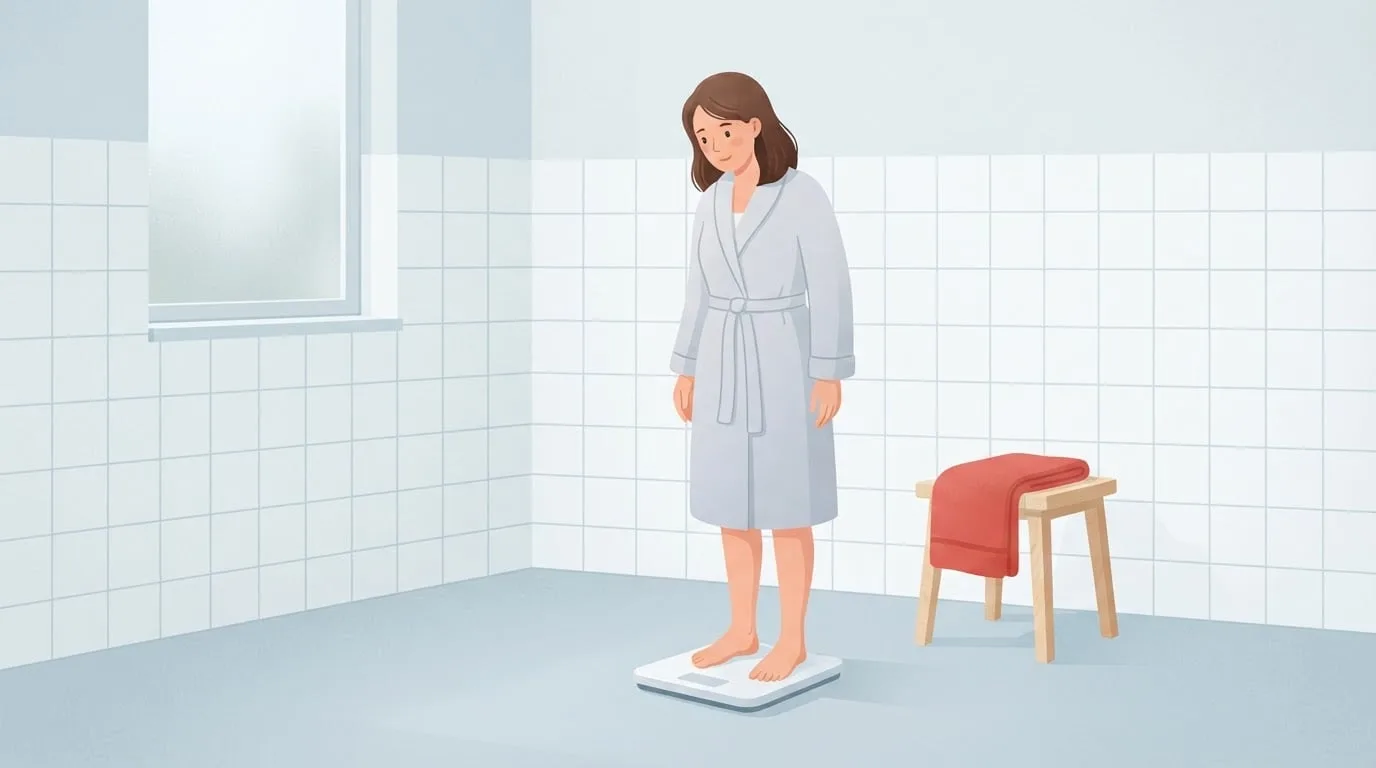
You stepped on the scale this morning and liked the number. Tonight, after dinner, the same scale says you're three pounds heavier. Nobody gains three pounds of fat between breakfast and dinner, so two questions follow: how much can weight fluctuate in a day, and why does my weight fluctuate so much? The answer to both starts with one fact. A scale weighs everything you're carrying, including dinner, every drink since breakfast and the water your body is holding.
That number still stings, and it's a common reason people give up. You eat well all week, see a higher number on Friday night, and decide the plan isn't working. Usually the plan is fine, and the reading is simply the wrong one to judge it by.
This page puts measured sizes on each part of the daily swing: food and drink, salt, carbohydrate, the bathroom, sweat and the menstrual cycle. It also shows what a normal week looks like and when a change on the scale deserves a closer look.
How Much Can Weight Fluctuate in a Day?
Weight can fluctuate by about 1 to 4 pounds (0.5 to 2 kg) in a day for most adults, and a large salty dinner or a long, sweaty workout can push the swing past that. No large study has weighed healthy adults every few hours from morning to night, so treat that range as arithmetic built from measured intakes and losses rather than the result of one weigh-in study. The arithmetic is easy, because a liter of water weighs a kilogram.
Start with what goes in. The National Academies' reference values set adequate total water intake at 3.7 liters a day for men and 2.7 liters for women, counting drinks and the water in food, and about a fifth of it arrives in food (Institute of Medicine, 2005). That's 6 to 8 pounds of water before you count the solid part of your meals, and almost all of it goes in between breakfast and bedtime.
Then look at what goes out, which happens around the clock. The same report puts urine output at 1 to 2 liters a day, water lost through the skin without visible sweating at about 450 mL, water breathed out at 250 to 350 mL for a sedentary adult, and water in stool at 100 to 200 mL. So by evening you're carrying the day's meals and drinks minus whatever has left so far. Overnight, with nothing coming in, the outflow catches up.
Here's roughly what each part of the swing weighs:
| What changes | Typical size | Source |
|---|---|---|
| Drinking water | 1 kg (2.2 lb) per liter until it's excreted | The mass of water |
| Urine | 1 to 2 liters a day (median 1.42 liters) | Institute of Medicine, 2005; Rose and colleagues, 2015 |
| Stool | About 128 grams a day (median, wet weight) | Rose and colleagues, 2015 |
| Breath and skin, without visible sweat | About 0.7 to 0.8 liters a day | Institute of Medicine, 2005 |
| Sweat during training | 0.8 to 1.5 liters an hour in athletes | Barnes and colleagues, 2019 |
| Three days of carbohydrate loading | About 0.9 kg more body water | Shiose and colleagues, 2016 |
| Menstrual cycle | About 0.45 kg higher around a period | Kanellakis and colleagues, 2023 |
| Weekly rhythm | About 0.35% of body weight | Turicchi and colleagues, 2020 |
Sizes are rounded from the studies cited on this page. Breath and skin losses add the report's figures for a sedentary adult, and they rise with activity and heat.
Morning weight moves too, just less. In 65 active men weighed first thing every morning for 4 to 15 days while they drank enough to replace their sweat losses, the average day-to-day variation was 0.51 kg, about 1.1 pounds or 0.7 percent of body weight (Cheuvront and colleagues, 2004). Three mornings in a row were enough to estimate each man's normal range.
Why Do I Weigh Less in the Morning?
You weigh less in the morning because you've gone seven or eight hours without eating or drinking while your body kept losing water. On the Institute of Medicine's figures, breath and skin release roughly a quarter of a liter over a night's sleep, and your kidneys keep producing urine that the first bathroom trip removes. Add a bowel movement and the morning reading usually sits about 0.5 to 1 kg (1 to 2 pounds) below the previous night's.
None of that overnight drop is fat. It's water and waste, and breakfast starts putting the water back.
Do you weigh more at night?
Yes. Most people weigh the most in the evening, after the day's meals and drinks and before the overnight losses begin. A late dinner, a few glasses of water before bed or a salty takeout meal moves the peak later and higher. That's why an evening reading compared with a morning one makes almost anyone look heavier, even in a week when nothing has changed.
Weight difference between morning and night in kg
Expect roughly 0.5 to 2 kg (1 to 4.5 pounds) between an evening weight and the next morning's. On an ordinary day, under a kilogram is typical. A gap closer to 2 kg usually follows a big evening meal, a lot of fluid late in the day or a salty day before.
Knowing what to do is the easy part.
FitCraft, our mobile fitness app, pairs you with an AI coach who builds you a personalized plan around your goals, schedule, and fitness level. Every FitCraft program is designed by Domenic Angelino, MPH (Brown University) and NSCA-CSCS, with research published in the Journal of Strength and Conditioning Research and Medicine & Science in Sports & Exercise.
Take the Free Assessment Free • 2 minutes • No credit cardWhy Does My Weight Fluctuate So Much?
Your weight fluctuates so much because so much of you is water, and the amount you're carrying changes with what you eat, drink and do. Six causes do most of the moving, and they often stack on the same day.
Food and drink
Everything you eat and drink weighs something until your body uses it or gets rid of it. A liter of water adds a kilogram the moment you swallow it, and a large dinner with a couple of drinks can weigh more than that. The scale can't tell a plate of pasta in your stomach from muscle or fat, so it counts it all.

Salt
Salt holds water outside your cells until your kidneys clear the extra sodium, which can take a few days. How much of that shows on the scale varies. In a metabolic-ward study of 32 healthy men, raising salt intake expanded blood plasma by about 315 mL at the highest dose without a measurable rise in body mass or total body water (Heer and colleagues, 2000). A week-long trial covered in our guide on how to lose water weight measured more than a liter of extra fluid after a salty week. Either way it's water, and it drains once your salt intake comes back down.
Carbohydrate and glycogen
Your muscles and liver store carbohydrate as glycogen, and each part of glycogen is stored with three to four parts water (Kreitzman and colleagues, 1992). Fill those stores and the scale climbs. In one study, eight volunteers drained their muscle glycogen with hard cycling, then ate 12 grams of carbohydrate per kilogram of body weight a day for three days. Muscle glycogen more than doubled, and total body water rose from 39.3 to 40.2 kg, about 0.9 kg in 72 hours (Shiose and colleagues, 2016).
It runs the other way too. The first days of a very low-calorie or low-carb diet drain glycogen and its water together, which Kreitzman's group called an illusion of easy weight loss. The water comes back when the carbohydrate does.
The bathroom
A trip to the bathroom is the fastest drop you'll see on the scale. A review of fecal and urine data from studies around the world put median stool output at about 128 grams a day, roughly three quarters of it water, and median urine output at about 1.42 liters a day (Rose and colleagues, 2015). Constipation keeps that weight on board for longer, and a high-fiber diet makes stool heavier. Neither one is fat.
Sweat and training
Exercise can take weight off fast, and nearly all of it is water. In sweat tests of 1,303 athletes, average sweat rates ran from 0.83 liters an hour in baseball to 1.28 in endurance sports and 1.51 in American football (Barnes and colleagues, 2019). Drink it back and the weight returns by dinner. Training can also push the scale up for a few days, because worked muscles hold extra fluid while they repair and store more glycogen as they adapt. Our article on why you might gain weight while working out covers that early rise.
Dehydration
Dehydration lowers the number. Every liter of sweat or urine you lose and don't replace takes about a kilogram off the scale, so a hot day, a stomach bug or a long session without drinking can make you look lighter than you really are. That lower reading isn't progress, and it comes back as soon as you rehydrate.
How Much Does a Woman's Weight Fluctuate in a Month?
A woman's weight often rises by about half a kilogram (1 pound) around her period and settles again afterward, on top of the same daily swings everyone has. When researchers measured 42 women twice a week through a menstrual cycle, weight peaked around menstruation by about 0.45 kg, matched by a 0.47 kg rise in extracellular water, the fluid outside the cells. They found no other significant change in body composition (Kanellakis and colleagues, 2023).
Daily weigh-ins show a similar ripple. In 128 women taking a three-phase birth control pill and weighing themselves every day for four cycles, average weight rose about half a pound in the first weeks of each cycle and fell by about the same amount in the last few days (Rosenberg, 1998). By the end of the fourth cycle the group's average weight was right where it started, and 52 percent of the women finished within 2 pounds of their starting weight.
So how much does a woman's weight fluctuate in a day? It moves for the same reasons as anyone's, roughly 1 to 4 pounds, with the cycle's slower ripple underneath. You can't stop cycle-related water, and there's no reason to try. If you're tracking a fat-loss trend, judge it across a whole cycle, about four weeks, rather than across any single week.
How Much Does Weight Fluctuate in a Week?
Weight also moves in a weekly rhythm. In 4,657 morning weigh-ins from 80 adults, weight tended to climb from Saturday, peak on Sunday or Monday and drift down through the week (Orsama and colleagues, 2014). The pattern was strongest in people who were losing weight or holding it steady, and among those losing weight, the week's lowest reading most often came on a Friday.
A larger European study of 1,421 adults in a weight-maintenance program put the weekly swing at about 0.35 percent of body weight (Turicchi and colleagues, 2020). That's under a pound for most people. The same study found a slower, bigger swing over the holidays: weight rose 1.35 percent on average over Christmas, and not all of it came off again in the months that followed.
How much weight can you gain in a week?
On the scale, several pounds, but very little of it is fat. A weekend of restaurant meals can add salt water, glycogen water and food in transit all at once, and most of it drains within a few days of normal eating. Real fat gain is slow by comparison, which is why the holiday result matters more than any weekend: 1.35 percent of a 180-pound person is about 2.4 pounds that didn't fully come back off.
When Is a Weight Change More Than a Fluctuation?
One reading tells you very little, because normal fluctuation can easily be bigger than a week of fat loss. Hydration researchers have worked out how big a change has to be before it means something. Measuring 18 healthy volunteers over three days, Cheuvront and colleagues (2010) calculated that body mass has to change by about 2.5 percent between measurements before the change stands out from ordinary variation with 95 percent confidence. For a 160-pound person, that's 4 pounds.
Real change shows up as a trend that holds for weeks: morning readings drifting in one direction, a waist measurement that follows, clothes that fit differently. How often to weigh, when, and how to average the readings is its own question, and our guide to how often you should weigh yourself works through the trials. If the trend has been flat for several weeks, our guide to the weight loss plateau covers what to check first.
Why does my weight fluctuate 10 lbs in a day?
A 10-pound swing within one day is far outside the normal range, so check the measurement first. Two different scales, heavy clothes and shoes, or a reading taken right after a large meal and several drinks can explain much of it. If the gain is real and comes with swelling in your legs or belly, shortness of breath, or keeps building over a few days, your body may be holding fluid it isn't clearing, and that needs a doctor. The water-weight guide linked above lists the warning signs.
What This Means for You
Your weight on any given day is a mix of tissue, water, food in transit and timing. Read one number and you mostly see the water and the food. Read your morning weights across several weeks and you see what's really changing.
That's why the habits that change your body, regular training and steady eating, deserve more of your attention than any single weigh-in. Sarah, 27, who lost 18 pounds in three months with FitCraft, put it this way: "First app that made exercise feel like something I chose, not forced."
If fat loss is your goal, our comparison of the best workout apps for weight loss looks at which ones make regular training easier to keep up. FitCraft is one of them. Its 3D AI coaches demonstrate every bodyweight and dumbbell exercise, your coach calls you by name mid-workout, streaks and calendar tracking show your consistency at a glance, and the workouts adjust as you progress.

Frequently Asked Questions
Is it normal to gain 3 lbs throughout the day?
Yes. Gaining about 3 pounds between your morning and evening weigh-ins is within the normal daily range of 1 to 4 pounds (0.5 to 2 kg). Most of it is the food and drink you've had since breakfast, and overnight losses usually take it back off.
Is it normal to gain 2 lbs at the end of the day?
Yes. Two pounds, about 0.9 kg, is a typical gap between a morning weight and an evening weight after meals. Water lost through breath, skin and urine overnight, plus the morning bathroom trip, usually brings it back down by the next morning.
Can dehydration affect weight?
Yes. Every liter of water you lose and don't replace takes about a kilogram, or 2.2 pounds, off the scale. Heavy sweating, a hot day or a stomach bug can make you look lighter, and the weight returns as soon as you rehydrate.
What time of day is your true weight?
No time of day shows a truer weight, but first thing in the morning, after the bathroom and before eating or drinking, is the most repeatable. It's also when the daily-weighing studies on this page had people step on the scale, which keeps your numbers comparable from one day to the next.
How much does weight fluctuate in a day in kg?
Most adults fluctuate by about 0.5 to 2 kg in a day, lightest in the morning after the bathroom and heaviest in the evening after meals. Even morning-to-morning weights varied by about 0.5 kg in active men who were drinking enough, so a one-day change of a kilogram or so is usually noise.
Why do I sometimes weigh more at night?
Because the scale is still counting the food and drink you've had during the day. Overnight you lose water through your breath, skin and urine without taking any in, so the next morning's reading is usually 0.5 to 1 kg lower than the night before.
How much does weight fluctuate in a week?
About 0.35 percent of body weight in a typical weekly rhythm, heaviest after the weekend and lightest late in the week, on top of the daily swing. Holidays add a bigger, slower rise: in a European study of more than 1,000 adults, weight went up 1.35 percent on average over Christmas.